Umibake

Tradition / Region: Japanese Mythology
Alternate Names:
Category: Yōkai, Sea Serpent, Snake


The Myth

Umibake is a yōkai known only from monster picture scrolls drawn after the Edo period. It appears among collections of strange beings painted together, without a written tale to explain its origin or deeds.

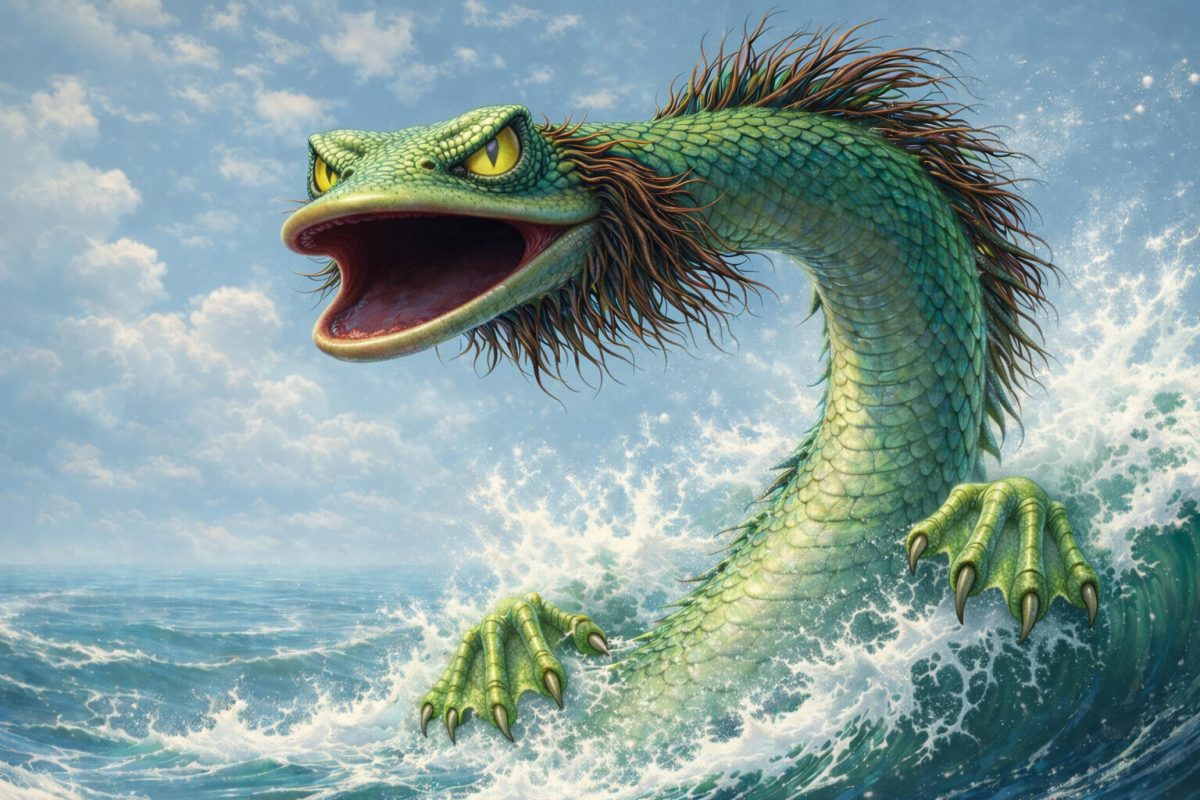
The Umibake emerges upon the surface of the water. Its body is long and slender like that of a serpent, stretching across the waves as it rises. Though its form is aquatic and elongated, its face and the shape of its hands resemble those of a familiar kind of yōkai often seen in monster scrolls, giving it an oddly human presence despite its inhuman body.

No story tells what Umibake does when it appears, nor why it comes forth from the water. It is simply seen there, floating or rising, a quiet and unsettling shape upon the surface of the sea.

Like many yōkai preserved only in pictures, Umibake remains a vision without explanation—its meaning carried only in its form, suspended between water and imagination.


Gallery


Sources

Tyz-Yokai Blog contributors. (n.d.). 海化け (Umibake). In TYZ-Yokai Blog, from https://tyz-yokai.blog.jp/archives/1036418400.html


Interpretive Lenses

Religious Readings
  • Christian Ascetic Deep Dive
Philosophical Readings
  • Nietzschean Deep Dive
Psychological Readings
  • Jungian Deep Dive
Esoteric Deep Dive
  • Hermetic Deep Dive
Political / Social Readings
  • Marxist Deep Dive
Other
  • How to Invite The Umibake

Uso no Seire

Tradition / Region: Japanese Mythology
Alternate Names:
Category: Yōkai, Fish, Monk, Catfish


The Myth

Uso no Seirei is a yōkai depicted in the Bakemono Emaki (Monster Picture Scroll) preserved in the Kawasaki City Museum.

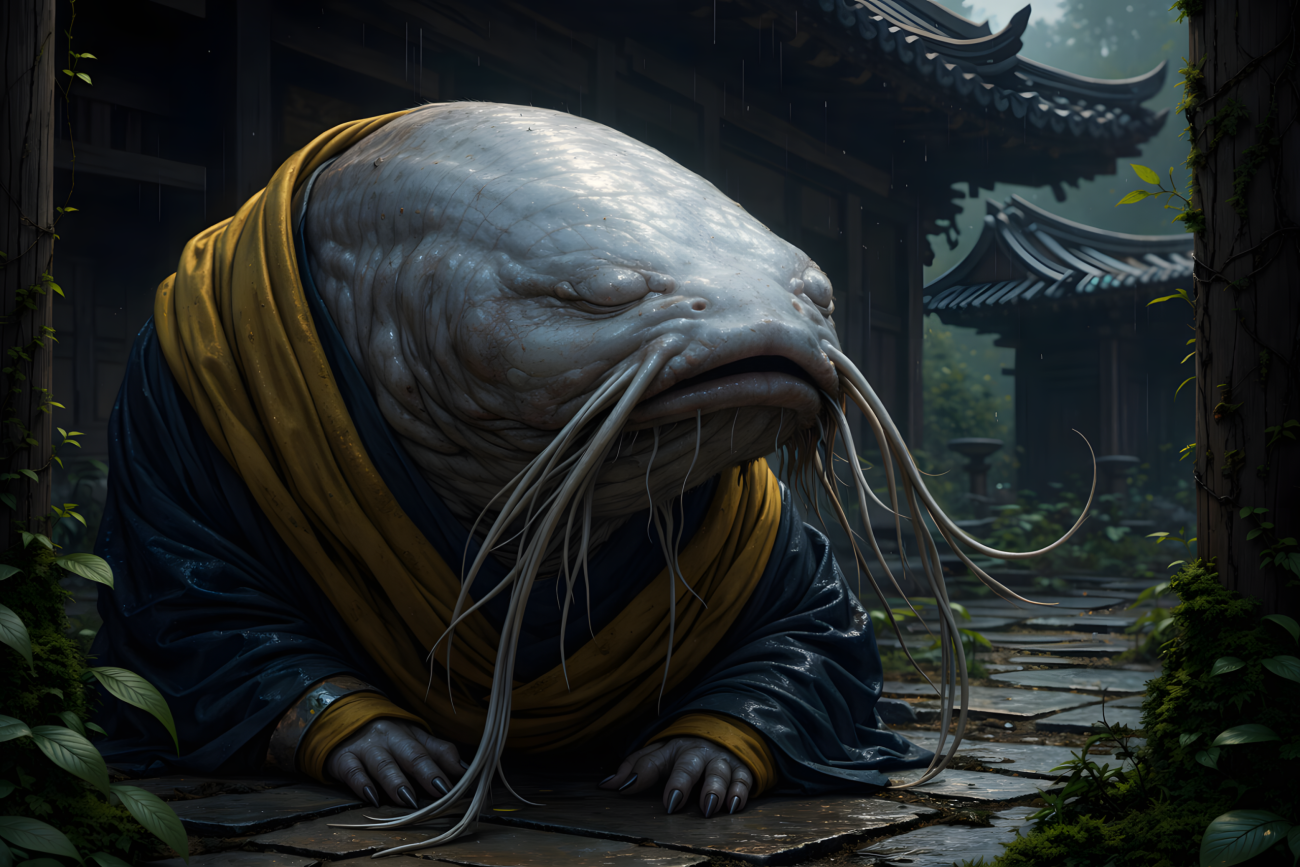
It appears in the form of a bald monk-like figure. Its face has no eyes, no nose, and no mouth. From where its face should be, long whiskers grow, resembling those of a catfish. The creature wears a kimono patterned with images believed to represent the uso, the bullfinch.

The spirit stands silently, without expression or speech. Its lack of facial features gives it an unsettling presence, as though it exists without identity or emotion. The bullfinch pattern upon its robes marks its nature, binding it to the idea of the uso itself.

Uso no Seirei does not act violently, nor does it chase or attack. It simply appears, featureless and mute, a quiet and uncanny figure among the monsters of the scroll.


Gallery


Sources

Tyz-Yokai Blog contributors. (n.d.). [Title of entry]. In TYZ-Yokai Blog, from https://tyz-yokai.blog.jp/archives/1010653494.html


Interpretive Lenses

Religious Readings
  • Christian Ascetic Deep Dive
Philosophical Readings
  • Nietzschean Deep Dive
Psychological Readings
  • Jungian Deep Dive
Esoteric Deep Dive
  • Hermetic Deep Dive
Political / Social Readings
  • Marxist Deep Dive
Other
  • How to Invite The Uso no Seire

Asukokoko

Tradition / Region: Japanese Mythology
Alternate Names:
Category: Yokai, Demon


The Myth

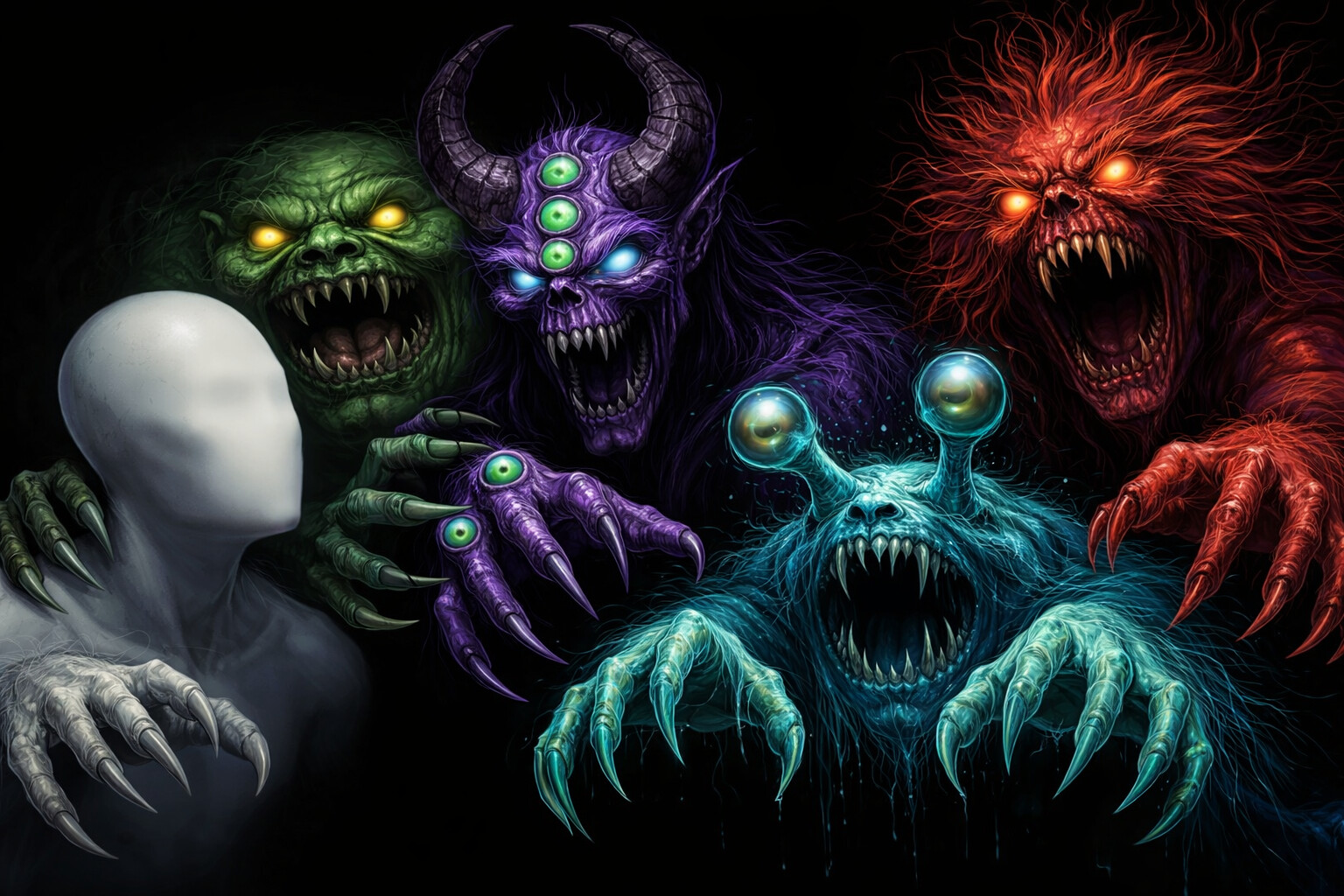
Asukokoko appears in an old depiction of the Night Parade of One Hundred Demons. It is not shown as a single body, but as a mass of many monster faces and grasping hands, all emerging from what looks like a drifting black cloud.

The faces leer and stare in different directions, while the hands reach outward as if the darkness itself were alive. There is no clear center to the creature, no fixed form that can be grasped or confronted.

Its name, Asukokoko, is understood to mean “here and there.” The monster is everywhere at once, scattered and unfixed, as though demons were appearing in many places at the same time.

Thus Asukokoko is not a single being that moves through the world, but a presence that manifests wherever fear gathers—faces and hands rising from darkness, here and there, without warning.


Gallery


Sources

Tyz-Yokai Blog contributors. (n.d.). [Title of entry]. In TYZ-Yokai Blog, from https://tyz-yokai.blog.jp/archives/1010652595.html


Interpretive Lenses

Religious Readings
  • Christian Ascetic Deep Dive
Philosophical Readings
  • Nietzschean Deep Dive
Psychological Readings
  • Jungian Deep Dive
Esoteric Deep Dive
  • Hermetic Deep Dive
Political / Social Readings
  • Marxist Deep Dive
Other
  • How to Invite The Asukokoko

Oto Akuka

Tradition / Region: Japanese Mythology
Alternate Names:
Category: Demon, Cow, Pig


The Myth

Oto Akuka is a demon recorded only once, in a single old Japanese scroll. Beyond this appearance, nothing more is known. There are no surviving stories, no extended legends, and no later mentions of the creature.

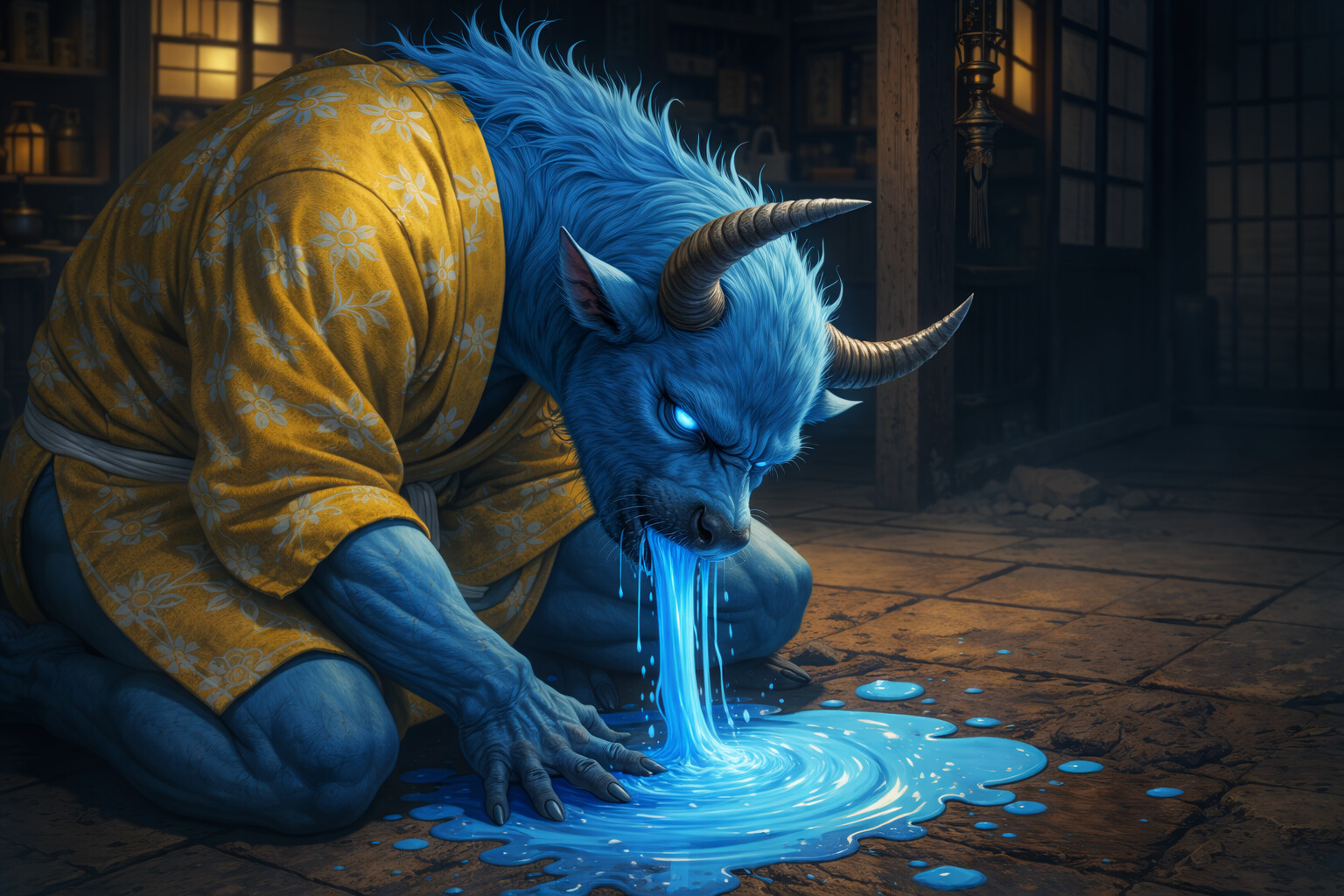
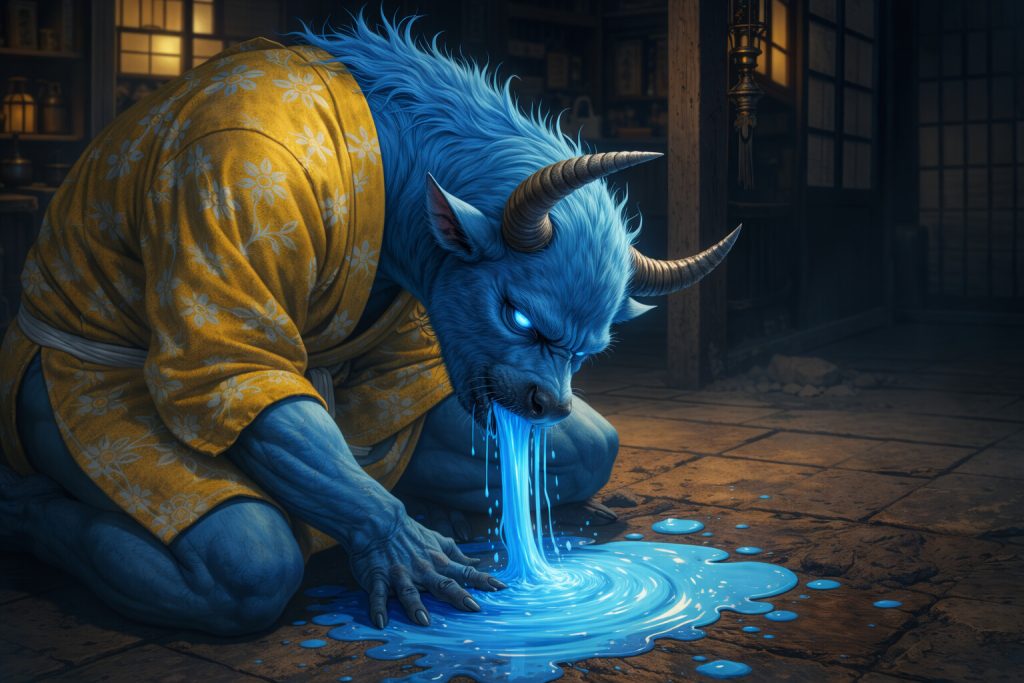
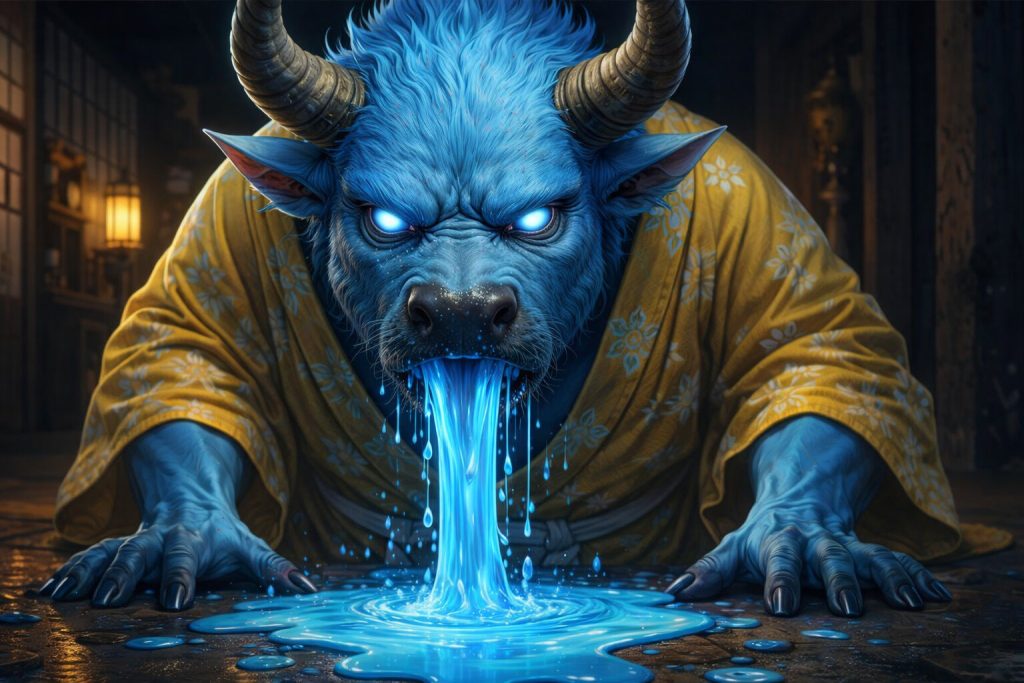
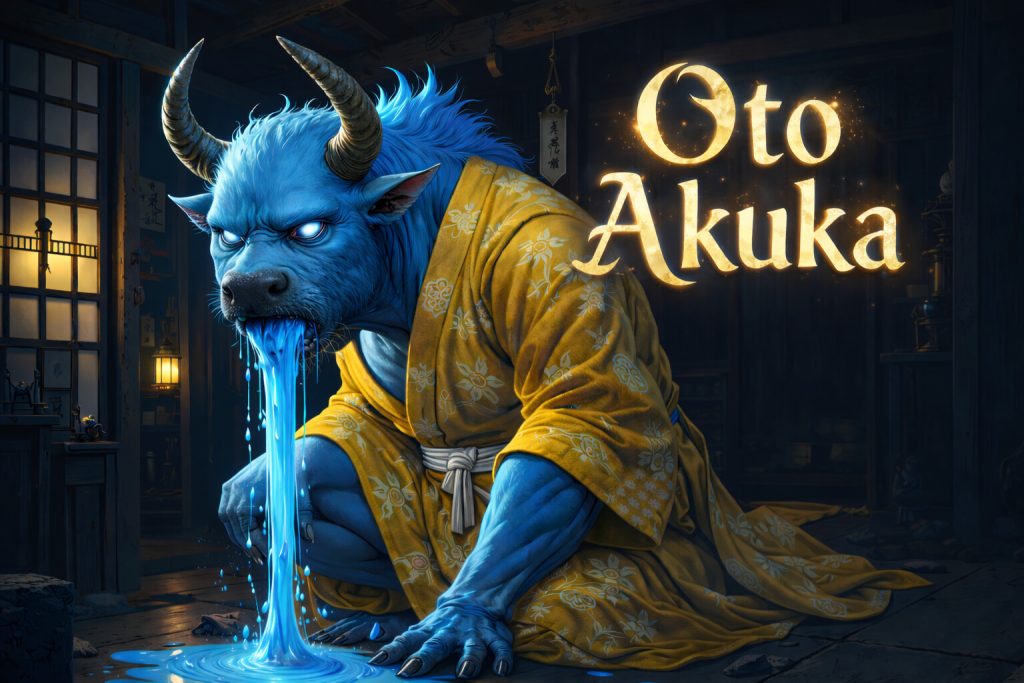
In the scroll, Oto Akuka is shown with blue skin and a beast-like face. Its head is bald and crowned with two horns, and its nose appears crushed, giving it the resemblance of a cow or a pig. The demon is depicted kneeling on the ground. One hand is pressed firmly against the floor, while the other supports its body as it vomits.

The image presents Oto Akuka not as a being that attacks others, but as one overcome by what rises within itself. The demon is shown in the moment of release, brought low and humiliated by its own condition. Its punishment is not delivered by an external force, but unfolds openly through its own body, in full view.

Oto Akuka remains an isolated figure in Japanese folklore—a single, unsettling image preserved in a scroll, offering no tale of origin or aftermath, only the enduring vision of a demon brought to shame.


Gallery


Sources


Youkai Gazou Database. (2007).
鬼;オニ,嘔吐;オウトInternational Research Center for Japanese Studies (Nichibunken). Retrieved from https://www.nichibun.ac.jp/cgi-bin/YoukaiGazou/card.cgi?identifier=U426_nichibunken_0080_0008_0005

Also mentioned in my book Legendary and Mythical Cows

Interpretive Lenses

Religious Readings
  • Christian Ascetic Deep Dive
Philosophical Readings
  • Nietzschean Deep Dive
Psychological Readings
  • Jungian Deep Dive
Esoteric Deep Dive
  • Hermetic Deep Dive
Political / Social Readings
  • Marxist Deep Dive
Other
  • How to Invite The Oto Akuka

Moku Musume

Tradition / Region: Japanese Mythology (Gunma–Nagano, Usui Pass)
Alternate Names: Shumoku Musume
Category: Yōkai / Mountain Dweller / Shark


The Myth

Moku Musume, also known as Shumoku Musume, is a yōkai known from monster paintings and traditional karuta cards. Her appearance is immediately recognizable and unlike that of any ordinary being. Her head is shaped like a shumoku, a T-shaped Buddhist mallet used to strike bells in temples. On each end of this T-shaped head are eyes, giving her vision to both sides, and her face resembles that of a hammerhead shark.

She is depicted as a female figure whose body is otherwise human, with the strange hammer-shaped head defining her supernatural nature. Because of this form, she is sometimes associated visually with Buddhist ritual objects, though her exact behavior is not described in surviving sources.

One karuta card explicitly names her as the “Shumoku Musume of Usui Pass,” suggesting that she was believed to appear at Usui Pass, the mountainous route connecting present-day Gunma and Nagano Prefectures. Travelers passing through the pass would have regarded the area as dangerous and uncanny, and the presence of Moku Musume was tied to this liminal mountain road.

Beyond her appearance and place-name association, little is recorded of her actions. She endures primarily as a visual yōkai, preserved through paintings and cards, her strange hammer-shaped head marking her as a being that belongs neither fully to the human world nor to the ordinary realm of spirits.


Interpretive Lenses

Religious Readings
  • Christian Ascetic Deep Dive
Philosophical Readings
  • Nietzschean Deep Dive
Psychological Readings
  • Jungian Deep Dive
Esoteric Deep Dive
  • Hermetic Deep Dive
Political / Social Readings
  • Marxist Deep Dive
Other
  • How to Invite The Spirit