Garmr

Tradition / Region: Norse Mythology
Alternate Names: Garm
Category: Dog


The Myth

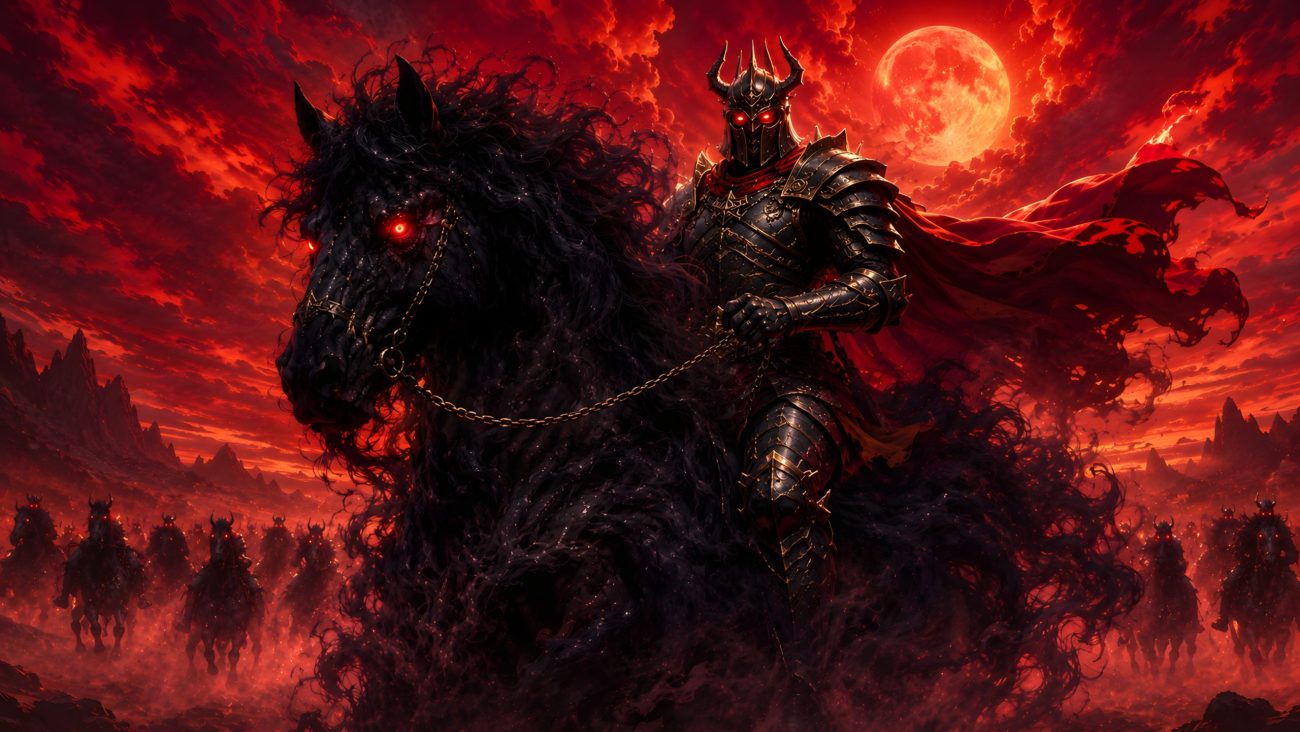
Garmr is the terrifying hound of the Norse underworld, associated with Hel, death, and the final cataclysm of Ragnarök. He is described as a blood-stained guardian who watches over the entrance to the realm of the dead, often said to be bound at the cave Gnipahellir.

In the Poetic Edda, Garmr is named as the greatest of hounds, and his howling is a prophetic sign of the world’s end. In the poem Völuspá, his cry is repeated as a refrain, each time marking another step toward Ragnarök — the breaking of bonds, the rise of chaos, and the coming destruction of the gods.

Another poem, Baldrs draumar, tells how Odin rides to the underworld and encounters a fearsome hell-hound, bloody on its chest and howling at him from afar. Though unnamed in the poem, this dog is often identified as Garmr.

In the Prose Edda, Garmr’s fate is sealed: when Ragnarök arrives, his bonds will snap and he will run free. He will fight the god Týr, and the two will slay one another in the final battle.

Because of his role as a guardian of the dead and his connection to apocalyptic prophecy, Garmr is often compared to other mythic hellhounds such as Cerberus, and in some traditions he is even equated with the monstrous wolf Fenrir.


Gallery


Sources

Wikipedia contributors. (n.d.). Garmr. In Wikipedia, from https://en.wikipedia.org/wiki/Garmr


Interpretive Lenses

Religious Readings
  • Christian Ascetic Deep Dive
Philosophical Readings
  • Nietzschean Deep Dive
Psychological Readings
  • Jungian Deep Dive
Esoteric Deep Dive
  • Hermetic Deep Dive
Political / Social Readings
  • Marxist Deep Dive

Dormarch

Tradition / Region: Welsh Mythology
Alternate Names: Dormarth
Category: Dog


The Myth

Dormarch is a supernatural hound from Welsh tradition, closely tied to the Otherworld and the Wild Hunt. Though hounds in myth often serve mortal hunters, Dormarch belongs to the otherworldly ruler Gwyn ap Nudd, king of Annwn and leader of the spectral hunt that gathers the souls of fallen warriors.

Some traditions claim the hound was once owned by the historical Welsh king Maelgwn Gwynedd, but later passed into the service of Gwyn ap Nudd, reflecting its shift from earthly to supernatural master.

Dormarch’s appearance is unusual even among mythic dogs. He is said to have one head and two front legs, but his body tapers quickly behind the chest and ends in three fish-like tails, blending features of land, sky, and water. His natural domain is described as “ar wybir” — riding upon the clouds — suggesting that he moves through the skies and mountain peaks alongside the Wild Hunt.

As a result, Dormarch represents not just a hunting dog, but a liminal creature of the air and Otherworld, tied to death, the passage of souls, and the supernatural chase.


Sources

Wikipedia contributors. (n.d.). Dormarch. In Wikipedia, from https://en.wikipedia.org/wiki/Dormarch


Bulgae

Tradition / Region: Korean Mythology
Alternate Names: Pulgae
Category: Dog


The Myth

Bulgae are the legendary fire dogs of Korean mythology, fierce supernatural hounds sent from the dark realm known as Gamangnara, the Kingdom of Darkness. Their role in myth is cosmic: they attempt to seize the Sun and Moon, and their attacks are believed to cause eclipses.

According to the traditional stories, the king of Gamangnara grew tired of eternal darkness and longed for light. He sent his powerful fire dogs to capture the Sun and bring it to his realm. But when a Bulgae bit the Sun, it was too hot, forcing the dog to drop it and retreat.

The king then sent another dog after the Moon. This time the Moon proved too cold, freezing the dog’s jaws and making it release its prize. Again and again the king dispatched fiercer hounds, yet none succeeded.

In Korean cosmological belief, solar and lunar eclipses occur when the Bulgae briefly bite the Sun or Moon before being forced to let go and flee back to the Dark World.


Sources

Wikipedia contributors. (n.d.). Bulgae. In Wikipedia, from https://en.wikipedia.org/wiki/Bulgae


Anchanchu

Tradition / Region: Bolivan Mythology
Alternate Names: Janchanchu, Anchancho
Category: Dog, Demon


The Myth

Anchanchu is a feared spirit in Aymara tradition, associated with caves, rivers, mines, and lonely places. He is regarded as a dangerous supernatural being that appears during the night, particularly between one and three in the morning, when encounters with him are considered most likely.

He is said to manifest as a red dog, though in other descriptions he may appear as a bald, heavy-set old man, showing his ability to take multiple forms. Because of this, people in some regions, such as Huancané, traditionally warn against wandering outside late at night.

Anchanchu is also believed to hold authority over underground resources. In this role he acts as a guardian of minerals and hidden wealth, controlling access to the riches of the earth. Those who wish to extract precious materials must ritually acknowledge him, sometimes through ceremonial practices such as the Dance of the Horns, which symbolically negotiates with the spirit for permission.

Thus Anchanchu occupies a dual role: a night-haunting demon who endangers travelers, and a powerful chthonic being tied to the wealth of the land beneath the ground.


Sources

Wikipedia contributors. (n.d.). Anchanchu. In Wikipedia, from https://en.wikipedia.org/wiki/Anchanchu


Black Shuck

Tradition / Region: English Mythology
Alternate Names: Old Shuck, Shock
Category: Dog


The Myth

Black Shuck is one of the most famous spectral dogs in English tradition, particularly in East Anglia. He is described as a huge black dog, often shaggy, sometimes with blazing eyes, and is generally considered a sign of death or disaster.

Legends claim that Black Shuck haunts lonely roads, churchyards, and coastal paths. Some stories portray him as merely terrifying, while others say he can kill those who encounter him, or foretell the death of someone close to them.

One of the most famous accounts dates to 1577, when the creature was said to have burst into the church at Bungay during a violent storm, killing two worshippers. On the same day, it reportedly appeared at Blythburgh church, killing three more people and leaving scorch marks and claw scratches that locals later claimed were still visible.

In some places, such as Shuck’s Lane in Overstrand, the dog is said to appear frequently. Witnesses sometimes report the smell of brimstone or burned ground where it has passed.

Although usually feared, a few traditions describe a gentler version of Black Shuck who silently accompanies travelers home at night as a guardian spirit rather than a death omen.

The name Shuck likely comes from an old regional word meaning “shaggy”, reflecting the creature’s wild, rough-coated appearance.


Sources

Wikipedia contributors. (n.d.). Black Shuck. In Wikipedia, from https://en.wikipedia.org/wiki/Black_Shuck


Gabriel Hounds

Tradition / Region: English Mythology
Alternate Names: Gabriel Ratchets, Gabble Retchets, Sky Yelpers
Category: Dog, Ghost, Death omen


The Myth

The Gabriel Hounds are said to be ghostly dogs that travel across the night sky.

They are rarely seen, but their cries are often heard — high, distant, and mournful, echoing above the land in darkness. Some describe them as dogs with human heads, flying through the air like a spectral hunt. When they pass over a house, it is said to foretell death or misfortune for those who live there.

In some traditions, the hounds are believed to be the restless souls of unbaptised children, wandering between worlds and crying through the night. In others, they belong to a supernatural hunt led by a figure named Gabriel, who is doomed to roam the skies with his dogs as punishment for having hunted on a holy day.

Their voices were sometimes explained by the sound of geese flying overhead at night, whose honking could resemble distant barking. Yet for many, the cries were not natural at all, but a warning from the unseen world.

Thus the Gabriel Hounds were remembered as sky-roaming ghost dogs — heard more often than seen, and feared wherever their eerie yelping was taken as a sign that death was near.


Sources

Wikipedia contributors. (n.d.). Black dog (folklore). In Wikipedia, from https://en.wikipedia.org/wiki/Black_dog_(folklore)


Q’ursha

Tradition / Region: Georgian Mythology
Alternate Names: Qursha, Kursha
Category: Dog


The Myth

Q’ursha was a mighty and loyal dog remembered in Georgian tales as the faithful companion of heroes.

His name meant “Black-Ear,” a common name for dogs, yet the creature himself was far from ordinary. Stories say he was born from a bird, either a raven or an eagle, and in some tellings he possessed wings. He was described as enormous and powerful, with vast paws, golden lips, and eyes as large as sieves. His bark thundered across the land, and he could leap across distances as wide as fields. No prey could escape his tracking.

He is most closely linked with the great hero Amirani. Amirani, the son of a goddess and a mortal hunter, wandered the world fighting monsters and demons. When he finally grew proud enough to challenge God, he was punished and chained inside a mountain. Q’ursha was trapped there with him.

The faithful dog never ceased trying to free his master. He licked the chains day after day, slowly weakening them. Each year Amirani came close to breaking free, yet just before he could escape, the bonds were renewed, and the struggle began again.

Q’ursha also appears in the tale of the hunter Betkil. After Betkil angered the mountain goddess, he was trapped on a high peak with the dog beside him. In some versions, Betkil sent Q’ursha down the mountain for help, and the dog returned with villagers, though they could not save him. In other tellings, when starvation set in, Q’ursha urged his master to kill and eat him to survive. Betkil killed the dog but, unable to bring himself to eat his faithful companion, died soon after.

Thus Q’ursha was remembered as the devoted hound of heroes — a winged, powerful dog whose loyalty endured even in captivity, and whose faithfulness became a lasting symbol in Georgian legend and song.


Sources

Wikipedia contributors. (n.d.). Q’ursha. In Wikipedia, from https://en.wikipedia.org/wiki/Q%27ursha


Dando’s Dogs

Tradition / Region: English Mythology
Alternate Names: Devil’s Dandy Dogs
Category: Dog, Ghost


The Myth

In English tradition there is a tale of Dando, a priest who loved hunting more than he loved the duties of his church.

One Sunday, after spending the day hunting instead of attending to sacred matters, he sat with his companions drinking. They gave him ale and wine, but he demanded more and more. At last he swore that if the drink he wanted could not be found on Earth, then it must be fetched from Hell itself.

At that moment a strange huntsman appeared among them. He offered Dando a flask and gave him drink, but then seized part of the priest’s game. Dando, drunk and furious, shouted that he would follow the huntsman even to Hell to recover it.

No sooner had he spoken than the huntsman carried him away, vanishing with him in an instant. Dando’s hounds gave chase, racing after their master, but they could not catch him.

From that time on, people said that Dando was lost, taken into the otherworld by the mysterious hunter. Yet his dogs never stopped searching. On certain mornings, especially early on Sundays, their howling is said to be heard in the distance, still hunting or still seeking their vanished master.

Thus Dando’s Dogs were remembered as ghostly hounds of the Wild Hunt — forever running across the unseen fields, chasing what they can never reach and echoing through the air as a warning against sin and excess.


Sources

Wikipedia contributors. (n.d.). Dando’s dogs. In Wikipedia, from https://en.wikipedia.org/wiki/Dando%27s_dogs


Börries

Tradition / Region: Dutch Mythology
Alternate Names: Barries, Stommelstaart
Category: Dog


The Myth

In the northern provinces, stories were told of a ghostly creature known as the Börries.

It appeared as a large black dog, often described as resembling a poodle or water dog, with glowing eyes as big as small bowls. People said it could be encountered at night on lonely mounds, crossroads, and open fields where the land lay quiet and empty.

The creature moved in a strange, swaying manner, stepping first with the legs on one side of its body and then the other, giving it an unnatural, rocking gait. Behind it stretched a rough, heavy tail that stuck straight out as it walked.

Those who met the Börries were warned to stand perfectly still. One must not move, not speak, and not even blink. If the traveler remained motionless, the beast would have no power over them. But if they showed fear or moved, it could bring danger or death.

Some tales said the Börries was a form taken by a werewolf, while others claimed it was a sign that death was near. It was sometimes said to appear with other uncanny creatures, such as a flying boar or a headless foal, making the encounter even more dreadful.

Thus the Börries was remembered as a swaying black hellhound of the northern lands — a night-roaming omen whose glowing eyes warned of danger and whose presence was often taken as a sign of approaching death.


Gallery


Sources

Abe de Verteller. (n.d.). Van aardmannetje tot zwarte juffer: Een lijst van Nederlandse en Vlaamse elfen en geesten. From https://abedeverteller.nl/van-aardmannetje-tot-zwarte-juffer-een-lijst-van-nederlandse-en-vlaamse-elfen-en-geesten/


Interpretive Lenses

Religious Readings
  • Christian Ascetic Deep Dive
Philosophical Readings
  • Nietzschean Deep Dive
Psychological Readings
  • Jungian Deep Dive
Esoteric Deep Dive
  • Hermetic Deep Dive
Political / Social Readings
  • Marxist Deep Dive

Koerakoonlased

Tradition / Region: Estonian Mythology
Alternate Names: Pendolls
Category: Dog


The Myth

The Koerakoonlased were originally remembered from stories connected to the feared warriors of Ivan IV. These soldiers were said to carry symbols of a dog’s head, representing their duty to track down enemies as a hound tracks its prey.

In later storytelling, this image passed from history into legend. The dog-headed symbol became something more than a sign, and people began to speak of beings who truly had such forms.

In these tales, the Koerakoonlased were imagined as creatures with the bodies of humans but the heads of dogs. They belonged to the realm of monsters and distant lands, sometimes placed beyond the known world. They were spoken of as strange and unsettling beings, neither human nor animal, living outside ordinary society.

Stories linked them with similar creatures known in other traditions, suggesting that the idea of dog-headed beings belonged to a wider world of myth. Over time, the Koerakoonlased remained in memory not as soldiers but as monstrous figures, part of folklore rather than history.

Thus they were remembered as dog-headed beings born from a symbol of power and fear, transformed by storytelling into creatures of legend.


Sources

Wikipedia contributors. (n.d.). Koerakõonlased. In Wikipedia, from https://et.wikipedia.org/wiki/Koerakoonlased