Kettetsu

Tradition / Region: Chinese Mythology, Japanese Mythology
Alternative names: Kettetsu, Gnawing Iron
Category: Cow


The Myth

Kettetsu is a strange beast from the southern regions, described with the horns and feet of a water buffalo and a body covered in jet-black fur. Its name means gnawing or eating iron.

The creature feeds on iron and drinks water. According to ancient accounts, its feces were harder than ordinary metal and could be used by people to make sharp weapons.

Descriptions of Kettetsu appear in the Shenyi Jing and later Chinese works such as the Bencao Gangmu. Japanese encyclopedias, including the Wakan Sansai Zue, also recorded the creature from these earlier accounts.

Some traditions placed Kettetsu among a group of iron-eating beasts associated with the baku. The baku itself was sometimes described as a creature capable of eating copper and iron, and in some accounts the two creatures were identified with one another.

In later interpretations, the legend of iron-eating beasts may have developed from ancient descriptions of pandas. An animal originally described as eating bamboo may have been misunderstood as eating the arrows and other objects made from bamboo, copper, and iron, eventually producing the strange tradition of a beast that consumed iron.


Sources

Takahashi, Toshihiro. “囓鉄 (Kettetsu).” 新版TYZ 妖怪図鑑 (New TYZ Yokai Encyclopedia). June 27, 2021. Accessed August 16, 2026. https://tyz-yokai.blog.jp/archives/1078437874.html


Hiromushime

Tradition / Region: Japanese Mythology
Alternative names: Tanaka no Mahito Hiromushime, Hiromushi-onna
Category: Cow


The Myth

Hiromushime was a wealthy woman from Sanuki Province who possessed cattle, horses, slaves, rice, money, and farmland. She was extremely miserly and exploited those around her through dishonest trade and harsh lending practices.

When selling sake, she diluted it with water to increase her profits. When lending rice and other goods, she used small measures and scales, but when collecting repayment she used larger ones. Some of her debtors were forced to abandon their homes and flee to other provinces.

In 776, Hiromushime became seriously ill. Shortly before her death, she told her husband and sons about a dream in which she had been brought before King Yama. She was shown three offenses: taking things belonging to temples and monks without repayment, adulterating sake for profit, and using different measures when lending and collecting debts.

Hiromushime died that same day. Her family decided to pray for her rather than cremate her body, gathering monks and ascetics to perform religious rites for nine days.

On the seventh day, Hiromushime suddenly returned to life and opened her coffin. Her body had been horribly transformed. Her upper body had become that of a cow, a horn had grown from her forehead, and her hands had become hooves. Only the lower half of her body retained its human form.

She no longer wanted ordinary food and instead ate grass, chewing it repeatedly and spitting it out before eating it again. She also lived without clothing and showed no concern for where she slept or defecated.

News of the transformation spread, and crowds gathered from surrounding areas to see her. Her family was filled with shame and grief and began making religious vows to atone for her wrongdoing.

They donated large amounts of property to temples, including seventy cows, thirty horses, rice fields, and thousands of bundles of rice. They also forgave all the debts owed by the people from whom Hiromushime had previously demanded repayment.

Five days later, while the provincial authorities were preparing their report about the strange event, Hiromushime died for a second time.


Sources

Takahashi, Toshihiro. “広虫女 (Hiromushime).” 新版TYZ 妖怪図鑑 (New TYZ Yokai Encyclopedia). April 19, 2014. https://tyz-yokai.blog.jp/archives/1010655084.html?


Gyūkan

Tradition / Region: Japanese Mythology
Alternative names: Kiukan
Category: Cow


The Myth

Gyūkan is a strange disease-causing entity believed to develop inside the human body. It is depicted as a cow with black horns and was understood as a mass that forms within the lungs.

According to the Shinmonsho, when the Gyūkan develops, it causes severe illness. When the afflicted person attempts to eat, the condition can trigger a sudden seizure and loss of consciousness.

The Gyūkan was considered difficult to treat once it had fully developed, although the Shinmonsho describes various acupuncture treatments that could be used against it. The creature is illustrated alongside other disease-causing beings in the sixteenth-century medical manual.


Sources

Takahashi, Toshihiro. “牛癇 (Gyūkan).” 新版TYZ 妖怪図鑑 (New TYZ Yokai Encyclopedia). June 27, 2021. Accessed August 16, 2026. https://tyz-yokai.blog.jp/archives/1078437904.html


Gozu

Tradition / Region: Japanese Mythology
Alternative names: Gozuki, Ox-Head Demon
Category: Cow


The Myth

Gozu appears as a terrifying oni with the head of an ox and the body of a powerful demon. He is one of the great guardians of Meido and Jigoku, where he serves Great King Enma, the ruler of the underworld. His companion Mezu has the head of a horse, while Gozu has the head of an ox.

Gozu and Mezu stand at the gates of hell and are among the first demons encountered by the dead when they enter Jigoku. They oversee the punishment of wicked souls and serve among Enma’s chief torturers.

The two demons possess immense strength, said to be powerful enough to move mountains. They operate the torture chambers of Jigoku and supervise the punishment of countless condemned souls.

If a soul manages to escape from hell, Gozu and Mezu are sent out to find the fugitive and drag it back into the underworld.

Gozu and Mezu are not the only animal-headed demons serving Enma. Other powerful guardians are said to possess the heads of deer, tigers, lions, and boars, and they hold high positions among the demons who guard and operate the tortures of Jigoku.

The tradition of Gozu and the other animal-headed guardians ultimately comes from Indian Buddhist mythology and entered Japanese tradition along with Buddhism through China.


Sources

Meyer, Matthew. “Gozu.” Yokai.com: The Illustrated Database of Japanese Folklore. Accessed August 15, 2026. https://yokai.com/gozu/


Kin-ushi

Tradition / Region: Japanese Mythology
Alternative names: The Golden Ox, Bekoko, Kin-ushi
Category: Cow


The Myth

The Kin-ushi is a golden ox associated with the gold-mining regions of Tōhoku. It appears as a golden lump of gold in the shape of an ox and is connected with the discovery and sudden collapse of a gold mine.

Long ago, in the village of Otomo in Tōno, a wealthy man employed an eccentric servant who spent his free time digging the earth with a hoe, claiming that he was searching for potatoes. One New Year’s Eve, the servant discovered gold in a valley called Hiseki.

The discovery made him wealthy, and he became known as Komatsu-dono. He employed many miners and began working the site as a gold mine. For the next one or two years, however, almost no gold was found, and people mocked Komatsu-dono for returning to his old habit of digging for potatoes.

He continued the mining despite the ridicule. On New Year’s Eve of the third year, the miners finally uncovered a piece of gold in the shape of an ox. Komatsu-dono was delighted and held a great banquet that lasted through the night.

On New Year’s Day, he held a ceremony to celebrate the opening of the mine. A brocade rein was fastened to the horns of the golden ox, and the miners attempted to pull it from the mine while singing that they wanted to pull the golden ox themselves.

The ox would not move. When the miners pulled harder, its horns broke away. They then fastened the rope around its neck and tried again. After the golden ox appeared to move several steps, the mine suddenly collapsed with a tremendous crash, killing seventy-five miners.

Among the miners was a cook known as Usotoki. He was an honest and dutiful man who cared for his blind elderly mother. He was also known for sharing grains of spilled rice with crows, although the miners mocked him for his simple and kind nature.

When the golden ox was being brought out of the mine, Usotoki entered the shaft to help pull it. Suddenly he heard someone calling his name near the entrance. He released the rope and ran outside, but found nobody there.

He returned to the mine, only to hear his name called again. Once more he went outside, but there was still nobody there. Puzzled, he entered the mine again.

A third time the voice called out to him, this time more loudly. Usotoki ran toward the entrance as quickly as he could. The moment he stepped outside, the mine shaft collapsed.

Usotoki was the only one among the miners to survive the disaster, saved by the mysterious voice that had repeatedly called his name.


Sources

Takahashi, Toshihiro. “金の牛 (Golden Ox).” 新版TYZ 妖怪図鑑 (New TYZ Yokai Encyclopedia). April 22, 2019. Accessed August 15, 2026. https://tyz-yokai.blog.jp/archives/1074400117.html


Mukyoku Dōjin

Tradition / Region: Japanese Mythology
Alternative names: Mukyoku Dōjin, Wuji Daoist, Boundless Taoist
Category: Cave dweller


The Myth

Mukyoku Dōjin appears as an extraordinary Taoist sage with a long white beard and a bald head who lives alone in a cave at the foot of Mount Hōtō, a legendary dwelling place of immortals east of the Bohai Sea. He possesses knowledge of the beginning and end of heaven and earth, the rise and fall of civilizations, the history of humanity, and the future of the world. He has lived through several cycles of birth and death and remembers his former lives.

According to the tale, a learned man named Kontonshi became obsessed with the future of humanity. Although he had studied the writings of many schools of thought, he regarded books as merely the remains of ancient knowledge and could find no answer to the questions that troubled him. His thoughts became so consuming that he neglected both food and sleep.

Kontonshi eventually heard of a Taoist sage living in seclusion in the mountains and immediately traveled to his cave. When he arrived, the withered-looking Mukyoku Dōjin smiled and greeted him before he had even spoken, telling him that he had been waiting for him.

The Taoist then began explaining the history of heaven and earth. He said that he had been born together with heaven and earth and would die together with them, having already experienced five cycles of birth and death. He remembered his previous lives and possessed knowledge of those yet to come.

Mukyoku Dōjin described the formation of the mountains and seas, followed by the appearance of living beings and eventually humanity. He compared the first humans to mushrooms growing in a swamp and maggots gathering around decaying flesh. As the primordial vapors condensed, they formed bodies that gradually developed into living creatures with a monkey-like appearance. These beings learned to obtain food and clothing, eventually reproducing and forming families.

When Kontonshi asked how long the Earth would survive, Mukyoku Dōjin explained that its existence would last 36,000 years. The first 12,000 years would be an uncivilized age, followed by 12,000 years of enlightenment and then 12,000 years of turmoil.

The Taoist said that humanity was currently living during the enlightened period and that its greatest prosperity would come roughly a thousand years later. Civilization would become more advanced and stable, human happiness would reach its greatest level, and the population of the Earth would increase greatly. Machinery would allow people to clear even remote mountains and wilderness and transform them into farmland and pasture.

He then described the final destruction of the Earth. As the age of turmoil approached, the sun would gradually lose its light and heat while the Earth accelerated its rotation. Human vitality would decline, lifespans would become shorter, and people would gradually become smaller.

Eventually the sun would no longer provide enough warmth for crops, animals, or human beings. Cold would spread across the world until the entire surface of the Earth became frozen. When the surface was covered completely in ice, heat trapped inside the planet would cause its axis to rupture. Fire and water would mix together, transforming the Earth into an enormous mass of boiling mud.

The sun itself would also freeze and perish, but the heat released from it would evaporate the surrounding water. From this destruction a new sun would eventually emerge, and the Earth would regain its form. Nature would return and a new generation of humanity would appear.

Mukyoku Dōjin explained that this cycle of destruction and renewal was comparable to the Buddhist concept of the kalpa. He also described countless other worlds existing beyond the Earth. The stars were said to contain their own lands inhabited by people and animals, while the universe consisted of innumerable worlds extending far beyond what human beings could comprehend.

Kontonshi continued questioning the Taoist about laws, philosophy, politics, nations, and the future of humanity, and Mukyoku Dōjin answered each question. When Kontonshi finally asked about the ultimate destiny of politics, nations, and the human heart, however, the Taoist had disappeared.

Only the evening mist remained around the mountain peaks, accompanied by the sound of wind moving through the pine trees. Kontonshi paid his respects at the entrance of the cave and returned home.


Sources

Takahashi, Toshihiro. “無極道人 (Mukyoku Dōjin).” 新版TYZ 妖怪図鑑 (New TYZ Yokai Encyclopedia). August 29, 2019. Accessed August 15, 2026. https://tyz-yokai.blog.jp/archives/1074589374.html


Yaobikuni

Tradition / Region: Japanese Mythology
Alternative names: Happyakubikuni, Sennenbikuni, Shirobikuni, Eight-Hundred-Year Nun, Thousand-Year Nun, White Nun
Category: Cave dweller


The Myth

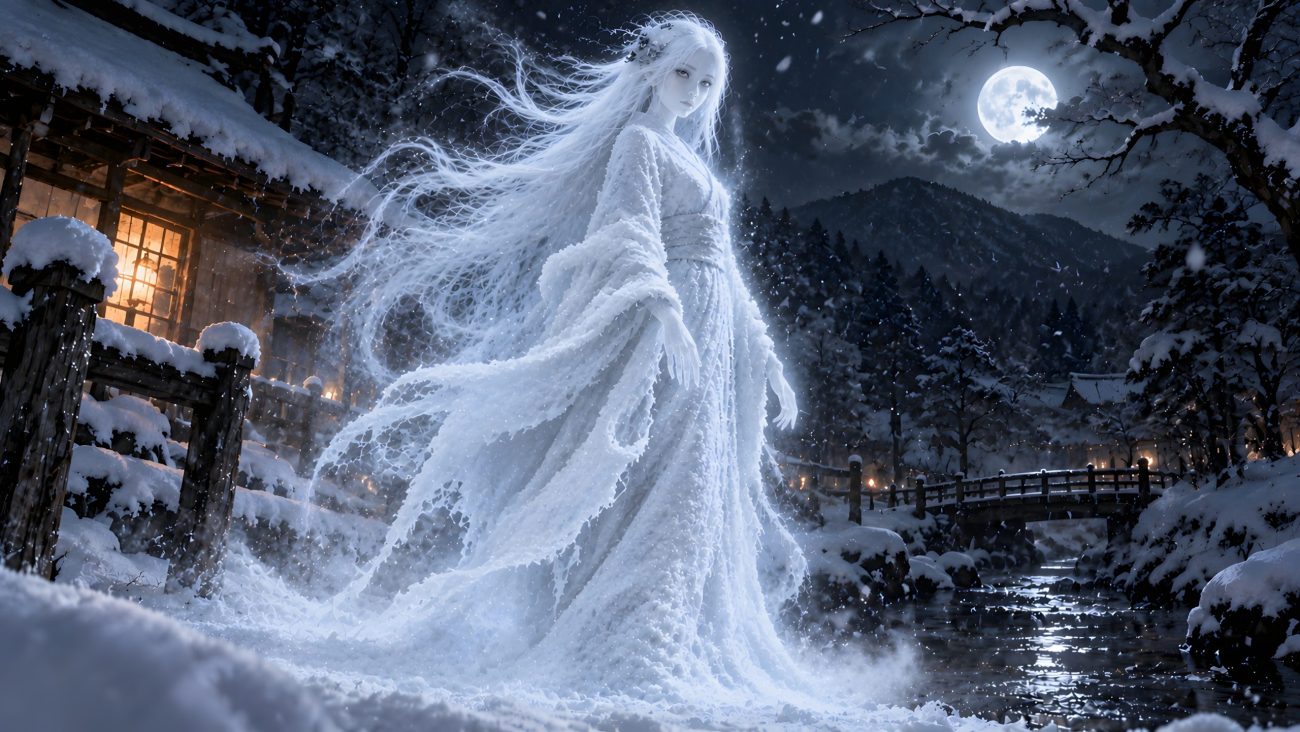
Yaobikuni appears as a woman who has lived for hundreds of years without aging. She is often described as a nun with exceptionally white skin and hair, and is said to have traveled throughout Japan while remaining young or unchanged despite her great age.

According to one of the most famous traditions from Wakasa Province, a fisherman or her father encountered a mysterious mermaid and brought its flesh home. Nobody was willing to eat the strange meat, but the man’s daughter eventually ate it. From that moment she ceased to age and gained an extraordinarily long life.

After many years, she became a Buddhist nun and began traveling throughout Japan. She continued her wandering for centuries, eventually reaching the age of 800 years. Stories of the extraordinarily old white-haired nun spread widely, and records from the Muromachi period describe an elderly nun who had come to Kyoto from Wakasa. Those wishing to see her were required to pay a fee according to their social position, while the gates of her residence were kept tightly closed.

Other versions tell that her father encountered a mysterious stranger in the mountains and was taken to a paradise-like place where he was given the flesh of a mermaid. He refused to eat it and brought it home, where his daughter consumed it and gained a life lasting more than 400 years.

In another tradition, a strange fish was caught in the sea and its flesh was discarded because everyone found it disgusting. The daughter alone ate it and gained supernatural longevity.

Some versions tell of a woman from Ōishi on Sado Island who gained a thousand years of life after eating mermaid flesh. She later gave 200 of those years to the lord of the province and eventually died in Wakasa at the age of 800.

Yaobikuni is also said to have traveled with a staff or pair of chopsticks. In many local legends, she planted them in the ground, where they took root and grew into trees. Temples throughout Japan preserve traditions connected with her, including stories of caves where she entered the earth and places where she stayed or founded temples.


Sources

Takahashi, Toshihiro. “八百比丘尼 (Yaobikuni).” 新版TYZ 妖怪図鑑 (New TYZ Yokai Encyclopedia). August 14, 2020. Accessed August 15, 2026. https://tyz-yokai.blog.jp/archives/1077741607.html


Shōjō Kozō

Tradition / Region: Japanese Mythology
Alternative names: Shōjō Boy, Shōjō Child
Category: Cave dweller


The Myth

The Shōjō Kozō is a small yokai depicted as a child with long hair and a completely red body resembling that of a Shōjō. Aside from its unusual appearance, little is recorded about the creature.

Unlike many other yokai, no legends or stories describing the Shōjō Kozō are known. It survives only through its depiction in the Monster Scroll, an illustrated collection of supernatural creatures painted by Miyagawa Harumizu during the mid-Edo period.

Because no accompanying tale was recorded, the Shōjō Kozō remains one of the more mysterious yokai in Japanese folklore, known almost entirely from its illustration.


Sources

Takahashi, Toshihiro. “猩々小僧 (Shōjō Kozō).” 新版TYZ 妖怪図鑑 (New TYZ Yokai Encyclopedia). Accessed July 28, 2026. https://tyz-yokai.blog.jp/archives/1051082152.html


Koshin-yama Yamaneko

Tradition / Region: Japanese mythology
Alternative names: Koshin Mountain Wildcat, Koshinzan Yamaneko
Category: Cat


The Myth

The Koshin-yama Yamaneko was a gigantic wildcat that had lived for hundreds of years, growing to the size of a calf and gaining immense supernatural powers. Its face resembled that of a raging tiger, its mouth stretched to its ears and was redder than blood, its fangs were as white as swords, and although its body was human-like, it rode a grotesque horse formed from an ancient tree spirit. Its eyes shone like torches, and after revealing its true form, they gleamed like mirrors while its whiskers resembled snowy pampas grass. It could command the beasts of the mountain, ride tree spirits as horses, speak human language, and even had the mountain and land gods as its servants.

Seventeen years before the events of the story, the local samurai Akaiwa Ikkaku climbed Mount Koshin to prove his bravery. Unknown to everyone, he was killed and devoured by the monstrous wildcat. The creature stole his clothes, assumed his appearance, and descended from the mountain to live in his place. It sought to possess Ikkaku’s beautiful second wife, Madoi, whose life was eventually drained through sleeping with the disguised monster. The false Ikkaku then continued living among humans, abusing his eldest son Kakutaro while living with the wicked woman Funamushi, whose greedy nature allowed her to remain unaffected by the monster’s supernatural influence.

Years later, the Dog Warrior Inukai Genpachi arrived in the region while searching for his scattered companions. After hearing rumors of a monstrous wildcat living on Mount Koshin, he became lost in the mountain during the night. There he encountered the mysterious horseman whose blazing eyes pierced the darkness. Genpachi fired an arrow that struck the rider’s left eye, forcing the monster and its attendants to flee. Soon afterward, he met the ghost of the real Akaiwa Ikkaku, who revealed the truth about his murder and begged Genpachi to save his son Kakutaro from the impostor.

Genpachi descended the mountain and uncovered the schemes of the false Ikkaku and Funamushi. They falsely accused Kakutaro’s wife Hinaginu and eventually demanded that her unborn child be sacrificed to restore the monster’s wounded eye. Rather than allow others to suffer, Hinaginu stabbed herself in the stomach. At that moment the sacred Jewel of Propriety burst from her body and flew across the room, shattering the chest of the false Ikkaku with divine punishment.

As the battle continued, the false Ikkaku rose again, cast aside his human disguise, and revealed himself as the monstrous wildcat. Declaring that only by tearing apart his enemies, drinking their blood, and devouring their flesh could he preserve his supernatural power, he attacked Kakutaro and Genpachi. After a fierce struggle, Kakutaro severed the monster’s hip, brought it crashing to the ground, and finally pierced its throat, avenging the death of his true father.

Although the monster’s body was burned, strange illnesses and supernatural disasters continued to plague the region. Its ashes were eventually gathered and reburied beneath a cat mound, appeasing the wildcat’s lingering curse. Afterward, peace returned, and it was said that rats no longer came near the surrounding fields.


Sources

Takahashi, Toshihiro. “庚申山の山猫 (Mountain Cat of Mt. Kōshin).” 新版TYZ 妖怪図鑑 (New TYZ Yokai Encyclopedia). August 13, 2018. Accessed July 28, 2026. https://tyz-yokai.blog.jp/archives/1071974070.html


Shusse Neko

Tradition / Region: Japanese mythology
Alternative names: Cat of Success
Category: Cat


The Myth

The Shusse Neko was a mysterious black cat said to appear within the Kawachi residence beyond the main gate of Fuchu Castle in Suruga Province. Anyone fortunate enough to see the cat was believed to receive good fortune. Those with great ambitions, who sought to cultivate virtue and achieve fame, were said to inevitably rise in status after encountering it. Because of its ability to bring prosperity and advancement, the mysterious black cat became known as the Cat of Success.


Sources

Takahashi, Toshihiro. “出世猫 (Shusseneko).” 新版TYZ 妖怪図鑑 (New TYZ Yokai Encyclopedia). Accessed July 28, 2026. https://tyz-yokai.blog.jp/archives/1010655155.html