Matsutake-bakemono

Tradition / Region: Japanese Mythology
Alternate Names: Matsutake Monster
Category: Plant, mushroom


The Myth

Long ago, on a distant place known as Dwarf Island, there lived tiny creatures skilled in transformation. Yet they grew bored of practicing their tricks in a land where nothing seemed new. Wanting to improve their powers, they decided to travel to Japan, where many famous spirits and monsters were said to live.

They hid themselves inside a hollow in the mast of a great ship and at last reached Osaka. When they stepped ashore, they were stunned by what they saw. Everything was enormous — the houses, the streets, and above all the people. Still, they did not abandon their plan.

They journeyed to Mount Yoshino, hoping to learn from well-known monsters there. They sought out Imohoribo of Mount Imoyama and Semushibo of Mount Seyama, but the two only laughed at them. Mocking their small size, they joked that the little creatures should crawl into their ears and clean out the dirt. Ashamed and discouraged, the travelers left.

They went on to visit other famous beings, including a monster of Saga and the mighty Fuji Daitahoshi. Yet everywhere they went, their size made them seem insignificant, and they could only flee from the towering figures they met.

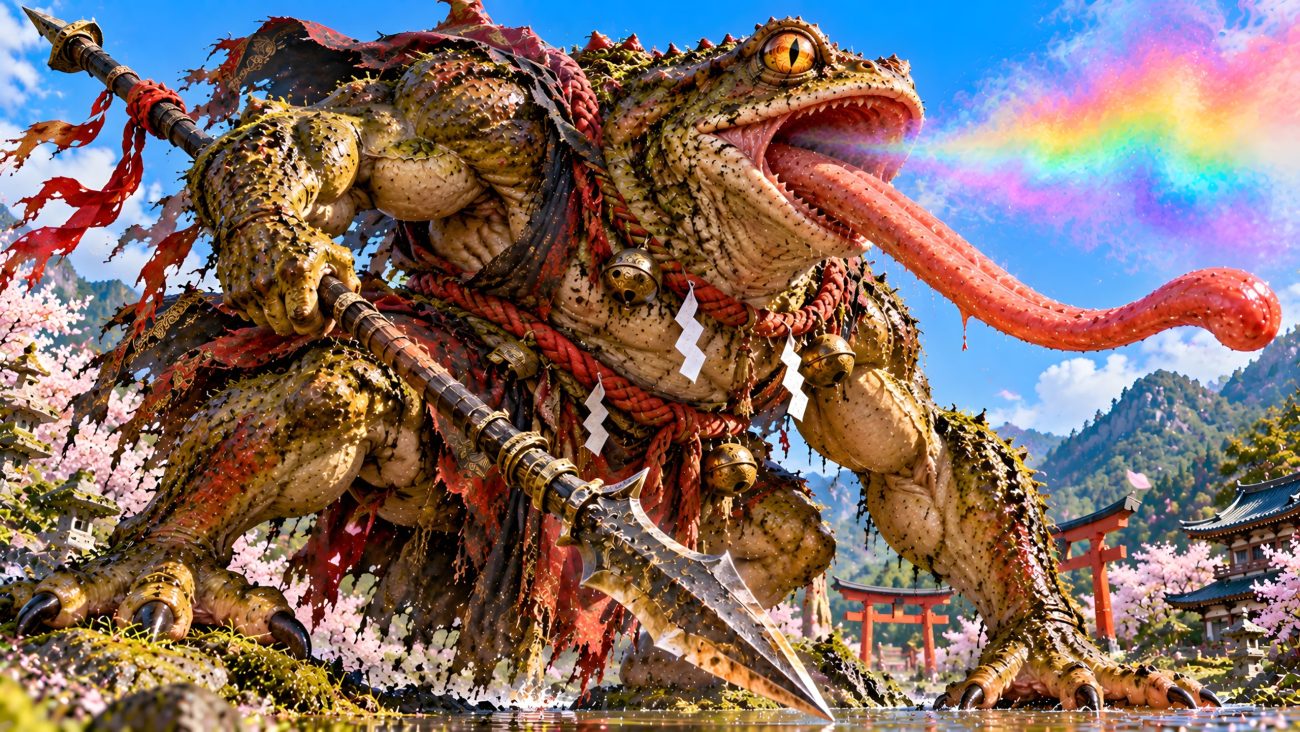
At last they reached Miho no Matsubara. There, from the forest floor, appeared a strange being — a Matsutake-bakemono, a monster in the form of a matsutake mushroom. It called out, “Who am I? I am only a small thing.”

Hearing this, the tiny travelers explained their journey. The matsutake monster welcomed them kindly and told them that being small could be an advantage, since people would not easily fear them. It gave them careful directions toward Mount Hakone and urged them to continue their training.

But when they arrived in Hakone, the monster there refused to take them as students. Instead, it warned them that their fate in Japan was uncertain and advised them to return home while they still could.

Before leaving, the little creatures went down to Edo, hoping at least to frighten the townspeople and prove their abilities. Yet their plan failed. Their bodies were so small that people treated them like toys, picking them up and playing with them. After being handled and tossed about, they were finally captured.

In the end, the tiny monsters saw a painted crane by the artist Sesshū and, believing it to be real, were so startled that they vanished completely, disappearing without a trace. Thus their journey ended, remembered only as a curious tale of wandering spirits and the small mushroom monster who alone had treated them with kindness.


Gallery


Sources

Tyz-Yokai Blog. (n.d.). Matsutake-bakemono. Retrieved March 1, 2026, from https://tyz-yokai.blog.jp/archives/1013072024.html


Interpretive Lenses

Religious Readings
  • Christian Ascetic Deep Dive
Philosophical Readings
  • Nietzschean Deep Dive
Psychological Readings
  • Jungian Deep Dive
Esoteric Deep Dive
  • Hermetic Deep Dive
Political / Social Readings
  • Marxist Deep Dive

Ghost Shimeji

Tradition / Region: Japanese Mythology
Alternate Names: Transforming Shimeji, Phantom Shimeji
Category: Plant, mushroom


The Myth

In the mountains near Shiroishi, there once stood a small, poor temple where a priest lived alone. The forest around it was deep and silent, and few people ever came that way.

One night, after the priest lay down to sleep, he noticed movement in his room. A group of figures had appeared, all dressed in white kimonos and white hats. They walked in a slow circle around his bed, again and again, without speaking. Terrified, the priest pulled his futon over himself and watched through a small gap, hardly daring to breathe.

Only one of the figures made a sound. As the group circled, that person repeated in a low voice, “Salt and miso, how frightening… salt and miso, how frightening…”

The same thing happened the next night. And the night after that as well. Each time the silent procession returned, circling his bed while the same voice muttered its strange warning.

At last, the priest resolved to discover who they were. Before sleeping, he prepared a needle threaded with string and kept it hidden beside him. When the figures appeared again, he quietly reached out and stitched the thread into the hem of the robe of the one who spoke of salt and miso.

Soon after, the figures left as always.

The next morning, the priest gathered the thread and began to follow it. It led him out of the temple, through the forest, and into a grove of towering cedars. There, behind the temple grounds, stood an enormous old stump. All around it grew countless clusters of shimeji mushrooms, packed so thickly they seemed to cover the wood like a living carpet.

The priest understood then that the white-clad visitors had been these mushrooms in disguise. They had come each night hoping he would eat them, for it was said that if salt or miso were sprinkled on shimeji mushrooms, they would stop growing.

And so the priest left the forest undisturbed, knowing that the silent guests of the night were not spirits of the dead, but mushrooms seeking a place at his table.


Gallery


Sources

Tyz-Yokai Blog. (n.d.). Ghost Shimeji. Retrieved March 1, 2026, from https://tyz-yokai.blog.jp/archives/1013072022.html


Interpretive Lenses

Religious Readings
  • Christian Ascetic Deep Dive
Philosophical Readings
  • Nietzschean Deep Dive
Psychological Readings
  • Jungian Deep Dive
Esoteric Deep Dive
  • Hermetic Deep Dive
Political / Social Readings
  • Marxist Deep Dive

Ninmenju

Tradition / Region: Japanese Mythology
Alternate Names: Jinmenju
Category: Plant


The Myth

In remote mountain valleys there grows a strange and unsettling tree known as the Ninmenju, the Human-Face Tree. At first glance it appears ordinary, its trunk and branches no different from any other woodland tree. But when it blossoms, its true nature is revealed.

Instead of normal flowers, the Ninmenju produces heads shaped like human faces. These faces cannot speak, yet they are alive in their own way. They smile constantly, their expressions gentle and curious, and sometimes they even laugh softly among themselves as they sway in the wind.

When autumn comes, the tree bears fruit shaped like these same human faces. Travelers who dared taste them said the fruit was sweet and sour, pleasant despite its eerie form.

The tree reacts to those who pass beneath it. If a traveler laughs at the strange sight of the smiling heads, the flowers will laugh in return. Their laughter echoes back from the branches, as though the tree itself is mocking the person below. But if the laughter grows too loud or too harsh, the delicate heads begin to wither. One by one they wilt, loosen, and fall from the tree to the ground.

Stories say that this tree did not originate in Japan. It was said to have come from distant lands far to the west, beyond deserts and foreign kingdoms, in territories known only from travelers’ tales. From there, its legend journeyed across countries and centuries until it became known in the mountains of Japan, where the smiling faces still bloom in hidden valleys.


Gallery


Sources

Wikipedia contributors. (n.d.). Jinmenju. In Wikipedia. Retrieved March 1, 2026, from https://en.wikipedia.org/wiki/Jinmenju


Interpretive Lenses

Religious Readings
  • Christian Ascetic Deep Dive
Philosophical Readings
  • Nietzschean Deep Dive
Psychological Readings
  • Jungian Deep Dive
Esoteric Deep Dive
  • Hermetic Deep Dive
Political / Social Readings
  • Marxist Deep Dive

Daigo Hakurō

Tradition / Region: Japanese Mythology
Alternate Names:
Category: Wolf


The Myth

In the mountains of Daigo in Yamashiro Province, many wolves were said to roam, troubling travelers and woodcutters who entered the forests.

One day a young boy went into the mountains to gather firewood. As he worked, a wolf suddenly appeared, seized him, and carried him deep into the wilderness. When the wolf reached a grassy place, it set the boy down. Realizing he could not escape by force, the boy pretended to be dead.

The wolf clawed open the earth and dug a large pit. It pushed the boy into the hole and buried him beneath the soil. Yet each time the boy tried to move, the wolf returned to sniff the ground, guarding its hidden prey. At last, when the wolf seemed satisfied and went away, the boy dug himself free and climbed a tall tree nearby, hiding among the leaves to watch.

After some time, the wolf returned — this time accompanied by a great white wolf, far larger than the first. Together they dug open the pit, only to find it empty. The first wolf ran about in agitation, howling in anger, never suspecting the boy above them. At length it lowered its ears, bowed its head, and crouched before the great white wolf as if in shame.

The white wolf stood still for a time. Then it rose and struck the other wolf upon the head with its paw.

The punished wolf remained crouched and motionless. Evening fell, and the boy stayed in the tree through the night. By morning, passing woodcutters came near, and the boy cried out to them, asking for rescue and warning that a wolf sat below.

The men rushed forward with axes and blades, but the wolf did not move. When they approached, they found it already dead. Its skull had been crushed, and its head lay broken open.

When the boy told what he had witnessed, everyone was astonished. They praised his quick thinking and spoke of the strange justice of wolves, recalling the old saying that even tigers and wolves possess a sense of duty.

Thus the tale was told as proof that even among beasts, there can be order, judgment, and punishment.


Gallery


Sources

Tyz-Yokai Blog. (n.d.). Daigo Hakurō. Retrieved March 1, 2026, from https://tyz-yokai.blog.jp/archives/1074589299.html


Interpretive Lenses

Religious Readings
  • Christian Ascetic Deep Dive
Philosophical Readings
  • Nietzschean Deep Dive
Psychological Readings
  • Jungian Deep Dive
Esoteric Deep Dive
  • Hermetic Deep Dive
Political / Social Readings
  • Marxist Deep Dive

Shōben-no-

Tradition / Region: Japanese Mythology
Alternate Names:
Category: Wolf


The Myth

In Kotonan Town of Kagawa Prefecture, charcoal burners working deep in the mountains lived in simple huts far from villages. At night they relieved themselves in buckets kept as makeshift toilets beside the huts.

Yet many mornings the buckets were found strangely empty.

People said that in the dark hours a creature known as the Shōben-no- came creeping out of the forest. Silent and unseen, it approached the huts and drank the urine left in the containers. No one ever clearly saw it, but its presence was taken for certain, for the buckets never remained full overnight.

Some believed the being was not a yokai at all, but a wolf in disguise. Wolves, it was said, craved salt, and the taste of urine drew them from the mountains. Across the region stories spread of wolves licking urine barrels or creeping near homes in search of the salty liquid.

To keep the creature away, some people moved their toilets indoors or placed them in courtyards. Others left salt outside in hopes of satisfying the animal before it came closer to the house.

In some places it was said that wolves which drank urine became dangerous and might attack people. In others, they were believed to do so only when sick, seeking the liquid as a cure. One tale tells that when a wolf repeatedly came to drink from a household’s bucket, the family prayed to the deity Gion-san, and after the prayers the visits ceased.

Thus the Shōben-no- remained a shadow of the mountains — perhaps a yokai, perhaps a wolf — known only by the emptied buckets it left behind.


Gallery


Sources

Tyz-Yokai Blog. (n.d.). Shoben-no. Retrieved March 1, 2026, from https://tyz-yokai.blog.jp/archives/1010654291.html


Interpretive Lenses

Religious Readings
  • Christian Ascetic Deep Dive
Philosophical Readings
  • Nietzschean Deep Dive
Psychological Readings
  • Jungian Deep Dive
Esoteric Deep Dive
  • Hermetic Deep Dive
Political / Social Readings
  • Marxist Deep Dive

Kintakakō

Tradition / Region: Japanese Mythology
Alternate Names:
Category: Dog


The Myth

In the Saigo region of Miyazaki Prefecture, people once believed that certain invisible spirits could possess human beings. Among these were snake gods, Inari spirits, dog spirits, and a more powerful presence known as the Kintakakō.

Dog spirits in the region were thought to be unseen by ordinary eyes. Some said they appeared like rats, snakes, or dogs with forked tails. These spirits could be sent against a person out of jealousy, hatred, or rivalry. Those who were weak in body or spirit — the elderly, the sick, or pregnant women — were especially vulnerable.

When such a spirit entered someone, the person might suddenly lose their senses while walking along the road. They would shout strange words, speak wildly, or collapse before recovering as if nothing had happened. Others suffered joint pain, fever, or lingering illness. People believed these afflictions were the work of dog spirits directed by hostile families.

The Kintakakō were said to be similar to these dog spirits but of higher rank and greater power. They were feared because they were said to bite their victims. A person possessed by one was called a kazemochi. The condition was believed to run in families, passed down through bloodlines. Children under the influence of a Kintakakō were said to speak boldly and strangely, uttering words no child should know.

In nearby districts, certain priests known as Hijirigami were believed able to drive these spirits away. Some people described the possessing being as a small animal the size of a kitten. A household that secretly kept such a creature might prosper, for it was believed to harm enemies and steal fortune from others on behalf of its master.

Thus the Kintakakō was feared both as a curse and as a dangerous blessing — an unseen dog spirit whose bite could bring madness, illness, or hidden wealth, depending on whose command it obeyed.


Gallery


Sources

Tyz-Yokai Blog. (n.d.). Kintakakou. Retrieved March 1, 2026, from https://tyz-yokai.blog.jp/archives/1085598002.html


Interpretive Lenses

Religious Readings
  • Christian Ascetic Deep Dive
Philosophical Readings
  • Nietzschean Deep Dive
Psychological Readings
  • Jungian Deep Dive
Esoteric Deep Dive
  • Hermetic Deep Dive
Political / Social Readings
  • Marxist Deep Dive

Inugami Myōjin

Tradition / Region: Japanese Mythology
Alternate Names: Inugami, Inuzuka, Loyal Dog
Category: Dog


The Myth

Across Japan there are many stories of loyal dogs who sacrifice themselves to save their masters, and in some places these dogs are worshipped as gods under the name Inugami Myōjin.

One ancient tale tells of a hunter who lived by the Shirajiya River. He hunted constantly in the mountains, killing deer and wolves without prayer or remorse. His only companion was a faithful hunting dog named Koshiromaru.

One day, the hunter entered the forest with his dog and was caught far from home when night fell. Uneasy, he took shelter beneath a rotten tree and prepared to sleep. As darkness deepened, Koshiromaru suddenly began barking wildly at him, leaping and circling in agitation. The hunter tried to quiet him, but the dog would not stop. Angered and thinking the dog had gone mad, the hunter drew his sword and cut off its head.

In that instant the severed head leapt into the hollow of the tree and clamped its jaws onto a giant snake that had been hiding there, ready to swallow the hunter whole. The head continued biting until the serpent died.

Realizing that his dog had tried to save him, the hunter was overcome with grief and remorse. To honor Koshiromaru’s loyalty, he built a shrine on that very spot and began worshipping the dog’s spirit as a deity. The shrine came to be known as Inugami Myōjin, and the region itself took its name from the dog’s sacrifice.

Another old story tells of a hunter in Mutsu who kept many dogs and often slept in the mountains with them. One night a single dog woke and barked fiercely, leaping at its master. Thinking it had turned savage, the man tried to strike it down. But when he stepped aside, the dog sprang into the hollow tree where the man had planned to sleep and attacked a massive snake hidden within. The hunter then understood the dog’s warning and killed the serpent. This time the dog survived, and the man returned home deeply grateful for its devotion.

In some darker versions, the master kills the dog in suspicion, only to be slain by the snake afterward. In others, the regretful master is reborn as a bird, forever crying out the dog’s name.

Because of these tales, loyal dogs who died protecting their masters came to be honored throughout Japan. Shrines, mounds, and place names commemorate them, and their spirits are believed to guard the living. Thus the faithful dog, once a humble companion, is remembered as Inugami Myōjin — a protector whose loyalty transcends death.


Gallery


Sources

Tyz-Yokai Blog. (n.d.). Inugami Myōjin. Retrieved March 1, 2026, from https://tyz-yokai.blog.jp/archives/1069534939.html


Interpretive Lenses

Religious Readings
  • Christian Ascetic Deep Dive
Philosophical Readings
  • Nietzschean Deep Dive
Psychological Readings
  • Jungian Deep Dive
Esoteric Deep Dive
  • Hermetic Deep Dive
Political / Social Readings
  • Marxist Deep Dive

Inugami-onna

Tradition / Region: Japanese Mythology
Alternate Names:
Category: Dog, Shape-Shifter


The Myth

Inugami-onna is said to be a strange and deadly being — a dog that has taken on the form of a woman.

She appears at first glance to be a beautiful human woman. Her face, body, and voice are entirely human, graceful and alluring. Only when looked at closely does her true nature reveal itself: her legs remain those of a dog, and from behind trails a canine tail that betrays what she truly is.

Those who encounter her are said to feel an immediate, piercing pain in their neck, as though struck by an invisible force. The pain worsens rapidly, and the victim soon collapses, dying in agony without any visible wound.

Because of this, people fear even catching sight of her. Some say she wanders lonely roads or deserted places, appearing silently before travelers. Others claim she comes only to those whose fate is already sealed.

Whether she was once a dog that became human through sorcery, or a spirit born from the power of an inugami, no one can say for certain. But the tales warn that beauty in the night may conceal something far more dangerous — and that meeting the gaze of Inugami-onna is often the last thing a person will ever do.


Gallery


Sources

Tyz-Yokai Blog. (n.d.). Inugami-onna. Retrieved March 1, 2026, from https://tyz-yokai.blog.jp/archives/1069395698.html


Interpretive Lenses

Religious Readings
  • Christian Ascetic Deep Dive
Philosophical Readings
  • Nietzschean Deep Dive
Psychological Readings
  • Jungian Deep Dive
Esoteric Deep Dive
  • Hermetic Deep Dive
Political / Social Readings
  • Marxist Deep Dive

Kyan

Tradition / Region: Japanese Mythology
Alternate Names:
Category: Dog


The Myth

In old tales recorded in Tōsei Goji Fusen Kaikyō, there is mention of a strange being called Kyan.

Night after night, travelers passing near the former mansion of Ono Sadakuro reported being harassed by something unseen. As they walked the road, they would suddenly feel a presence beside them. Coins would vanish from their purses, and small valuables would disappear without a trace, as though snatched by an invisible hand.

People said that the culprit was Kyan, a yokai whose name echoed the sharp cry of a barking dog. It was believed that the creature behaved much like an inugami, a dog spirit that knew the desires of its master and stole what was needed to satisfy them. Like such spirits, Kyan prowled the streets in the dark, troubling passersby and taking whatever small wealth it could seize.

Because of this, some came to see Kyan as a supernatural thief tied to the shadow of Ono Sadakuro, the infamous rogue. Others said it was the spirit of greed itself, wandering the night in canine form, forever snatching coins from the living.

Whatever its true nature, travelers learned to guard their belongings carefully when passing that road after nightfall, for if Kyan was near, even the smallest coin might vanish into the dark.


Gallery


Sources

Tyz-Yokai Blog. (n.d.). Kyan. Retrieved March 1, 2026, from https://tyz-yokai.blog.jp/archives/1069339638.html


Interpretive Lenses

Religious Readings
  • Christian Ascetic Deep Dive
Philosophical Readings
  • Nietzschean Deep Dive
Psychological Readings
  • Jungian Deep Dive
Esoteric Deep Dive
  • Hermetic Deep Dive
Political / Social Readings
  • Marxist Deep Dive

Jigoku-inu

Tradition / Region: Japanese Mythology
Alternate Names: Hell Dogs, Dogs of Hell
Category: Dog


The Myth

In the Usuki domain of Bungo Province during the An’ei era, there lived a man named Den’emon in the village of Hōsen’an. After falling gravely ill, he suffered for about one hundred days and died on the fifteenth day of the third month in the year 1776.

Yet after half a day had passed, Den’emon suddenly revived. When the villagers gathered around him, he told them of what he had experienced after death.

At the moment he thought he had died, he felt himself falling from a great height into a place of absolute darkness, like plunging into the bottom of a well. The darkness there was deeper than any night in this world, and nothing could be seen.

After a time, he heard barking.

The sound was so terrible that it filled him with dread beyond description. The villagers asked how loud it had been, and Den’emon replied that even if a hundred claps of thunder were combined, they would not equal the roar of the dogs in hell. Though he could not see them, their voices shook the darkness, and he also heard the screams of sinners who trembled in terror at their approach.

Overcome with fear, Den’emon began to chant the nembutsu over and over. As he prayed, the dreadful place seemed to fade away, and suddenly he awoke back in his own bed, alive once more.

After this experience, Den’emon declared that he had lived without faith and had entertained only evil thoughts, but now he wished sincerely to be reborn in the Pure Land. He said that no suffering in this world could compare to the terror of hearing the barking of the dogs of hell. From that day forward he devoted himself to the Buddha and constantly chanted the nembutsu.

Hearing his story, many villagers were moved to faith as well. It was said that the terrible barking of the dogs of hell described by Den’emon matched what was written in Buddhist teachings, and so his tale was taken as a warning to live a righteous life.


Gallery


Sources

Tyz-Yokai Blog. (n.d.). Jigoku-inu. Retrieved March 1, 2026, from https://tyz-yokai.blog.jp/archives/1077741606.html


Interpretive Lenses

Religious Readings
  • Christian Ascetic Deep Dive
Philosophical Readings
  • Nietzschean Deep Dive
Psychological Readings
  • Jungian Deep Dive
Esoteric Deep Dive
  • Hermetic Deep Dive
Political / Social Readings
  • Marxist Deep Dive