Akabeko

Tradition / Region: Japanese mythology
Alternate Names: Red Cow
Category: Cow


The Myth

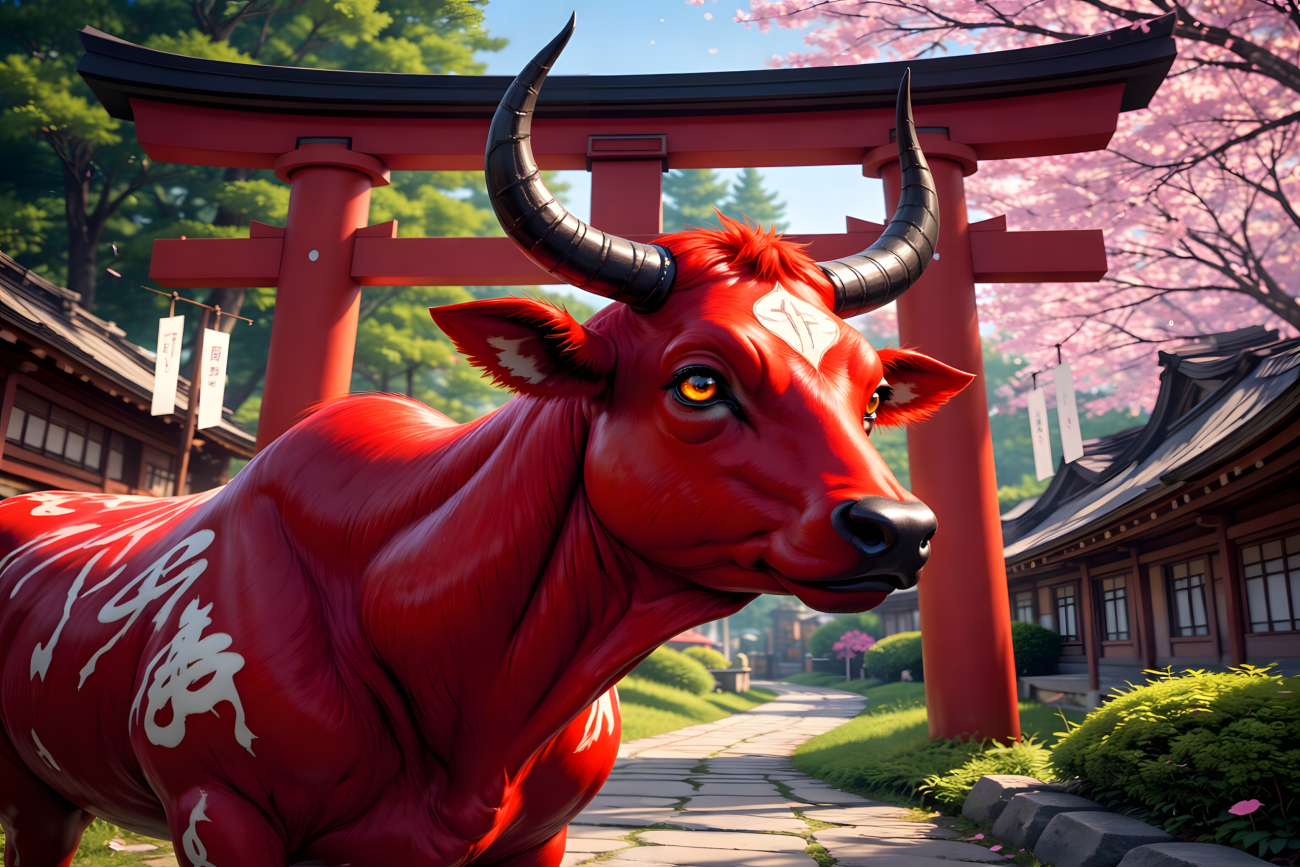
Long ago, during the early ninth century, monks were building Enzō-ji temple in the town of Yanaizu. The work was heavy, and the task of carrying stone and timber up to the site was exhausting. One day, a powerful red ox appeared and began helping the monk Tokuitsu Daishi, hauling construction materials tirelessly as if it understood the sacred purpose of the work.

The red ox labored until the temple was complete. When the final stone was set, it did not return to the wild. Some say it turned to stone on the temple grounds; others say it simply chose to remain there forever, watching over the place it had helped create. From then on, it was known as Akabeko—the Red Cow.

Generations later, people remembered Akabeko not only for its strength, but for its devotion. Small figures of the red cow were made in its image, and it was said that Akabeko protected children from sickness and misfortune. Its red color was believed to drive illness away, just as the living cow had once driven fatigue and hardship from the builders of the temple.

To this day, Akabeko endures as a gentle guardian. Those who visit its likeness at Enzō-ji rub it for luck, honoring the red cow that gave its strength freely and chose to remain behind as a silent protector of the faithful.


Gallery


Sources

TYZ Yokai Encyclopedia. (2021, March 3). 赤べこ (Akabeko), from https://tyz-yokai.blog.jp/archives/1078437861.html

Wikipedia contributors. (n.d.). Akabeko. In Wikipedia, The Free Encyclopedia, from https://en.wikipedia.org/wiki/Akabeko


Interpretive Lenses

Religious Readings
  • Christian Ascetic Deep Dive
Philosophical Readings
  • Nietzschean Deep Dive
Psychological Readings
  • Jungian Deep Dive
Esoteric Deep Dive
  • Hermetic Deep Dive
Political / Social Readings
  • Marxist Deep Dive
Other
  • How to Invite The Akabeko

Ahtin Taikahärkä

Tradition / Region: Finnish mythology
Alternate Names: Ahti’s Magic Bull
Category: Cow


The Myth

By the will of Ahti, King of the Islands, a wondrous creature was brought fully into the world. It was no spirit or illusion, but a living bull of immense size and strength. Its horns shone like gold and silver, and its body pressed heavily upon the earth as though the land itself struggled to bear it.

The bull wandered in quiet majesty. When it came upon a small lake, it lowered its great head and drank deeply, lingering at the water’s edge as if bound to that place. Its breath was slow and powerful, and the world seemed to pause around it.

Far away in the northern land of Pohjola, its ruler became aware of the bull’s existence. In response, he created a wolf—lean, fierce, and driven by a single purpose—and sent it forth to hunt the magical beast.

In time, bull and wolf met.

Their clash was brief and violent, and the outcome was already woven into fate. The wolf brought the bull’s life to an end, and the creature with horns of gold and silver vanished from the world.

What remained was only the memory of its creation: a life summoned by divine power, brilliant and real, yet destined to endure only for a moment before being reclaimed by the forces set against it.


Gallery


Sources


Kalevala: The Epic Poem of Finland: RUNE XXVII, the Unwelcome Guest
(J. M. Crawford, Trans.). (1888).


Interpretive Lenses

Religious Readings
  • Christian Ascetic Deep Dive
Philosophical Readings
  • Nietzschean Deep Dive
Psychological Readings
  • Jungian Deep Dive
Esoteric Deep Dive
  • Hermetic Deep Dive
Political / Social Readings
  • Marxist Deep Dive
Other
  • How to Invite The Ahtin Taikahärkä

Aatxe

Tradition / Region: Basque mythology, Spanish Mythology, French Mythology
Alternate Names: Etsai, Aatxegorri
Category: Cow


The Myth

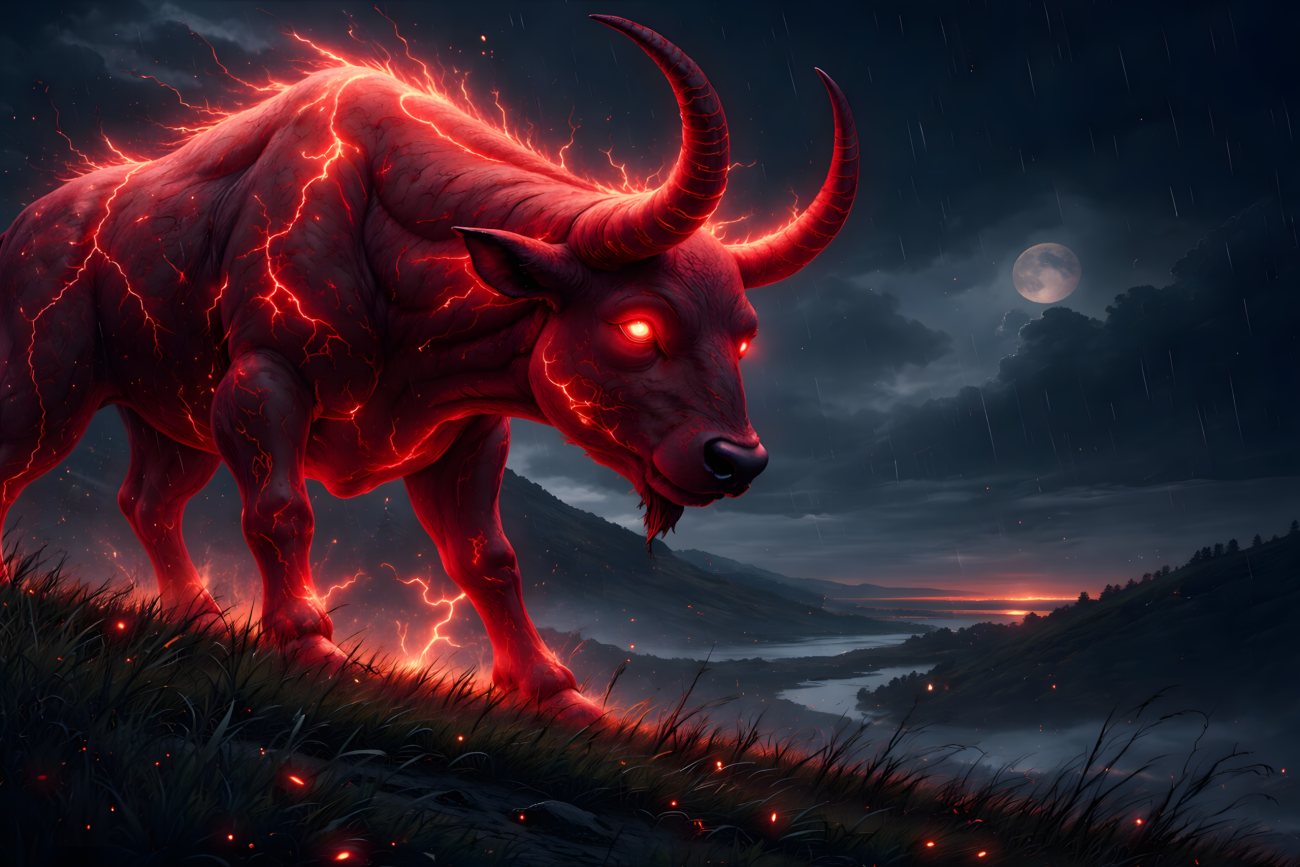
Aatxe is a spirit in Basque folklore whose name means “young bull.” He is a cave-dwelling shapeshifter most often appearing as a young red bull, but he may also take the form of a man, cow, or calf. He emerges at night, especially during storms, from caves or hollows where he lives. He attacks criminals and other malevolent people and protects others by making them stay home when danger is near. He is considered a representative or enforcer of Mari.

In the ancient Basque lands, justice was not written in books or spoken by judges. It lived in the land itself. It moved through mountains, valleys, and storms, watching quietly. One of its strongest forms was the Aatxe.

The Aatxe did not live among people. He dwelled deep within caves carved into the earth—dark places where the world opens inward. These caves were not empty hollows but living thresholds, places where the human world touched something far older. From there, the Aatxe kept watch, standing between humanity and the forces beneath the ground.

He did not emerge without reason.

The Aatxe came forth only when rain fell. When storms covered the land, villages grew quiet and honest people stayed inside by their fires. Only those with secrets, ill intent, or guilt walked abroad in such weather. Rain stripped the world of witnesses and noise, leaving only the sound of water and footsteps. It was then, in the blurred paths and empty roads, that the Aatxe appeared.

Those who encountered him knew why he had come.

The Aatxe did not need to question or accuse. He did not bargain, hesitate, or explain. His presence alone was judgment. The guilty felt it immediately—an inescapable certainty that no excuse could undo what had already been done. Fear came not from violence, but from inevitability.

He was not an independent being, but a form taken by Mari, the great power of earth and storm. Through wind and rain, she shaped the conditions of justice, and through the Aatxe she made it visible. The storm was not a warning—it was the space in which judgment could occur.

Thus the people believed that morality was part of nature itself. To act wrongly was not merely to break a rule, but to step out of harmony with the world. And when that happened, the land would answer—quietly, patiently, and without mercy—through the coming of rain and the silent watch of the Aatxe.


Gallery


Sources

Bane, T. (2016). Encyclopedia of spirits and ghosts in world mythology (p. 13). McFarland.

Barandiaran Ayerbe, J. M. D. (n.d.). Aatxe. Auñamendi Eusko Entziklopedia. Retrieved, from https://aunamendi.eusko-ikaskuntza.eus/artikuluak/artikulua.php?id=eu&ar=5626

Julien, D. H. U. Y., and Jean-Loïc LE QUELLEC. “Les Ihizi: et si un mythe basque remontait à la préhistoire?.”

Rose, C. (1998). Spirits, Fairies, Leprechauns and Goblins. Norton.


Interpretive Lenses

Religious Readings
  • Christian Ascetic Deep Dive
Philosophical Readings
  • Nietzschean Deep Dive
Psychological Readings
  • Jungian Deep Dive
Esoteric Deep Dive
  • Hermetic Deep Dive
Political / Social Readings
  • Marxist Deep Dive
Other
  • How to Invite The Aatxe

Oto Akuka

Tradition / Region: Japanese Mythology
Alternate Names:
Category: Demon, Cow, Pig


The Myth

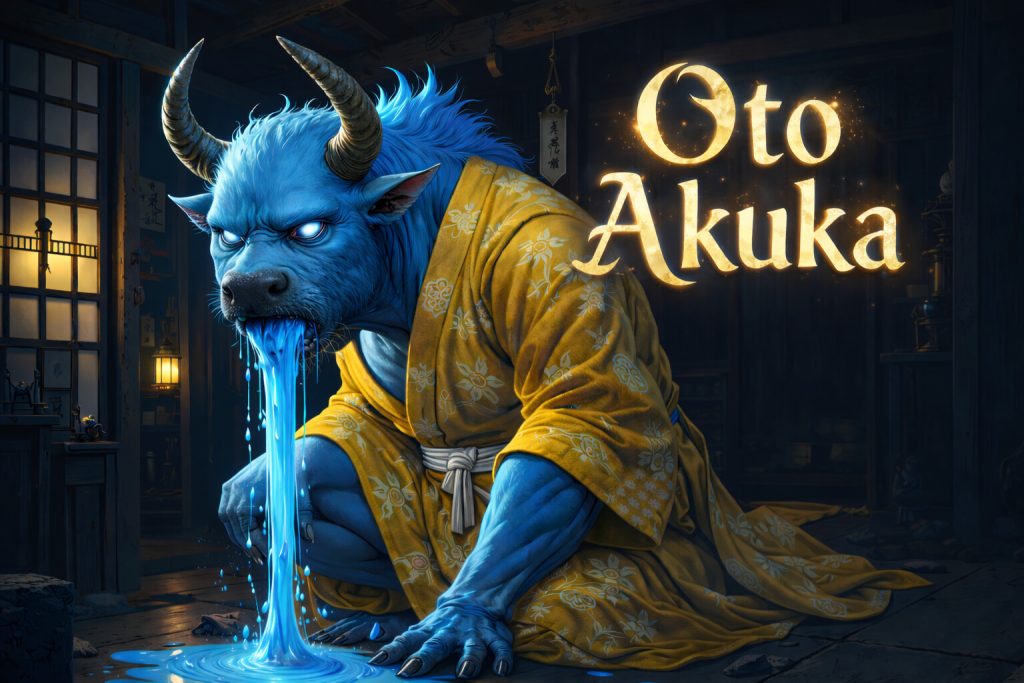
Oto Akuka is a demon recorded only once, in a single old Japanese scroll. Beyond this appearance, nothing more is known. There are no surviving stories, no extended legends, and no later mentions of the creature.

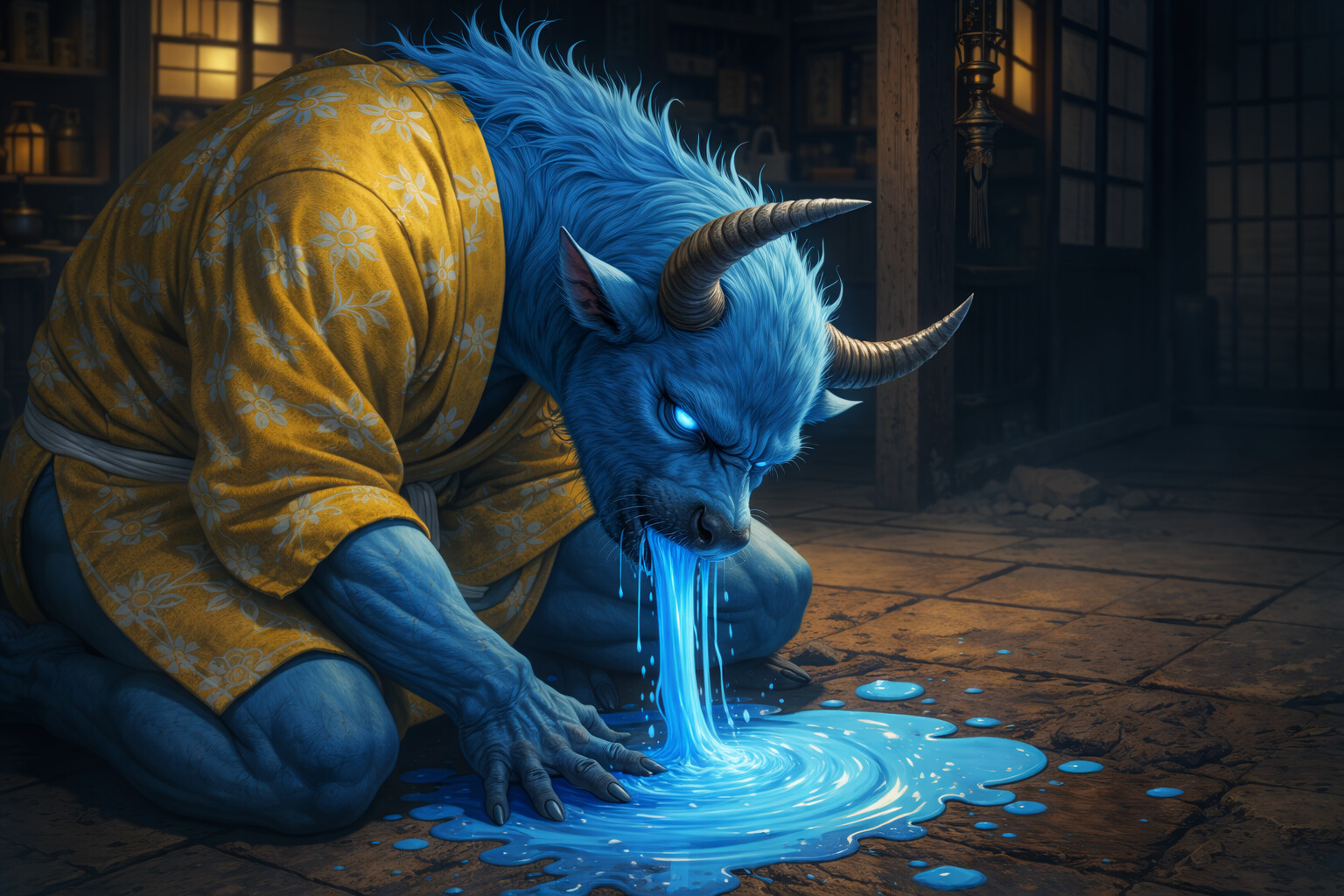
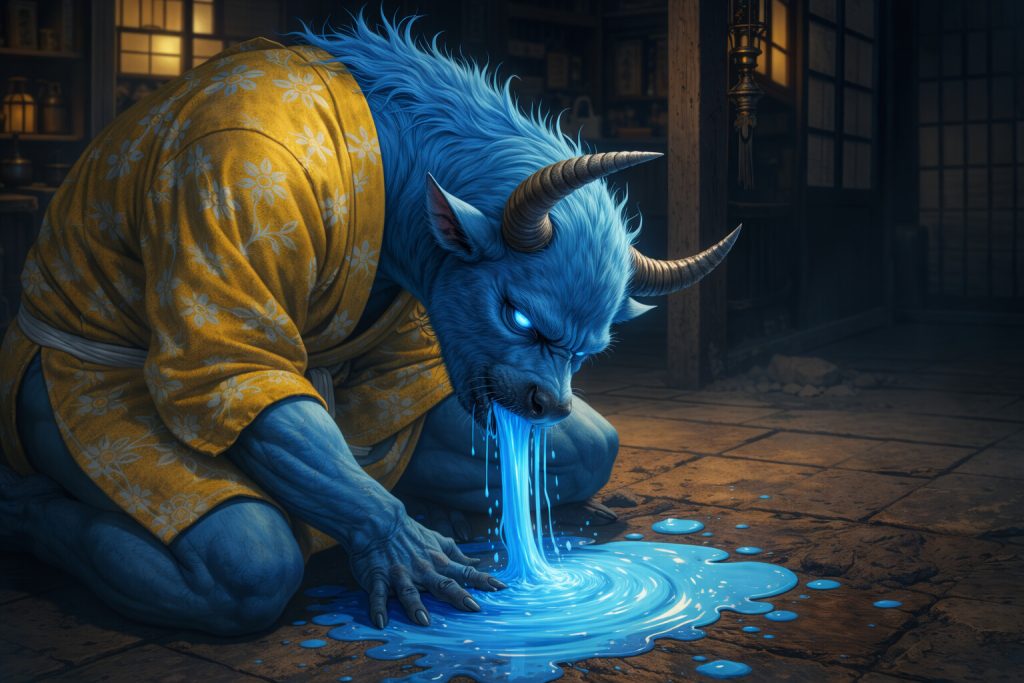
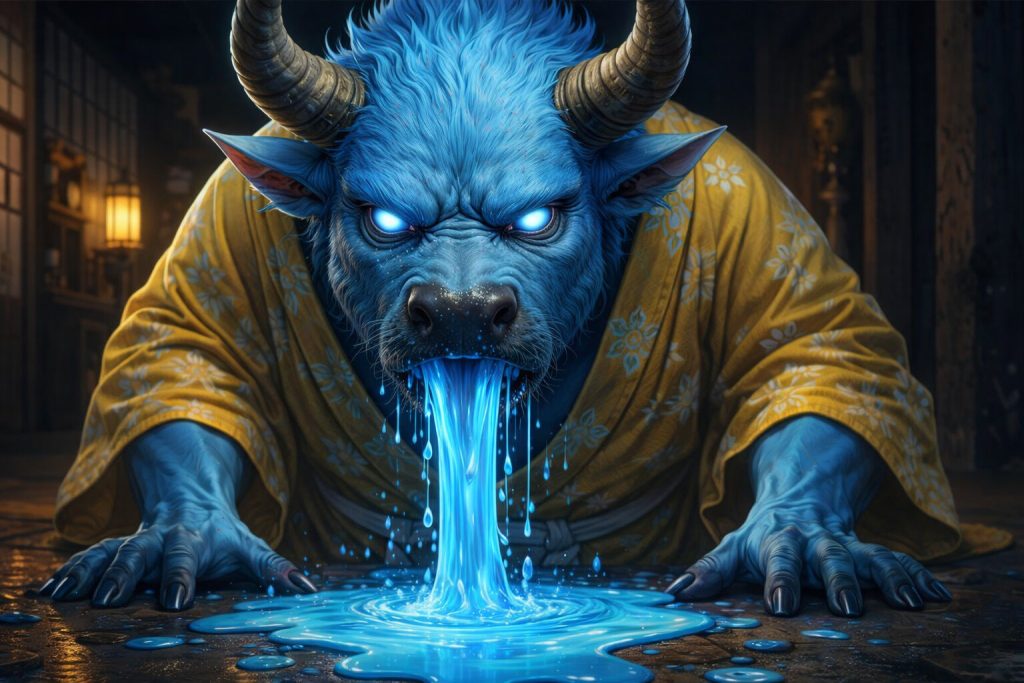
In the scroll, Oto Akuka is shown with blue skin and a beast-like face. Its head is bald and crowned with two horns, and its nose appears crushed, giving it the resemblance of a cow or a pig. The demon is depicted kneeling on the ground. One hand is pressed firmly against the floor, while the other supports its body as it vomits.

The image presents Oto Akuka not as a being that attacks others, but as one overcome by what rises within itself. The demon is shown in the moment of release, brought low and humiliated by its own condition. Its punishment is not delivered by an external force, but unfolds openly through its own body, in full view.

Oto Akuka remains an isolated figure in Japanese folklore—a single, unsettling image preserved in a scroll, offering no tale of origin or aftermath, only the enduring vision of a demon brought to shame.


Gallery


Sources


Youkai Gazou Database. (2007).
鬼;オニ,嘔吐;オウトInternational Research Center for Japanese Studies (Nichibunken). Retrieved from https://www.nichibun.ac.jp/cgi-bin/YoukaiGazou/card.cgi?identifier=U426_nichibunken_0080_0008_0005

Also mentioned in my book Legendary and Mythical Cows

Interpretive Lenses

Religious Readings
  • Christian Ascetic Deep Dive
Philosophical Readings
  • Nietzschean Deep Dive
Psychological Readings
  • Jungian Deep Dive
Esoteric Deep Dive
  • Hermetic Deep Dive
Political / Social Readings
  • Marxist Deep Dive
Other
  • How to Invite The Oto Akuka