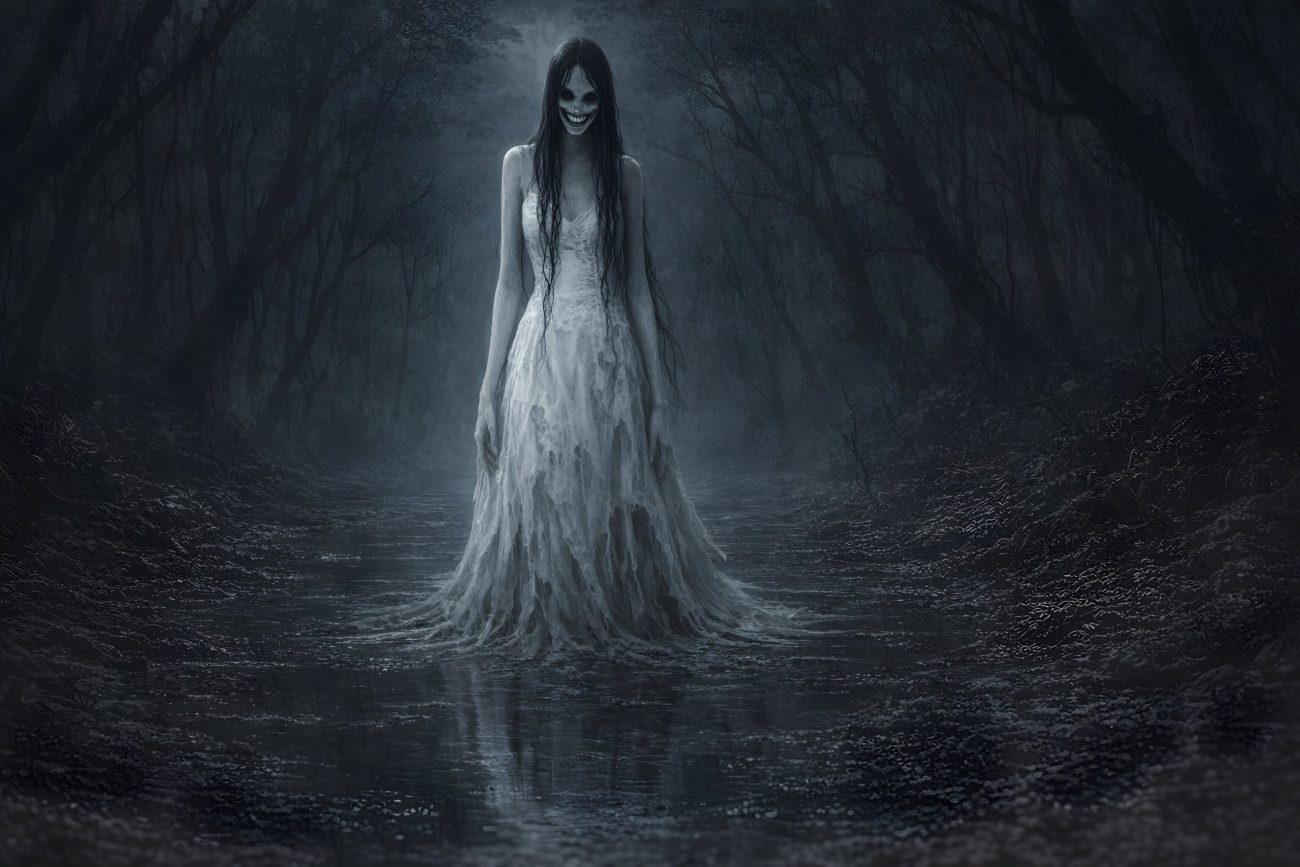
Near Ettelbrück there is said to appear at night a strange water-being known as the Baachjöfferchen. It emerges from the mill pond called Millewo, dressed in white.
From there it wanders along the stream beside Feulener Straße, babbling softly as it moves. After following the water for a time, it turns to the right across a gentle slope and makes a wide arc through the land.
At last it returns to the very place where it first appeared and slips back into the water, its murmuring voice fading as it disappears beneath the surface.
Between Böwingen and Useldingen there once lay a place known as the Wild Woman’s Hedge, where the road now runs.
People said that a wild woman lived there. Parents warned their children not to linger in that place, telling them it was not a good spot, for the wild woman dwelt there.
Thus the hedge was remembered as the haunt of a hidden female spirit who lingered in the landscape.
Sources
sagen.at contributors. (n.d.). Wildfrauenhecke zu Useldingen. In sagen.at, from https://www.sagen.at/texte/sagen/luxemburg/Wildfrauenhecke.html
In the Beringer Forest stands a high rock known as Wölfraleh, the Rock of the Wild Woman. It is hollowed out into a roughly square chamber with one side open, and a narrow stairway leads up from below.
According to the old stories, a wild woman once lived there, alone in the stone chamber. Others say that it was not a spirit but a lonely, childless couple who once made their dwelling in the rock, cut off from the rest of the world.
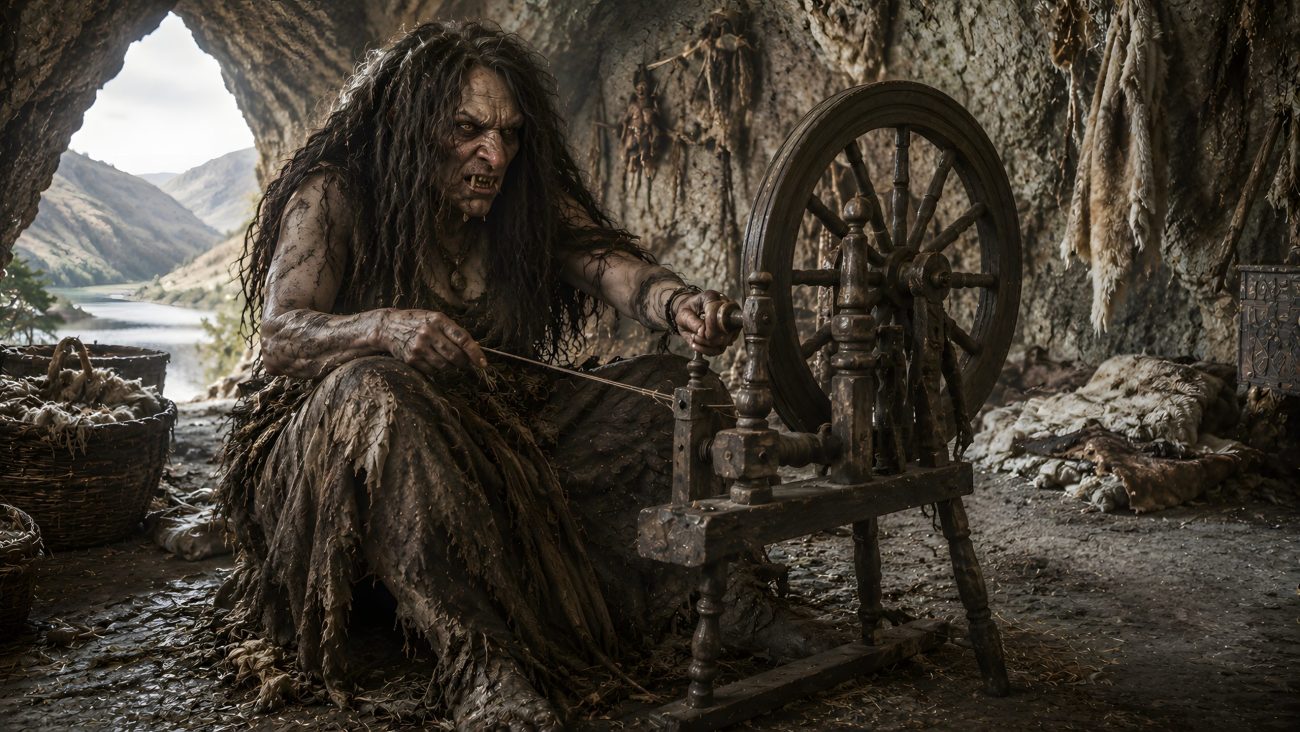
A similar tale is told of another hollow rock near Mersch, where a woman once lived entirely by herself. She did nothing but spin and lived in such isolation that people called her Wölfra, the solitary one.
Thus the rocks of the region were remembered as the homes of a lone woman who lived apart from all others, spinning in her stone dwelling.
Sources
sagen.at contributors. (n.d.). Die Wölfraleh bei Beringen. In sagen.at, from https://www.sagen.at/texte/sagen/luxemburg/woelfraleh.html
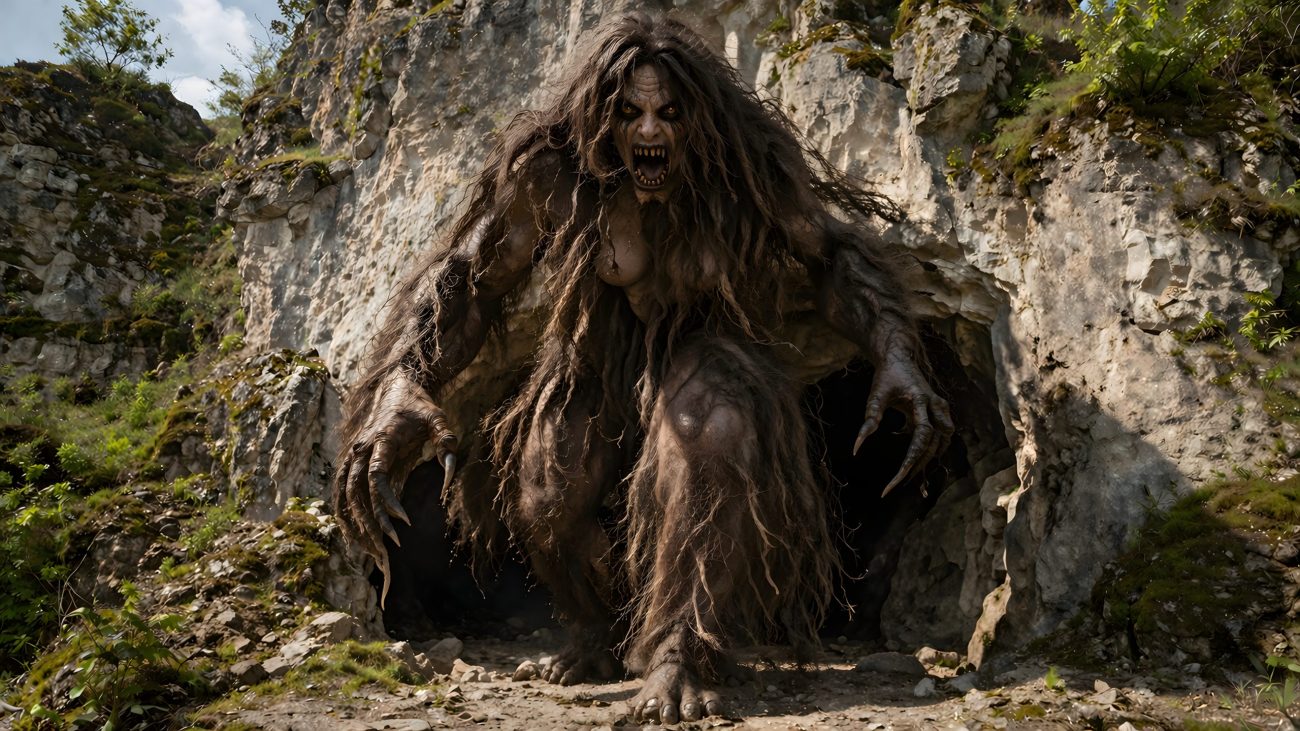
Before the ironworks of La Sauvage were built in the early seventeenth century, the valley was uninhabited and known as the Valley of the Wild Woman. The name came from a fearsome being said to live in a cave in the rock of La Cronnière.
She was said to feed on raw meat. Thick hair covered her entire body and hung down to her feet, serving as her only clothing. Her eyes, red-rimmed and buried deep beneath her hair, glowed like coals. From her wide mouth protruded double rows of teeth, and her voice sounded like the hooting of an owl. Her fingers ended in sharp claws with which she tore apart the game she hunted or the sheep she seized from the fields.
When the wild woman died, the tale says she was refused entry to Hell because she was mistaken for the female of a wild animal. Forced back to the earth, she returned as a dreadful ghost and wandered the valley by night, spreading terror throughout the surrounding region.
At last a pious hermit from the Selomon Forest drove her spirit away across the sea. He did so by invoking Saint Donatus and Our Lady of Luxembourg, and in remembrance of this deliverance, their holy images were placed upon the rock of La Cronnière.
Sources
sagen.at contributors. (n.d.). Die wilde Frau zu La Sauvage. In sagen.at, from https://www.sagen.at/texte/sagen/luxemburg/Wilde_Frau_La_Sauvage.html
In the valley of the Wôbâch, a small stream that flows into the Eisch between Simmern and Heckenhof, there once lived a wild woman in a cave. Because of her, the place came to be called Wölfragrond.
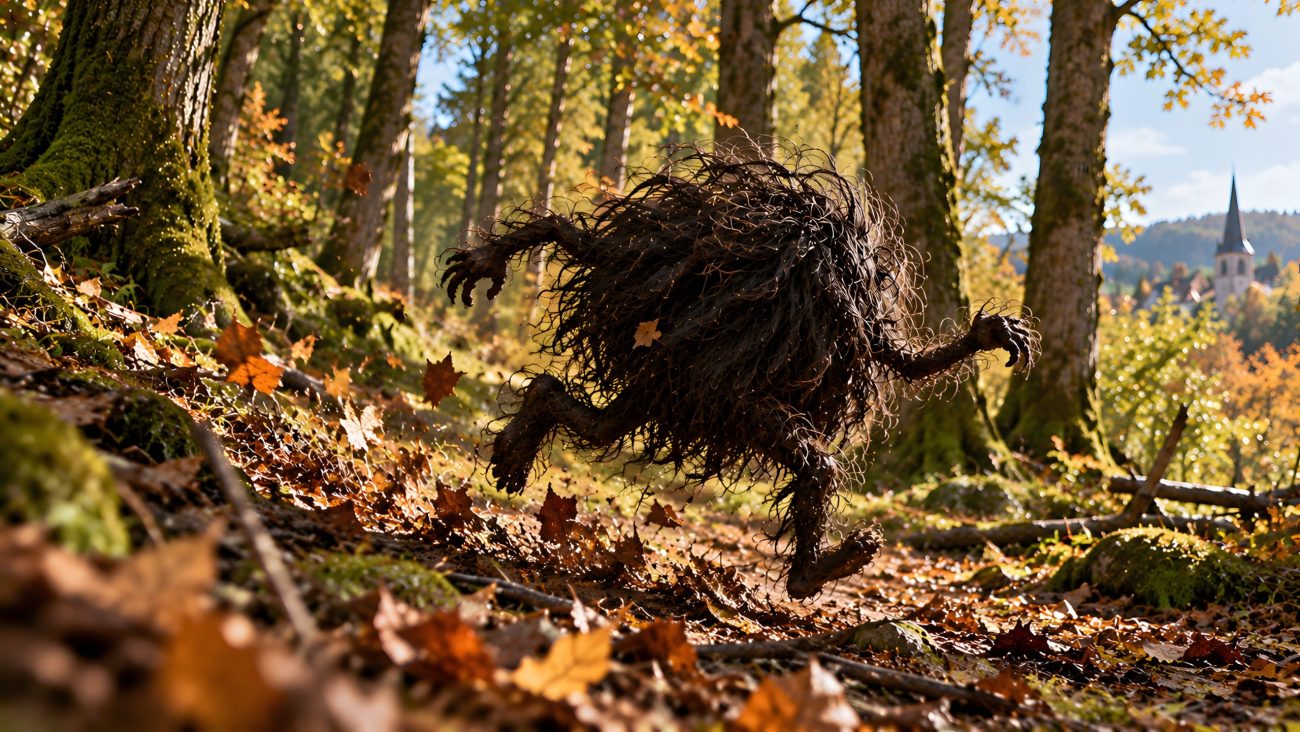
She was said to be completely covered in hair from head to foot. By day she hid in her cave, but as soon as night fell she came out and walked along the banks of the Eisch. There she attacked and strangled whatever she could seize, whether human or animal. Because of this, no one dared to pass through the place at night.
At last a knight from Simmer Castle set out to rid the region of the creature. Whether he ambushed her or met her by chance, he took the silver cross from his rosary, hammered it into a ball, and loaded it into his rifle. With this bullet he shot and killed the wild woman, and the valley was freed from her terror.
Sources
sagen.at contributors. (n.d.). Die wilde Frau in der Wôbâch. In sagen.at, from https://www.sagen.at/texte/sagen/luxemburg/Wilde_Frau_Wobach.html
In earlier times, when ghosts were still believed to roam the land, there lived near Heßlingen, by the Wolf’s Mill in the forest called Wölfragrond, a strange being known as Böschgretchen.
She was said to have once been a woman of exceptional height and beauty who had been cursed and bound to the swamp there. People disliked passing that place, though no one was known to have been harmed by her.
One day, an old man known as Burgklees came along the path from Remich. Brave as he was, he went straight past the swamp. But as soon as he neared it, he felt uneasy. Pressing on, he heard someone calling behind him, “Klees, Klees, wait!” He turned and saw Böschgretchen standing before him. Terrified, he tried to flee, but the ground beneath him began to give way. He leapt aside and escaped, reaching home pale and exhausted, collapsing at his door.
The spirit remained in the area for many years and was seen by many. Once, a shepherd grazing his flock near Heßlingen noticed his dog behaving wildly, running and howling so loudly that people came to help. Following the dog, they found Böschgretchen lying dead in a wolf’s den, sunk knee-deep in mud. They pulled the body out, carried it to Ellingen, and buried it in the churchyard, where later the wall was built so that her grave now lies within its foundations.
It was said that once every seven years the dead woman returns by night to the place where she died, and that on stormy nights old people have heard her moaning there.
Tradition / Region:Luxembourg Mythology Alternate Names: Rock Fairy of the Felser Cliffs Category:Fairy
The Myth
Two hundred years ago, a strange woman was said to live in the high cliffs that rise above the vineyards between Machtum and Grevenmacher. She was known as Felsefrächen, the Rock Fairy. Some said she lived alone, others that there were three of them.
She was rarely seen by day and then only at mealtimes, when she would silently approach the workers and vintners. At night she roamed the mountains, and around the witching hour her loud singing and cries could be heard. In the Felser cliffs there are two nearby crevices, one large enough for a person to walk through upright, and it was said she always entered through one and left through the other, passing into her hidden underground dwelling.
Her chief work was said to be spinning, and she was known to prepare helpful potions for sick livestock. For this reason she was more loved than feared by the people of the surrounding villages.
One day a woman sent her son to the rock spirit to fetch a drink for a sick cow. The creature took a liking to the boy and lured him into her dwelling beneath the rock, refusing to let him leave. The boy disliked the place and tried twice to escape while she was away, but failed. On the third attempt the rock woman became enraged. She attacked the boy, tore him in two, threw one part into the Moselle River, and devoured the other.
When the deed became known, the people captured the rock creature and burned her at the stake.
Yet it was said that she was often seen afterward, especially by women who went to the Moselle early in the morning to wash their clothes.
Sources
sagen.at contributors. (n.d.). Das Felsefrächen bei Grevenmacher. In sagen.at, from https://www.sagen.at/texte/sagen/luxemburg/Felsefraechen.html
Tradition / Region:Luxembourg Mythology Alternate Names: The Keyhole Spirit, The English Witch-Bride Category: Spirit
The Myth
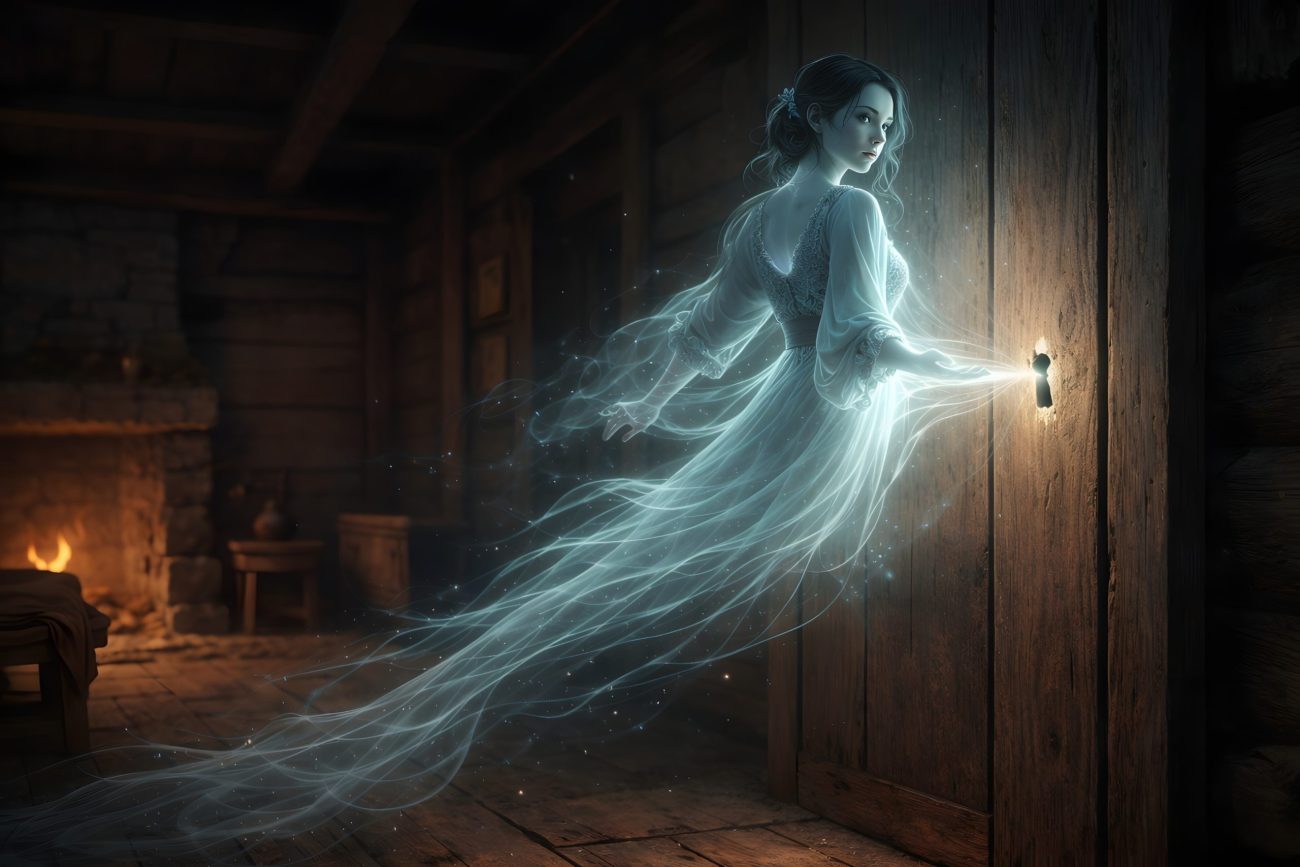
A young man once lived alone in his house and was content with his life. One night a very beautiful maiden suddenly appeared to him. He was deeply struck by her beauty and wished she might become his wife. Yet whenever he tried to hold her back, she vanished as suddenly as she had come.
Troubled, he sought advice from a clever neighbor. She told him that the maiden must be entering and leaving through the keyhole of his front door and that if he sealed it once she was inside, she would not be able to escape.
The young man found the keyhole and made a plug that fit it exactly. That night, when the maiden appeared again, he leapt from bed and sealed the hole. The girl could not leave. He kept her with him and asked her to become his wife. She agreed, and they married, and in time they had three children.
Years later, while his wife baked pancakes, the man idly thought it no longer mattered whether the hole remained closed. He removed the plug.
At once the woman cried out loudly before the children, saying that she could hear the bells ringing in England. Then, in an instant, she vanished through the opened hole and was never seen again.
The man remained behind with his three children, and people said that if he had not opened the way, the strange woman — said to be a witch-spirit from England — would have stayed with him.
In the buildings of Echternach Abbey there once haunted a goblin known as the Kiddelsmehnchen. He was said to tease and trouble the inhabitants in many ways.
An old man who worked in an outbuilding, burning potash day and night, was often visited by the little being. While the man sat quietly beside his cauldron, praying with his face buried in his hands, the goblin would sometimes enter and begin hammering loudly on a nearby anvil. Sparks flew, the building shook with the noise, and yet the old man remained calm. After a time, the strange blacksmith would leave as silently as he had come.
The same man was sometimes tasked with guarding a nearby cloth bleaching ground at night. Once he saw someone moving about the canvas in the darkness. He called out, but received no reply, and followed the figure toward the door. Just as he reached out to seize the supposed thief, the figure vanished into thin air. Only then did he realize that the Kiddelsmehnchen had tricked him.
The goblin also frightened others in the abbey. When the porters sat quietly in the evening and the children were already in bed, the creature would cause loud clattering, banging, and cries in the corridors and stairways, as though horses and donkeys were running through the building and terrified children were calling for help. But whenever people rushed out to investigate, everything was silent and no trace could be found.
At other times the goblin would drop from the roof in the form of a barrel, causing a terrible crash. When the people gathered to see what had happened, they found nothing at all.
Thus the Kiddelsmehnchen continued to trouble the abbey with its tricks and noises, appearing and disappearing at will.
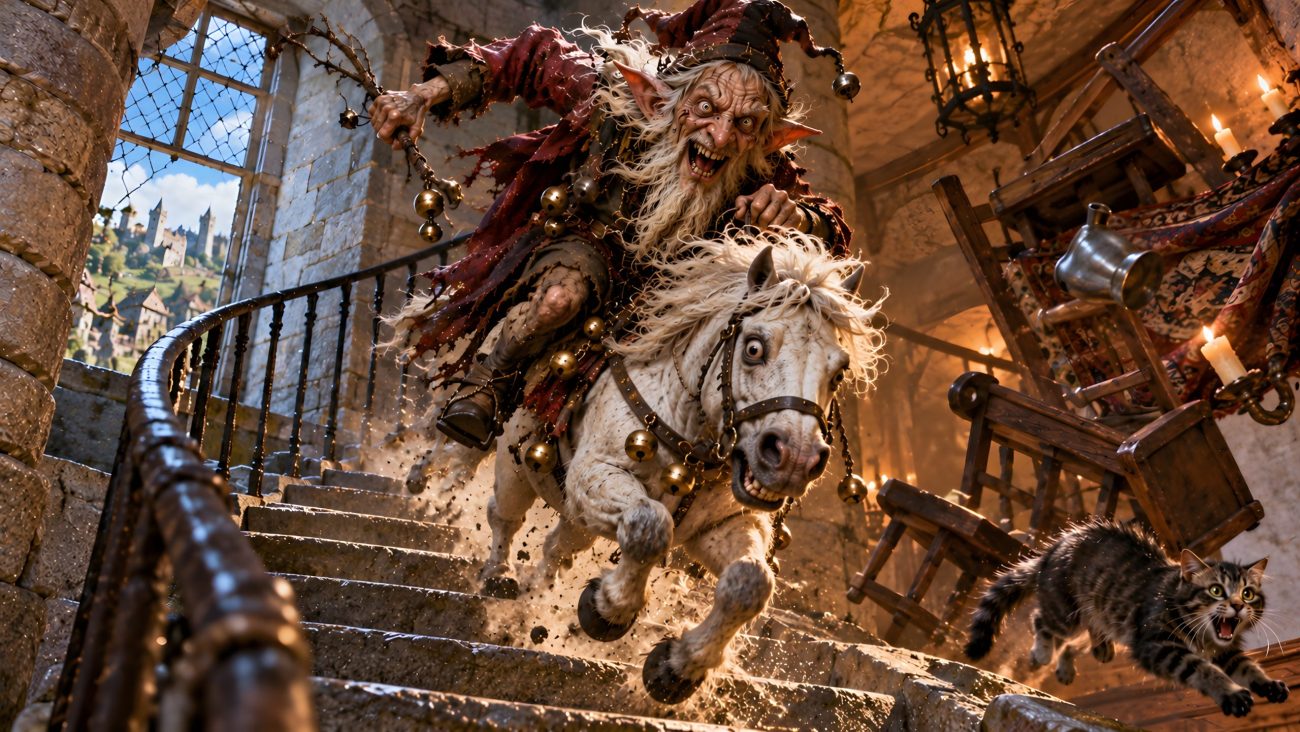
Engelbertchen is a goblin said to have haunted a very old house in Ehnen, Luxembourg. He sometimes appeared as an old man with a silver-white beard and at other times rode a small white horse. His sudden appearances and strange movements made him a source of fear for the house’s inhabitants.
The goblin was especially notorious for racing up and down the house’s tall stone spiral staircase at great speed, producing an eerie clattering that terrified those who heard it. At midnight, he could also be heard dragging tables and moving other furniture around the house, creating the impression of a restless supernatural presence within the building.
According to the account, the haunting eventually ceased. Although the old house still stood when the legend was recorded, Engelbertchen had not been heard or seen for a long time.
Sources
sagen.at contributors. (n.d.). Engelbertchen oder Engelspferdchen. In sagen.at, from https://www.sagen.at/texte/sagen/luxemburg/Engelsbertchen.html