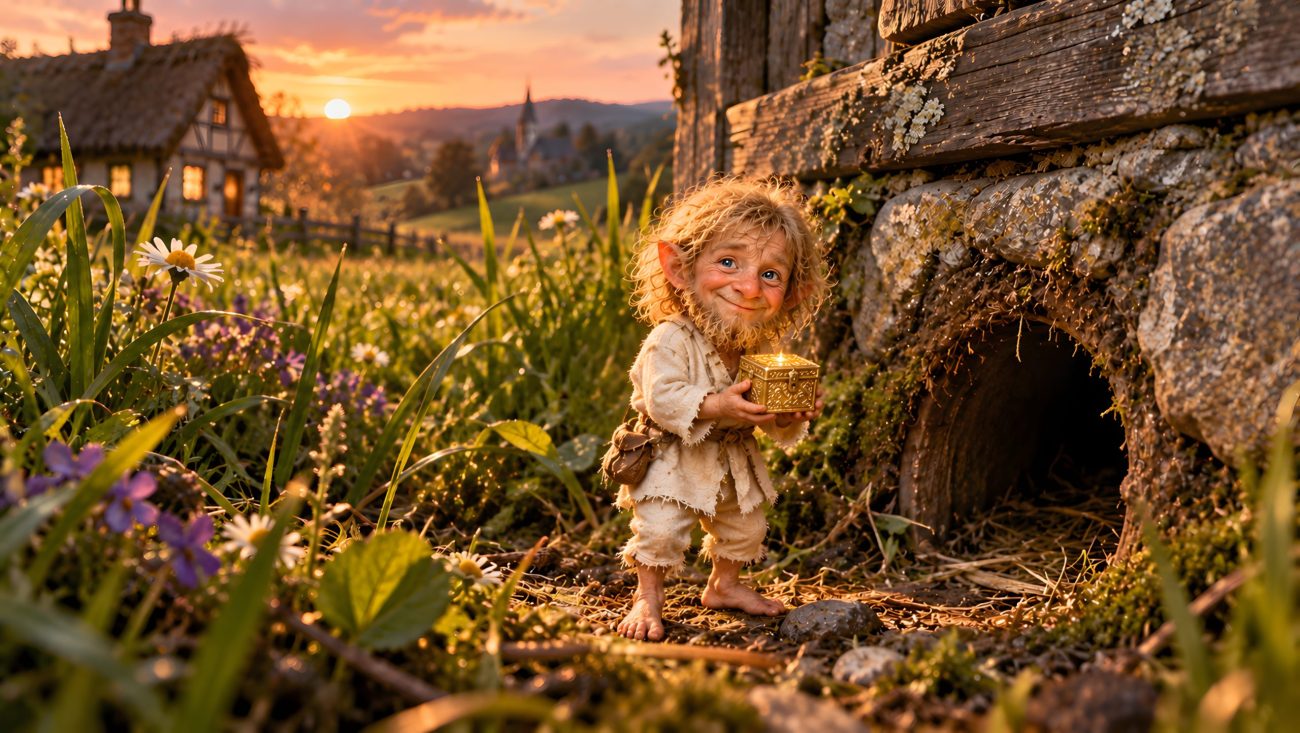
Dwarf of Bösälgäu

Tradition: Swiss Mythology
Alternative Names: The Mountain Men of Bösälgäu
Category: Dwarf


The Myth

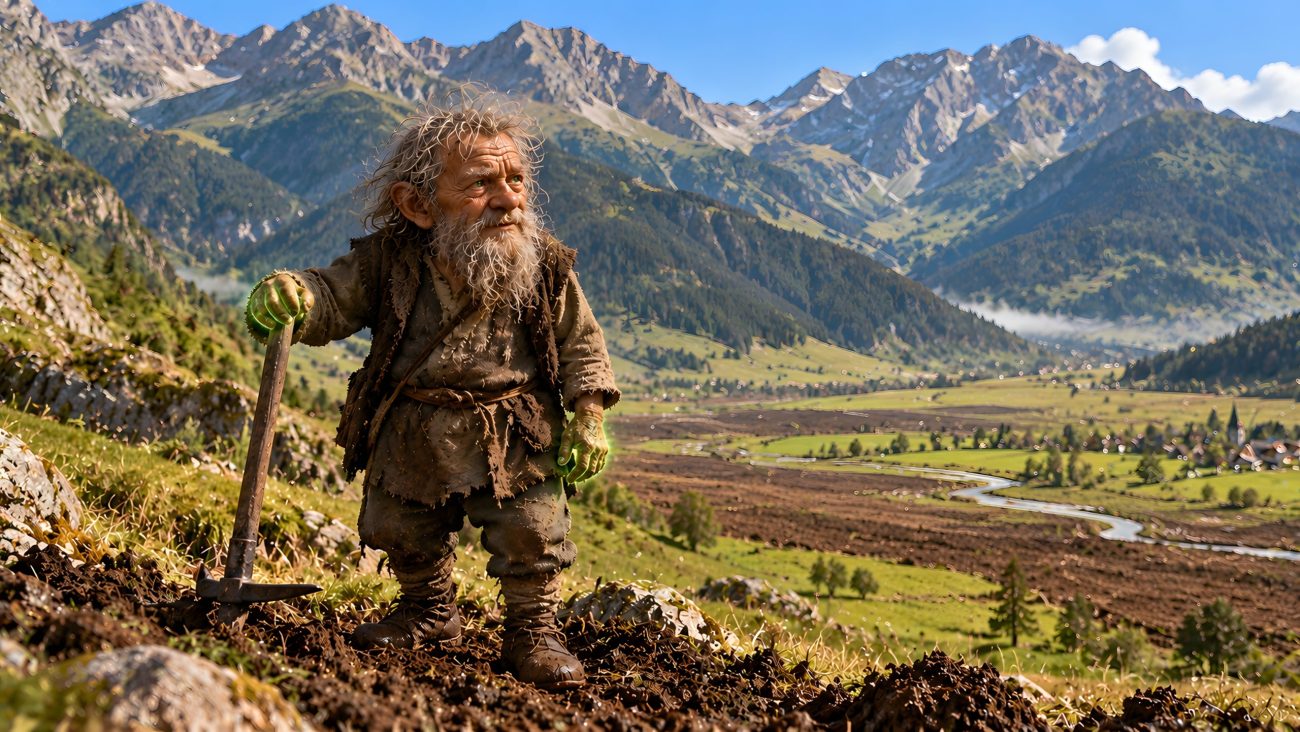
The mountain dwarfs of Bösälgäu lived among the high mountains of the Bernese Oberland, where an ancient city once stood on the mountain terrace where only small alpine huts remain today. The dwarfs were said to protect the city and occasionally came down from the mountains to visit its people. They helped the inhabitants, encouraged peace and unity, and watched over the city as long as its people lived well together.

But eventually greed, arrogance, quarrels, and immorality spread through the city. The mountain dwarfs saw what was happening and warned the inhabitants that disaster was coming. Their terrible warning was:

“D’Furggefluh is split,
Schlegel and Wegge are cold,
whoever wants to flee, run!”

Those who understood the warning fled from the city as quickly as they could. The others remained behind, and soon the mountains themselves seemed to turn against them. The city collapsed beneath a tremendous fall of rock, burying its inhabitants beneath the rubble. The old city disappeared completely, leaving only the small mounds of earth that shepherds later pointed out as the supposed remains of its walls.

After the destruction of Bösälgäu, the mountain dwarfs vanished as well. They were never again seen among the people, and the ancient city remained buried beneath the mountains.


Sources

Theodor Vernaleken. “Böselgäu.” In Kinder- und Hausmärchen in den Alpenländern. Vienna, 1863. Reproduced by SAGEN.at. https://www.sagen.at/texte/sagen/vernaleken/boeselgaeu.html


Dwarf of Gadmen

Tradition: Swiss Mythology
Alternative Names: –
Category: Dwarf


The Myth

The dwarfs of Gadmen had a custom of sitting together on a large rock, where they could watch the farmers working in the surrounding countryside. The little mountain folk regularly came to the rock and quietly observed the people below.

One day, a few scoundrels decided to play a cruel trick on them. They built a fire directly on the rock and allowed it to burn until the stone became red-hot. They then swept away the coals and left the place looking completely harmless. The next morning, the unsuspecting dwarfs returned to their usual rock and sat down upon it, only to burn themselves terribly on the heated stone.

The dwarfs cried out in anger at the treachery, but the surviving account ends with their angry reaction and gives no further details of what became of them.


Sources

“Die Zwerge auf dem Felsstein.” SAGEN.at – Traditionelle Sagen aus Deutschland. Reproduced by SAGEN.at. https://www.sagen.at/texte/sagen/grimm/zwergeaufdemfelsstein.html


Cherry Tree Dwarf

Tradition: Swiss Mythology
Alternative Names: The Dwarfs of the Bernese Mountains
Category: Dwarf


The Myth

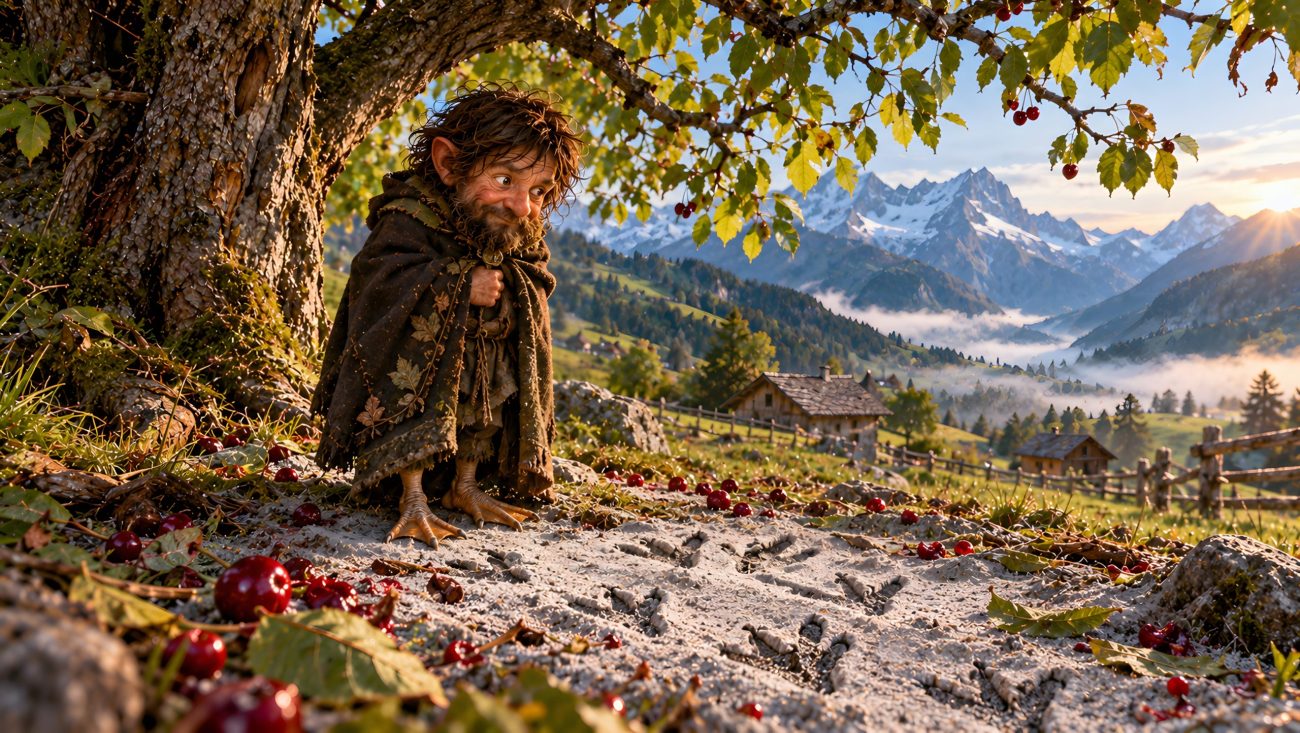
The dwarfs who lived among the ravines and hills of the Bernese countryside were friendly and kind to the people of the valley, often carrying out difficult work during the night. Farmers would arrive in the morning with their wagons and tools only to discover that much of their work had already been completed. The dwarfs would hide among the bushes nearby, laughing as the people wondered who had helped them. Sometimes their help seemed strange, for they would cut down grain before it was fully ripe, angering the farmers. But when hail and thunderstorms soon swept across the fields and destroyed everything in their path, the people understood that the dwarfs had been protecting their crops and gratefully accepted their mysterious assistance.

The friendship between the dwarfs and the people eventually ended because of human wickedness. A shepherd had a magnificent cherry tree high on the mountain, but every summer, when the cherries ripened, the tree was mysteriously stripped bare three nights in succession. The villagers believed the dwarfs were responsible, saying that the little beings came silently at night in long cloaks with their feet carefully covered, carrying out their work while everyone slept. The shepherd became curious about their hidden feet and wanted to discover whether they were different from human feet. The following summer, when the dwarfs once again came to harvest the cherries, he scattered ashes around the tree before going to bed. At dawn, he found that every cherry had disappeared, but the ashes revealed the secret: all around the tree were the unmistakable imprints of many goose feet.

The shepherd laughed and mocked the dwarfs, boasting that their secret had finally been discovered. The little people were furious that their hidden nature had been exposed. Soon afterward, they ransacked and destroyed their own houses before abandoning the valley and retreating deeper into the mountains. From that time onward, they refused to help humankind and were never seen again. The shepherd who had betrayed them suffered a miserable fate as well, becoming sickly and senile for the rest of his life.


Sources

“Die Füße der Zwerge.” SAGEN.at – Traditionelle Sagen aus Deutschland. Reproduced by SAGEN.at. https://www.sagen.at/texte/sagen/grimm/diefuessederzwerge.html


Little Mountain Man

Tradition: Swiss Mythology
Alternative Names: Little Mountain Spirit
Category: Dwarf


The Myth

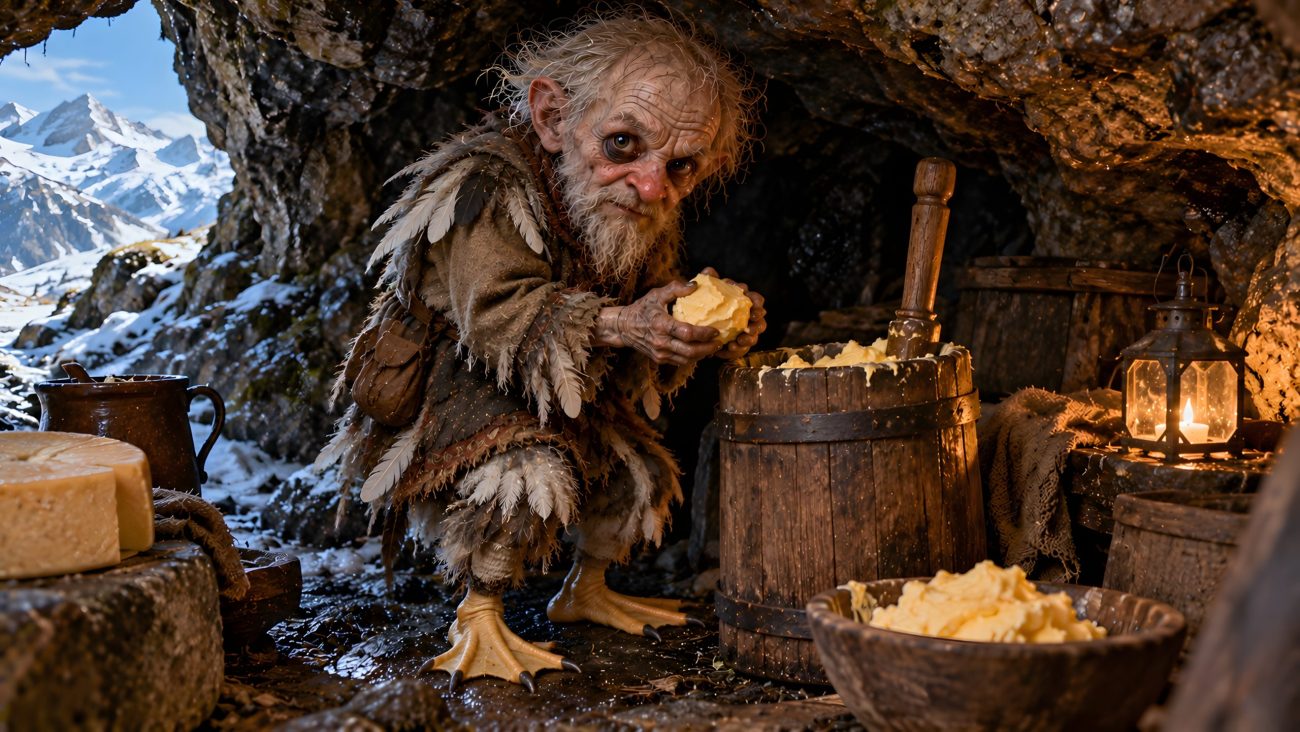
The Little Mountain Man was a tiny supernatural being with goose-like feet who lived among the mountains of Valais. He was small enough to hide inside a butter churn, and he moved about so quietly that the people he helped could never see him. An old man from Ernen owned a lonely little farm on Eggel in the Hochfluh area, where he kept his cattle during the winter. Each evening he had to climb up from Ernen to care for them, and the work became increasingly difficult as the snow deepened. One evening, exhausted after the climb, he sat beside the frozen well outside his cottage and wished aloud that someone would at least light his stove so that he could warm himself after his day’s labor. When he entered the cottage, he was astonished to find that his wish had already been fulfilled. A great log was burning brightly in the stove, the cheese had been pressed and placed neatly beneath its bricks, and the kitchen was perfectly tidy. Thinking that someone must have come to help him, he searched the parlor, but it too was empty. Yet freshly churned golden butter stood ready, the room had been swept, and everything was in perfect order. He hurried to the barn, expecting to find some helpful neighbor there, but there was no one. The cows had already been fed, groomed, and milked, and they rested contentedly on fresh straw. In the milk cellar, the milk had been placed in copper tubs and was already covered with a thick golden cream.

The old man could not understand who had done all this work. He thanked God for the mysterious help and returned to Ernen the next day. When he came back to the mountain farm that evening, everything had once again been completed before his arrival. The same thing happened day after day. The cows grew fatter, the butter and cheese grew more plentiful, and even the great haystack seemed never to lose so much as a single straw. Eventually the old man’s gratitude turned into curiosity, and he desperately wanted to see the invisible helper. He watched the house, kitchen, and stable through every crack and opening he could find, but nothing appeared. Then, near the end of winter, he finally heard the butter churn moving in the parlor. He crept closer and carefully lifted the cover. Inside the churn stood a tiny man with goose feet, quietly taking out the freshly made butter. The old man immediately understood that a little mountain spirit had been caring for his farm throughout the winter. Rather than frightening him away, he was delighted and decided to reward his mysterious helper.

He went down to Ernen and had a beautiful new coat made for the little mountain man. When he returned to the farm, he placed the coat on the table before going to bed. He intended to wake early and watch the dwarf when he discovered his gift, but he slept too long. When he finally awoke, the coat had vanished. Then he heard a voice singing outside: “Now I am a handsome man who can no longer shepherd.” With those words, the little mountain man disappeared forever.


Sources

“Das Bergmännlein.” SAGEN.at – Traditionelle Sagen aus der Schweiz. Reproduced by SAGEN.at. https://www.sagen.at/texte/sagen/schweiz/allgemein/bergmaennlein.html


Tree Dwarf

Tradition: Swiss Mythology
Alternative Names: The Dwarfs of the Hasli Valley
Category: Dwarf


The Myth

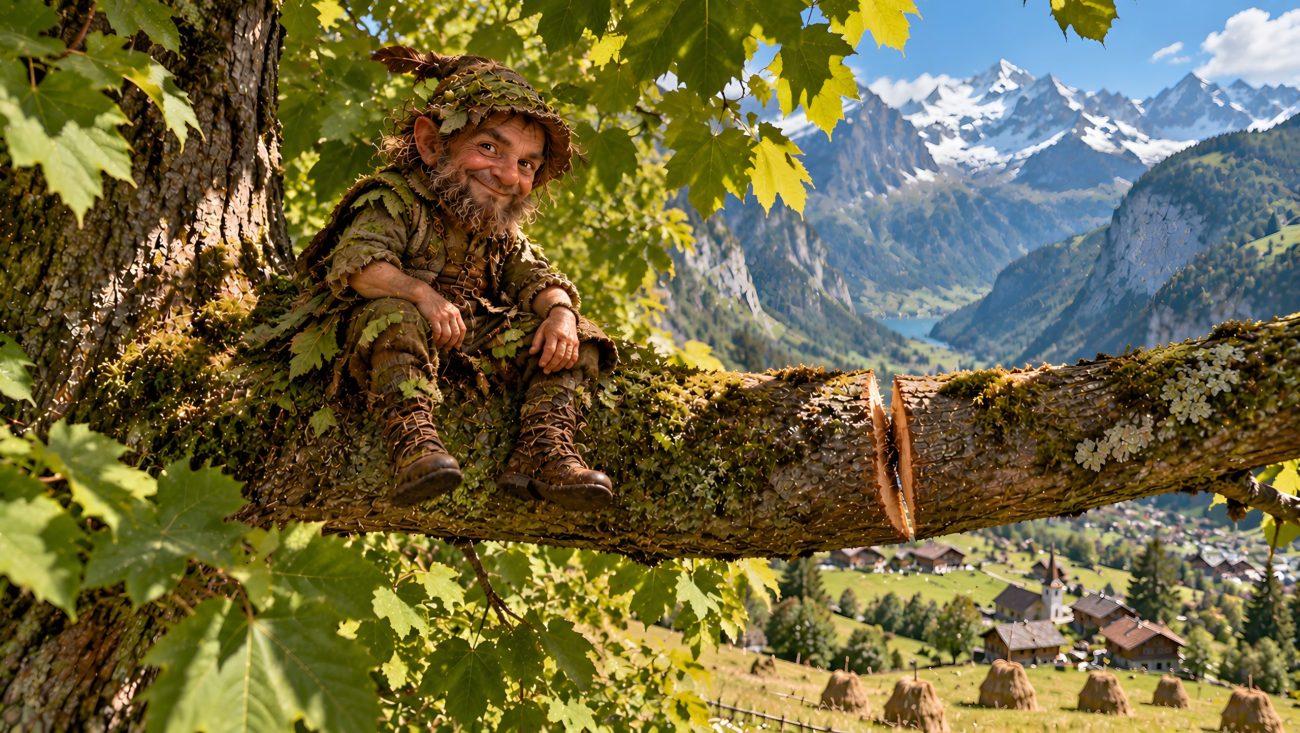
The dwarfs of the Hasli Valley were a hidden mountain folk who sometimes came down from the cliffs during summer. They would join the people working in the valley, either helping with their work or simply watching them, especially when the haymakers were busy. The dwarfs particularly enjoyed sitting together on the long, sturdy branches of a maple tree, sheltered beneath its thick green leaves.

One day, however, some wicked people decided to play a cruel trick on them. During the night they secretly sawed through one of the maple’s great branches, leaving it barely attached to the trunk. The next morning, unaware of what had been done, the dwarfs climbed onto the branch as they usually did. Suddenly it broke beneath them, sending the little mountain people tumbling to the ground. The wicked people laughed at their misfortune, and the dwarfs were furious. They cried out:

“Oh, how high the sky is
and how great the unfaithfulness!
Here today and nevermore!”

The dwarfs kept their word. From that day onward, they never again appeared among the people of the valley, disappearing forever from the country.


Sources

“Die Zwerge auf dem Baum.” SAGEN.at – Traditionelle Sagen aus Deutschland. Reproduced by SAGEN.at. https://www.sagen.at/texte/sagen/grimm/zwergeaufdembaum.html


Dwarf Woman

Tradition: Swiss Mythology
Alternative Names: Gotwärgi
Category: Dwarf


The Myth

The Dwarf Woman was a small supernatural being associated with the Gotwärgi, the dwarf folk of the Valais mountains. Her child was stunted and dwarfish in appearance, unable to speak like an ordinary child, and the creature could easily be mistaken for a strange human infant.

In Zeneggen, a mother had a child who never seemed to grow properly. Despite all her loving care, it remained tiny and dwarfish, and although it appeared intelligent and understood everything she said, it never spoke a single word. Worried and unable to understand what was wrong, the mother went to her neighbor for advice. The neighbor became suspicious and told her to give the child several empty eggshell halves to play with while secretly watching what it did. The mother followed the advice, and when the child saw the eggshells, it suddenly exclaimed in amazement that it had never seen so many little pancakes before. The mother was delighted to finally hear her child speak, but her neighbor was convinced that this proved something stranger was happening. She suspected that the mother’s real child had been stolen from its cradle and replaced with a Gotwärgi, a dwarf child.

The frightened mother was told to take the strange child up the hill and beat it until its cries could be heard across the valleys, believing that this might force the dwarf people to return her real child. Although she found it almost unbearable to strike the little creature, she eventually carried it up the hill and began to beat it. The child cried out so loudly that the surrounding hills echoed with its screams. Suddenly, a little dwarf woman came rushing toward them. In her arms was a beautiful, healthy child. The mother stared in astonishment, realizing that her own child had indeed been taken. The dwarf woman immediately snatched the stunted child from the mother’s arms, placed the beautiful child in her lap, and cried, “Then you take yours and I’ll take mine, you merciless little mother!” Clutching her own dwarfish child tightly, the dwarf woman disappeared down the mountain like a chamois, while the human mother remained behind, overwhelmed with wonder and joy as she finally held her true child again.


Sources

“Die Zwergenfrau.” SAGEN.at – Traditionelle Sagen aus der Schweiz. Reproduced by SAGEN.at.
https://www.sagen.at/texte/sagen/schweiz/allgemein/zwergenfrau.html


Dwarf of the Koralpe

Tradition: Austrian Mythology
Alternative Names: Mountain Dwarf of the Koralpe
Category: Dwarf


The Myth

Deep within the Koralpe mountains of Carinthia lived a hidden people of dwarfs. Farmers living around the Lavant Valley could sometimes see the little people moving about in the mountains, apparently busy with some kind of work, although nobody knew what they were doing.

The dwarfs were believed to possess great quantities of gold and other treasures taken from inside the mountains. This rumor eventually made the local farmers greedy. They devised a plan to capture one of the dwarfs and use it to force the others to reveal where their treasure was hidden.

They succeeded in capturing one and kept the little creature prisoner for thirty years. Again and again it insisted that it possessed no treasure, but the farmers refused to believe it. They promised that it would only be allowed to return to its mountain home if it gave them the riches they desired.

After so many years of captivity, the dwarf became overwhelmed by longing for the mountains. At last it told its captors that although it could not give them gold, it could repay them with something that would prove far more valuable to everyone living around the lake.

The people accepted the offer and released the dwarf. A few days later, a tremendous rumbling came from the lake, sounding like distant thunder. The inhabitants rushed toward the water, expecting another disastrous flood.

Instead, they discovered that the lake had vanished.

Where the dark waters had once covered the Lavant Valley lay a broad stretch of rich, muddy earth. The newly exposed land was excellent for fields and meadows, and people soon began settling across it. Villages and settlements gradually appeared throughout the valley, growing prosperous from the fertile ground.

Wolfsberg was eventually built at the place where the lake had once been deepest. The dwarf had given the people something far more valuable than the gold they had sought: an entire valley in which they could live and prosper.


Sources

Franz Pehr. “Der Dank des Bergmännleins.” SAGEN.at – Traditionelle Sagen aus Österreich (Kärnten). Reproduced by SAGEN.at.
https://www.sagen.at/texte/sagen/oesterreich/kaernten/franz_pehr/derdankdesbergmaennleins.html


Little Man of Venice

Tradition: Swiss Mythology
Alternative Names: The Venetian
Category: Dwarf


The Myth

The Little Man of Venice was a small, dark-haired man who regularly traveled from Venice to the high Alpine pastures of Glarus. He was an excellent gold seeker, spending his summers among the shepherds while searching the mountain rocks and streams for glittering stones. The shepherds found him strange but entertaining, and he would share their milk, cheese, whey, and hayloft while they tended their cattle. The little Venetian was remarkably successful at his work. He would climb among the rocks and search through the mountain streams, gathering stones that caught his eye, and within only eight days he could fill seven sacks with them. Once the sacks were full, he would mysteriously disappear, only to return again and begin collecting more stones. The shepherds eventually decided to play a trick on him. They secretly hid one of his sacks and waited to see what he would do. When the little man returned, he immediately knew that one of his sacks was missing and calmly asked whether the shepherds would retrieve it or whether he should do so himself. The shepherds laughed and challenged him to find it. Without hesitation, the little Venetian climbed a steep slope straight to the hiding place and returned with the missing sack, astonishing the shepherds with his uncanny knowledge.

When the summer ended and the first cold winds began sweeping over the mountains, the little man prepared to return to Venice. Before leaving, he told the shepherds that if any of them ever came to Venice, he would reward him with a sack filled with pure silver. Most of the shepherds soon forgot the promise, but one poor shepherd remembered it. He had a sickly wife and many children and knew exactly what he could do with a sack of silver. After the herds came down from the Alps, he set off on the long journey toward Venice. When he finally reached the city, he had no idea where the little Venetian lived and did not even know his name. As he wandered sadly through the narrow streets, however, someone suddenly tapped him on the shoulder. A small, elegantly dressed gentleman greeted him warmly and immediately began asking about Glarus and the shepherds he had known there. The shepherd recognized him as the little man from the Alpine pasture. The Venetian welcomed him into his magnificent home, a marble palace whose walls were so polished that they gleamed like mirrors. A dark stream flowed outside, white doves flew above it, and the shepherd was given everything he could desire, including a rich red wine that seemed to fill him with strength. Yet despite all this luxury, the shepherd could not stop thinking about his wife and children. He became increasingly homesick and longed to see his distant home again.

The Venetian understood his sadness and led him into a room the shepherd had never seen before. On its wall hung a magnificent mirror, and when the little man told him to look into it, the shepherd saw Glarus as clearly as though it were standing on the other side of the wall. He could even see his own house, where his wife was washing their child with tears in her eyes because she missed him. The Venetian then offered to send him home with either gold or silver. The shepherd remembered the promise made on the Alpine pasture and asked only for the sack of silver he had been promised. The Venetian allowed him to enter his treasury, where the shepherd filled a sack with silver. Before he left, the little man warned him to guard the sack carefully and, if he had to sleep at an inn, to place it beneath his head. The shepherd began his journey home, but one evening, still far from Switzerland, he stopped at a small Italian inn. Exhausted from the journey, he placed the heavy sack beneath his head and fell asleep.

When he awoke, he was no longer in Italy. He was lying in his own bed in Glarus, hearing the familiar clock in his house and his goats outside. For a moment he thought the entire journey to Venice had been a dream, but then he felt something hard beneath his head and discovered that the sack of silver was still there. His wife and children rushed to him, and the poor shepherd’s fortune was transformed. He became a wealthy man, and his descendants remained respected in Glarus. They became known as the Venetian people, in memory of the mysterious little man who had brought their ancestor his fortune.


Sources

“Das Venedigermännlein.” SAGEN.at – Traditionelle Sagen aus der Schweiz. Reproduced by SAGEN.at.
https://www.sagen.at/texte/sagen/schweiz/allgemein/venediger_maennlein.html


Eloko

Tradition: Nkundo Mythology, Congo Mythology
Alternative Names: Biloko
Category: Dwarf


The Myth

The Eloko is a small but terrifying forest creature said to dwell inside hollow trees in the forests of the Congo. It is described as a cannibalistic dwarf or troll, with grass growing as a beard and leaves serving as its clothing. An Eloko often carries a small bell, whose sound is used to lure unsuspecting people deeper into the forest and place them under its enchantment.

Despite its small stature, the Eloko possesses tremendous strength and is far more powerful than an ordinary human. According to the tradition, only exceptional heroes or sorcerers are capable of defeating one. The creatures embody the dangers of entering the forest alone and of deliberately tempting fate.

One story tells of a man who built a fenced hut deep in the forest so that he could hunt game. Whenever he left to return to his village, he warned his wife never to answer if she heard the sound of a little bell. The bell, he told her, belonged to an Eloko, and answering its call would bring death.

One day, while her husband was away, the woman heard the bell. Its monotonous ringing seemed to come from deep within the forest, gradually drawing closer to the hut. Eventually she could no longer resist and ran outside, calling for the creature to come to her.

The Eloko appeared and announced that it had come. The woman welcomed it and prepared food, but the creature refused the meal. It told her that it ate only human flesh and demanded a piece of her body. The woman willingly offered her arm, and the Eloko cut away a piece of flesh, roasted it, and ate it before disappearing into the forest.

When her husband returned, he found her lying in bed with a serious wound. She claimed that she was suffering from sores and refused to explain what had happened. The following day, however, the same thing happened again. The Eloko returned while the husband was away, and the woman once again allowed it to take flesh from her body.

This time the husband suspected that something was terribly wrong. Instead of returning to the village, he secretly remained nearby and waited for the creature. When the Eloko came again, he confronted it. The creature declared that this time it wanted the woman’s liver.

The husband immediately attacked. He shot the Eloko with an arrow, pierced it with his spear, and finally cut off its head. But the creature had already wounded the woman in the liver, and she died from the injury. The story ends as a warning that those who deliberately play with danger may eventually be destroyed by it.

The Biloko could also appear as an organized enemy rather than solitary forest monsters. In another tale, Likinda, Itonde, and Lianja went to war against the Biloko. They scattered mbole fruits along a path and used them to lure the creatures into an ambush, killing almost all of them.

Only the sorcerer Inkankanga and his wife survived. Likinda pursued them and transformed himself into a baby, causing Inkankanga’s wife to pick him up and care for him. Later, Likinda climbed a tree and appeared to throw fruit down to the couple. Instead, he transformed himself into one of the fruits and allowed Inkankanga to swallow him.

The sorcerer realized that Likinda was now inside him and became terrified. He killed his own wife, blaming her for the disaster, and spent the rest of the day begging Likinda not to destroy him. Eventually he gave up hope, and Likinda killed him from within before returning to his village, where his strange victory became a source of laughter and celebration.


Sources

“Eloko.” A Book of Creatures. November 21, 2016. https://abookofcreatures.com/2016/11/21/eloko/


Heimchen

Tradition: German Mythology
Alternative Names: Heimele, Butzelmännchen, Erdmännele, Heimchenkönigin
Category: Dwarf


The Myth

The Heimchen are tiny supernatural beings, sometimes no taller than a finger, who appear in several forms throughout German folklore. In the Vogtland they are little mountain people living inside a great cave, while in Thuringia they are tiny earth spirits living in the mouse holes of human houses. They are often cheerful and friendly, helping people without being seen.

The mountain Heimchen live inside a hidden cavern illuminated as brightly as daylight by a gigantic carbuncle. Gemstone flowers grow throughout the underground meadow, while a soft humming fills the cavern like the sound of harps. The entrance does not always appear, and the little mountain people cannot always be seen by human eyes.

These Heimchen keep tiny golden sheep, no larger than lambs. Their shepherdess is Ilsa, an enchanted girl dressed in white who carries a golden staff. She remains among the mountain people while waiting to be freed from her enchantment.

In Thuringia, the Heimchen are also called Heimele, Butzelmännchen, or Erdmännele. These tiny beings live in mouse holes and emerge in the evening dressed in white. Hundreds of them may gather in a meadow, where they dance together in great circular dances. Their appearances are believed to reveal whether good or bad fortune is coming to the people living nearby.

The little spirits can also reward people who care for them. Small golden boxes containing delicate and delicious gifts may be found outside their mouse holes in the morning. The Heimchen are especially fond of helping humans secretly. They tend fields, look after cattle, and watch over children when their parents are away.

The Heimchen were once said to have been particularly helpful around the villages of Cosdorf and Rödern. Their constant assistance made the farmers prosperous, as the tiny spirits quietly helped with their work and cared for the animals.

Eventually, however, a stern stranger arrived and warned the villagers that Perchta should not be trusted. He told them that the Heimchen were actually the souls of children who had died without being baptized. After hearing this, the villagers became suspicious of the little spirits and stopped accepting their help.

Perchta then decided that the time had come to leave. She gathered the Heimchen and crossed the stream with them, taking the mysterious little people away from the villages. They never returned, and the prosperity they had brought with them disappeared as well.

The Heimchen are also connected with Perchta herself. In some Thuringian traditions they form part of her supernatural retinue, appearing as the wandering souls of unbaptized children. Their nature therefore ranges from benevolent household helpers and cheerful dwarfs to mysterious spirits belonging to the world of the dead.


Sources

“Heimchen.” Wikipedia: The Free Encyclopedia. Wikimedia Foundation. Accessed October 4, 2026. https://en.wikipedia.org/wiki/Heimchen