Tradition: Austrian Mythology
Alternative Names: Mountain Dwarf of the Koralpe
Category: Dwarf
The Myth
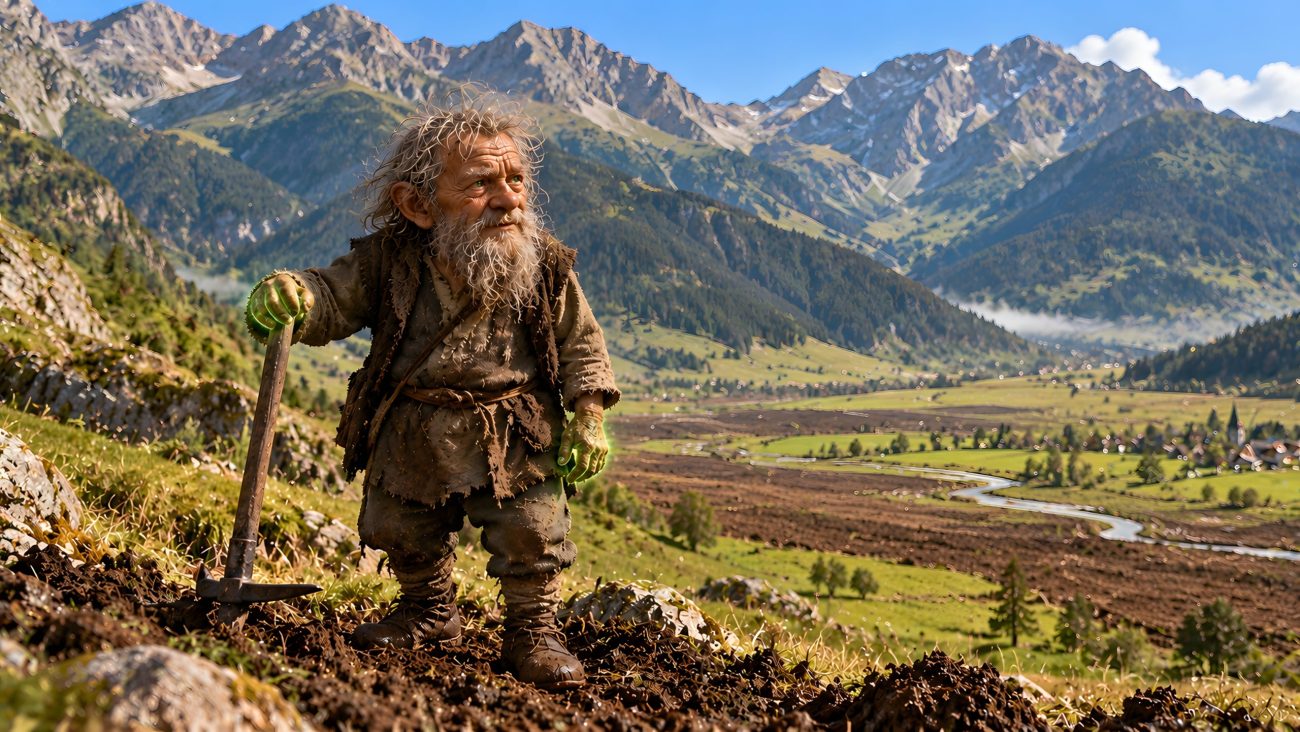
Deep within the Koralpe mountains of Carinthia lived a hidden people of dwarfs. Farmers living around the Lavant Valley could sometimes see the little people moving about in the mountains, apparently busy with some kind of work, although nobody knew what they were doing.
The dwarfs were believed to possess great quantities of gold and other treasures taken from inside the mountains. This rumor eventually made the local farmers greedy. They devised a plan to capture one of the dwarfs and use it to force the others to reveal where their treasure was hidden.
They succeeded in capturing one and kept the little creature prisoner for thirty years. Again and again it insisted that it possessed no treasure, but the farmers refused to believe it. They promised that it would only be allowed to return to its mountain home if it gave them the riches they desired.
After so many years of captivity, the dwarf became overwhelmed by longing for the mountains. At last it told its captors that although it could not give them gold, it could repay them with something that would prove far more valuable to everyone living around the lake.
The people accepted the offer and released the dwarf. A few days later, a tremendous rumbling came from the lake, sounding like distant thunder. The inhabitants rushed toward the water, expecting another disastrous flood.
Instead, they discovered that the lake had vanished.
Where the dark waters had once covered the Lavant Valley lay a broad stretch of rich, muddy earth. The newly exposed land was excellent for fields and meadows, and people soon began settling across it. Villages and settlements gradually appeared throughout the valley, growing prosperous from the fertile ground.
Wolfsberg was eventually built at the place where the lake had once been deepest. The dwarf had given the people something far more valuable than the gold they had sought: an entire valley in which they could live and prosper.
Sources
Franz Pehr. “Der Dank des Bergmännleins.” SAGEN.at – Traditionelle Sagen aus Österreich (Kärnten). Reproduced by SAGEN.at.
https://www.sagen.at/texte/sagen/oesterreich/kaernten/franz_pehr/derdankdesbergmaennleins.html