Adlet

Tradition / Region: Inuit mythology, Canadian Mythology, Greenlandic Mythology
Alternate Names: Erqigdlet, Adlit
Category: Dog, Hybrid


The Myth

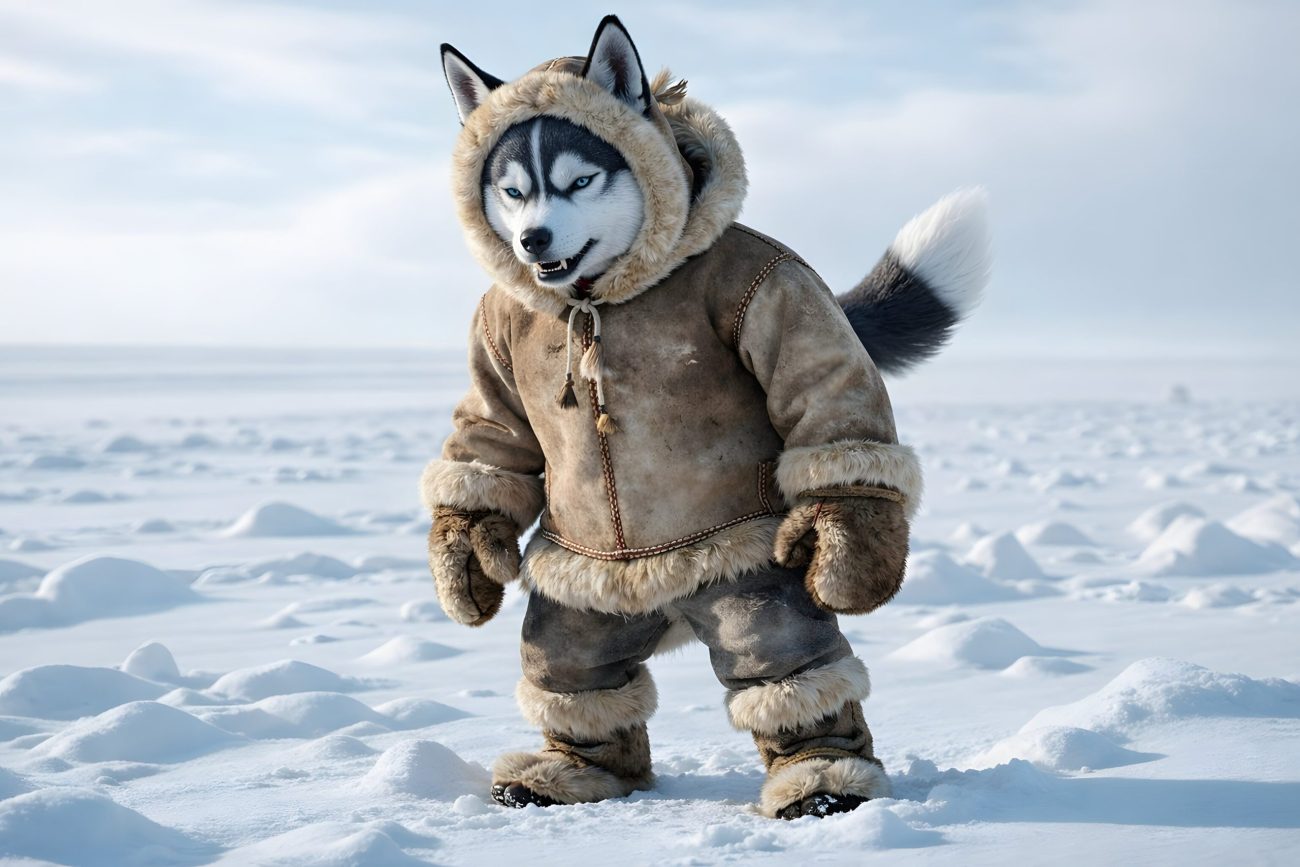
The Adlet are a race of beings spoken of in Inuit tradition. They are said to be taller than ordinary people and to live inland, away from the coast. Their form is half human and half dog: from the waist up they resemble a man, but their lower bodies are those of dogs. They run swiftly across the land and are often remembered as fierce enemies of humankind. In some stories they are cannibals, and encounters with them are dangerous and violent.

Their origin is told in an old story about a young woman named Niviarsiang, who lived with her father, Savirqong. Though many men wished to marry her, she refused every suitor. Because she would not take a husband, people came to call her “she who would not marry.”

At last, instead of choosing a man, she took a dog as her husband. The dog, named Ijirqang, had white and red spots on his coat. From this strange union ten children were born. Five of them were fully dogs, but the other five were unlike any people before them: their upper bodies were human, while their lower halves were those of dogs. These children were the first Adlet.

Ijirqang did not hunt, and the household was soon starving. The hungry children cried constantly, and Savirqong, their grandfather, was forced to bring them food. At last he grew weary of this burden. He carried his daughter, her husband, and their children out to a small island and left them there, saying that he would provide meat if the dog swam to shore each day to fetch it.

To help her husband, Niviarsiang hung a pair of boots around Ijirqang’s neck so he could carry the meat back across the water. The dog swam to shore as instructed. But when he arrived, Savirqong did not fill the boots with food. Instead, he filled them with stones. Weighted down, Ijirqang drowned in the sea.

When Niviarsiang learned what had happened, she sought revenge. She sent her young dogs across the water to attack her father. They gnawed off his hands and feet as punishment for killing their father.

Later, when Niviarsiang herself came near Savirqong in his boat, he seized his chance. He pushed her overboard. She clung to the side, trying to pull herself back in, but he cut off her fingers one by one. As they fell into the ocean, each finger changed form and became a sea creature. From them came the seals and the whales that fill the waters.

Fearing that her father might next destroy her strange children, Niviarsiang sent the Adlet away from the coast and into the interior lands. There they multiplied and became a great inland people.

Her dog children she placed in a makeshift boat and sent them across the sea. It is said that when they reached the far shore, they became the ancestors of distant northern peoples.

From that time on, the Adlet lived inland, remembered as swift, powerful, and dangerous beings whose blood was both human and animal.


Gallery


Sources

Wikipedia contributors. (n.d.). Adlet. In Wikipedia, from https://en.wikipedia.org/wiki/Adlet


Interpretive Lenses

Religious Readings
  • Christian Ascetic Deep Dive
Philosophical Readings
  • Nietzschean Deep Dive
Psychological Readings
  • Jungian Deep Dive
Esoteric Deep Dive
  • Hermetic Deep Dive
Political / Social Readings
  • Marxist Deep Dive

Prikulich of Stolzenberg

Tradition / Region: Romanian Mythology
Alternate Names: Prikulitsch; The Stolzenberg Dog Fiend
Category: Dog


The Myth

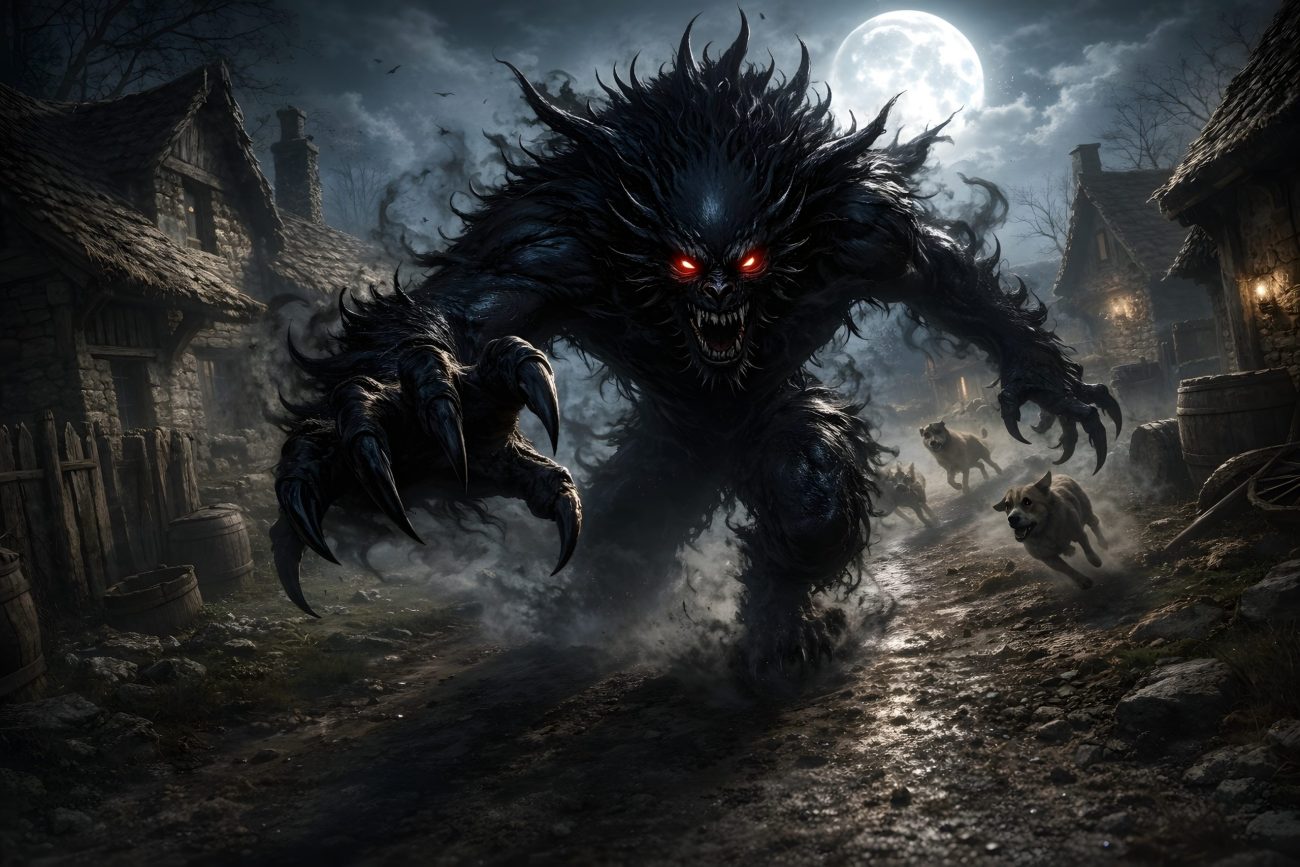
One night, a villager was walking along the path near the clay pit known as the Leimkel. As he paused beside one of the deep holes, something suddenly tumbled out into the path. It was a thick, black creature, as large as a wolf, rolling from the pit and plunging into the ditch beside the road.

Terrified, the man folded his hands and began to pray the Lord’s Prayer. The prayer protected him, and the creature did not approach. Later he learned what it had been — a Prikulich.

He saw the being again in Stolzenberg itself, once more around midnight. He had just come from his mother’s house when a dark shape slipped out of a courtyard and crossed the street only a few steps in front of him. Its large, dark eyes rolled strangely in its head as it passed.

People in the village said the creature was none other than a Galician Jewish tradesman who had settled there. At night he wandered in the form of a beast, and many claimed to have seen him fighting with the village dogs. They said this was why the man’s face was often torn and scratched.

Once, the gendarmes seized him and stabbed him until he bled. At that moment the creature’s power broke, and he stood before them again in human form. Instead of cursing them, he spoke with relief:

“Thank you for doing this to me. Now I am redeemed.”


Sources

sagen.at contributors. (n.d.). Der Prikulitsch in Stolzenberg. In sagen.at, from https://www.sagen.at/texte/sagen/rumaenien/siebenbuergen/stolzenberg.html


Prikulich of Giesshübel

Tradition / Region: Romanian Mythology
Alternate Names: Prikulich; The Dog Prikulich
Category: Dog


The Myth

In the village of Giesshübel there once lived a reckless young man known for chasing after the maids and living without restraint. One day, when he returned home, something uncanny happened. As he entered, he suddenly flipped over, and in that instant he was no longer a man but a white dog marked with grey spots.

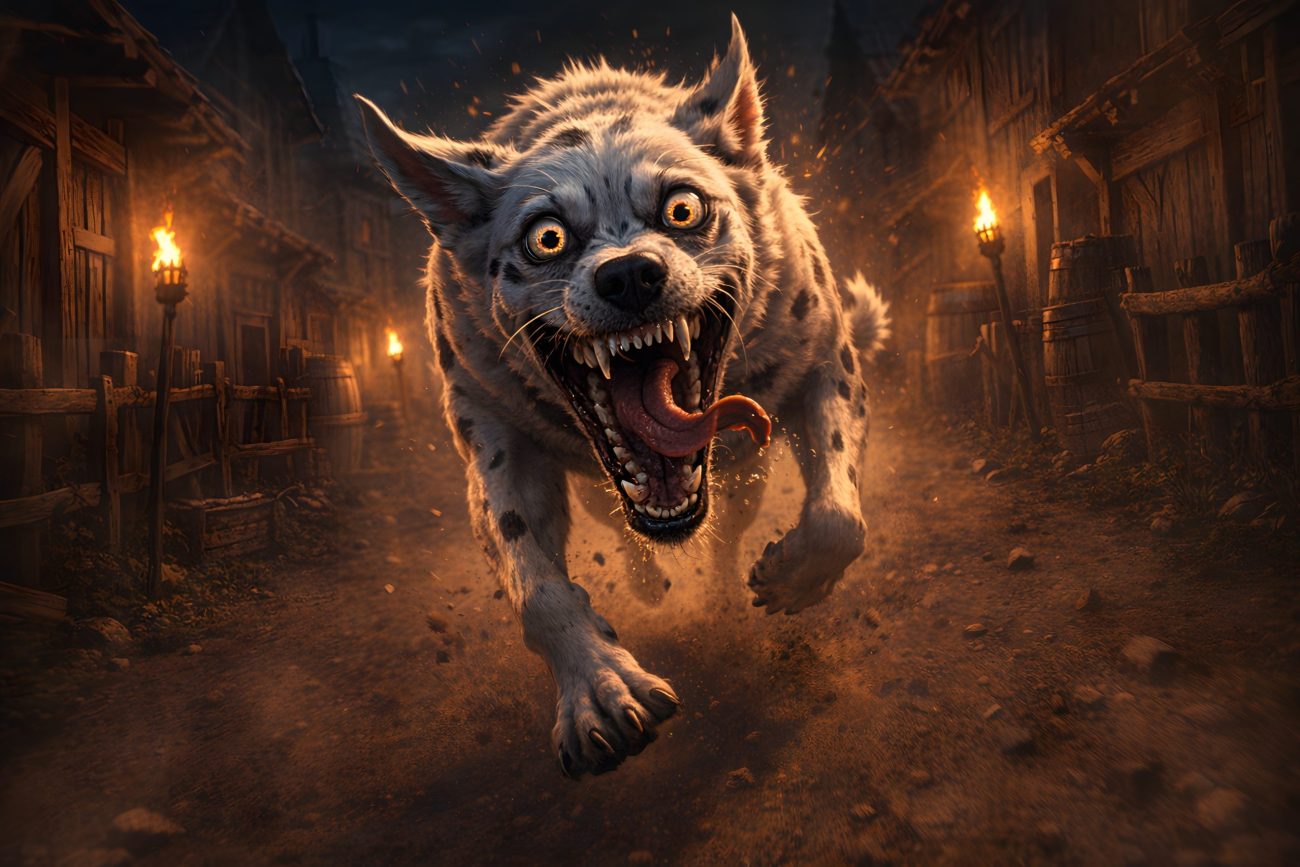
From then on, the creature lived a double existence. By day the dog stayed quietly in the stable, keeping out of sight. But each night, when midnight came, it slipped out into the street. There it ran through the village and fought fiercely with the other dogs, as if driven by some restless and savage urge.

One night, when the dog returned home, his mother was waiting. Suspecting what he truly was, she struck him in the side with an awl. At the touch of the iron, the dog tumbled over once, twice, and a third time.

With the last turn, the animal vanished, and the young man lay there again in human form, freed from his strange condition.


Sources

sagen.at contributors. (n.d.). Der Prikulitsch in Giesshübel. In sagen.at, from https://www.sagen.at/texte/sagen/rumaenien/siebenbuergen/giesshuebel.html


Prepelitsch

Tradition / Region: Romanian Mythology
Alternate Names:
Category: Dog, Shapeshifter


The Myth

Near Agnetheln, a young married couple once worked together in the fields. When their drinking water was gone, the husband told his wife he would fetch more. Before leaving, he warned her that if a dog should come and attack her, she must defend herself bravely.

No sooner had he gone than a large dog appeared and rushed at the woman. It was fierce and relentless. She fought back as best she could, struggling to drive it away, but the beast managed to seize her apron and tear off a corner before finally running off across the fields.

Some time later her husband returned with the water. As she turned toward him, she froze in horror. Caught between his teeth was the very piece torn from her apron.

From that moment it was clear that the dog had not been an ordinary animal, but the man himself in another form.


Sources

sagen.at contributors. (n.d.). Prepelitsch. In sagen.at, from https://www.sagen.at/texte/sagen/rumaenien/siebenbuergen/prepelitsch.html


Bachhund of the Stöckelter Moor

Tradition / Region: Luxembourg Mythology
Alternate Names: Moor Hound, Black Dog of Stöckelts
Category: Dog


The Myth

Near the Stöckelter Moor, which lies between the districts of Sandweiler and Itzig, people long believed that an evil spirit dwelt in the marsh. This being was called the Bachhund.

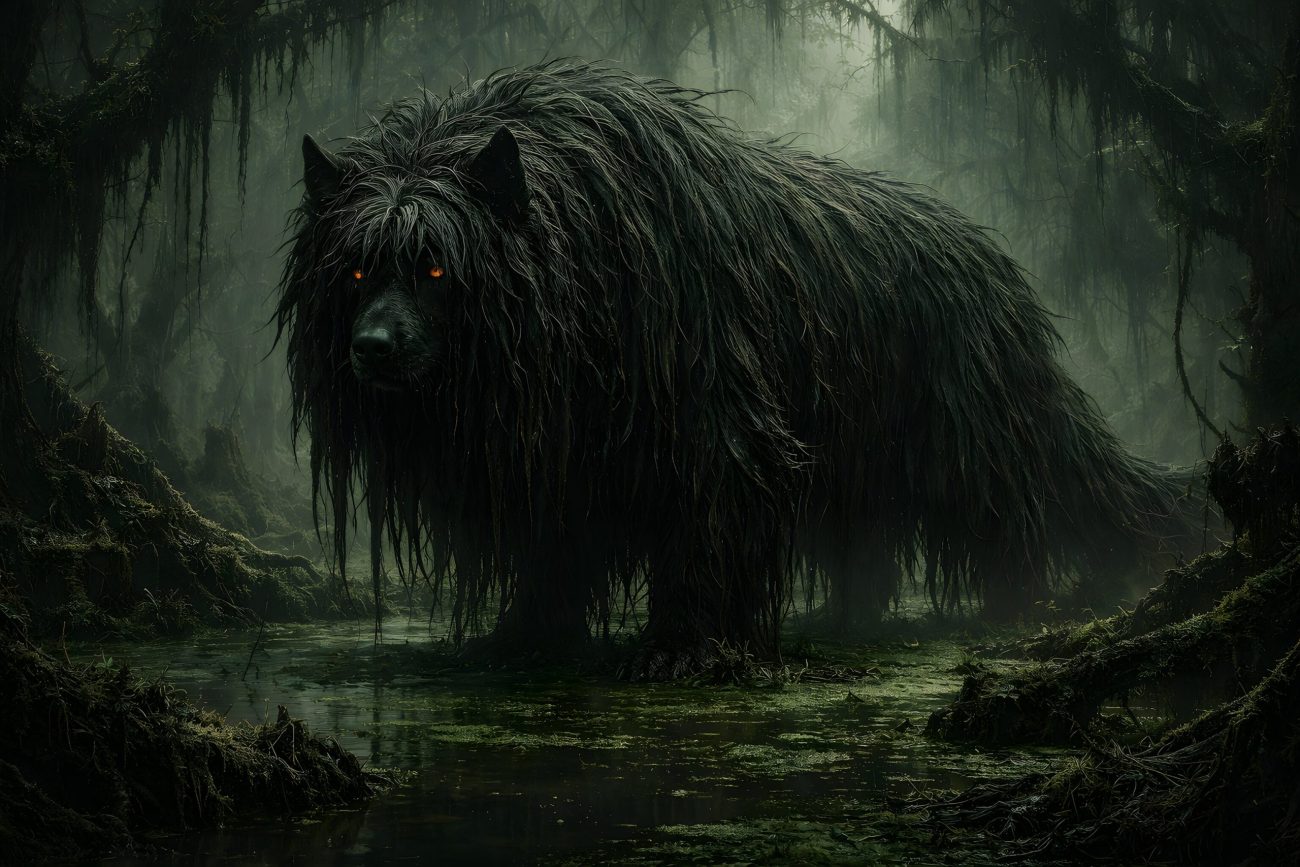
It was said to roam the heights of Stöckelts at night in the form of a large black dog. At times, a terrible roaring could be heard across the moor and in the surrounding woods, a noise that rose like a distant thunderstorm and filled the place with dread.

One story tells of a woman from Kontern who, near the moor, heard someone calling out “Hoo! Hoo!” Thinking it was a lost traveler, she answered with the same call. The exchange happened three times. But when she called out the third time, a large black dog suddenly leapt from the air beside her and stared fixedly at her. Terrified, she hurried away as fast as she could.

Thus the Stöckelter Moor was remembered as a place haunted by the Bachhund, whose presence was feared and whose roaming was said to continue even in later times.


Sources

sagen.at contributors. (n.d.). Der Bachhund. In sagen.at, from https://www.sagen.at/texte/sagen/luxemburg/Bachhund.html


Muselhond of Grevenmacher

Tradition / Region: Luxembourg Mythology
Alternate Names: Moselle Hound
Category: Dog


The Myth

Near Grevenmacher there was said to live a strange being known as the Muselhond. He usually stayed in the waters of the Moselle and only rarely appeared in the countryside around the town. Because he harmed no one, he was not greatly feared.

Early in the morning he was often seen as a large dog. After making his rounds around the town, he would plunge into the Moselle and there reappear in the form of a man. Washerwomen sometimes saw him rolling noisily down the river like a tumbling cask. Children who behaved too boldly while bathing were warned that the Muselhond would drag them under the water.

He was said to be friendly toward fishermen, and two fishermen from Grevenmacher were believed to have once caught an enormous quantity of fish with his help.

Opposite Temmels, people sometimes heard voices shouting “Carry me across! Carry me across!” Two figures, one tall and one short, were said to roll about in the meadow there. Yet when the ferryman crossed over, he found no one waiting. This too was attributed to the Muselhond, who was thought to delight in such tricks.

Thus the Muselhond was remembered as a strange river being who moved between water and land, sometimes appearing as a dog, sometimes as a man, and whose presence lingered in the tales told to children.


Gallery


Sources

sagen.at contributors. (n.d.). Der Muselhond zu Grevenmacher. In sagen.at, from https://www.sagen.at/texte/sagen/luxemburg/Muselhond.html


Interpretive Lenses

Religious Readings
  • Christian Ascetic Deep Dive
Philosophical Readings
  • Nietzschean Deep Dive
Psychological Readings
  • Jungian Deep Dive
Esoteric Deep Dive
  • Hermetic Deep Dive
Political / Social Readings
  • Marxist Deep Dive

Adhnúall

Tradition / Region: Irish mythology
Alternate Names: Adnual
Category: Dog


The Myth

Adhnúall, whose name means “Sweet of Sound,” was one of the hunting dogs of Fionn mac Cumhaill, leader of the Fianna. Unlike the more famous hounds, Adhnúall was remembered not for ferocity alone, but for a voice so beautiful and sorrowful that it could stir the heart.

Once, the dog was stolen by Arthur, the son of the king of Britain. The Fianna pursued the matter and reclaimed Adhnúall, restoring him to Fionn. From that time on, the hound remained closely bound to his master’s fate.

It was said that Adhnúall played a quiet but decisive role in love as well as in the hunt. Through the dog’s presence and guidance, Sadhbh was led into Fionn’s heart, beginning a bond that would shape both their lives.

In later days, a great battle was fought in Leinster, and many of the Fianna were slain. The loss weighed heavily upon Adhnúall. Stricken with grief, the hound ran the full circuit of Ireland three times, as though seeking every fallen companion and every memory of the Fianna.

When his strength was spent, Adhnúall returned to the battlefield. He went to a hill where three warriors of the Fianna and their lovers lay buried together. There, he lifted his head and gave three long howls, each filled with sorrow and farewell. When the last cry faded, Adhnúall lay down and died of grief.

Thus ended the life of the sweet-voiced hound, whose loyalty bound him to love, loss, and the fate of the Fianna themselves.


Sources

Wikipedia contributors. (n.d.). Adhnúall. In Wikipedia, The Free Encyclopedia, from https://en.wikipedia.org/wiki/Adhn%C3%BAall