Tradition: Chinese Mythology, Japanese Mythology, Korean Mythology, Vietnamese Mythology, American Mythology
Alternative Names: Jade Rabbit, Yutu, 玉兔, Moon Hare, Lunar Rabbit
Category: Rabbit
The Myth
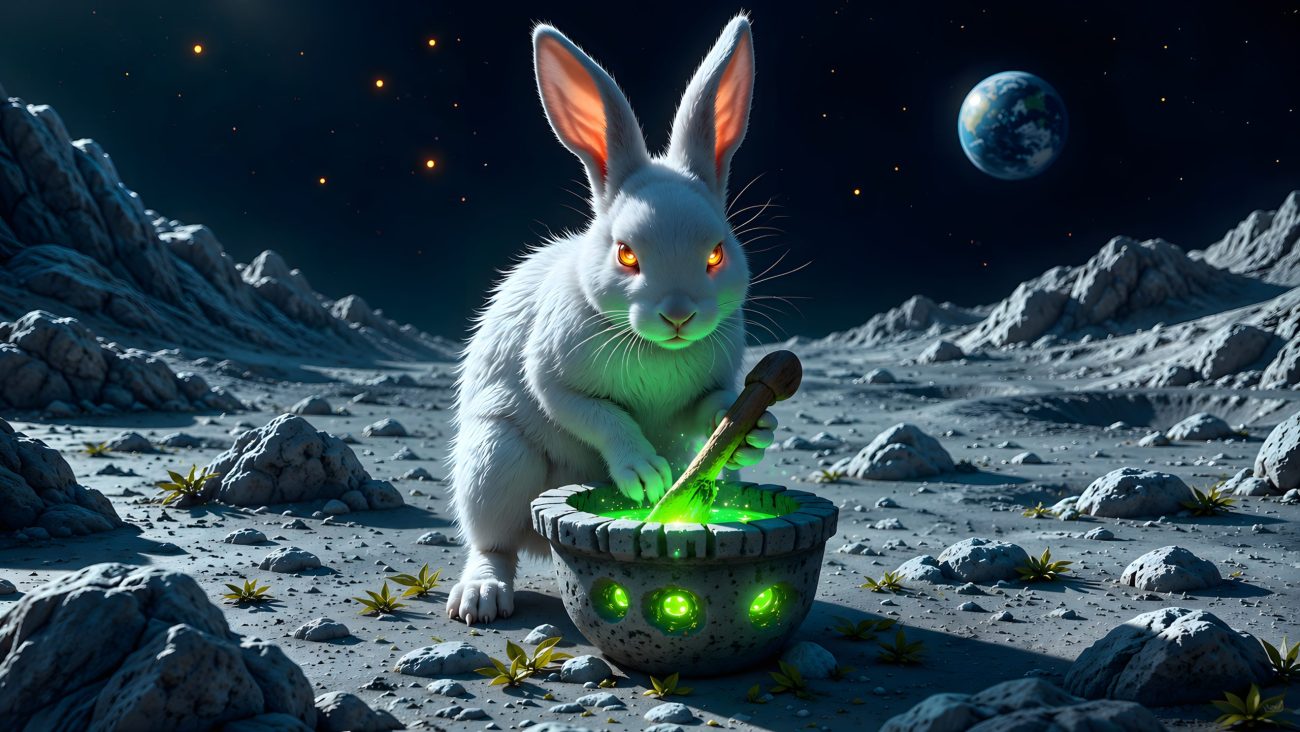
The Moon Rabbit, also known as the Jade Rabbit or Moon Hare, is a mythical rabbit or hare believed to inhabit the Moon. Its image originates from interpretations of the dark markings on the lunar surface, which resemble a rabbit. The creature appears in traditions across East Asia, including China, Japan, Korea, and Vietnam, as well as in some Indigenous American cultures. In East Asian mythology, the Moon Rabbit is commonly depicted pounding ingredients with a mortar and pestle. The substance it prepares varies between traditions: Chinese and Vietnamese accounts often describe it making the elixir of immortality, while Japanese and Korean versions commonly portray it preparing rice cakes, such as mochi or tteok. Some Chinese depictions also show the rabbit making medicine for mortals or preparing mooncakes.
In Chinese tradition, the Moon Rabbit is frequently associated with Chang’e, the goddess of the Moon, for whom it prepares the elixir of life. References to a lunar hare appear in early Chinese literature, including the Chu Ci, a collection of poems compiled during the Western Han period. Later sources also mention the Jade Hare and Gold Hare, names used poetically for the animal on the Moon and, by extension, for the Moon itself. The image of the rabbit preparing medicine remained influential in Chinese poetry and art, including depictions embroidered on imperial robes.
A Buddhist story offers another explanation for the rabbit’s presence on the Moon. In the Jataka tales, a monkey, an otter, a jackal, and a rabbit resolve to practise charity on the full-moon day. When an old man asks them for food, the other animals gather what they can find, but the rabbit can offer only grass. To demonstrate its generosity, it throws itself into a fire so that the man can eat its flesh. The rabbit remains unharmed, and the old man reveals himself to be Śakra, king of the gods. Moved by the rabbit’s selflessness, he places its likeness on the Moon so that its virtue will be remembered. The rabbit is consequently regarded in this story as a Bodhisattva. A Japanese version recorded in the Konjaku Monogatarishū features a fox and a monkey as the rabbit’s companions.
The Moon Rabbit also appears in the Chinese novel Journey to the West. In one episode, a celestial rabbit escapes from the Moon Palace and disguises herself as a woman, intending to marry the monk Tang Sanzang and absorb his vital yang essence. Sun Wukong discovers her identity and battles her. Before he can defeat her, the celestial figure Taiyin Xingjun arrives and reveals that the creature is the Jade Rabbit, a guardian of the mystical elixir in the Moon Palace. Taiyin Xingjun explains that the rabbit secretly escaped from the palace and asks Sun Wukong to spare her. The Monkey King agrees, and the rabbit is returned to the Moon. The Moon Rabbit is also closely connected with lunar festivals across Asia, including China’s Mid-Autumn Festival, Japan’s Tsukimi, Korea’s Chuseok, and Vietnam’s Tết Trung Thu, where it forms part of the imagery and traditions associated with the Moon.
Sources
“Moon Rabbit.” Chinese Wikipedia. Wikimedia Foundation. https://zh.wikipedia.org/wiki/%E6%9C%88%E5%85%94