
Garmina Witches

Tradition / Region: Swiss Mythology
Alternate Names: Witches of Oute Garmina
Category: Sheep


The Myth

On the mountain path that runs from Vättis to Untervatz, across the Owaggis and Salatz Alps, there was once said to be a lonely place called Oute Garmina. There, long ago, three witches lived together.

A young hunter from Vättis often roamed the Calanda mountains and passed that way on his hunts. Several times he encountered the sisters, yet they could not harm him. He was said to wear “clean shoes,” and because of this, their magic failed against him.

Unable to touch him directly, the witches tried another trick. They transformed themselves into chamois and appeared on the slopes, hoping to lure him into danger. One day, as he crossed the Alp Gwaggis, he saw three chamois grazing peacefully on a grassy ledge. Thinking them ordinary game, he raised his gun and fired. Yet every shot missed.

Suddenly the animals sprang toward him. Sensing danger, he threw himself flat to the ground, and the attack failed. Later, an old man from Vatz told him the truth: the chamois were not beasts, but the witches of Garmina. He instructed the hunter how to defeat them.

The hunter followed his advice. He mixed Trinity-blessed salt into his powder and loaded a consecrated silver bullet. The next time he saw the chamois, he fired again. This time his aim did not fail. One of the animals was struck and fell from the rocks, tumbling down the cliff.

The hunter went at once to Garmina. There he found that he had indeed slain one of the witches, killed by a shot through the head.

And so the story remained among the mountain people, who remembered that on the high paths of Garmina, even grazing animals might hide something far more dangerous.


Sources

SAGEN.at. (n.d.). Die Garmina-Hexen. Retrieved March 1, 2026, from https://www.sagen.at/texte/sagen/schweiz/st_gallen/garmina_hexen.html.

Hafukohotsu Fox

Tradition / Region: Japanese Mythology
Alternate Names: Hafukohotsu Fox of Hirofuchi Mikura
Category: Fox


The Myth

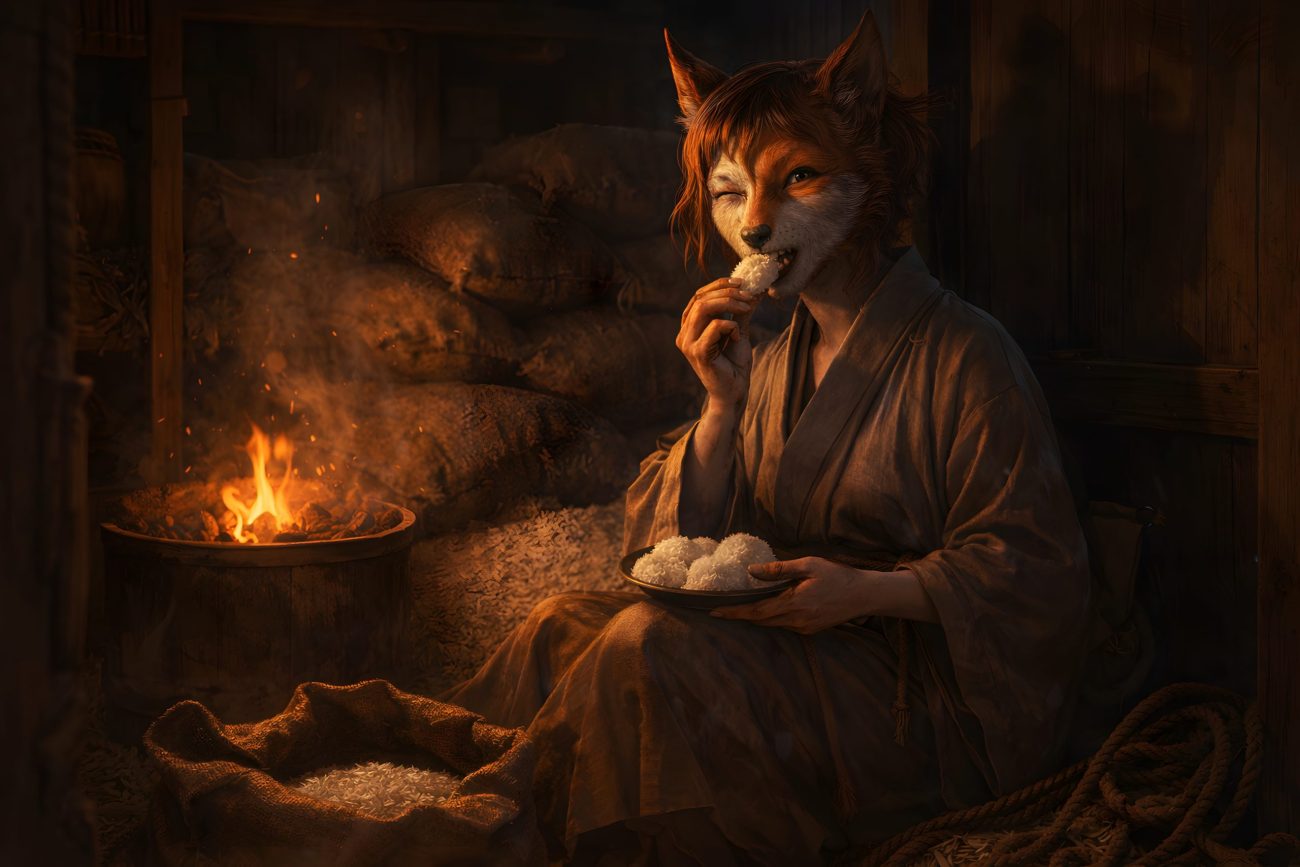
In Hirofuchi Village, where the Date clan once kept its rice storehouses, many old foxes and raccoon dogs were said to live nearby, often frightening the villagers.

One night, a man assigned to guard the storehouse sat alone by the hearth, smoking. Suddenly his father appeared at the door, visiting at an unusual hour with no clear reason. The guard watched him closely and noticed something strange. His father was blind in one eye — the left — yet now that eye was shut while the other was open. Realizing this could not be right, he understood that the visitor must be a fox in disguise.

Hiding his suspicion, he spoke cheerfully.
“I have some rice cakes the villagers gave me. Would you like some?”

The false father smiled and accepted. The guard continued, pretending to think aloud about how his father preferred to eat them. The disguised fox hesitated, unsure of the answer, then finally replied,
“I… like hafukohotsu…”

The guard knew at once the creature had failed to say the name of the kinako rice cakes his real father loved. Still pretending nothing was wrong, he served the fox the bean-flour mochi and let him eat.

Later, as the guard prepared to sleep, he told the visitor there was no spare bedding and asked whether he could sleep wrapped in an empty rice sack. A real father would have taken offense, but the fox eagerly agreed. Seeing his chance, the guard wrapped the sack around him and tied it tightly with rope.

The fox complained mildly but soon fell asleep.

When dawn came and sunlight reached the storehouse, the creature realized it had been trapped. It struggled desperately, but the ropes held fast, and at last its tail slipped from the sack, revealing its true form — a large, old fox.

The story spread quickly through Hirofuchi and beyond. People laughed at the foolish fox who could not pronounce the name of rice cakes and had allowed himself to be tied up so easily. From then on, it was remembered as the Hafukohotsu Fox of Hirofuchi, a tale passed down to remind people that even clever fox spirits can sometimes be outwitted by careful eyes and quick thinking.


Sources

Tyz-Yokai Blog. (n.d.). Hafukohotsu Fox. Retrieved March 1, 2026, from https://tyz-yokai.blog.jp/archives/1077543077.html.


Harugitsune

Tradition / Region: Japanese Mythology
Alternate Names: Oharu-gitsune, Oharu the Fox
Category: Fox, shapeshifter, Household dweller


The Myth

In the port town of Akasaki, there once lived a fox spirit called Harugitsune, known affectionately as Oharu. She made her home in the forest behind Lord Ikeda’s rice storehouse, where a great pine tree stood on a steep cliff. At its roots was a hollow, and there Oharu lived with her children.

To care for them, she often slipped into town disguised as a human maid. She covered her ears with a handkerchief and folded the hem of her kimono to hide her tail. In this form she entered busy homes, helping with chores and quietly taking food back to the forest.

Oharu was mischievous but gentle. While serving tea, she would sometimes scoop ashes from the brazier and drop them into a teacup, smiling to herself. Before long, the townspeople realized she was a fox, yet they did not drive her away. Instead they welcomed her kindly.

Whenever someone teased her by saying, “I saw it, Oharu-san,” she would only laugh softly, “Huff, huff,” even when her tail slipped into view. The people would continue to invite her in, pour tea for her, and watch her playful tricks with fond amusement.

After her work was done, they gave her food to carry home, and she would return to her den in high spirits, smiling as she went back to her waiting children.

It was also said that Oharu kept a lamp burning in her den. She bought oil for it from a local shop at night, paying with coins that turned into camellia leaves by morning. The shopkeeper knew he had been fooled, yet he sold to her willingly, charmed by her gentle nature.

In time, people tied a pole and basket to the great pine tree above her den to use it as a marker for sailors watching the weather. As more people came and went, a path formed through the forest, and eventually the foxes vanished from the hollow at the tree’s base.

Afterward, a shrine to Inari was built on the spot. And though the forest changed, people remembered that once a kindly fox named Oharu had lived there, moving between town and wilderness, laughing softly as she cared for her young.


Sources

Tyz-Yokai Blog. (n.d.). Harugitsune. Retrieved March 1, 2026, from https://tyz-yokai.blog.jp/archives/1075303216.html.


Hakumō Hachibi Kitsune

Tradition / Region: Japanese Mythology
Alternate Names: White-Haired Eight-Tailed Fox
Category: Fox


The Myth

In a village east of Incheon, strange events troubled the people for several years. Young men returning from nearby villages often spoke of meeting a beautiful woman on the mountain path at dusk. She appeared suddenly, graceful and calm, yet before anyone could question her, she vanished just as mysteriously. Each time she was seen, chickens from the village also disappeared.

One evening, a man working in a field encountered such a woman. She appeared beside him without warning and spoke gently, saying that traveling alone at night was lonely and asking him to accompany her to a distant village. Glad for company, he agreed and walked beside her.

But before long he collapsed and lost consciousness.

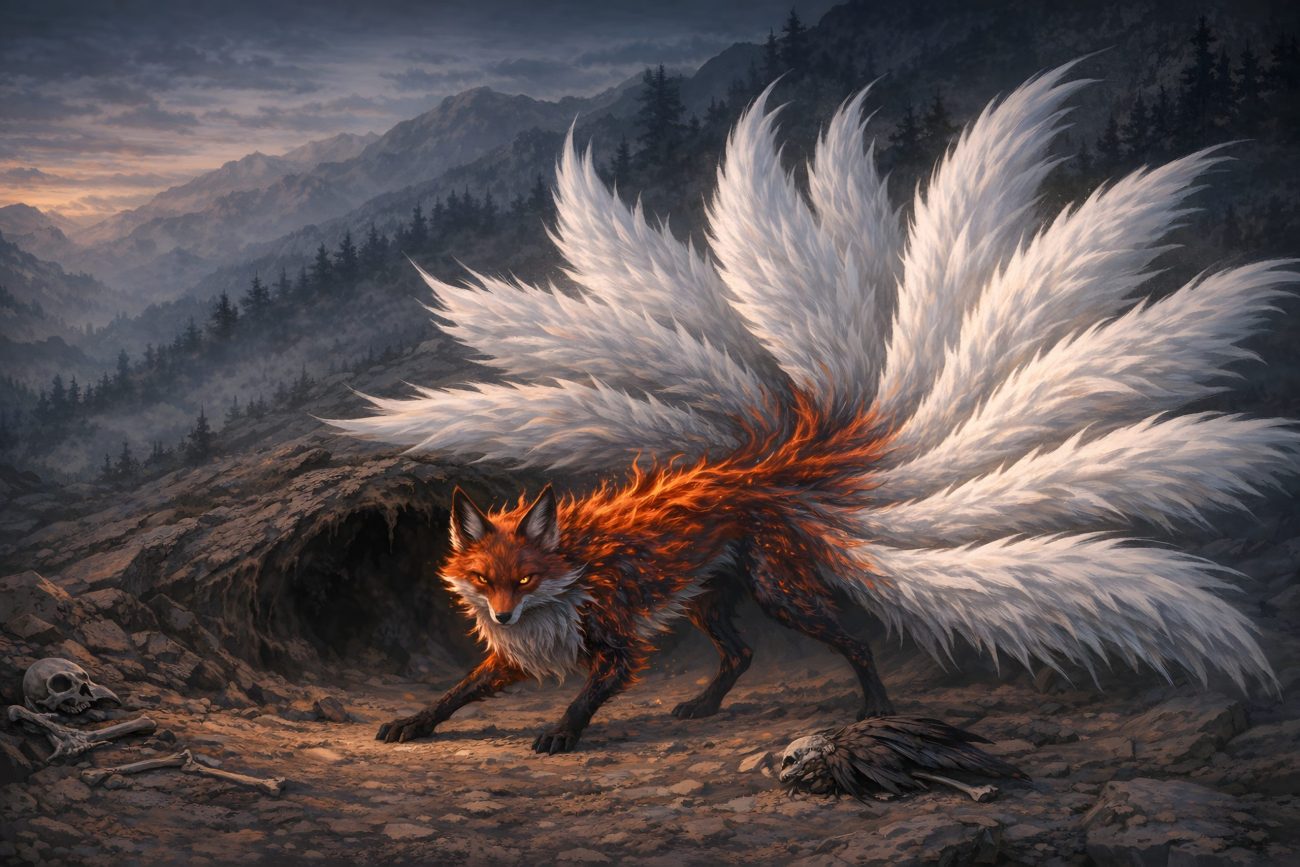
When he awoke, others told him what they had seen. He had wandered toward a hole by the roadside, thrusting his head inside while struggling as though something unseen held him. When the villagers examined the hole, they found it filled with countless bones of chickens and other birds. The tunnel stretched deep into the earth, so far that no one could see its end.

People came to believe that the mysterious woman and the vanishing livestock were connected. The hole was said to be the dwelling of a fox spirit, and the woman herself its human form.

Soon afterward, a witness claimed to have seen the creature directly — a fox with a reddish body and eight tails, each tail shining white as snow. Word spread quickly, and the tale of the White-Haired Eight-Tailed Fox traveled far beyond the village. Some even spoke of organizing a hunt to capture the strange fox alive.

Thus the spirit of the mountain path was remembered as a fox of great age and power, appearing as a beautiful woman by twilight and returning to the earth by night, leaving only bones and rumors behind.


Sources

Tyz-Yokai Blog. (n.d.). Hakumō Hachibi Kitsune. Retrieved March 1, 2026, from https://tyz-yokai.blog.jp/archives/1040562430.html.


Akaeri

Tradition / Region: Japanese Mythology
Alternate Names: Aka-eri
Category: Fox


The Myth

Near Sendasuka Nishi on Chiejima Island there once lay a deep and gloomy body of water known as Dongan Pond. Willow trees leaned over its banks, bamboo thickets surrounded it, and the surface of the water shone a murky blue-black. People already whispered that kappa and raccoon dogs haunted the place.

Around the Taishō period, another rumor spread.

A strange being called Akaeri was said to live in the bushes near the pond. Those who claimed to see it described a creature about the size of a ten-year-old child, with a red body and the features of a fox. Yet what made it most unsettling was not its shape, but its posture.

Akaeri did not skulk or creep like an animal. It sat at the edge of the thicket facing the pond, legs crossed and back straight, like a person quietly resting. From a distance it looked almost human, but the red body and fox-like face betrayed its true nature.

The sight of it was so eerie that schoolchildren walking from Nishichiejima to the elementary school avoided the pond entirely, choosing longer routes rather than pass near the bushes. Workers traveling nearby also spoke of it. One plasterer returning each day would say that a strange red creature sat there again, unmoving, watching the water.

Whether it was spirit, fox, or something else, the figure remained part of the pond’s reputation. And long after the stories faded, people still remembered Dongan Pond as a place where something red once sat silently at the water’s edge, waiting in the reeds.


Sources

Tyz-Yokai Blog. (n.d.). Akaeri. Retrieved March 1, 2026, from https://tyz-yokai.blog.jp/archives/1013136220.html.


Zhu Nuo

Tradition / Region: Chinese mythology
Alternate Names: Guan Guan, Crested Beast
Category: Fox


The Myth

In the mountains described in ancient records, there was said to live a strange creature known as the Crested Ibis Beast.

It was shaped like a fox, but its body was not entirely of the land. From its sides grew wings like those of a fish, strange and otherworldly, as though it belonged partly to the waters as well as the mountains. The creature dwelled in barren places where few trees grew, among blue waters and rocky slopes where great snakes also lived.

When it cried out, it spoke its own name. The sound carried far across the mountains, and people believed that when this call was heard, unrest and fear would soon spread through the land. Its appearance was taken as an omen, a sign that something troubling was about to happen.

Thus the fox-winged beast of the mountains was remembered as a herald of disturbance — a creature neither wholly of sky nor earth, whose voice alone could unsettle a country.


Sources

Wikipedia contributors. (n.d.). 朱獳. In Wikipedia. Retrieved March 1, 2026, from https://zh.wikipedia.org/wiki/%E6%9C%B1%E7%8D%B3.


Ginko

Tradition / Region: Japanese Mythology
Alternate Names: Gingitsune
Category: Fox


The Myth

In forests, fields, mountains, and around temples, there are said to dwell rare fox spirits known as Ginko, the Silver Foxes.

Their fur shines pale like moonlight, and they move quietly through the night as messengers of the goddess Dakini. Unlike wandering fox spirits that trick or deceive, the Ginko are counted among the holy foxes. They are pure beings who serve in the unseen world and carry out the will of their divine mistress.

People say the Silver Foxes embody the power of the moon. Just as the moon reflects light in darkness, the Ginko guide the hidden paths of the night and protect sacred places. They are often spoken of together with their counterparts, the Golden Foxes, who represent the sun. Where one brings the light of day, the other carries the calm glow of night.

Among the sacred fox clans, the Ginko belong to the families of benevolent spirits who dwell close to temples and holy grounds. They are not feared but respected, for they move between the human world and the divine.

Thus the Silver Fox is remembered as a fox of moonlight — a quiet, shining presence in the night, walking the boundaries of shrine and forest in service to the gods.


Gallery


Sources

yokai.com. (n.d.). Ginko. Retrieved March 1, 2026, from https://yokai.com/ginko/?srsltid=AfmBOoq1PBcCaFpbBaPtig5_luguQBQFZxsRhvuLNZmnnO2Xfm_DjteL


Interpretive Lenses

Religious Readings
  • Christian Ascetic Deep Dive
Philosophical Readings
  • Nietzschean Deep Dive
Psychological Readings
  • Jungian Deep Dive
Esoteric Deep Dive
  • Hermetic Deep Dive
Political / Social Readings
  • Marxist Deep Dive

Reynard

Tradition / Region: English Mythology
Alternate Names: Reinaert, Renart, Reinhard
Category: Fox


The Myth

In the tales told across the courts and villages of medieval Europe, there lived a fox named Reynard, cleverer than any other creature in the land.

Reynard lived in a world where animals spoke, ruled, and judged one another like humans. Lions sat as kings, bears served as courtiers, wolves acted as lords and rivals. Among them all, Reynard was known for his sharp tongue and sharper mind. He relied not on strength, but on wit, always seeking advantage through cunning schemes.

Again and again he deceived the other animals. He tricked them out of food, wealth, and honor, and when they gathered to punish him, he found ways to twist the truth or invent stories that spared him. His greatest enemy was his uncle, the wolf Isengrim, whom Reynard humiliated many times through trickery and false promises.

Often the animals brought complaints before the king’s court, demanding justice. Reynard was summoned repeatedly to answer for his misdeeds, yet each time he spoke so cleverly that punishment slipped from him. Sometimes he blamed others, sometimes he spun tales of hidden treasures or secret dangers, and sometimes he escaped entirely before judgment could fall.

Though many despised him, others admired his intelligence and daring. His stories spread across many lands, and in each telling he remained the same — a fox who could not be easily caught, living by wit in a world where strength ruled.

Thus Reynard became known throughout Europe as the fox who outwitted kings and beasts alike, a figure of mischief and cunning whose adventures were told wherever people gathered to laugh at the follies of the powerful.


Sources

Wikipedia contributors. (n.d.). Reynard the Fox. In Wikipedia. Retrieved March 1, 2026, from https://en.wikipedia.org/wiki/Reynard_the_Fox.


Hakuzōsu

Tradition / Region: Japanese Mythology
Alternate Names: Hakuzosu, Hakuzōsu the Fox-Priest
Category: Fox


The Myth

At a temple called Shōrin-ji in Izumi Province there once lived a poor priest named Hakuzōsu. He had little income and few visitors, and his life was one of quiet hardship. Hoping for divine aid, he prayed for seven days and seven nights before the altar of the Inari deity.

At the end of his prayers, a white fox suddenly leapt from the altar and curled up before him. Seeing this as a sign from the god, the priest took the fox in and cared for it. From that time on, fortune changed. Offerings began to arrive at the temple, and people came more often. It seemed that the fox had brought blessing with it.

The fox was no ordinary animal. It could take human shape and sometimes transformed into a warrior, guarding the temple and driving away bandits who threatened the grounds. It stayed close to the priest, as though bound to him by gratitude or divine purpose.

Yet there was danger nearby. Hakuzōsu had a nephew who was a hunter of foxes. Suspicious of the strange events at the temple, the man soon realized that the white fox sometimes took the form of his uncle. Determined to catch it, he used all the tricks of his trade to try to trap the creature.

Still, the fox remained elusive, shifting between forms and slipping away whenever danger came too near.

Stories of the fox-priest spread, and people said that descendants of the white fox lingered around the temple grounds long afterward, some even bearing the mark of three legs like their ancestor.

Thus Hakuzōsu was remembered as a fox who walked among humans in the robes of a priest — a creature of Inari’s favor, whose presence brought both blessing and mystery to the temple where he once dwelled.


Sources

Wikipedia contributors. (n.d.). Hakuzōsu. In Wikipedia. Retrieved March 1, 2026, from https://en.wikipedia.org/wiki/Hakuz%C5%8Dsu

yokai.com. (n.d.). Hakuzōsu. Retrieved March 1, 2026, from https://yokai.com/hakuzousu/?srsltid=AfmBOoqwM964QwrmicqVN43qzmMLevLPyJUwL0_eJzcEtCVma_AP0YLw


Firefox

Tradition / Region: Finnish Mythology
Alternate Names: Tulikettu, Tulirepo, Tulikko
Category: Fox


The Myth

Deep in the forests of the far north, and in the lonely wilderness where few people travel, there is said to live a rare and wondrous fox known as the Firefox.

By day it appears as a dark, almost black fox, slipping silently through the trees and hiding in remote dens where almost no one ever sees it. But when night falls, the creature reveals its true nature. Its tail begins to glow and sparkle, scattering fire-like light as it moves. Some say the sparks trail behind it, lighting the darkness as it runs across the snow.

Stories tell that when the fur of a Firefox is brushed in a certain way, it shines with a strange radiance, giving off a light unlike ordinary flame. Because of this, its hide was believed to be precious beyond measure. It was said that in earlier times, people used the leather of such a fox to illuminate dark storehouses safely, without the danger of open fire.

Hunters dreamed of encountering the Firefox, for capturing one was believed to bring wealth for the rest of their lives. Yet the creature lived far from human paths, hidden in the northern wilds, and very few ever claimed to have seen it.

Thus the Firefox remained a creature of distant forests and winter nights — a fox whose tail burned with light, glimpsed only by the fortunate or the lost beneath the northern sky.


Sources

Wikipedia contributors. (n.d.). Firefox (mythology). In Wikipedia. Retrieved March 1, 2026, from https://en.wikipedia.org/wiki/Firefox_(mythology)