Gargouille

Tradition: French Mythology
Alternative Names: La Gargouille, Goji, Gargoyle
Category: Dragon


The Myth

Gargouille was a terrible dragon that terrorized the countryside around Rouen. It had the appearance of a typical Western European dragon, with bat-like wings, a long neck, and the ability to breathe fire.

The monster was eventually confronted by Saint Romanus, the bishop of Rouen. In one version of the legend, Saint Romanus subdued Gargouille with a crucifix. In another, he captured the beast with the help of a condemned man who was the only person brave enough to volunteer.

The saint then led the captured dragon back to Rouen. There, the people burned the monster, but its head and neck refused to be consumed by the flames. Having been hardened by its own fiery breath, these parts of Gargouille survived the fire.

The surviving head and neck were mounted upon the walls of Rouen Cathedral. The monstrous remains were said to protect the church from evil spirits, transforming the defeated dragon into a guardian of the sacred building.


Sources

“Gargoyle.” Wikipedia: The Free Encyclopedia. Wikimedia Foundation. Accessed October 3, 2026.
https://en.wikipedia.org/wiki/Gargoyle


Velue

Tradition: French Mythology
Alternative Names: Velue, Peluda, “The Shaggy One,” “The Hairy One”
Category: Dragon, Turtle


The Myth

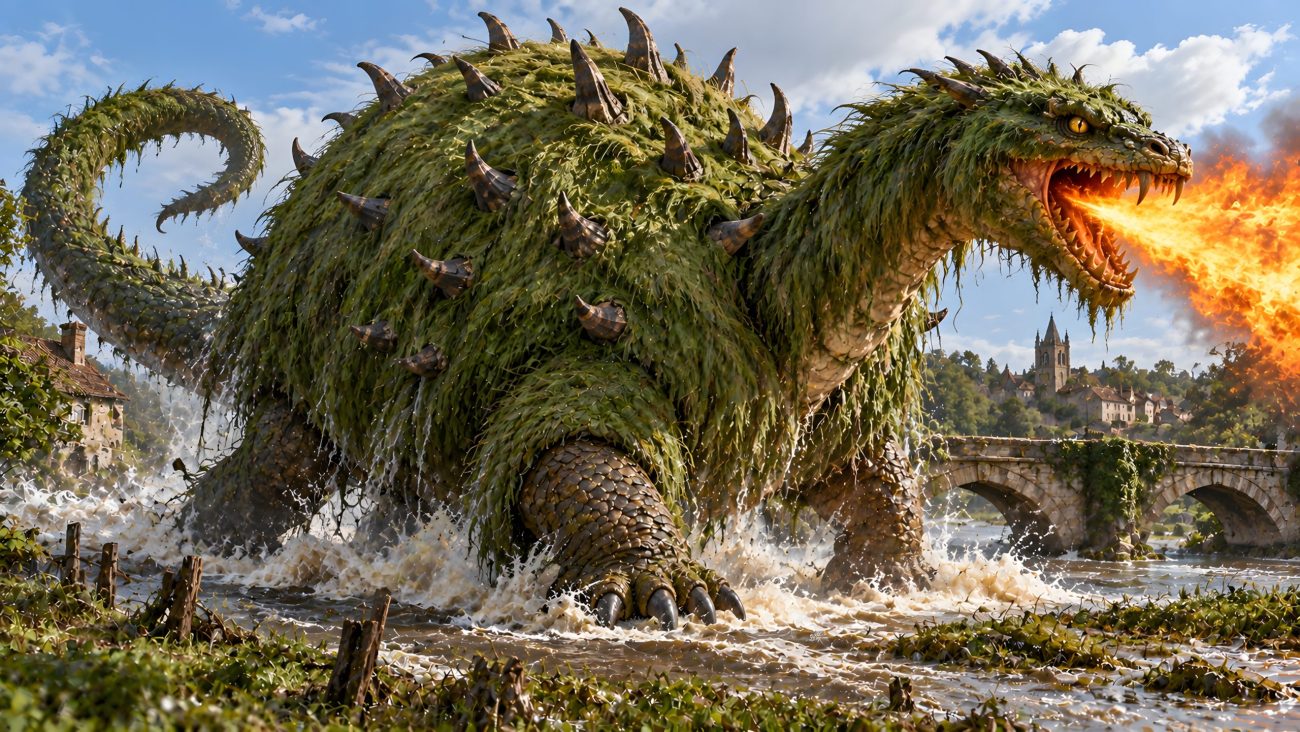
The Velue, whose name means “the shaggy one” or “the hairy one,” was a monstrous dragon said to haunt the Huisne River near La Ferté-Bernard in the Sarthe. Its body was enormous and egg-shaped, roughly the size of a large ox, and covered entirely in shaggy green fur. Sharp spikes protruded from its hairy hide, while its head resembled that of a terrifying serpent. Its immense legs were compared to those of a tortoise, and behind it dragged a powerful serpentine tail capable of killing a man or beast with a single sweep.

The Velue was said to have survived the biblical Flood after being overlooked by Noah. Having escaped the destruction of the world, the creature supposedly carried a grudge against creation and devoted the rest of its existence to destruction and spite.

It breathed fire and laid waste to farms, fields, and crops around the Huisne. Flocks of sheep disappeared down its enormous jaws, with their shepherds sometimes following them as the dragon’s dessert. Walls and moats offered little protection. The Velue was bold enough to enter the streets of the old city itself, terrifying the inhabitants and spreading destruction wherever it went.

Whenever people tried to drive it away, the monster retreated into the Huisne. Its gigantic body displaced so much water that the river overflowed its banks, flooding the surrounding countryside and ruining the fields. The dragon could therefore destroy the land whether it was upon the riverbank or beneath the water.

Women and children were said to be among the Velue’s favorite prey, and it possessed a particular appetite for agnelles, the “she-lambs” of the land—the beautiful and virtuous young women of La Ferté-Bernard. This taste eventually brought about its downfall.

After the Velue seized a young maiden and devoured her, her fiancé set out in pursuit of the monster. He followed its trail to its lair beneath an ivy-covered bridge over the Huisne. There he confronted the beast and struck at its vulnerable tail with his weapon. The blow killed the Velue instantly, bringing an end to the creature that had terrorized the countryside. Its death was celebrated throughout the region.

The story belongs to the tradition of French local dragons such as the Tarasque. Its surviving form is relatively recent: its foundations appear to reach back to the fifteenth century, while the tale was revived and considerably expanded during the nineteenth century. It never developed the major festivals or fixed iconographic traditions associated with some better-known French dragons, although a terracotta fountain sculpture dating from the seventeenth or eighteenth century, discovered in a ditch along the road to La Chapelle-Saint-Rémy, is considered the oldest surviving depiction associated with the Velue.

The association between the Velue and the word agnelles may itself preserve an older local joke. During the sixteenth century, La Ferté-Bernard sided with the Catholic League during the wars of Henri IV. Its governor, Dragues de Comnène, claimed descent from eastern kings and was known for his cunning. During a siege commanded by René de Bouillé, he sent soldiers out of the city disguised as women. The deception nearly succeeded when some of the besiegers approached the apparent damsels gallantly, only to discover that they were walking into an ambush. René de Bouillé’s forces eventually drove the disguised soldiers away, and the incident delighted Henri IV. It gave rise to jokes about the “agnelles de la Ferté“—the “she-lambs of La Ferté”—of whom, as the saying went, only two were needed to strangle a wolf.

The creature is sometimes called Peluda, but this name is a later Spanish rendering of the French Velue. Its popularity as a name for the monster owes much to Jorge Luis Borges, and it is not an original Occitan name for the dragon.


Sources

“Velue.” A Book of Creatures. January 18, 2019. https://abookofcreatures.com/2019/01/18/velue/


Rô Beast

Tradition: French Mythology
Alternative Names: Rô, Beast of Rô
Category: Dragon


The Myth

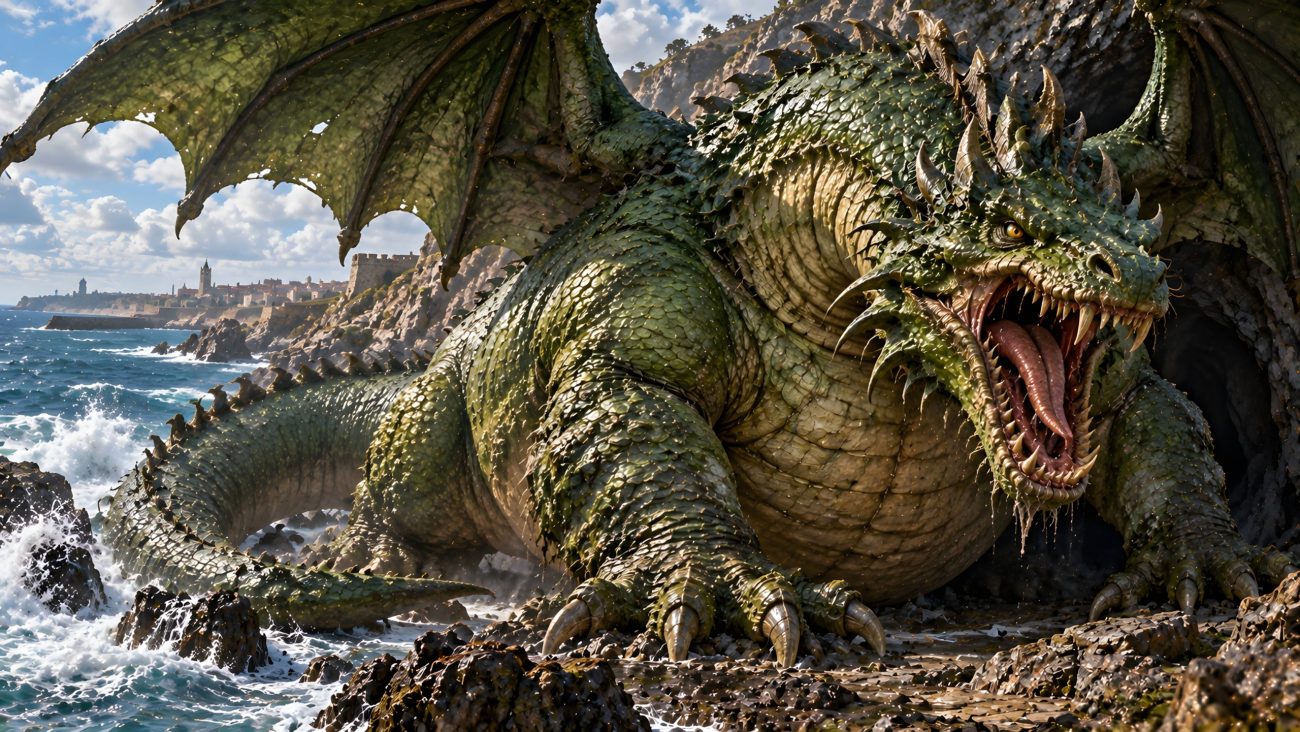
The Rô Beast was a hideous dragon with a winged body and a long, scaly tail. It possessed a malign intelligence almost like that of a human, using its cunning to set traps for people and devour them. The creature lived in a cavern at the Pointe de Roux near Aytré, off La Rochelle, and its terror spread throughout the surrounding coastline. No one was able to stand against it.

The reign of the Rô Beast finally ended when seven pagan heroes arrived by boat on the rising tide. They had come specifically to judge the monster. When Rô saw them approaching, it panicked and retreated toward the Pont de la Pierre, keeping its eyes fixed upon the seven figures who pursued it.

There the heroes attacked. They loosed seven arrows at the dragon, each one intended to seal away a part of its terrible senses. Two arrows struck and closed its eyes, two pierced and blocked its ears, two sealed its nostrils, and the final arrow pinned its monstrous mouth shut.

Rô roared and thrashed in agony, but the heroes cast the helpless beast into a deep pit. There it was condemned to remain until the end of time. The seven heroes then took their places around the pit, becoming eternal guardians who watched over the imprisoned dragon.

Yet Rô was never truly silent. The beast still lives within its prison, screaming and howling with rage. Its cries are said to stir the surrounding sea. When Rô howls toward the north, the Gulf of Chevarache in the Breton Pertuis becomes agitated with waves. When it turns its fury toward the south, the waters of Maumusson begin to stir. The old people feared what might happen if the imprisoned beast ever turned its voice toward the west, for then, they said, the islands themselves would be reduced to dust.

The landscape around the legend became bound to the story. The Pont de la Pierre was once associated with a ruined cromlech, while seven granite stones surrounding a deep pit were regarded as the seats of the seven heroes who had judged Rô. An image resembling the beast was also recognized in the arch of the principal portal of the Church of Talmont, although the figure may instead represent the lion of Ezekiel.

The seven mysterious heroes remain an equally ancient part of the legend. Their arrival from the sea evokes warriors such as Vikings, while the tale may preserve the memory of an older Gaulish tradition in which divine or heroic figures came from across the sea. The name Rô itself has likewise been interpreted as possibly preserving the corrupted name of an older pagan deity.


Sources

“Ro.” A Book of Creatures. May 14, 2021. https://abookofcreatures.com/2021/05/14/ro/


Lou Carcolh

Tradition: French Mythology
Alternative Names: Carcolh, The Carcolh
Category: Dragon, Mollusc


The Myth

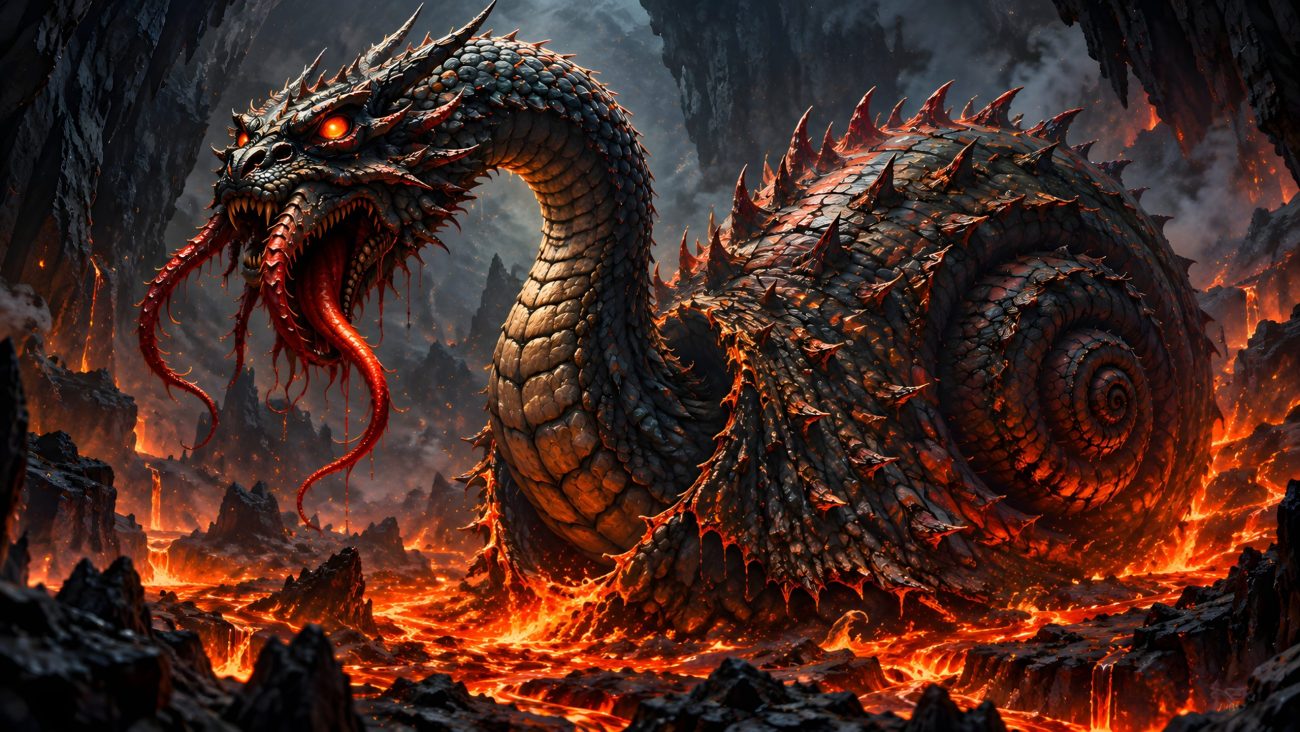
Lou Carcolh is a gigantic, slimy creature resembling a monstrous serpent combined with a snail. It has a huge shell upon its back and long, hairy tentacles capable of reaching far beyond its body. The creature is said to dwell in a cavern beneath Hastingues in the Landes of southwestern France.

The Carcolh’s approach could be detected before the beast itself appeared. A trail of thick slime would sometimes be seen stretching through the landscape, announcing that the enormous creature was drawing near. Its long tentacles were its most dangerous weapon. Hidden within or near its cavern, the Carcolh could stretch them out over a great distance, seize an unsuspecting person, and drag them back into its lair without ever revealing itself.

Hastingues itself became closely associated with the monster. The town sits upon a rounded hill, giving it the nickname “the Carcolh,” while local men were said to warn young and beautiful women with the ominous words that the Carcolh would catch them.


Sources

“Lou Carcolh.” Wikipedia: The Free Encyclopedia. Wikimedia Foundation. Accessed October 2, 2026. https://en.wikipedia.org/wiki/Lou_Carcolh


Guivre

Tradition: French Mythology
Alternative Names: Guivre, Givre, Vouivre
Category: Dragon


The Myth

The Guivre is a long, serpentine dragon with a dragon’s head and, in some descriptions, horns upon its forehead. Its hind legs are barely visible or may be absent altogether, giving the creature the appearance of an enormous serpent. Guivres were said to possess venomous breath and were notoriously aggressive, sometimes attacking people without provocation. They dwelled in pools and lakes, forests, and other damp places throughout the French countryside.

Yet the Guivre had a strange weakness: it was said to fear naked human beings. When confronted with one, the fierce creature would blush and turn its head away.

One of the most unusual tales surrounding the creature concerns Samson of Dol and Saint Suliao. Samson had come to visit Suliao with a group of followers. Suliao was poor and could offer his guests little food, but he did what he could to provide them with a meal.

One of the priests accompanying Samson was dissatisfied with the humble food. He secretly took a bread roll and hid it beneath his robe. Almost immediately, the man began to convulse. Suliao pulled open his robe to discover the terrible cause: a hideous little serpentine creature, the Guivre, had somehow emerged in connection with the stolen bread.

Suliao rebuked the priest and seized the creature. He exorcised it and then ordered another man to carry it to the roof of a building in Garot and throw it down, casting the monstrous serpent away.

The Guivre is also closely associated with the name Vouivre, and the two names can describe the same creature. In other French traditions, however, the Vouivre takes on a more distinctive form. In the tales of Franche-Comté, it is described as an enormous serpentine dragon carrying a ruby upon its forehead, the precious stone serving as its eye.

Other traditions give the Vouivre a female form, with dazzling green scales that produce a sound as she flies. She is depicted as greedy and associated with precious treasures, wearing pearls upon her head and a golden ring around her tail. She spends most of her time hidden inside a cave, emerging only briefly to bathe.


Sources

“Guivre.” Wikipedia: The Free Encyclopedia. Wikimedia Foundation. Accessed September 26, 2026. https://en.wikipedia.org/wiki/Guivre


Grand’Goule

Tradition: French Mythology
Alternative Names: Grand’Goule, Grande Gueule, Bonne Sainte Vermine
Category: Dragon


The Myth

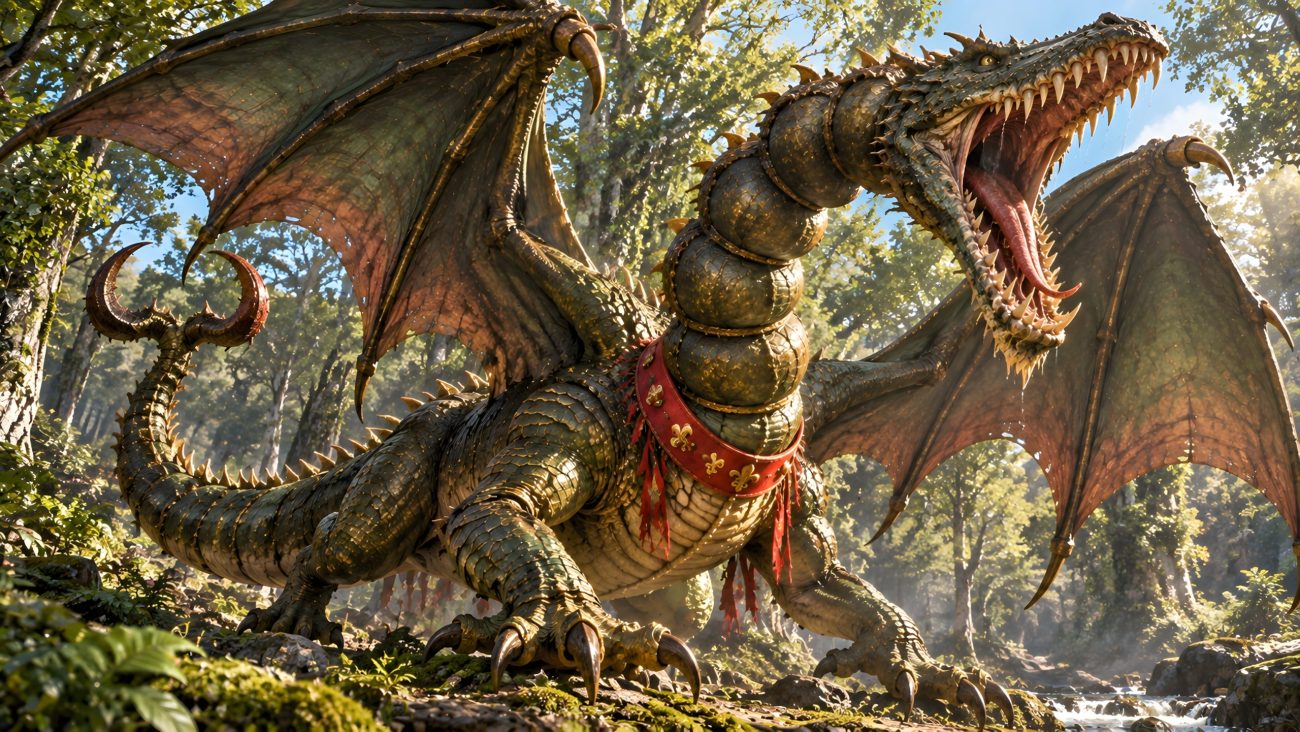
The Grand’Goule was a monstrous dragon with bat-like wings, a huge gaping mouth, hooked claws, and a forked stinger like that of a scorpion. Its body was bronze-green, with a red collar around its neck, and its enormous jaws gave it the name Grand’Goule, derived from grande gueule, meaning “great gullet” or simply “big mouth.”

The dragon terrorized the city of Poitiers until it was finally slain. Saint Radégonde of Poitiers is said to have destroyed the creature through fervent prayer. Her prayer became almost a weapon in itself, flying through the air like a projectile and striking the dragon with the force of a crossbow bolt.

The beast’s death is also remembered through the tale of a condemned criminal who volunteered to kill it in exchange for his life. He succeeded in bringing the monster down, but its poisonous breath killed him at the very moment of his triumph.

The Grand’Goule was not remembered solely as a monster. On rogation days it was brought out and carried in procession alongside the relic of the True Cross. Ribbons and banderoles adorned its great body, and people treated the dragon with a curious mixture of reverence and affection. Cherries, tarts, and pastries were thrown directly into its enormous mouth, including the golden-brown casse-museaux, “snout-breakers.” Because of this strange role as a beloved sacred monster, the Grand’Goule came to be affectionately known as the Bonne Sainte Vermine, the “Good Holy Vermin.”

Stories of the creature continued to be associated with a physical relic in Poitiers. The Scotsman John Lauder described seeing the remains of a hideous crocodile-like beast with a gigantic mouth, chained to a wall in a palace. It was said to be centuries old and to have killed several prisoners before a condemned man shot it and won his freedom. The claim that the creature had spontaneously generated from rotting matter in the prison was already met with doubt, but the monstrous remains themselves were treated as a relic of the old Grand’Goule.


Sources

“Grand’Goule.” A Book of Creatures. April 23, 2021. https://abookofcreatures.com/2021/04/23/grandgoule/


Drac

Tradition: French Mythology
Alternative Names: Drac de Beaucaire, Invisible Demon
Category: Dragon


The Myth

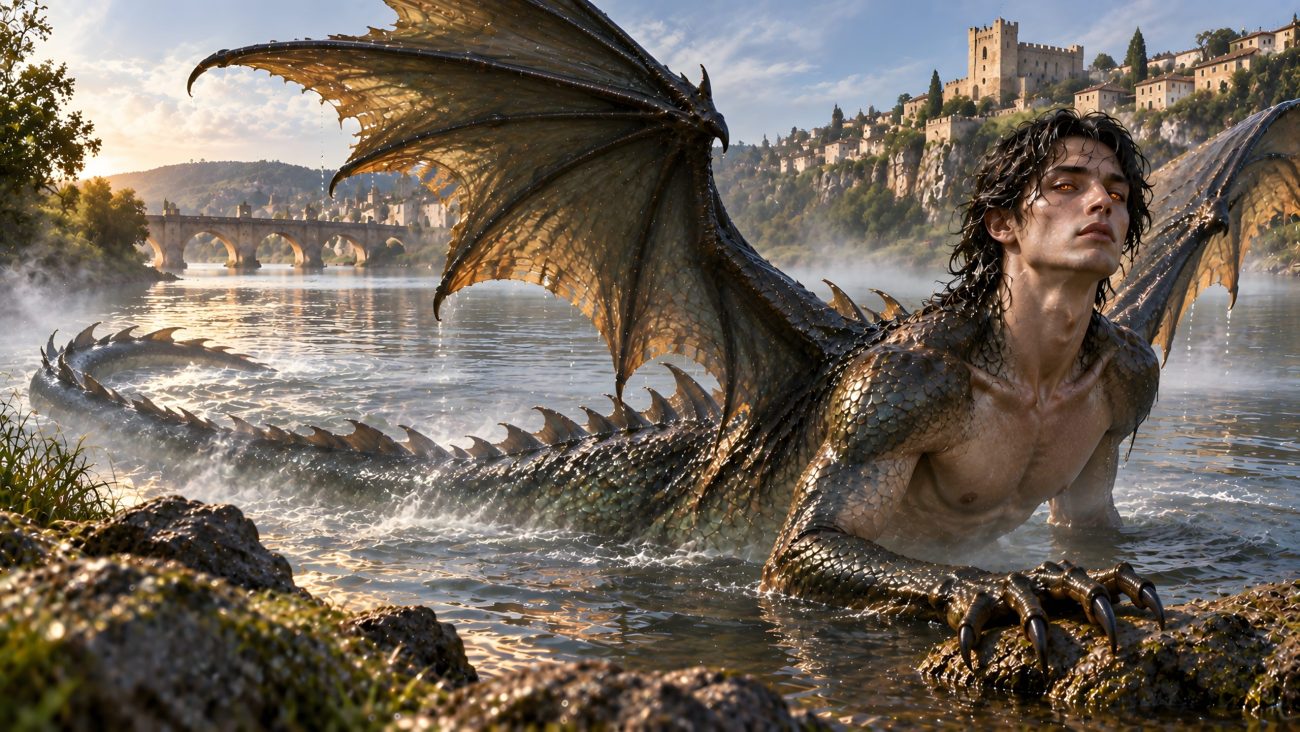
The Drac is a malevolent water dragon that haunts the Rhône River around Beaucaire. Its appearance can vary, but it is described as a winged amphibious creature with a reptilian body and the shoulders and head of a beautiful young man. The Drac possesses the power to become completely invisible, making it almost impossible to see or capture.

The Drac lured people into the river with its soft and enchanting voice before dragging them beneath the water. It was said to have killed thousands of knights and villagers, yet its ability to disappear from sight allowed it to escape those who tried to hunt it.

One day, a young woman was washing the cloths of her newborn child beside the river when she noticed a golden cup decorated with a pearl floating upon the water. She reached out to take it, but suddenly fell into the river. An invisible claw seized her wrist, and she lost consciousness.

When she awoke, she found herself inside a crystal cave. She could no longer remember how she had arrived there, for the Drac’s magic had erased her memories. Captivated by the creature’s voice and eyes, she became subject to its will. The Drac had chosen her to care for his child, and she became its wet nurse.

Every night, she rubbed a special balsam onto the child’s eyes. The ointment allowed the child to see its invisible father. As she performed this task, some of the balsam entered her own eyes, giving her the ability to see the Drac as well.

Seven years passed. The Drac’s child grew up, and the woman was no longer needed. Rather than killing her, the Drac released her from his enchantment and returned her to the riverbank.

She eventually found her way home, where she discovered that her husband had grown old and that her own child had grown up without remembering her. Yet the love between them remained, and she gradually returned to her former life. Even after her return, however, she was troubled by frequent dreams of dragons.

One day, while walking through the marketplace, she suddenly saw the Drac. She cried out, and the creature realized that she could see him. The Drac asked whether she could see him, and she answered that she could.

It placed one claw over her left eye and then over her right. When the claw covered her right eye, she could no longer see the Drac. The creature then tore out her right eye. She spent the rest of her life telling people what had happened to her, but those who heard the story believed that she had become insane.


Sources

“Drac.” Dragons Wiki. Fandom. Accessed September 20, 2026. https://dragons.fandom.com/wiki/Drac


Bifron

Tradition: French Mythology
Alternative Names: Bifron
Category: Demon


The Myth

Bifron appears in the form of a monstrous creature. When he takes human form, he makes people knowledgeable in astrology and teaches them the secrets of geometry. He also knows the virtues of herbs, stones, and precious plants.

Bifron transports corpses from one place to another and can move the remains of the dead. He has also been seen lighting torches on the tombs of the dead.

Bifron commands twenty-six legions of demons.


Sources

Collin de Plancy, Jacques Albin Simon. Dictionnaire infernal: répertoire universel des êtres, des personnages, des livres, des faits et des choses qui tiennent aux apparitions, aux divinations, à la magie, au commerce de l’enfer, aux démons, aux sorciers, aux sciences occultes, etc. 4th ed. Paris: Chez Tous Les Libraires, 1845.


Farfadets

Tradition: French Mythology
Alternative Names: Fadets
Category: Demon, Gnome


The Myth

Farfadets are small supernatural creatures, sometimes only half a meter tall. They are described as wrinkled, brown-skinned beings who usually wear tattered brown clothing, although they may also go naked.

They live in woodlands but may attach themselves to a nearby farm or homestead. Farfadets are generally helpful rather than malicious, although they are playful and mischievous.

They are particularly fond of horses. They may secretly tend and groom them or weave ringlets into their manes. At farms, they perform small tasks in the fields during the night in return for a bowl of milk or cream left outside the house.

However, Farfadets can be driven away by excessive kindness. Leaving new clothes out for them, for example, may frighten them away.

In Provence and other parts of Occitania, similar creatures are known as fadets.


Sources

“Farfadet.” Wikipedia: The Free Encyclopedia. Wikimedia Foundation. Accessed September 9, 2026. https://en.wikipedia.org/wiki/Farfadet


Yan-gant-y-tan

Tradition: French Mythology
Alternative Names: Yan-gant-y-tan
Category: Demon


The Myth

Yan-gant-y-tan is a strange demon that wanders through the countryside of Finistère at night. He carries five candles, one burning on each finger of his right hand, and spins them around like a flaming wheel.

Because of the candles, Yan-gant-y-tan cannot turn quickly while walking, since doing so might extinguish their flames. His appearance is sometimes described as that of a wiry old troll or a hairy wild man, but the five burning candles on his hand distinguish him from other creatures of this kind.

Encountering Yan-gant-y-tan is considered an evil omen, particularly for travelers journeying at night. One way of avoiding his bad omen is to leave a small bag of gold or a gold chain around a travelers’ post. Yan-gant-y-tan will take the offering and leave the house alone for another day.

Despite his reputation as a bad omen, Yan-gant-y-tan can also appear to travelers who have no light and give them five candles, allowing them to find their way through the night.


Sources

“Yan-gant-y-tan.” Wikipedia: The Free Encyclopedia. Wikimedia Foundation. Accessed September 9, 2026. https://en.wikipedia.org/wiki/Yan-gant-y-tan