Axehandle Hound

Tradition / Region: American Mythology
Alternate Names: Axhandle Hound, Ax-handle Hound
Category: Dog


The Myth

Among the tall tales of the lumber camps of Minnesota and Wisconsin, woodsmen told of a strange and troublesome creature known as the Axehandle Hound.

The animal was said to resemble a dog, but its body was shaped like an axe. Its head formed a broad blade, while its long, straight body resembled the handle of a tool set atop short, stubby legs. Because of this strange shape, it moved in an awkward but determined way as it prowled through the forests at night.

The Axehandle Hound did not hunt animals for food. Instead, it lived on axe handles. Whenever a careless woodsman left his tool unattended outside a cabin or camp, the creature might come creeping in the dark. By morning, the handle would be chewed away, leaving only the useless metal head behind.

The hound was said to travel from camp to camp under cover of night, sniffing out wooden handles wherever they could be found. Loggers warned each other to keep their tools close, for once the creature found a camp rich in axes, it would return again and again.

Some believed there was one way to protect against it. Axe handles made from red oak were said to repel the beast, and camps that used them claimed to be left undisturbed.

So the Axehandle Hound became part of lumberjack lore — a strange dog-shaped spirit of the forest, wandering the logging roads in search of forgotten tools and leaving frustrated woodsmen in its wake.


Gallery


Sources

Wikipedia contributors. (n.d.). Axehandle hound. In Wikipedia, from https://en.wikipedia.org/wiki/Axehandle_hound


Interpretive Lenses

Religious Readings
  • Christian Ascetic Deep Dive
Philosophical Readings
  • Nietzschean Deep Dive
Psychological Readings
  • Jungian Deep Dive
Esoteric Deep Dive
  • Hermetic Deep Dive
Political / Social Readings
  • Marxist Deep Dive

Cursed Cow of Emerline Allen

Tradition / Region: American Mythology
Alternate Names:
Category: Cow


The Myth

Long ago in the United States there lived an old woman named Emerline Allen, feared among her neighbors for her power to lay spells upon cattle. People said that anyone who angered her might soon see misfortune fall upon their livestock.

One night, some villagers claimed to have seen Emerline working a spell against Grandma Parker’s cow. Not long afterward, the animal stopped giving milk. Each day it yielded only a single small cup, no matter how it was tended.

Grandma Parker was told of a way to break such a curse. She was to take the little milk the cow produced, set it to boil, and cut it with a knife. By doing this, the spell would be severed, and the one who cast it would be forced to come begging.

She followed the instructions exactly. Soon after, Emerline Allen appeared at her door, asking for bread. She promised that if she were given something to eat, the cow would recover. But Grandma Parker refused her request.

With nothing given, Emerline went away in pain, and people said she suffered greatly. From that time on, the cow’s milk returned, and it gave as much as before.

Later, Emerline tried again to seek help, begging others for small things, but no one would give her anything. Left without relief, she endured her suffering alone, while the cow remained healthy and the spell never returned.


Gallery


Sources

University of North Carolina at Chapel Hill, Folklore Council. (1948–1960). North Carolina Folklore, p. 307.


Interpretive Lenses

Religious Readings
  • Christian Ascetic Deep Dive
Philosophical Readings
  • Nietzschean Deep Dive
Psychological Readings
  • Jungian Deep Dive
Esoteric Deep Dive
  • Hermetic Deep Dive
Political / Social Readings
  • Marxist Deep Dive

Water Babies

Tradition / Region: Paiute Mythology, American Mythology
Alternate Names: Paakniwat, Pa’oha’a, Pā’ōna, Paohmaa, Pangam kiktam, Pa’-nawi-s, Pa-nugis, Para Ub, s’o:lmexw; Water-Baby Spirits
Category: Mermaid


The Myth

In springs, quiet pools, and lonely streams of the western lands, people tell of beings called Water Babies. They are small spirits who dwell where water rises from the earth, rarely seen but often heard.

Most often they appear as human infants — tiny, beautiful, and helpless-looking. Sometimes, however, they are said to have fish tails, or strange reptilian bodies, and only imitate the cries of a child. Their voices echo from reeds, from rock pools, or from the dark mouth of a spring, sounding exactly like a lost baby wailing in distress.

Those who hear the crying are warned not to go searching for it. In many traditions, the sound itself is a sign that death is near, a warning carried on the water. In others, the danger comes from pity: anyone who follows the cry and tries to pick up the unseen child may be seized by the spirit, pulled into the water, or struck by misfortune soon after.

Because of this, the cries of Water Babies are feared. They are the voices of the springs themselves — calling, mourning, and luring — and wise people turn away from the sound and leave the waters undisturbed.


Gallery


Sources

native-languages.org contributors. (n.d.). Water Babies. In native-languages.org, from https://www.native-languages.org/water-babies.htm


Interpretive Lenses

Religious Readings
  • Christian Ascetic Deep Dive
Philosophical Readings
  • Nietzschean Deep Dive
Psychological Readings
  • Jungian Deep Dive
Esoteric Deep Dive
  • Hermetic Deep Dive
Political / Social Readings
  • Marxist Deep Dive
Other
  • How to Invite The Water Babies

Nibiinaabe

Tradition / Region: Anishinabe Mythology, American Mythology
Alternate Names: Nibinabe, Nibanaba, Nibanabe, Nibiinaabeg (plural), Nibiinabekwe (female form)
Category: Mermaid


The Myth

In the lakes and rivers of the Anishinaabe lands live the Nibiinaabe, the water people.

They are shaped like human beings from the waist up, but below they bear the tail of a fish. They dwell beneath the surface of deep waters, moving silently through reeds and currents where the light fades into shadow.

The Nibiinaabe are seldom seen. At times, a ripple in still water or a fleeting shape beneath the surface is said to be one of them watching. They are not drawn to villages, nor do they linger near busy shores. Loud noises drive them away, and the crash of drums or shouting will send them retreating into the depths.

Some say that on quiet evenings, when mist lies low over the water, they rise near the surface and sing softly to one another in voices that blend with the sound of waves against the shore.

Among the Ojibwe, the Nibiinaabe are honored as a clan symbol. The Mermaid Clan bears their name, and their totem remembers these beings of the water—guardians of lakes and rivers, neither wholly human nor wholly fish, but belonging to the living spirit of the waters themselves.


Gallery


Sources

native-languages.org contributors. (n.d.). Nibiinaabe. In native-languages.org, from https://www.native-languages.org/nibiinaabe.htm


Interpretive Lenses

Religious Readings
  • Christian Ascetic Deep Dive
Philosophical Readings
  • Nietzschean Deep Dive
Psychological Readings
  • Jungian Deep Dive
Esoteric Deep Dive
  • Hermetic Deep Dive
Political / Social Readings
  • Marxist Deep Dive
Other
  • How to Invite The Nibiinaabe

Ne Hwas

Tradition / Region: Wabanaki Mythology, American Mythology
Alternate Names: Nehwas, Newas, Niwah
Category: Mermaid


The Myth

In the waters of the Passamaquoddy homeland, there is a spirit remembered as Ne Hwas—a being of river and sea, half woman and half fish, moving between the world of people and the deep places beneath the surface.

One story tells of two young girls who wandered too close to the water’s edge. They were drawn by the shimmer of the tide and the distant singing that seemed to rise from beneath the waves. Whether through curiosity, longing, or enchantment, they entered the water—and did not return as they had been.

When they were seen again, it was in the currents. Their bodies had changed. From the waist down, they bore the glistening tails of fish. Their hair flowed around them like riverweed, and their voices carried strangely across the water. They were no longer bound to the shore.

Some say they had become spirits of the water, Ne Hwas, belonging now to the hidden world beneath the surface. They swam through inlets and along rocky coasts, appearing at times to fishermen or children who lingered near the tide pools. They were not cruel, but neither were they fully human anymore. The water had claimed them.

Those who glimpsed them told of sadness in their eyes, as though they remembered the warmth of the land but could never quite return to it. And so their story remained—a warning and a wonder—about the deep waters, and how those who step too far into their mystery may find themselves changed forever.


Gallery


Sources

native-languages.org contributors. (n.d.). Ne Hwas. In native-languages.org, from https://www.native-languages.org/ne-hwas.htm


Interpretive Lenses

Religious Readings
  • Christian Ascetic Deep Dive
Philosophical Readings
  • Nietzschean Deep Dive
Psychological Readings
  • Jungian Deep Dive
Esoteric Deep Dive
  • Hermetic Deep Dive
Political / Social Readings
  • Marxist Deep Dive
Other
  • How to Invite The Ne Hwas

Lumpeguin

Tradition / Region: Wabanaki Mythology, American Mythology
Alternate Names: Lampeqin, Lampekwin, Lumpegwen, Lumpeguinuwok (plural)
Category: Mermaid


The Myth

In the rivers and coastal waters of Wabanaki lands dwell the Lumpeguin, small and powerful water spirits. Some say they appear as little people with shining eyes and long hair dripping with river water. Others say they are like tiny mermaids, with human faces and fish tails flashing silver beneath the surface. They move easily between water and shore, belonging fully to neither.

The Lumpeguin are beings of quiet magic. They can multiply food from almost nothing. A scrap of bread may become a feast in their hands. A handful of snow may be baked into warm loaves. Some carry enchanted pots that never empty, feeding those they favor. Their gifts, however, are never given lightly.

Like many nature spirits, a Lumpeguin’s power is bound to a magical garment—an article of clothing that allows them to move between worlds. If that garment is stolen, the Lumpeguin falls under the power of the thief. In old tales, men—and sometimes even animals—have hidden these garments and forced Lumpeguin women to remain on land as wives. Though they may live for a time among humans, their hearts remain with the water. If they ever recover their hidden clothing, they return at once to the rivers and are never seen again.

One tale tells of two Lumpeguin sisters who were captured in this way by Marten, a clever forest being. He hid their magical garments and claimed them as wives. The sisters lived with him, but they did not forget who they were. Through patience and cunning, they eventually regained their garments and set off on journeys of their own, traveling through forest and water alike, neither fully captive nor fully free until they reclaimed their power.

The Lumpeguin remind those who hear their stories that the spirits of the rivers cannot be possessed without consequence. Water gives life and sustenance, but it belongs first to itself. Those who try to bind it may hold it for a while—yet in the end, it always slips back to its own depths.


Gallery


Sources

native-languages.org contributors. (n.d.). Lumpeguin. In native-languages.org, from https://www.native-languages.org/lumpeguin.htm


Interpretive Lenses

Religious Readings
  • Christian Ascetic Deep Dive
Philosophical Readings
  • Nietzschean Deep Dive
Psychological Readings
  • Jungian Deep Dive
Esoteric Deep Dive
  • Hermetic Deep Dive
Political / Social Readings
  • Marxist Deep Dive
Other
  • How to Invite The Lumpeguin

Sabawaelnu

Tradition / Region: Micmac Mythology, American Mythology
Alternate Names: Sapowanilnu, Sapoqwanilnu; Halfway People
Category: Mermaid


The Myth

In the rivers, coves, and ocean inlets of Mi’kmaq lands live the Sabawaelnu—the Water People. They are called the Halfway People because they are neither fully human nor fully fish. From the waist up they appear as men and women, with long hair that flows like currents in the tide. From the waist down they bear the powerful tail of a fish, swift and strong in the water.

They dwell beneath the waves, in places where the water turns dark and green and deep. Sometimes they rest among kelp forests that sway like underwater trees. Sometimes they gather near rocky shores where the sea breathes in and out with the tide.

The Sabawaelnu are masters of storms. When the wind rises suddenly and the waves grow sharp and angry, it is said that the Water People are moving beneath the surface. A flick of a tail can churn the sea. A song rising from the depths can call the clouds together.

Yet they are not wicked spirits. They do not trouble those who honor them. Fishermen who greet the waters with respect, who never mock the sea or boast against it, are left unharmed. Some elders say that if you listen carefully to the wind over the water, you can hear the Sabawaelnu singing. Their songs carry warnings—of coming rain, of shifting winds, of dangerous tides.

Those who understand the meaning hidden in their voices can prepare before the storm arrives.

On calm evenings, when the surface of the water lies smooth as glass, a watcher might glimpse a shape moving just below. A pale arm breaking the surface. A dark head slipping between the swells. Then nothing—only ripples spreading outward.

They are the people of the water, halfway between worlds, powerful and watchful. The Sabawaelnu remind all who live near the sea that the waters are alive, and that respect is the price of safe passage.


Gallery


Sources

native-languages.org contributors. (n.d.). Sabawaelnu. In native-languages.org, from https://www.native-languages.org/sabawaelnu.htm


Interpretive Lenses

Religious Readings
  • Christian Ascetic Deep Dive
Philosophical Readings
  • Nietzschean Deep Dive
Psychological Readings
  • Jungian Deep Dive
Esoteric Deep Dive
  • Hermetic Deep Dive
Political / Social Readings
  • Marxist Deep Dive
Other
  • How to Invite The Sabawaelnu

Buffalo Woman

Tradition / Region: Pawnee mythology, American Mythology
Alternate Names:
Category: Cow, Hybrid


The Myth

In the earliest days, when the Pawnee still wandered and lived on roots and wild plants, a strange woman appeared at dusk near their gambling grounds. She moved in silence, her body wrapped in a covering that hid her hair, and she passed through the place where the people played before vanishing over the hills.

The next morning, her tracks were found—but they were not human footprints. They were the split hooves of an animal. Still, the people continued their games.

On another evening, the woman returned. This time she ran across the gambling ground and circled it. As she fled over the hills, a man saw her transform before his eyes into a buffalo. He pursued her for many days, until he reached a place where there was nothing but water. There, exhausted, he lost consciousness.

When he awoke, the Buffalo Woman touched him and led him into a lodge. Inside sat four ancient men, the gods of the west. They told him that the buffalo were being given to the people so they might live. They taught him how the buffalo were to be prepared and honored, showing him that the heart and tongue were sacred and must be offered in gratitude. They also entrusted him with seeds—corn, beans, squash, and tobacco—tied in buffalo hide, gifts meant to sustain the people.

Thus the Buffalo Woman was revealed as a messenger between worlds. She crossed between human and animal, bringing food, life, and sacred instruction. From that time on, the Pawnee lived by the buffalo and honored the western gods first in their offerings, remembering the woman who came at dusk and changed the fate of the people.


Gallery


Sources

Dorsey, G. A. (1906). The Pawnee Mythology (Part I).


Interpretive Lenses

Religious Readings
  • Christian Ascetic Deep Dive
Philosophical Readings
  • Nietzschean Deep Dive
Psychological Readings
  • Jungian Deep Dive
Esoteric Deep Dive
  • Hermetic Deep Dive
Political / Social Readings
  • Marxist Deep Dive
Other
  • How to Invite The Buffalo Woman

Babe

Tradition / Region: American Mythology
Alternate Names: Babe the Blue Ox
Category: Cow


The Myth

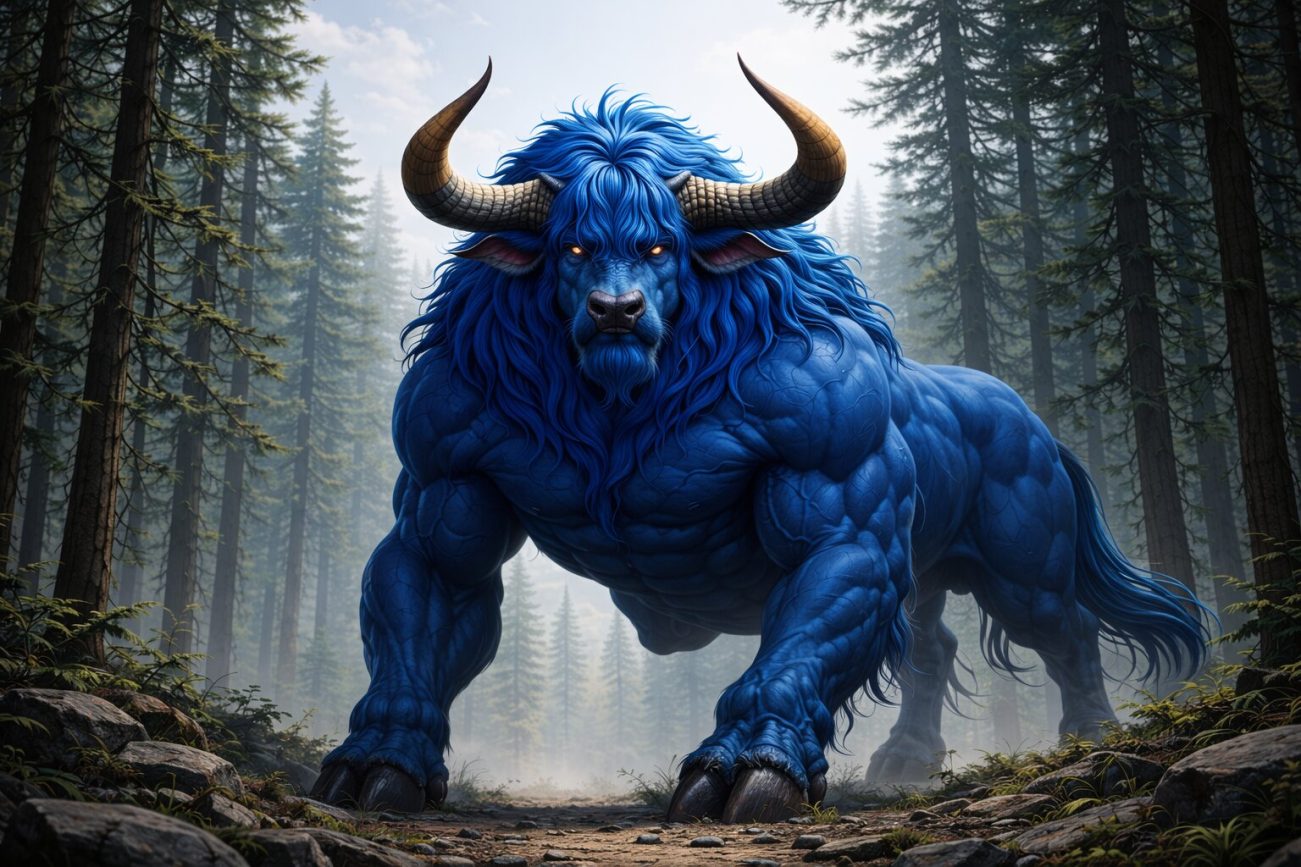
Babe the Blue Ox was the faithful companion of Paul Bunyan, the greatest lumberjack the world had ever known.

During the legendary Winter of Blue Snow, when cold gripped the land more fiercely than ever before, Paul Bunyan found a small ox calf trapped and close to freezing in the wilderness. He lifted the calf in his arms and carried it back to his camp, warming it by the fire until it survived. Though the cold left its body, it never left its hide, and the calf remained forever blue. Because of this, Bunyan named him Babe.

Babe grew with astonishing speed. Before long he became so large that his height was said to equal forty-two axe handles stacked end to end. His horns stretched so far apart that a crow would take an entire day to fly from one tip to the other.

Wherever Paul Bunyan went, Babe followed. Together they hauled entire forests, dragged logs across continents, and reshaped the land itself. It is said that their travels carved the Black Hills and that their labors tore open the earth to form the Grand Canyon. Babe moved steadily at Bunyan’s side, silent and immense, his blue form standing out against the open sky.

Thus Babe the Blue Ox became part of the legend of the land itself—a symbol of enormous strength, endless work, and the vast scale of the American frontier, where even animals could grow as large as the stories told about them.


Gallery


Sources

Dixon-Kennedy, M. (1996). Native American Myth & Legend: An A–Z of People and Places. p. 35.

Encyclopedia Mythica. (n.d.). Babe. Retrieved from https://pantheon.org/articles/b/babe.html


Interpretive Lenses

Religious Readings
  • Christian Ascetic Deep Dive
Philosophical Readings
  • Nietzschean Deep Dive
Psychological Readings
  • Jungian Deep Dive
Esoteric Deep Dive
  • Hermetic Deep Dive
Political / Social Readings
  • Marxist Deep Dive
Other
  • How to Invite The Babe

The Slide-Rock Bolter

Tradition / Region: American Mythology
Alternate Names:
Category: Fish, Mountain dweller


The Myth

High in the mountains of Colorado, where the slopes are steep and the ground falls away at terrifying angles, there lives a monstrous creature known as the Slide-Rock Bolter. It inhabits only the most dangerous terrain, where the mountainsides tilt sharper than forty-five degrees and a misstep can mean death.

The Slide-Rock Bolter has an enormous head with small, intent eyes and a vast mouth that stretches far back beyond its ears. Its tail ends in a split flipper armed with massive hooks. With these, the creature fastens itself to the crest of a mountain or ridge, clinging there motionless for days at a time while it watches the gulches below.

When a tourist—or any other unlucky creature—wanders into view, the Bolter prepares to strike. It loosens its grip, lifts its hooked tail, and launches itself downhill like a living avalanche. As it slides, thin grease drools from the corners of its mouth, slicking the rock and increasing its speed. In a single roaring descent, it scoops up its victim, gulps them whole, and uses its own momentum to surge up the opposite slope. There it hooks its tail over a new ridge and waits once more.

Some say entire parties of tourists have vanished in a single sweep. Others tell of forested slopes scoured bare, where spruce trees were torn out by the roots or sliced down as cleanly as if by a giant scythe when a Bolter thundered through from the heights above.

One tale tells of a forest ranger who dared to fight the monster with cunning rather than fear. He constructed a lifelike dummy tourist, dressed in plaid jacket and knee breeches, clutching a guidebook to Colorado. The figure was packed with explosives and placed in plain sight on a slope beneath Lizzard Head, where a Slide-Rock Bolter had been waiting for days.

The next day, the Bolter struck.

The explosion that followed was said to flatten half the buildings in the town of Rico, which were never rebuilt. For the rest of the summer, buzzards circled the surrounding hills, feeding on what remained.

And so the Slide-Rock Bolter lives on in mountain lore: a patient predator of slopes and shadows, forever waiting above the trail for the careless step below.


Gallery


Sources

Cox, W. T. (1910). Fearsome Creatures of the Lumberwoods: With a Few Desert and Mountain Beasts. Press of Judd & Detweiler, Inc.


Interpretive Lenses

Religious Readings
  • Christian Ascetic Deep Dive
Philosophical Readings
  • Nietzschean Deep Dive
Psychological Readings
  • Jungian Deep Dive
Esoteric Deep Dive
  • Hermetic Deep Dive
Political / Social Readings
  • Marxist Deep Dive
Other
  • How to Invite The The Slide-Rock Bolter