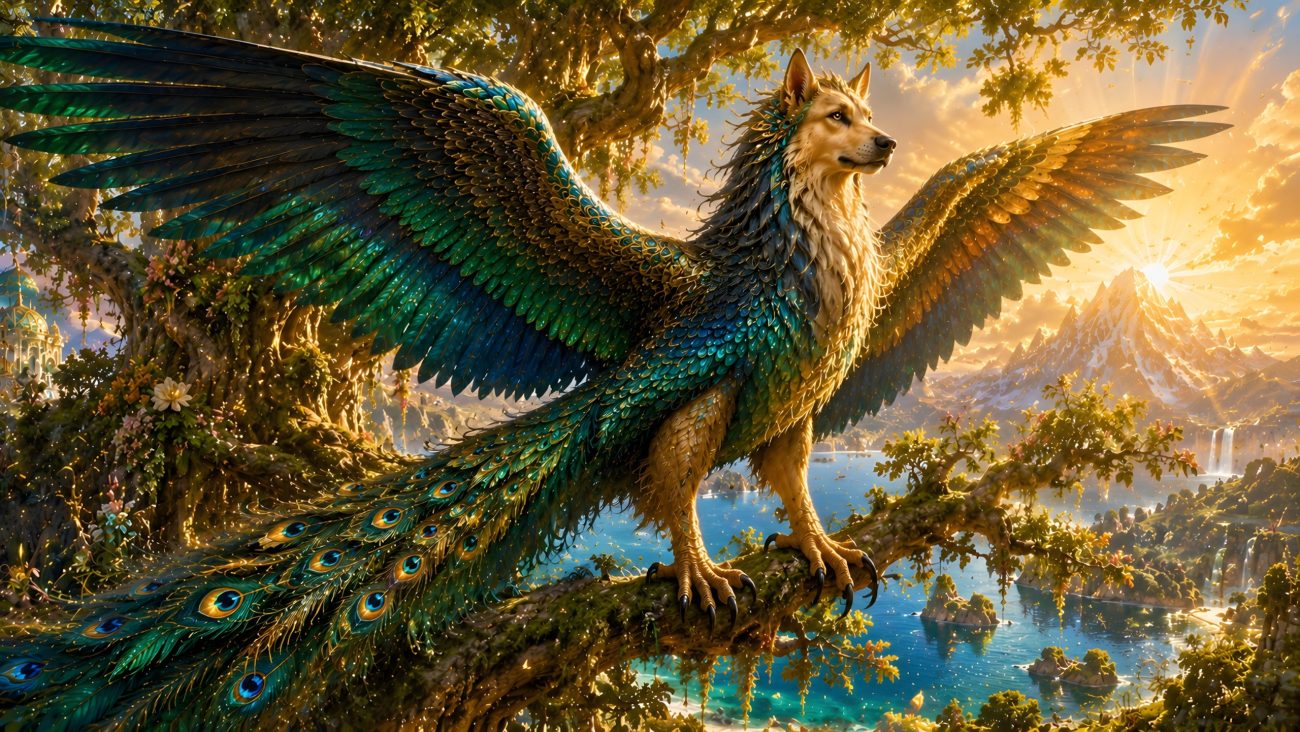
Tradition / Region: Persian Mythology, Iranian Mythology
Alternative names: Senmurv; Simorgh; Simurg; Simoorg; Simorq; Simourv
Category: Bird, Dog
The Myth
The Simurgh is a colossal and benevolent bird of Persian mythology, dwelling upon the Tree of Life that stands in the middle of the cosmic sea. Enormous enough to carry away an elephant, it is commonly described as having the body of a peacock, the head of a dog or human, the claws of a lion, and copper-colored feathers. Ancient beyond measure, the Simurgh is said to have witnessed the destruction of the world three times and possesses the wisdom of every age. When it takes flight from the Tree of Life, the seeds of every plant scatter across the world, bringing healing and fertility to the earth.
The Simurgh is best known for raising the abandoned prince Zal. Rejected at birth because of his white hair, Zal was left upon Mount Alborz, where the compassionate bird found him, nurtured him as her own, and taught him great wisdom. When he was grown, she returned him to humanity but gave him three golden feathers, telling him to burn one whenever he needed her aid. Later, when Zal’s wife Rudaba faced certain death in childbirth, the Simurgh answered his call and instructed him in performing a successful cesarean section, saving both mother and child. That child grew up to become the legendary hero Rostam.
The Simurgh later came to Rostam’s aid as well, healing both him and his horse Rakhsh after they were wounded in battle. She also revealed the only way to defeat the invincible prince Esfandiyār, instructing Rostam to fashion a double-headed arrow from a tamarisk branch. Although the Simurgh warned that killing Esfandiyār would bring lasting sorrow, Rostam followed her counsel, and the enchanted arrow ended the prince’s life, fulfilling the bird’s prophecy.
Sources
Wikipedia contributors. (n.d.). Simurgh. In Wikipedia. Retrieved June 29, 2026, from https://en.wikipedia.org/wiki/Simurgh