Torapee and Torapa

Tradition: Thai mythology
Alternative names: Torapee, Torapa
Category: Cow


The Myth

Torapa was originally a giant who was tasked with guarding the gates of Lord Shiva’s palace. After disobeying his master, he angered Shiva and was cursed to be reborn as a giant buffalo named Torapa.

Torapa was destined to be killed by his own son, Torapee. From the time he was young, Torapee would compare the size of his hoofprints with those of his father. He knew that when his own hoofprints became equal in size to his father’s, he would be strong enough to challenge and kill him.

Eventually, the day came when Torapee’s hoofprints were approximately the same size as Torapa’s. Torapee then challenged his father and killed him, fulfilling the curse.

The name Torapee subsequently became associated with an ungrateful child in Thai proverbial speech, referring to someone who repays their parents with hostility rather than gratitude.


Sources

“The Mythical Creatures in Thailand.” Explore Bangkok. Accessed August 30, 2026. https://www.explore-bangkok.com/mythical-creatures-in-thailand/


Toralindo

Tradition: Indonesian Mythology
Alternative names: Toralindo
Category: Cow


The Myth

Toralindo is a gigantic buffalo from the mythology of the Torajan people of Sulawesi. It is believed to support the Earth upon its horns, and its movements are associated with earthquakes.

Toralindo is an enormous buffalo capable of carrying the Earth on its horns. Its movements can cause the ground to shake, and its reactions to sounds or animals can influence the stability of the Earth.

According to Torajan tradition, the Earth is flat and is supported by the giant buffalo Toralindo. When Toralindo is bitten by a fly, it shakes its head to drive the insect away, causing an earthquake.

Different villages have different ways of trying to stop Toralindo from shaking its head. Some people begin to meow loudly, because buffaloes are believed to be afraid of cats. When Toralindo hears the meowing, it forgets about the fly and stops shaking its head.

Other people imitate a pig being struck with a stick, believing that the resulting squealing will distract Toralindo and prevent it from continuing to shake its head.


Sources

“Toralindo.” New Bestiary (Bestiary.us). Accessed August 30, 2026. https://www.bestiary.us/toralindo


Tonzo

Tradition: Japanese mythology
Alternative names: –
Category: Cow


The Myth

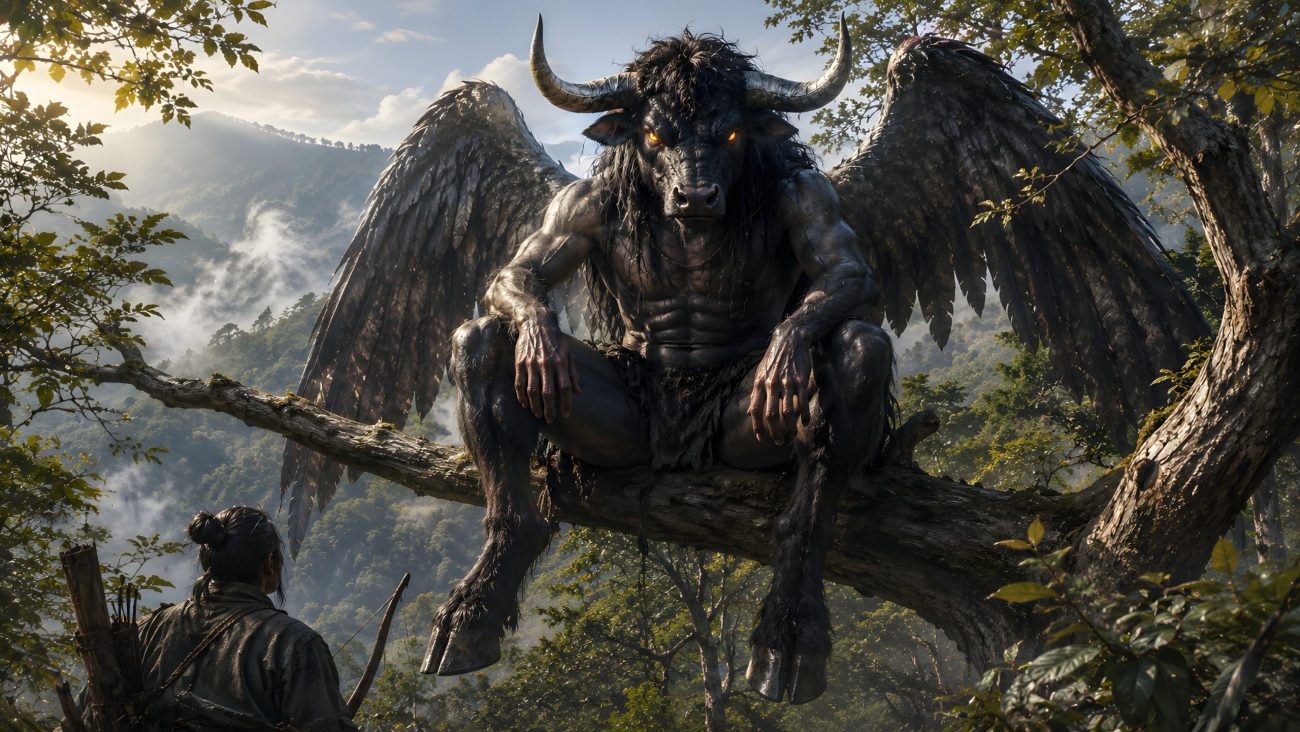
Tonzo is a mysterious yokai from Iwaizumi in Iwate Prefecture. It is described as a pitch-black, bull-like flying monster with enough supernatural strength to shake the ground and destroy trees.

One evening, an experienced hunter named Sahei-dono went hunting in Miyanosawa. For some reason, no deer appeared that night. As dawn approached, he was preparing to leave when a pitch-black creature resembling a bull suddenly jumped out before him.

The creature spoke in a human voice and declared that it was Tonzo, challenging Sahei to strike it and threatening to crush him if he did. Sahei had his hand on the knife at his waist, but he was so frightened that he fled.

Some time later, Sahei went to Yokonaga-mine. Near a chestnut tree, Tonzo appeared again. The ground trembled as the creature leaped onto the tree. It shook the tree violently and snapped its branches.

Tonzo then reminded Sahei of their previous encounter and threatened to seize and kill him if he returned. Terrified, Sahei begged for forgiveness and fled.

About ten days later, Sahei fell ill and died.

The true nature of Tonzo is unknown. The only description preserved in the tradition is that it was a flying monster resembling a bull.


Sources

Takahashi, Toshihiro. “トンゾウ (Tonzo).” 新版TYZ 妖怪図鑑 (New TYZ Yokai Encyclopedia). December 3, 2011. https://tyz-yokai.blog.jp/archives/1010654094.html


Mill Devil

Tradition: Czech Mythology
Alternative names: Mill Devil
Category: Demon


The Myth

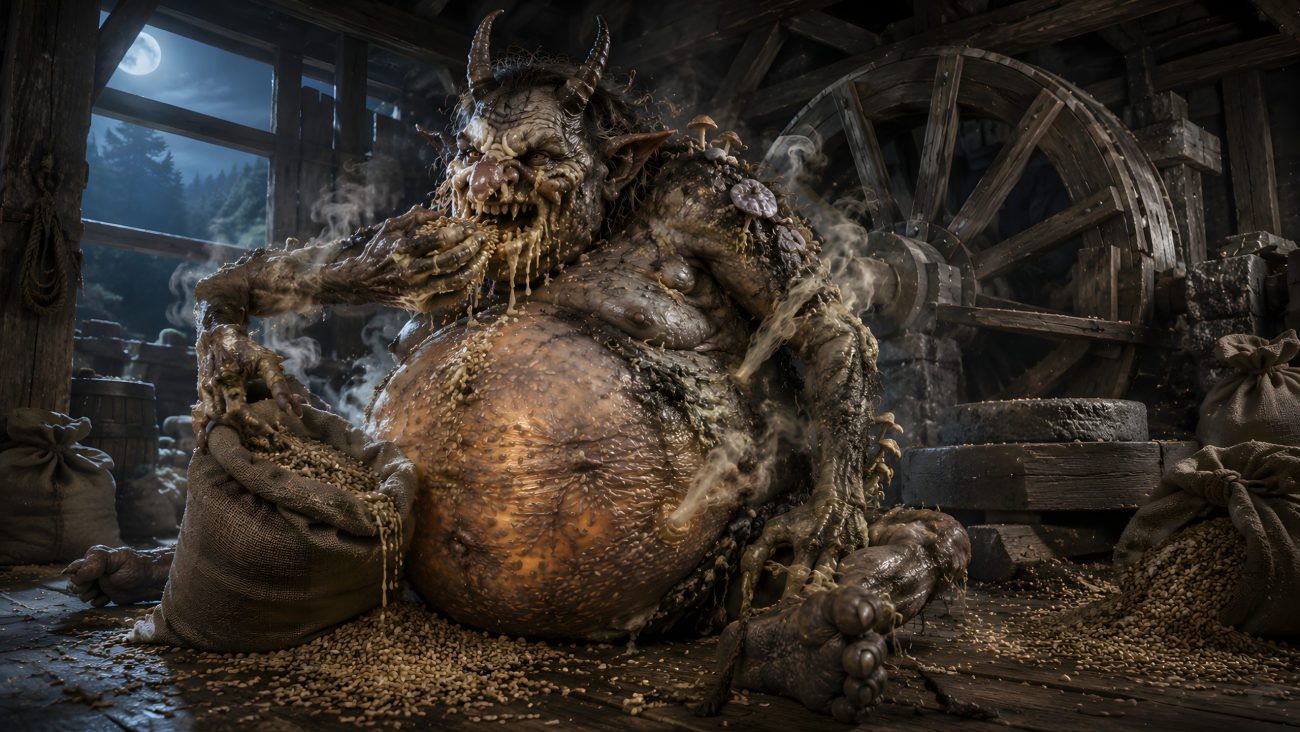
The Mill Devil is a group of hellish spirits summoned through a magical book and associated with an old mill near Langendorf. They appear as numerous devils with glowing eyes and licking tongues, capable of moving with great speed and performing impossible tasks.

The devils have a terrifying appearance, with glowing eyes and tongues that lick from their mouths. They appear in large numbers and are violent and threatening, seeking to strangle those who summon them.

Behind Langendorf stood an old mill whose miller possessed a grey book that allowed him to summon the forces of Hell. One Holy Day, the miller’s children were left alone at home. While rummaging through old things, they discovered the mysterious book. They opened it and began reading the words inside.

Suddenly, the entire mill filled with devils. They raged through the building with glowing eyes and licking tongues, threatening to strangle the children.

At that moment, the miller was sitting in church. During High Mass, he suddenly became restless and felt that something was wrong. He rose from his place and hurried home.

The devils were already waiting for him. They demanded that he quickly tell them what he wanted them to do. The miller tore the fur from his body and threw it before them, ordering them to count every hair in it.

The devils immediately fell upon the fur and began counting. While they were occupied, the miller ran into the mill and poured a sack of grain into the stream.

The devils soon finished counting and announced that the fur contained seven hairs. They demanded another task, threatening to tear the miller apart if he did not give them one quickly.

The miller ordered them to retrieve every grain he had thrown into the stream. The devils fished the grains from the water and returned, again demanding another task.

The miller then gave them an impossible command: they were to remove all the ice from the pond, carry it to the yeast stone, set it alight, and bring him the ashes.

Enraged by the miller’s mockery and impossible demands, the devils finally abandoned him and returned to Hell. Before leaving, however, they took the mill wheel with them as revenge.


Sources

Watzlik, Hans. “Schnelle Knechte.” In Böhmerwald-Sagen. Budweis: Böhmerwalder Dorfbücher, 1921, Heft 5. Reproduced by SAGEN.at. https://www.sagen.at/texte/sagen/tschechien/watzlik/schnelleknechte.html


Gesindel

Tradition: Czech Mythology
Alternative names: Gesindel
Category: Demon


The Myth

The Gesindel is a hellish rabble of supernatural beings from the folklore of the Bohemian Forest. They appear as groups of devil-like figures associated with strange gatherings, card playing, and supernatural music.

The Gesindel has no single fixed appearance. They are described as groups of devils, sometimes appearing as several figures gathered together in isolated places.

Near Rederhof in Eisenstraß lies a wide, flat stone with hoof-shaped impressions in it. According to local tradition, Satan was said to dance upon this stone. Because of this, the farmers avoided the stone and would not rest upon it.

Once, Martin passed by the stone and saw four figures sitting upon it. They appeared to be nodding devils and were playing cards. Martin would have liked to know which card was the trump, but he did not dare ask.

The hellish rabble also haunted the Huisriegel. In broad daylight, they would drum upon the ground, blow their instruments like a whole band of musicians, and play so loudly that the cattle in the pasture became agitated. The shepherd himself was frightened so badly that he fled over all nine mountains.


Sources

Watzlik, Hans. “Gesindel.” In Böhmerwald-Sagen. Budweis: Böhmerwalder Dorfbücher, 1921, Heft 5. Reproduced by SAGEN.at. https://www.sagen.at/texte/sagen/tschechien/watzlik/gesindel.html


Trud

Tradition: Czech Mythology
Alternative names: –
Category: Demon


The Myth

The Trud is a frightening supernatural being from the folklore of the Bohemian Forest. It is associated with nighttime attacks, borrowing objects, and a strange form of possession. The Trud can appear as a woman or an old, wrinkled female figure, and it is capable of becoming extremely heavy when it sits upon a sleeping person.

A musician from St. Catherine’s Church was once visited by a Trud during the night. After dealing with it, he apparently drove it away and warned it to return the following day for matches. Another story explains why people were afraid to lend household objects: a musician’s wife was about to borrow a hoe from a neighbor when her cousin warned her not to go. The neighbor had supposedly trapped the Trud the previous night and was waiting for someone to come to the house and borrow something. The woman immediately returned home.

The Trud could also attack sleeping people. A blacksmith’s apprentice once felt the Trud settle upon his chest while he slept. It was enormously heavy, making it difficult for him to breathe. He eventually grabbed a handful of threshed straw, and the weight immediately became lighter. He jumped from his bed and trapped the straw in a vise.

When morning came, the blacksmith discovered an old, wrinkled woman in his workshop, with her hair caught in the vise. She begged him to release her. He opened the gate and drove her away by beating her.

A miller from High Art described another encounter with the Trud. He heard it approaching while making a constant whirring sound and crying out. It then jumped onto him, sat on his chest, and seemed to draw something from his body. He described the creature as having a round, pig-like beak and claimed that the Trud consumed the vitality or substance of its victims.


Sources

Watzlik, Hans. “Die Trud.” In Böhmerwald-Sagen. Budweis: Böhmerwalder Dorfbücher, 1921, Heft 5. Reproduced by SAGEN.at. https://www.sagen.at/texte/sagen/tschechien/watzlik/dietrud.html


Bosch

Tradition: Breton Mythology, French Mythology
Alternative names: —
Category: Demon


The Myth

The Bosch is a supernatural creature believed to arise from theft committed aboard a ship. It has no fixed appearance and may take different forms depending on the nature of the crime that created it. Once born, it hides in the bow of the vessel and brings persistent misfortune to the crew.

A Bosch may survive for several months or even several years before gradually weakening and disappearing. While it remains aboard, the ship’s nets stay empty, favorable winds fail to appear, and misfortune continually afflicts the sailors.

In the Audierne region, maritime theft was paradoxically regarded as a source of good luck for the thief, because the Bosch created by the theft would remain behind on the ship. Elsewhere in Finistère, however, such supernatural consequences were regarded as a serious danger. Evil spirits could arise from acts of greed and wrongdoing aboard ships, making it necessary to fumigate a vessel before putting out to sea. The spirits were believed capable of becoming small enough to hide inside a thimble, so smoke had to reach every part of the ship.

There were two known ways to rid a vessel of a Bosch.

The first was to transfer it to another ship. The captain would identify a fortunate vessel whose crew enjoyed plentiful catches and good fortune. During the night, he would secretly board it and steal a small object, usually a pair of oarlocks. The Bosch would then leave its original ship and attach itself to the newly afflicted vessel.

The second method was to drive the creature into the sea. The captain would secretly steal some hay and hide it aboard the ship. At night, the hay would be set on fire near the mizzenmast while the captain shouted that there was a devil aboard.

The sailors, startled by the alarm, would seize whatever they could find and begin striking wildly around the vessel, beating every corner in an attempt to drive the supposed demon out. Faced with the smoke, flames, and blows, the Bosch would eventually flee into the sea, freeing the ship from its curse.


Sources

Countess Sica. “Bosch.” A Book of Creatures. July 8, 2015. https://abookofcreatures.com/2015/07/08/bosch/


Onna-oni

Tradition: Japanese Mythology
Alternative names: The Woman Demon
Category: Demon


The Myth

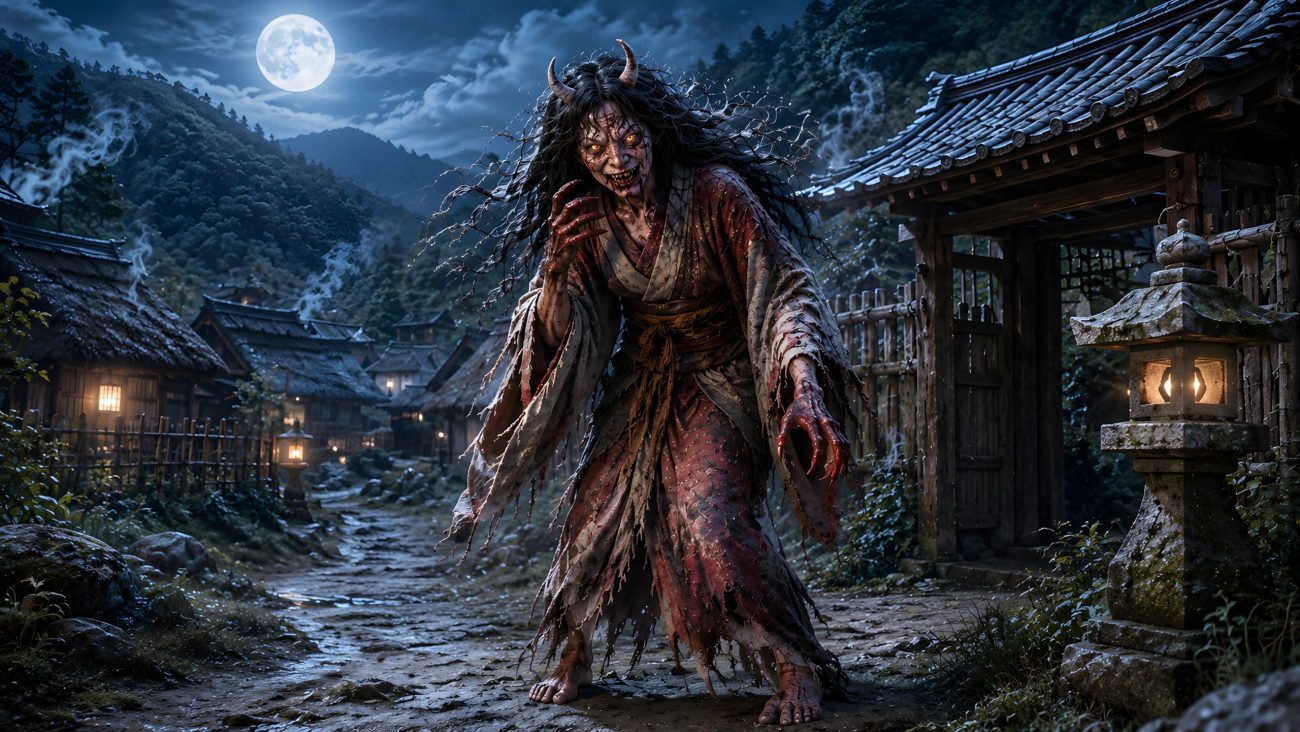
Onna-oni is the name given to a woman said to have transformed into an oni. In the surviving account, however, the creature is primarily known through a widespread rumor in medieval Kyoto rather than through an actual encounter or description of its appearance.

Around the Ōchō era (1311–1312), a rumor spread that a woman from Ise Province had become an oni and had been brought to Kyoto.

About twenty days later, people in the Shirakawa district of Kyoto began wandering through the streets saying that they were going to see the oni. Rumors constantly changed its supposed location: some claimed that it had been seen at Saionji, others that it was heading toward the retired emperor’s residence, while others insisted that it was currently somewhere else.

Despite all the excitement, nobody could actually claim to have seen the oni. At the same time, nobody could confidently declare that the story was false. People of every social rank continued talking about the supposed demon.

One day, the writer of Tsurezuregusa traveled from Higashiyama toward the area near Angoin. He encountered residents from the area north of Shijō Street running northward in excitement, shouting that an oni was at Ichijō Muromachi.

From around Imadegawa, he could see an enormous crowd gathered around the imperial viewing stands for the Kamo Festival. The area was packed with people and filled with commotion. Although the writer wondered whether the rumors might have some truth to them, people were sent to investigate, yet none returned claiming to have actually encountered the oni.

The disturbance continued until sunset and eventually even resulted in fights among the crowd.

At the same time, a sickness was spreading throughout the area that caused people to suffer for two or three days. Some people therefore claimed that the false story about the woman who had become an oni had been a portent of the disease.

The account connects the rumor with the widespread Three-Day Disease and the feverish excitement surrounding public entertainment and religious festivities in Kyoto.


Sources

Takahashi, Toshihiro. “女の鬼 [おんな‐おに] (Onna-oni).” 新版TYZ 妖怪図鑑 (New TYZ Yokai Encyclopedia). July 20, 2020. https://tyz-yokai.blog.jp/archives/1077741577.html


Gaibyō-ki

Tradition: Japanese mythology
Alternative names: The Coughing Disease Oni
Category: Demon


The Myth

Gaibyō-ki are small oni associated with an outbreak of coughing sickness. They are depicted as three small demons riding on clouds and attempting to enter a household, where they spread the disease.

The story appears in Ehon Sayoshigure under the title Okina Ekijin o Fusegu.

Around the Eishō era (1504–1521), coughing sickness spread through four or five villages in Echizen Province. Many villagers became seriously ill and were confined to their beds.

A rōnin lived in one of the affected villages, but strangely, nobody in his household became sick.

One night, an old man appeared at the rōnin’s house and told him that he lived beneath the southeastern corner of the house. He explained that oni carrying the coughing disease had recently been entering people’s homes and causing them to suffer. Because he recognized the rōnin’s virtuous conduct, the old man had been standing guard outside the house each night to keep the oni away.

After the old man departed, the rōnin dug beneath the southeastern corner of the house. There he discovered a box buried in the ground.

Believing that the box represented the old man who had protected his household, the rōnin built a shrine and worshipped him.

The accompanying illustration shows three small oni riding through the clouds as they attempt to enter the rōnin’s home, while the old man stands before the gate and glares at them, preventing their entry.


Sources

Takahashi, Toshihiro. “咳病の鬼 [がいびょう‐き] (Gaibyō-ki).” 新版TYZ 妖怪図鑑 (New TYZ Yokai Encyclopedia). July 19, 2020. https://tyz-yokai.blog.jp/archives/1077741576.html


Kigyō-yubi

Tradition: Japanese mythology
Alternative names: Oni-shaped Finger
Category: Demon


The Myth

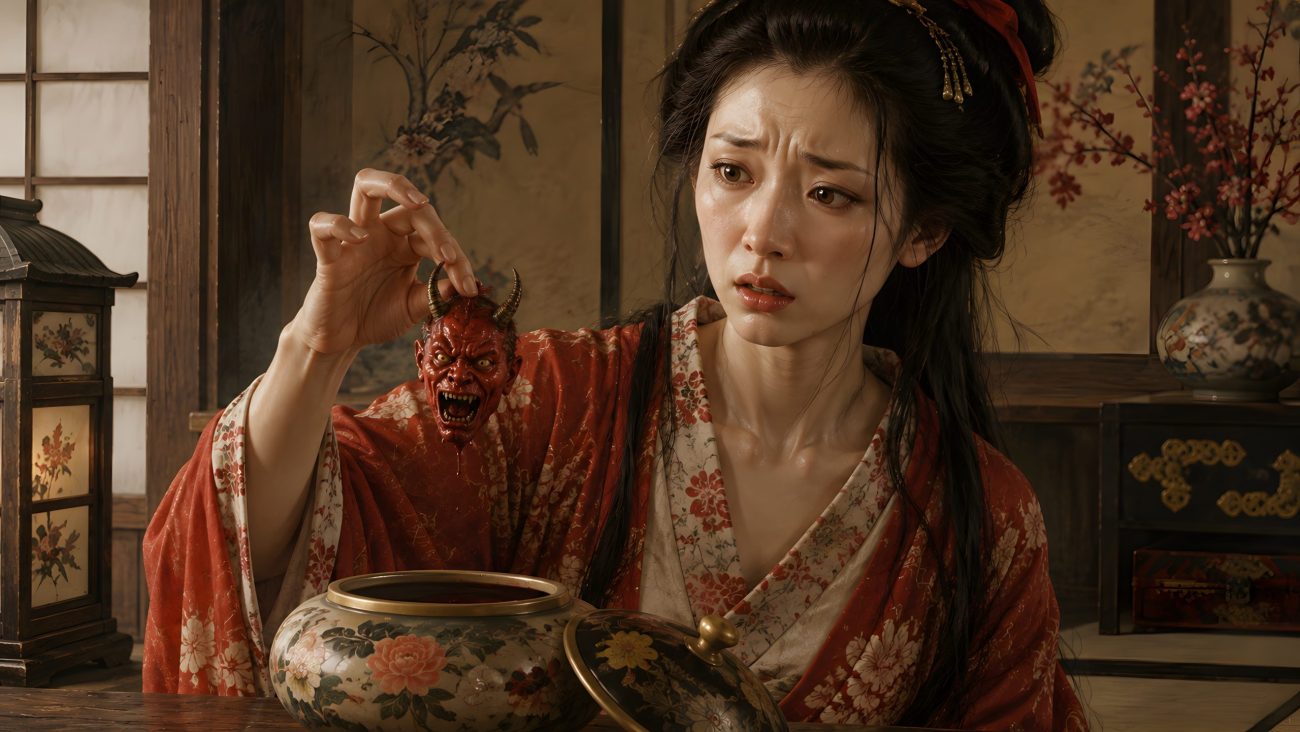
Kigyō-yubi is a severed human finger that appears to transform into the head of a small oni. The transformed finger is described as having a red complexion, two curled horns, and bright, star-like eyes, resembling the traditional Japanese depiction of an oni.

The story appears in the second volume of Kaishū Yakōkon, in a tale concerning a courtesan named Tatsuta.

Tatsuta was born in Kyoto and became a shirabyōshi, a female entertainer who performed songs and dances. After moving to Naniwa, she became highly sought after because of her beauty and skill at singing. She eventually fell deeply in love with a young merchant named Yamamoto Matashuke, and remained devoted to him even while continuing her work as a courtesan.

Matashuke, however, eventually abandoned her and married another woman. Tatsuta was devastated by his change of heart. She repeatedly sent him letters and, as proof of her devotion, even cut off her hair and one of her fingers and sent them to him. Matashuke regarded these gifts as troublesome and returned them.

Consumed by grief, jealousy, and resentment, Tatsuta became increasingly distraught. The severed finger remained in a container in her possession.

One day, when Tatsuta looked at the finger, she saw that it had transformed into the head of a tiny oni. It was red, had two curled horns, and possessed eyes that shone like stars. Terrified, Tatsuta covered the container and believed that her intense jealousy had caused her severed finger to become an oni.

She went to a reclusive monk named Ryōfū and confessed what had happened. When Ryōfū opened the container, however, he saw nothing unusual. The object was simply a human finger.

When he asked Tatsuta whether she still saw an oni, she insisted that she did. Ryōfū concluded that the oni was a manifestation of the demon within her own jealous mind, projected onto the severed finger.

Ryōfū taught her Buddhist teachings and gave her the ten recitations of the Buddha’s name. Three days later, Tatsuta returned and happily explained that she could no longer see the finger as an oni. She wished to shave her head and become Ryōfū’s disciple.

Ryōfū initially refused, explaining that she could not simply abandon her life as a courtesan. Instead, he taught her that she could turn her heart toward Buddhism even while remaining outwardly in her existing circumstances.

Tatsuta continued as a courtesan for some time, but eventually fulfilled her wish and became Ryōfū’s disciple. She shaved her head, took the name Eirin Bikuni, and established a hermitage at Sonezaki.


Sources

Takahashi, Toshihiro. “鬼形の指 [きぎょう‐ゆび] (Kigyo-yubi).” 新版TYZ 妖怪図鑑 (New TYZ Yokai Encyclopedia). September 22, 2018. https://tyz-yokai.blog.jp/archives/1072385607.html