Tradition: Japanese Mythology
Alternative Names: 羊角風, Yōkaku-fū
Category: Sheep, Spirit
The Myth
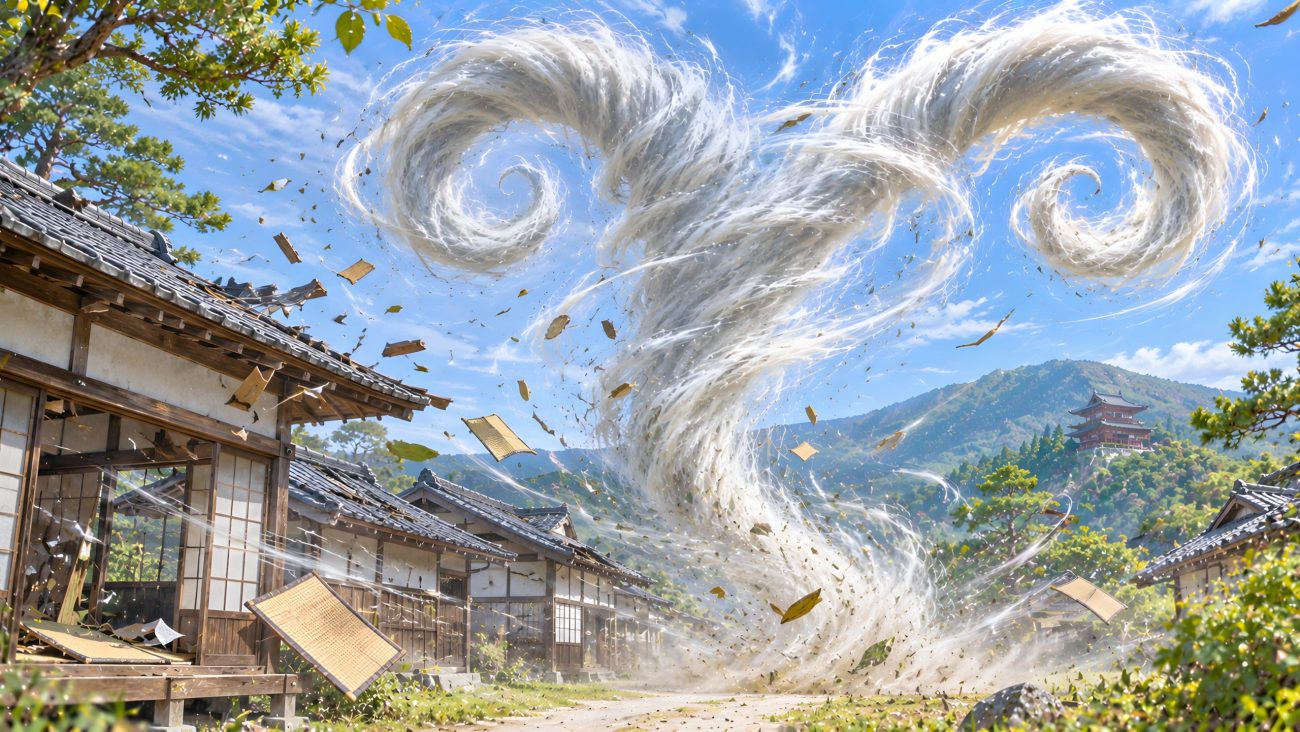
Yōkakufū is a term for a whirlwind in Japanese folklore. The name literally refers to a “sheep-horn wind,” describing how a swirling column of wind twists and rises like the shape of a sheep’s horns.
According to Kanden Jihitsu, a violent wind resembling a Yōkakufū swept through the area around Imadegawa in Kyoto on the last day of the seventh month of 1802. The wind damaged rooftops and lifted ceilings, floorboards, and tatami mats into the air. Despite the destruction, the damage was confined to a narrow path approximately one ken wide, while the surrounding area remained untouched. No rain fell during the event.
The wind reportedly travelled from Tanaka Village to the western foothills of Mount Hiei, where it stopped. Since a wind accompanying a serpent’s ascent into the sky would be expected to bring rain, the phenomenon was thought to be a Yōkakufū instead. The account adds that similar events sometimes occurred in northern Japan, where such winds were known as Ichimokuren.
The text also discusses kamaitachi, another type of unusual wind phenomenon.
Sources
Tyz-Yokai. (n.d.). Yokakufu. https://tyz-yokai.blog.jp/archives/1017486173.html