Tradition: Japanese Mythology
Alternative Names: 雲外鏡, うんがいきょう, Mirror Beyond the Clouds
Category: Object
The Myth
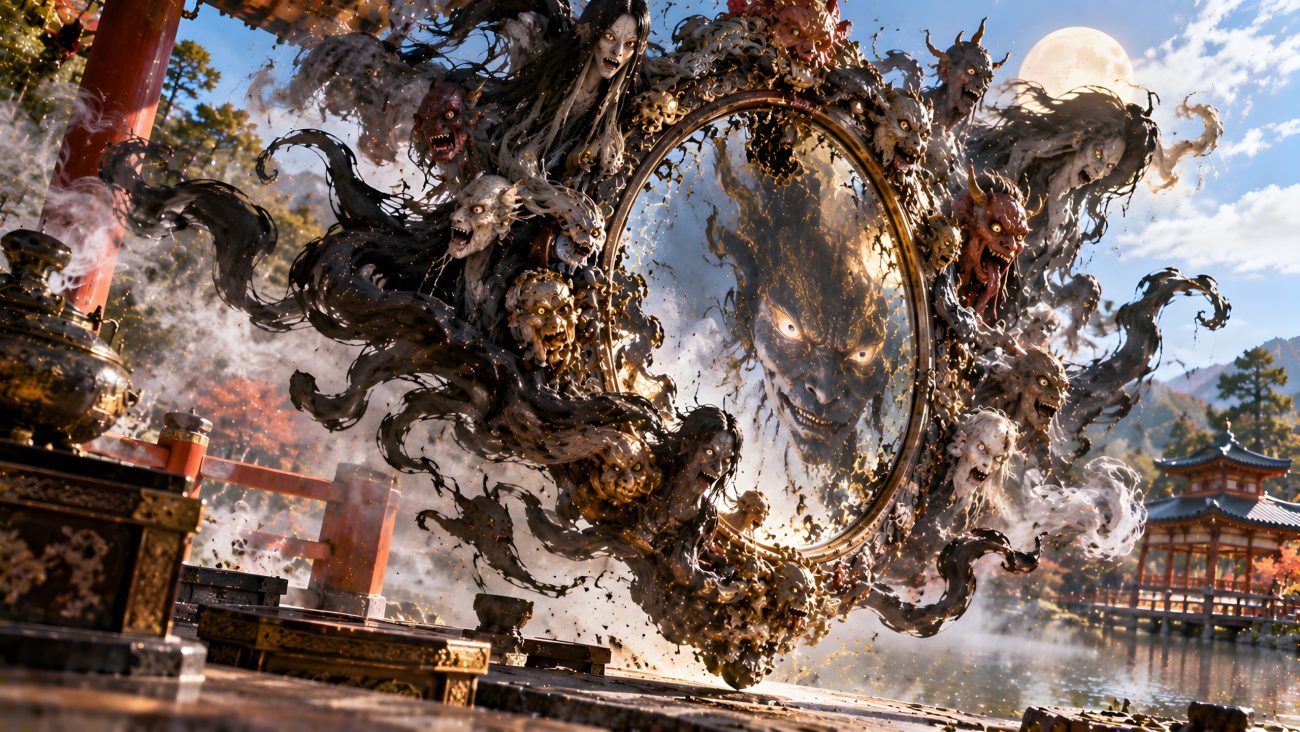
Ungaikyō is a haunted mirror that reveals demons and monsters in its reflective surface. The spirit inhabiting the mirror, together with the countless supernatural beings reflected in it over the years, can manipulate its images and make them appear in almost any form. Anyone who gazes into an Ungaikyō may see a monstrous, transformed version of themselves staring back. According to later interpretations, a mirror that reaches one hundred years of age can also develop a soul and become a yokai, following the Japanese tradition of old objects acquiring supernatural life.
Ungaikyō can also be used to capture spirits. During the full moon on the fifteenth night of the eighth month in the traditional lunar calendar, water is poured into a crystal dish to reflect the moonlight. If this water is then used to paint the image of a yokai onto a mirror, the spirit depicted is said to inhabit the mirror. This practice connects the creature with traditional moon viewing and the belief that reflections can serve as a means of contact with the supernatural.
The Ungaikyō was illustrated by Toriyama Sekien in his collection Hyakki Tsurezure Bukuro, where it was inspired by the Chinese legend of the Shōmakyō, or demon-revealing mirror. This legendary mirror could expose the true forms of supernatural beings disguised as humans. King Zhou of the Shang dynasty used it to reveal that his consort Daji was actually a wicked nine-tailed fox spirit plotting to ruin his kingdom. Once exposed, she fled, eventually becoming associated with the Japanese legend of Tamamo no Mae. Sekien proposed that a mirror repeatedly exposed to demons and monsters might gradually absorb their supernatural qualities until it became a yokai itself.
In modern portrayals, Ungaikyō sometimes appears as one of the transformations of a tanuki. By inflating its belly, the animal displays an image upon its skin, resembling a television screen. This version originates not from traditional folklore but from Daiei Films’ yokai movies of 1968–1969. Despite its modern origin, it has become a recognizable interpretation of the mirror spirit.
Sources
“Ungaikyō.” Yokai.com. https://yokai.com/ungaikyou/