Tradition: Spanish Mythology, Portuguese Mythology
Alternative Names: Trasgo, Trasno, Cornín, Xuan Dos Camíos, Gorretín Coloráu
Category: Goblin
The Myth
The Trasgu, also known as the Trasgo, Trasno, or Trasno, is a mischievous goblin found in the folklore of northern Spain, particularly Asturias, Galicia, and Cantabria, as well as northern Portugal. Its origins are associated with Celtic mythology, and similar beings appear in other European traditions. The Trasgu is especially well known in Asturian mythology, where it is regarded as a domestic spirit that enters houses at night and causes trouble for their inhabitants.
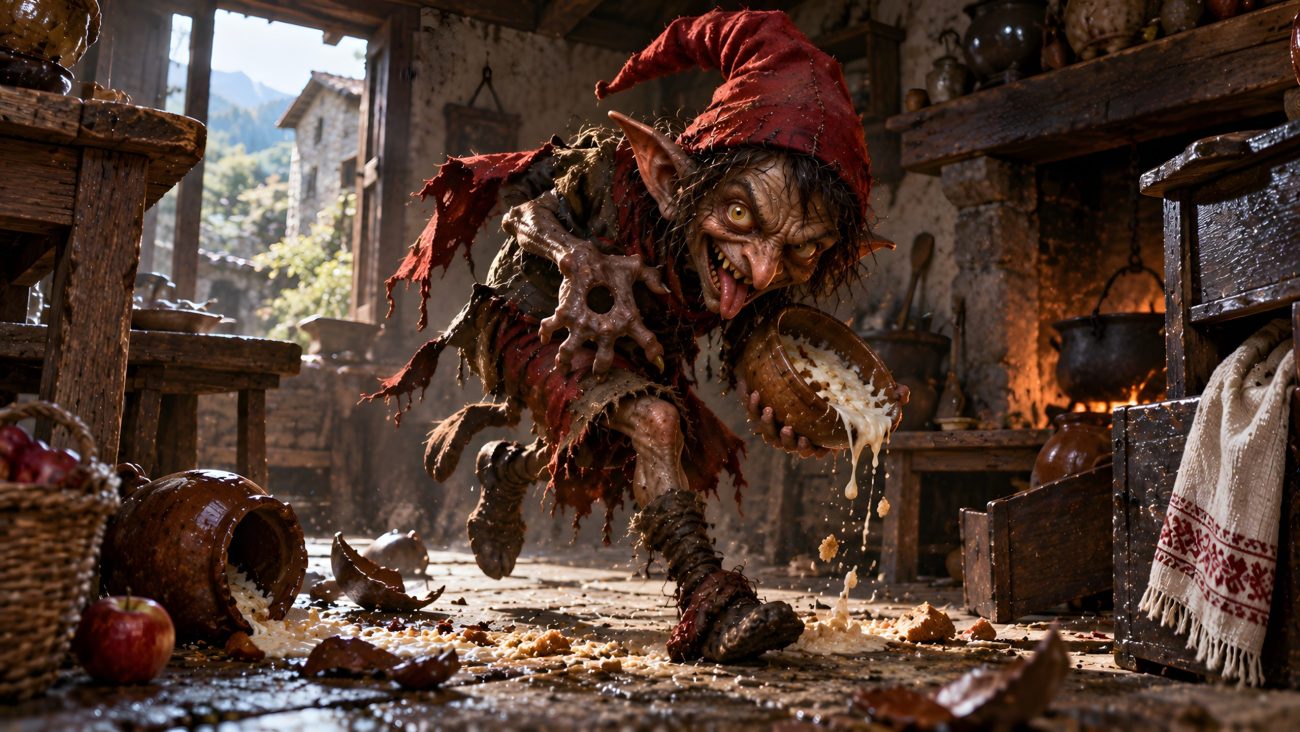
In Asturias, the Trasgu is usually depicted as a tiny man with dark skin, a limp in his right leg, red clothing, and a pointed red hat. A distinctive feature is a hole in his left hand. Other descriptions give him horns, a tail, sheep-like ears, and unusually long legs. He may wear a long black-and-gray cloak or a tight, dark-brown outfit. Depending on the region, he is also known as Cornín or Xuan Dos Camíos in western Asturias, and as Gorretín Coloráu, meaning “little red hat,” in eastern Asturias.
The Trasgu enters homes during the night, making strange noises and moving objects from their usual places. When mischievous, he may break kitchen vessels, frighten livestock, rummage through chests of clothing, and spill water. Despite these disturbances, his pranks generally cause no lasting material damage, and the household’s possessions are often found as they were before. When treated well, however, the Trasgu may become helpful and perform domestic chores while the inhabitants sleep.
In Cantabrian folklore, the Trasgu takes a somewhat different form. He is described as a small goblin with a black face and green eyes who lives in forests. He delights in mocking people and playing tricks, particularly on girls occupied with activities such as shepherding. Because he must hide from humans, his clothing is made from leaves and moss. In Portuguese folklore, the Trasgu or Trasno is especially familiar in the Trás-os-Montes region. Traditions of similar mischievous beings also spread beyond Portugal, inspiring related legends in places such as Brazil.
Sources
“Trasgu.” Wikipedia: The Free Encyclopedia. Wikimedia Foundation. Accessed October 17, 2026. https://en.wikipedia.org/wiki/Trasgu