Tradition: Japanese Mythology
Alternative Names: Tendō-san no Kin Kusari, Tendō-san’s Golden Rope, Tendō-san’s Chains of Gold
Category: Object
The Myth
Tendō-san’s Gold Chain is a Japanese folktale found in versions across the country, from the Tōhoku region in the north to Kyūshū and the southwestern islands. The story begins with a mother and her three children. One day, a fearsome Yamauba, a mountain witch, devours the mother and disguises herself as her victim to approach the children. Suspicious of the visitor, the children refuse to open the door, making excuses such as claiming that their visitor’s hands are too hairy. The Yamauba shaves the hair from her arms and returns, only to be rejected again because her voice sounds different. She then drinks dew from bamboo groves or sugar water to alter her voice, eventually deceiving the children into letting her inside. The youngest child is eaten, but the two surviving siblings discover the truth and flee.
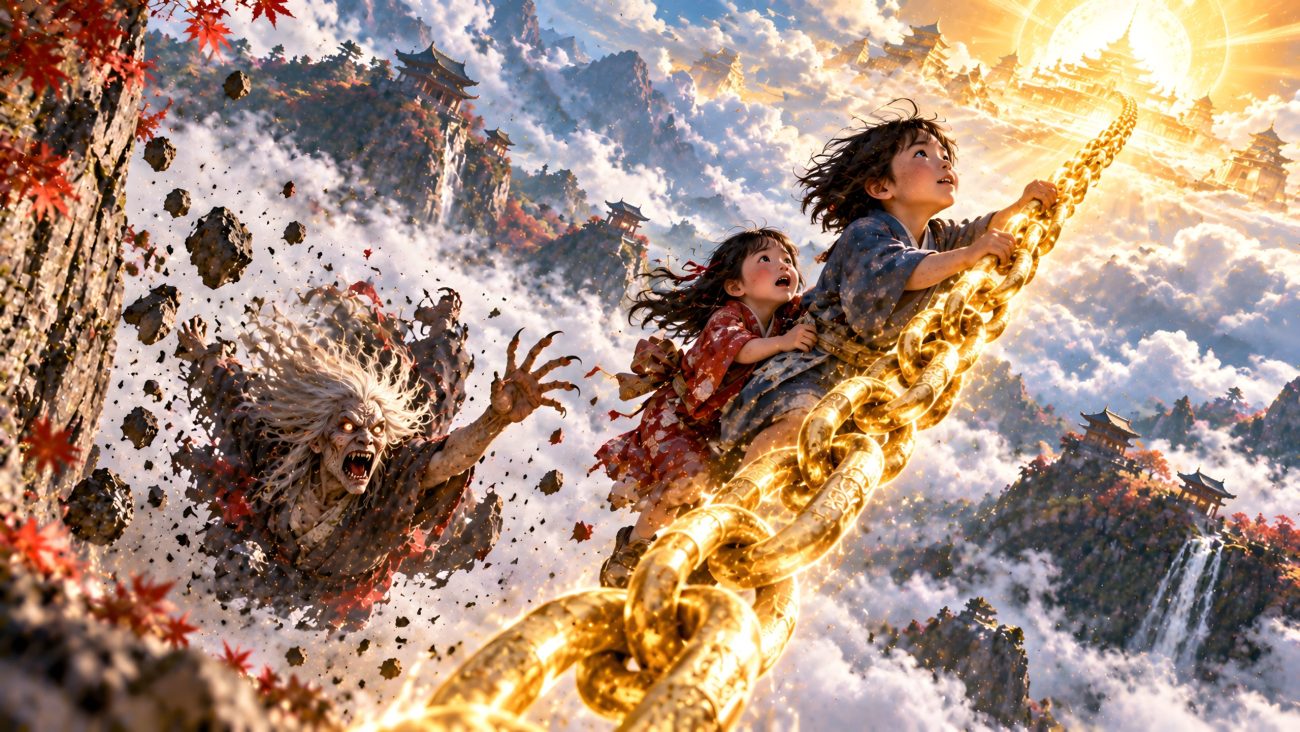
The Yamauba pursues the escaping children, who attempt to outwit her and separate themselves from their pursuer. When they are finally in danger of being caught, a golden chain or rope descends from heaven, sent by Tendō-san, a heavenly power associated with the sun. The siblings seize the chain and climb into the sky, where they become stars. The Yamauba asks heaven for a rope as well, but the one sent to her is made of ash or rotten material. It breaks while she is climbing, causing her to fall to her death. In some versions, her blood stains the stems of buckwheat red, explaining their colour.
The tale varies considerably between regions and storytellers. In some versions, one or both siblings become the moon rather than stars, and the story has sometimes been connected to the children’s song asking how many moons there are. Other versions omit the golden chain entirely, ending instead with the Yamauba falling from a tree. Some Kagoshima variants even allow the mother to be revived. Although the story contains frightening elements, it often portrays the Yamauba as a figure repeatedly outwitted by clever children, giving the tale a humorous dimension alongside its themes of danger, escape, and heavenly rescue.
Sources
“Tendo-kin-kusari.” 新版TYZ 妖怪図鑑 (New TYZ Yokai Encyclopedia). https://tyz-yokai.blog.jp/archives/1079718379.html