Tenchishindousai

Tradition / Region: Japanese Mythology
Alternate Names: Tenshin Dōsai; Shindōsai
Category: Catfish, Fish, Yokai


The Myth

One night, during the Ansei era, a wandering rōnin arrived at a guardhouse in Edo and begged for shelter and food. He was tall, powerfully built, and strange in appearance, like a man hardened by severe training. The guards refused him, saying the guardhouse was not a place for lodging, and told him to seek an inn elsewhere.

At this, the man’s face grew pale.

He declared, “I am Tenchishindousai. There is none who does not know my name. Yet because the land has been calm for many years, people have grown contemptuous. They catch my kin, roast them, stew them, and kill them without cause. I have come to avenge them.”

He spoke of his journey: how he had shaken people to death at temple gatherings, how he had passed through province after province—mountains, capitals, and ports—causing the earth to tremble beneath his feet. Now, he said, he had arrived in Edo.

When the guards realized he claimed to be the Earthquake itself, they tried to seize him. Enraged, Tenchishindousai vanished on the spot.

At once, heaven and earth roared. The ground convulsed violently. Houses collapsed, storehouses fell, fires erupted across the city, and countless people were crushed or burned. Amid the devastation, Tenchishindousai spoke again, saying that the gods were absent from the land—and that if the deity who pins the earth were to arrive, the destruction would grow even greater.

With that, he fled north.

Those who saw his true form said his face was that of a giant catfish, the ancient creature that writhes beneath the land and shakes the world when angered. Thus the people believed the great earthquake was not chance, but revenge—carried out by Tenchishindousai, the living will of the trembling earth.


Gallery


Sources

TYZ-Yokai Blog contributors. (n.d.). 添地震大歳 (Tenchishindōsai). In TYZ-Yokai Blog, from https://tyz-yokai.blog.jp/archives/1069000650.html


Interpretive Lenses

Religious Readings
  • Christian Ascetic Deep Dive
Philosophical Readings
  • Nietzschean Deep Dive
Psychological Readings
  • Jungian Deep Dive
Esoteric Deep Dive
  • Hermetic Deep Dive
Political / Social Readings
  • Marxist Deep Dive
Other
  • How to Invite The Tenchishindousai
Osaba

Tradition / Region: Japanese Myhtology
Alternate Names: Big mackerel
Category: Yokai, Fish, Mackerel


The Myth

Long ago, in the seas near Irabu Island, there lived a monstrous fish known as the Osaba. Vast and terrifying, it rose from the deep whenever a boat passed, overturning vessels and devouring the people who fell into the water. So great was the fear it inspired that no one dared to sail from Irabu, and the island was left cut off by the sea.

At that time, the village head was a man named Tomomi Ujichika. Seeing his people trapped by terror and loss, he resolved to face the Osaba himself.

After offering prayers to the gods, Ujichika armed himself with a dagger and set out alone in a small boat, sailing far into the open sea. The waters were calm until, without warning, the great Osaba appeared, parting the waves as it opened its enormous mouth and rushed toward him.

Ujichika leapt into the sea and was swallowed whole.

Inside the belly of the beast, he fought desperately, slashing and stabbing until he tore through its entrails. Unable to endure the wounds, the Osaba died, and its blood spread through the surrounding waters.

Ujichika returned to shore victorious and was honored by the villagers, who praised him as their savior. Yet the struggle had drained his life. Not long after, he died from exhaustion, and the people wept for him.

The place where he was buried, Hiyaji, was later revered as a sacred mountain, for there rested the hero who gave his life to free his people from the terror of the Osaba.


Gallery


Sources

TYZ-Yokai Blog contributors. (n.d.). Osaba. In TYZ-Yokai Blog, from https://tyz-yokai.blog.jp/archives/1059767734.html


Interpretive Lenses

Religious Readings
  • Christian Ascetic Deep Dive
Philosophical Readings
  • Nietzschean Deep Dive
Psychological Readings
  • Jungian Deep Dive
Esoteric Deep Dive
  • Hermetic Deep Dive
Political / Social Readings
  • Marxist Deep Dive
Other
  • How to Invite The Osaba

Akugyo

Tradition / Region: Japanese mythology
Alternate Names: Daigyo; Raichōgyo
Category: Fish, Yokai


The Myth

In the seas near Kibi Province, sailors spoke in fear of the Akugyo, the Evil Fish. Vast beyond measure, it rose from the depths to overturn ships as easily as toys, devouring the sailors who fell screaming into the water.

Some Akugyo breathed fire from their mouths, scorching ships before dragging them under. Others resembled enormous ningyo, their bodies covered in gold and silver scales that gleamed beneath the waves. There were also Akugyo shaped like colossal mermaids, bearing two white horns like those of an oni sprouting from their heads. Fishermen dreaded these monsters, for a boat could become trapped between the creature’s massive fins, leaving the crew helpless as the Akugyo fed.

In the sixth month of 1805, an Akugyo appeared off the coast of Echigo Province. Its body stretched more than eleven meters in length, and its horns were longer than a man’s arm. The terror it caused was so great that the Lord of Kaga dispatched a vast force—fifteen hundred men and four hundred fifty cannons—to hunt it down. After a great battle at sea, the monster was finally slain.

Another tale tells of Izutsuya Kanroku, a famed taiko drummer from Kaga. While crossing the Sea of Japan, his boat suddenly came to a halt. Beneath it lay the back of an Akugyo, and the vessel had become lodged upon the monster’s body. Believing death inevitable, Kanroku took up his drum and played with all the strength he had left. His drumming thundered across the sea and sky, echoing like a storm.

Moved—or perhaps startled—by the sound, the Akugyo shifted. The boat slipped free, and Kanroku escaped unharmed.

Thus the Akugyo remains a creature of terror and wonder: a destroyer of ships, yet sometimes driven away by courage, sound, and human resolve.


Gallery


Sources

Wikipedia contributors. (n.d.). Akugyō. In Wikipedia, The Free Encyclopedia, from https://en.wikipedia.org/wiki/Akugyo


Interpretive Lenses

Religious Readings
  • Christian Ascetic Deep Dive
Philosophical Readings
  • Nietzschean Deep Dive
Psychological Readings
  • Jungian Deep Dive
Esoteric Deep Dive
  • Hermetic Deep Dive
Political / Social Readings
  • Marxist Deep Dive
Other
  • How to Invite The Akugyo

Saba-i-gusa

Tradition / Region: Japanese Mythology
Alternate Names:
Category: Fish, Yokai, Mackerel


The Myth

Among the sayings of the townspeople there was one about mackerel: that it rots while still alive. From this saying arose the strange creature known as Saba-i-gusa.

Saba-i-gusa has the head of a fish, the body of a man, and three legs. Thanks to these three legs, it is said to be a fast runner. One illustration shows it sprinting down the road, sweat pouring from its body, muttering to itself as it runs toward Osaka.

It complains bitterly of its fate. People praised it for being quick, urging it to hurry without rest, so it has been running day and night on all three legs. In its haste, its insides have turned inside out and begun to rot, even though it is still alive. Exhausted and foul-smelling, it worries that no one will hire it if they see its condition, yet it forces itself onward, trying to look lively and useful.

Despite its speed, Saba-i-gusa never reaches its destination in good condition. Its body decays as it runs, proving the truth of the saying that mackerel spoil even before their journey is done.

Thus Saba-i-gusa became a living joke: a creature born from words, embodying haste, overwork, and the misfortune of being praised for speed when speed itself leads to ruin.


Gallery


Sources

TYZ-Yokai Blog contributors. (n.d.). サバイグサ (Saba-i-gusa). In TYZ-Yokai Blog, from https://tyz-yokai.blog.jp/archives/1071801435.html


Interpretive Lenses

Religious Readings
  • Christian Ascetic Deep Dive
Philosophical Readings
  • Nietzschean Deep Dive
Psychological Readings
  • Jungian Deep Dive
Esoteric Deep Dive
  • Hermetic Deep Dive
Political / Social Readings
  • Marxist Deep Dive
Other
  • How to Invite The Saba-i-gusa

Tomoe

Tradition / Region: Japanese Mythology
Alternate Names:
Category: Fish, Carp, Yokai


The Myth

In Kawachi Province there lies a deep pool known as Uchisuke-ga-fuchi, whose waters were said never to dry. On its bank lived a fisherman named Uchisuke, a solitary man who made his living by catching carp.

One day, Uchisuke caught a female carp of uncommon dignity, marked by patterns unlike any he had seen before. Instead of selling it, he kept the fish. As years passed, a tomoe crest appeared upon its scales, and the carp grew strangely attached to him. It began to respond when called by name, lingered near him like a companion, and in time even left the water to sleep in his house and share his meals.

For eighteen years Uchisuke kept the carp in a tank. By then it had grown to the size of a young girl of fourteen or fifteen.

At last, Uchisuke married. One night, while he was away fishing, a beautiful woman wearing a pale blue kimono patterned with rising waves burst into the house. She spoke to the new wife with fury, saying that she had known Uchisuke for many years and was even carrying his child. Burning with resentment at being cast aside, she ordered the wife to return to her parents’ home at once, warning that if she did not, a great wave would rise within three days and drag the house into the pond.

Terrified, the wife fled and told Uchisuke what she had seen. He laughed it off, saying that such a woman could never have desired him, and that it must have been an illusion. As dusk fell, he returned to the pond in his boat.

Suddenly the water surged. Seaweed parted, and a massive carp leapt into the boat. From its mouth it spat out a small being shaped like a human child, with hair upon its head, yet with scales upon its body. Then the carp plunged back into the depths and vanished.

Uchisuke fled in terror. When he returned home and looked into the fish tank, Tomoe was gone.

After this, the villagers spoke among themselves and said, “In all things, it is not good for humans to keep living creatures too close to them.”


Gallery


Sources

TYZ-Yokai Blog contributors. (n.d.). 巴御前 (Tomoe). In TYZ-Yokai Blog, from https://tyz-yokai.blog.jp/archives/1010655112.html


Interpretive Lenses

Religious Readings
  • Christian Ascetic Deep Dive
Philosophical Readings
  • Nietzschean Deep Dive
Psychological Readings
  • Jungian Deep Dive
Esoteric Deep Dive
  • Hermetic Deep Dive
Political / Social Readings
  • Marxist Deep Dive
Other
  • How to Invite The Tomoe

Kingyo-Yūrei

Tradition / Region: Japanese Mythology
Alternate Names: Goldfish Ghost
Category: Yōkai, Ghost, Fish, Goldfish


The Myth

In an age when grudges were believed to stain the world itself, there lived a woman named Monohana whose life ended in cruelty and betrayal. Bound with rope and murdered unjustly, her resentment did not fade with death. Instead, it clung to what lay closest to her final suffering.

In the water where goldfish swam, her hatred took hold.

The fish, once harmless and beautiful, became vessels for her spirit. Their eyes gleamed with an unnatural light, and their movements grew violent and erratic. From within their small bodies, Monohana’s fury watched and waited.

When the man who had wronged her and the woman who shared his crime drew near, the goldfish surged from their container, water spilling as if driven by invisible hands. The possessed fish attacked without mercy, striking at the guilty as though guided by human will. In their thrashing bodies lived the scream Monohana was denied in death.

Thus the goldfish ghost was born—a yōkai formed not from flesh, but from resentment itself. It is said that wherever goldfish are kept, the memory of betrayed women lingers in the water, and that even the most delicate creatures may carry the weight of unresolved hatred.


Gallery


Sources

TYZ-Yokai Blog contributors. (n.d.). 金魚幽霊 (Kingyo-Yūrei). In TYZ-Yokai Blog, from https://tyz-yokai.blog.jp/archives/1037178954.html


Interpretive Lenses

Religious Readings
  • Christian Ascetic Deep Dive
Philosophical Readings
  • Nietzschean Deep Dive
Psychological Readings
  • Jungian Deep Dive
Esoteric Deep Dive
  • Hermetic Deep Dive
Political / Social Readings
  • Marxist Deep Dive
Other
  • How to Invite The Kingyo-Yūrei

Furukawa Namazu

Tradition / Region: Japanese Mythology
Alternate Names: Furukawa Catfish
Category: Yōkai, Well dweller, Fish, Catfish


The Myth

In the Furukawa River area of Iguchi, there were many ancient wells whose origins were long forgotten. Each of these wells was said to be home to a great catfish, known as the master of the well.

One day, the young men of the village gathered together and spoke of a plan to catch these catfish. Among them sat a single young man no one recognized, who listened quietly as they talked.

That night, carrying torches, the young men went to the old wells to carry out their plan. Yet when they arrived, something was wrong. Though every well was known to have its master, not a single catfish could be found.

As they searched in confusion, one young man leaned over a large old well. Suddenly, he screamed. Startled, the others rushed to look inside, and there they saw many masters of the wells gathered together in one place.

The strangers’ secret had been revealed. One of the catfish had disguised itself as a human, slipped into the village, and overheard their discussion. The masters of the Furukawa wells had assembled to speak of the danger.

From that time on, it is said that the people of this region never again tried to catch catfish from wells.


Gallery


Sources

TYZ-Yokai Blog contributors. (n.d.). 一つ目小僧 (Hitotsume-kozo). In TYZ-Yokai Blog, from https://tyz-yokai.blog.jp/archives/1010655102.html


Interpretive Lenses

Religious Readings
  • Christian Ascetic Deep Dive
Philosophical Readings
  • Nietzschean Deep Dive
Psychological Readings
  • Jungian Deep Dive
Esoteric Deep Dive
  • Hermetic Deep Dive
Political / Social Readings
  • Marxist Deep Dive
Other
  • How to Invite The Furukawa Namazu

Kebō

Tradition / Region: Japan Mythology
Category: Yōkai, Crab


The Myth

Kebō is a strange yōkai said to have appeared in the fields of Hama in Satsuma Province. It is described as being about the size of a four- or five-year-old child, small but unsettling in form.

Its body is covered in red hair, giving it a wild, unkempt appearance. Kebō has a human-like head and torso, with two arms and four legs, each ending in black, sharp, claw-like tips. Around its waist, thick hair hangs down like a coarse skirt.

Although it resembles a small humanoid, Kebō is also compared to an aged ebi-gani, a creature likened to a shrimp or crab that has lived far beyond its time. This gives it an uncanny, half-human, half-creature quality.

Kebō is said to feed on small fish. It does not cry out or speak, remaining silent at all times. When encountered by people, it does not attack. Instead, it is described as smiling quietly, watching without expression or sound.

Because of its silence, its strange smile, and its unnatural form, Kebō is remembered not as a violent yōkai, but as an eerie presence—one that appears briefly, observes, and disappears without explanation.


Gallery


Sources

TYZ-Yokai Blog contributors. (n.d.). 化け物屋敷のうわさ (Bakemono-yashiki no Uwasa). In TYZ-Yokai Blog, from https://tyz-yokai.blog.jp/archives/1077511760.html


Interpretive Lenses

Religious Readings
  • Christian Ascetic Deep Dive
Philosophical Readings
  • Nietzschean Deep Dive
Psychological Readings
  • Jungian Deep Dive
Esoteric Deep Dive
  • Hermetic Deep Dive
Political / Social Readings
  • Marxist Deep Dive
Other
  • How to Invite The Kebō

Abumi-guchi

Tradition / Region: Japanese Mythology
Alternate Names: Abumiguchi
Category: Object, Yokai


The Myth

On old battlefields where grass grows over rusted iron and forgotten bones, an Abumi-guchi is said to wait.

Long ago, it was nothing more than a stirrup—one of a matched pair belonging to a warrior who rode into battle and never returned. When the fighting ended, the dead were buried or burned, the living went home, and the stirrup was left behind in the dirt, still shaped to bear a foot that would never again step into it.

As years passed, the abandoned object awakened.

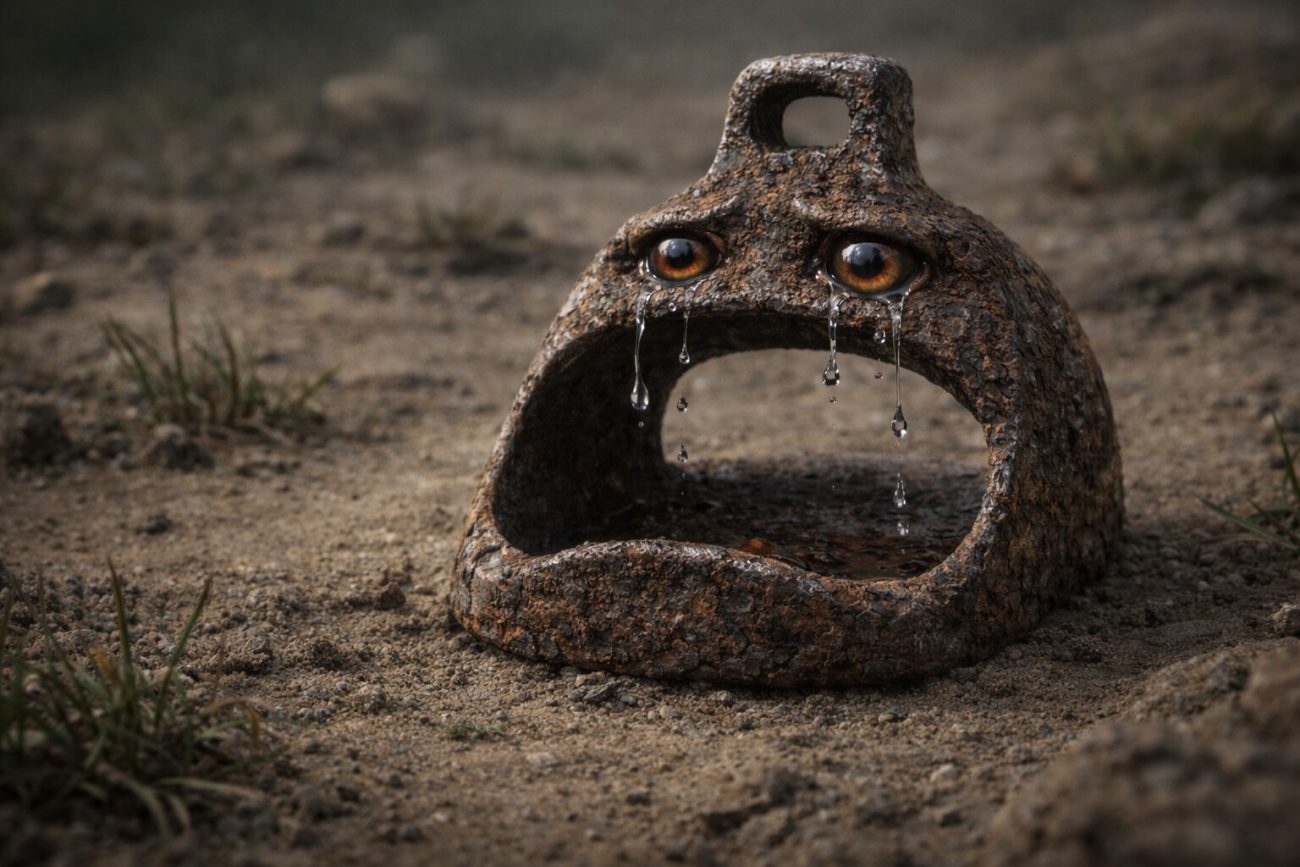
The iron frame sprouted coarse fur, and where the foot once rested, a mouth formed—wide, soft, and wordless. Thus the Abumi-guchi was born, a tsukumogami shaped not by malice, but by longing.

Unlike many yōkai, the Abumi-guchi does not roam. It does not hunt, trick, or frighten travelers. It remains where it fell, half-buried in grass or mud, facing the direction from which its master once rode. It waits patiently, endlessly, believing that the warrior will return to claim it.

Those who encounter an Abumi-guchi describe it as gentle and sorrowful. It does not attack. It does not speak. If approached, it merely watches with its hollow mouth, as though expecting a familiar presence. Some say it shifts slightly when footsteps approach, mistaking strangers for its long-dead owner.

The Abumi-guchi is said to endure until it finally decays completely, or until time itself erases the memory of the battle. Until then, it remains a symbol of loyalty without reward—an object bound to a purpose that can never again be fulfilled.

In Japanese folklore, the Abumi-guchi stands as a quiet reminder that even tools can grieve, and that devotion, when left behind, may linger far longer than the lives that once gave it meaning.


Gallery


Sources

Yokai.com contributors. (n.d.). Abumi-guchi. In Yokai.com — The Japanese Mythology Database, from https://yokai.com/abumiguchi/

Wikipedia contributors. (n.d.). Abumi-guchi. In Wikipedia, The Free Encyclopedia, from https://en.wikipedia.org/wiki/Abumi-guchi


Interpretive Lenses

Religious Readings
  • Christian Ascetic Deep Dive
Philosophical Readings
  • Nietzschean Deep Dive
Psychological Readings
  • Jungian Deep Dive
Esoteric Deep Dive
  • Hermetic Deep Dive
Political / Social Readings
  • Marxist Deep Dive
Other
  • How to Invite The Abumi-guchi

Azuki Hakari

Tradition / Region: Japanese Mythology
Alternate Names: Azukihakari, Bean Counter
Category: Yōkai, Household Dweller, Red beans


The Myth

In the quiet hours after midnight, when houses settle and the world grows still, the Azuki Hakari makes itself known—not by sight, but by sound.

It is said to dwell in rural homes, temples, and old buildings, hiding in attics, ceilings, or garden shadows. No one has ever seen an Azuki Hakari. Its presence is announced only through a sequence of noises that unfold with deliberate precision, as though following a ritual known only to the spirit itself.

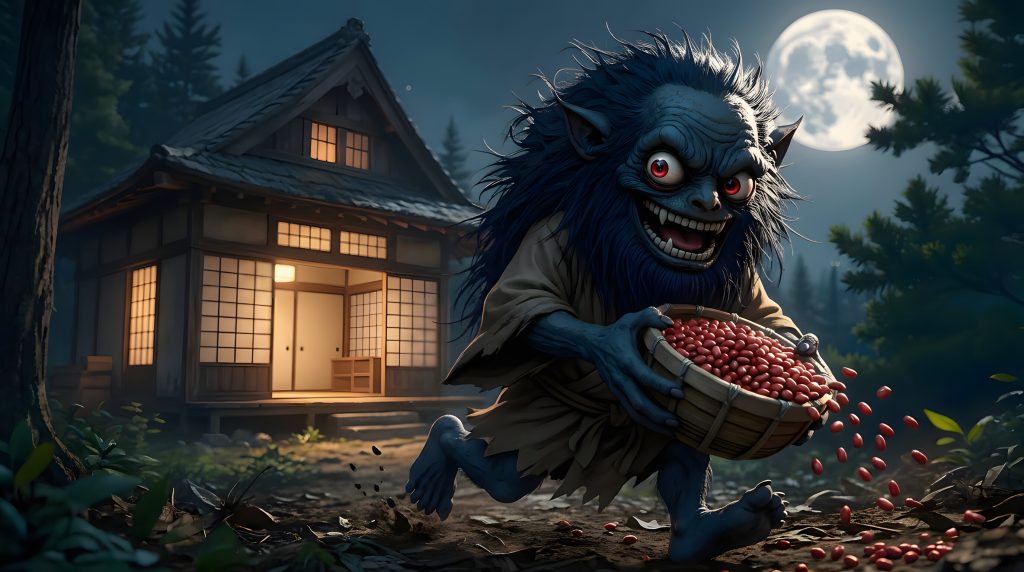
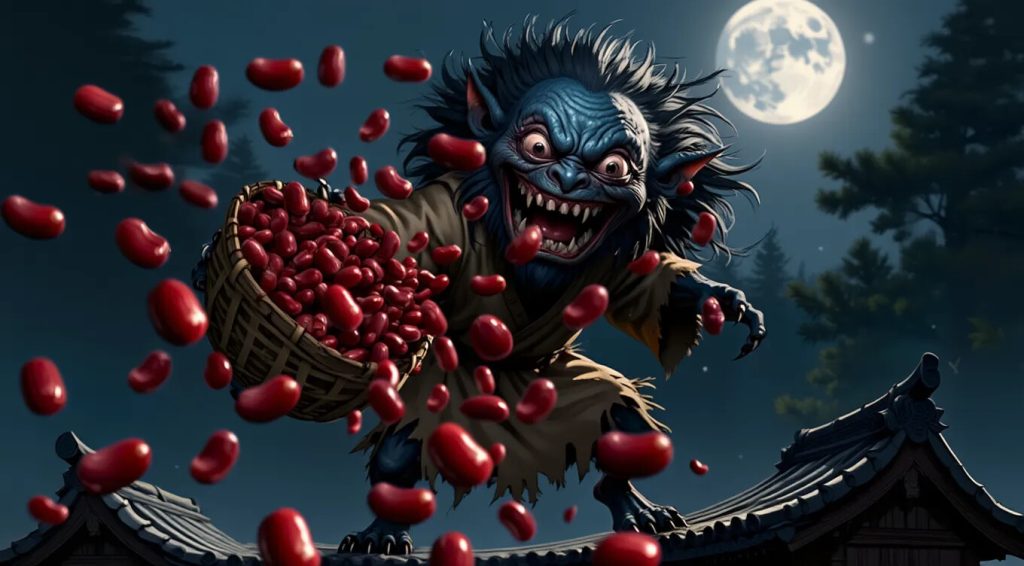
An encounter often begins with heavy footsteps above the room, pacing slowly in the narrow space between ceiling and roof. The steps are deliberate, neither hurried nor random, as if someone were measuring the house from above. Soon after, another sound joins the steps: the dry, rhythmic scattering of azuki beans, striking against windows or sliding doors. The sound repeats steadily, like counting—bean after bean—growing louder with time.

As the night deepens, the noises change. The dry patter of beans becomes the sound of splashing water, as though something unseen were washing or pouring liquid nearby. Finally, the rhythm resolves into the unmistakable clack of geta—wooden sandals—walking just outside the room, circling the house.

Those who dare to open the door or window in response are met with sudden silence. The footsteps vanish. The beans are gone. No water remains. There are no tracks, no marks, no sign that anything was ever there.

In older accounts, it is said that the Azuki Hakari may sometimes cause dust or scraps of paper to fall from the ceiling, but it never harms the residents. It does not steal, attack, or speak. Its purpose is unknown. It simply performs its nocturnal counting and departs.

Because the Azuki Hakari is never seen, its true nature remains uncertain. Some believe it is related to other azuki spirits, while others insist it is something separate—an invisible presence made entirely of sound. In many stories, encounters once attributed to river-dwelling azuki yōkai are now believed to have taken place within homes, pointing instead to the silent work of the bean counter.

Thus the Azuki Hakari endures in folklore as a reminder that not all spirits announce themselves with form or violence. Some are known only by rhythm and repetition, by footsteps in the dark and beans that were never there—proof that even an empty house is never truly empty.


Gallery


Sources

Wikipedia contributors. (n.d.). Azukihakari. In Wikipedia, The Free Encyclopedia, from https://en.wikipedia.org/wiki/Azukihakari

Yokai.com contributors. (n.d.). Azukihakari. In Yokai.com — The Japanese Mythology Database, from https://yokai.com/azukihakari/


Interpretive Lenses

Religious Readings
  • Christian Ascetic Deep Dive
Philosophical Readings
  • Nietzschean Deep Dive
Psychological Readings
  • Jungian Deep Dive
Esoteric Deep Dive
  • Hermetic Deep Dive
Political / Social Readings
  • Marxist Deep Dive
Other
  • How to Invite The Azuki Hakari