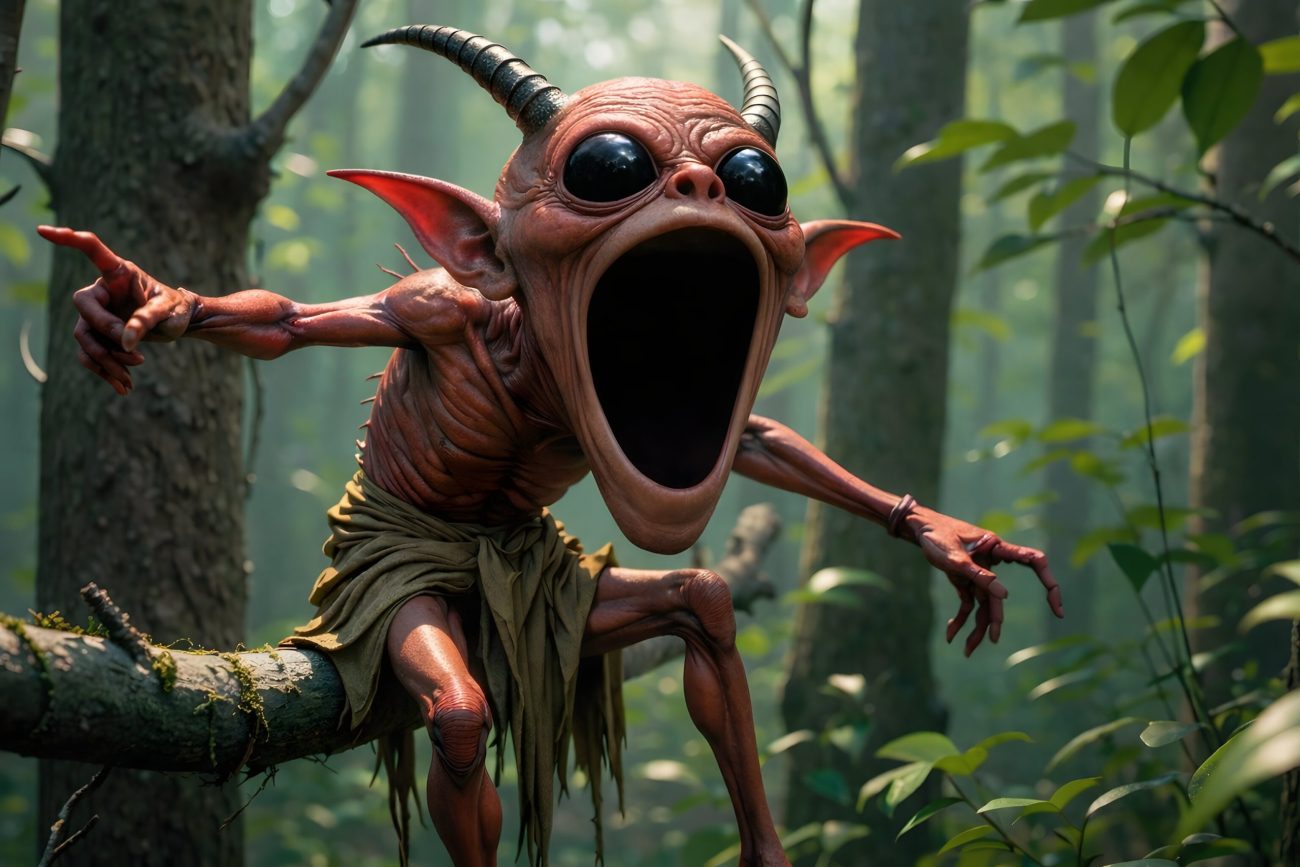
Devil Boruta

Tradition / Region: Polish mythology
Alternate Names: Boruta, Błotnik, Borowiec
Category: Demon, Swamp dweller, Shapeshifter


The Myth

In the forests, swamps, and muddy roads of Poland, people long spoke of Devil Boruta, a spirit who delighted in confusing travelers and leading them astray at night. When carts became stuck in the mud or paths vanished in the dark, it was Boruta who was blamed—lurking unseen, laughing as people wandered in circles through marsh and woodland.

Boruta was not always imagined as a horned demon. In older folk belief, he was closer note a wild forest spirit, a remnant of pre-Christian beings who ruled untamed places. After Christianization, this spirit was reshaped into a devil, though he retained his connection to bogs, dams, forests, and muddy crossings. He could appear suddenly as a black dog, slip through reeds as a shadow, or remain unseen while his presence was felt through fear and confusion.

Later stories—especially those popularized in books—portrayed Boruta as a devil dressed like a nobleman, tempting the upper classes with pride, corruption, and excess. Yet among common folk, Boruta was far less refined. He was a błotnik, a swamp devil, called upon when wagons sank into mud or when travelers lost their way. Peasants did not fear him as a tempter of souls so much as a malicious spirit of difficult terrain, a force of nature that punished arrogance and carelessness.

Boruta did not rule hell, nor did he demand worship. He belonged to the borderlands—between forest and field, road and swamp, safety and danger. To meet him was not always fatal, but it was humiliating, exhausting, and frightening. Those who mocked him or wandered carelessly risked being lost until dawn.

In this way, Devil Boruta stands as a shadow of older pagan spirits: no grand lord of evil, but a sly, muddy trickster who reminds humans that the wild places do not belong to them.


Gallery


Sources

Wikipedia contributors. (n.d.). Devil Boruta. In Wikipedia, The Free Encyclopedia, from https://en.wikipedia.org/wiki/Devil_Boruta


Interpretive Lenses

Religious Readings
  • Christian Ascetic Deep Dive
Philosophical Readings
  • Nietzschean Deep Dive
Psychological Readings
  • Jungian Deep Dive
Esoteric Deep Dive
  • Hermetic Deep Dive
Political / Social Readings
  • Marxist Deep Dive
Other
  • How to Invite The Devil Boruta

Mężyk

Tradition / Region: Polish mythology
Alternate Names: Mały mąż, mały człowiek, mały mężczyzna
Category: Demon, Gnome


The Myth

In the old beliefs of the Pomeranian people, Mężyk was a feared male demon who preyed upon the most vulnerable moments of human life. He was especially dangerous to women who had just given birth and to their newborn children, striking during the fragile time of childbirth and early infancy.

Mężyk was described as a small, male figure with a beard so long it reached all the way to the ground. He moved unseen through homes at night, slipping close to cradles. When his moment came, he would seize a child from its crib and hurl it onto the bench near the hearth. If no one intervened in time, he would steal the infant away completely, carrying it down into the underground world from which he came. Some believed the stolen children were never returned, replaced instead with sickly or unnatural beings.

He was considered the male counterpart to dangerous female spirits such as the dziwożony, mamuny, sybiele, and boginki—beings likewise blamed for the disappearance or exchange of infants. Together, these spirits embodied the deep anxieties surrounding childbirth, infant mortality, and unseen forces lurking at the edge of the household.

To protect against Mężyk, families relied on simple but powerful defenses. Iron or steel objects were placed in the cradle—knives, nails, or other metal items—believed to repel the demon and prevent him from approaching the child. Through such measures, people sought to guard newborns from the bearded thief who waited in the shadows, ready to snatch life away before it had fully begun.


Gallery


Sources

Wikipedia contributors. (n.d.). Mężyk (demon). In Wikipedia, The Free Encyclopedia (Polish), from https://pl.wikipedia.org/wiki/M%C4%99%C5%BCyk_(demon)


Interpretive Lenses

Religious Readings
  • Christian Ascetic Deep Dive
Philosophical Readings
  • Nietzschean Deep Dive
Psychological Readings
  • Jungian Deep Dive
Esoteric Deep Dive
  • Hermetic Deep Dive
Political / Social Readings
  • Marxist Deep Dive
Other
  • How to Invite The Mężyk

Loviduch

Tradition / Region: Polish Mythology
Alternate Names:
Category: Forest dweller, Demon


The Myth

Loviduch is a forest demon found in the folklore of the Lasowiaks, a subethnic group of the Lesser Poles living on the Tarnobrzeg Plain in southeastern Poland. According to beliefs recorded in the 19th century, the loviduch dwelled in the Sandomierz Forest, where it lay in wait for restless souls wandering far from their proper place.

In appearance, the loviduch was described as strange and unsettling. It resembled a tuberous or onion-shaped body, set upon spiny, five-toed feet. Its limbs were short and thin, ending in long fingers armed with sharp claws. Though small and misshapen, it was considered fearsome because of its purpose rather than its strength.

The loviduch did not prey upon the living. Instead, it hunted ghosts and wandering spirits, capturing those restless souls that lingered in wastelands far from human settlements. Its dwelling was said to be the desolate, empty places, where such spirits were believed to roam. Once it seized a soul, the loviduch tormented it relentlessly, mocking it and making it cry, though it never destroyed it outright.

Despite its cruel treatment of spirits, the loviduch posed no danger to living people. Humans were not its concern, and it did not attack or harm them. Its role was limited entirely to the supernatural realm, acting as a tormentor of the dead who failed to find rest.

Over time, the name loviduch came to be applied jokingly or disparagingly to certain medical workers, though this usage bore no resemblance to the original being. Unlike these human namesakes, the true loviduch of folklore remained a creature concerned only with ghosts and spirits, dangerous solely to the dead and invisible to the living.


Gallery


Sources

Bestiary.us contributors. (n.d.). lovidukh. In Bestiary.us, from https://www.bestiary.us/lovidukh


Interpretive Lenses

Religious Readings
  • Christian Ascetic Deep Dive
Philosophical Readings
  • Nietzschean Deep Dive
Psychological Readings
  • Jungian Deep Dive
Esoteric Deep Dive
  • Hermetic Deep Dive
Political / Social Readings
  • Marxist Deep Dive
Other
  • How to Invite The Loviduch

Bolts

Tradition / Region: Polish Mythology
Alternate Names: Errors
Category: Forest dweller, Demon


The Myth

Bolts are malicious forest or field demons known in the folk tales of Eastern Lesser Poland. They are believed to lure people away from proper paths, drawing travelers into wilderness, fields, or unfamiliar terrain where they lose their sense of direction.

These beings are closely associated with confusion and delusion, and are sometimes described as manifestations of madness or devilish influence. In local belief, bolts often appeared to people returning at night—especially those walking home from inns or taverns—leading them astray and preventing them from finding their way.

In the region of the Rzeszów Foothills, bolts were closely related to another figure known as the error, a demon said to sit at crossroads, sometimes beneath stones. Like the bolt, this being led nighttime travelers through open fields, causing spatial disorientation and helpless wandering. Because of these beliefs, people erected roadside shrines at such places and held special processions there, hoping to protect themselves from being misled.

Bolts were thought to nest near roads and highways, choosing places where travelers were most vulnerable. By means unknown, they caused sudden loss of orientation, making familiar routes feel unfamiliar. They seemed to take particular pleasure in confusing those who had spent the evening drinking, and many tales describe people arriving home at dawn ragged, bruised, and without their belongings, claiming that a bolt had led them astray.

In popular explanation, such misfortune was attributed not to human error, but to the direct action of these demons. To say that “a bolt went wild” became a way of explaining unexplained wandering, exhaustion, and loss.

Though later generations joked that the demon itself may have vanished, folklore preserves the belief that the experience of confusion in the night—of losing one’s way without knowing how—has never entirely disappeared.


Gallery


Sources

Bestiary.us contributors. (n.d.). Bolts. In Bestiary.us, from https://www.bestiary.us/belty/pl


Interpretive Lenses

Religious Readings
  • Christian Ascetic Deep Dive
Philosophical Readings
  • Nietzschean Deep Dive
Psychological Readings
  • Jungian Deep Dive
Esoteric Deep Dive
  • Hermetic Deep Dive
Political / Social Readings
  • Marxist Deep Dive
Other
  • How to Invite The Bolts