Sailors in the northern seas told of a strange being that appeared only when storms were near.
It was called the margyg.
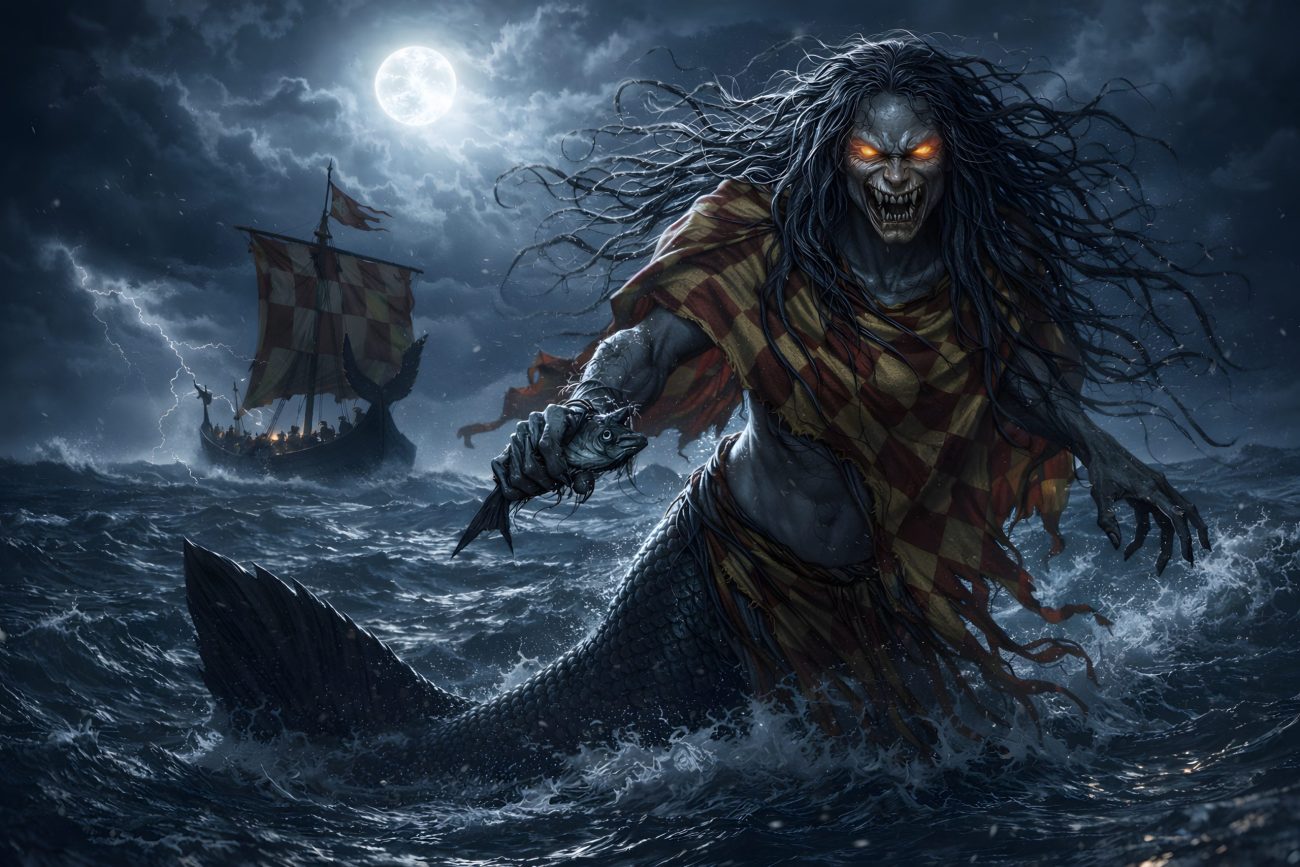
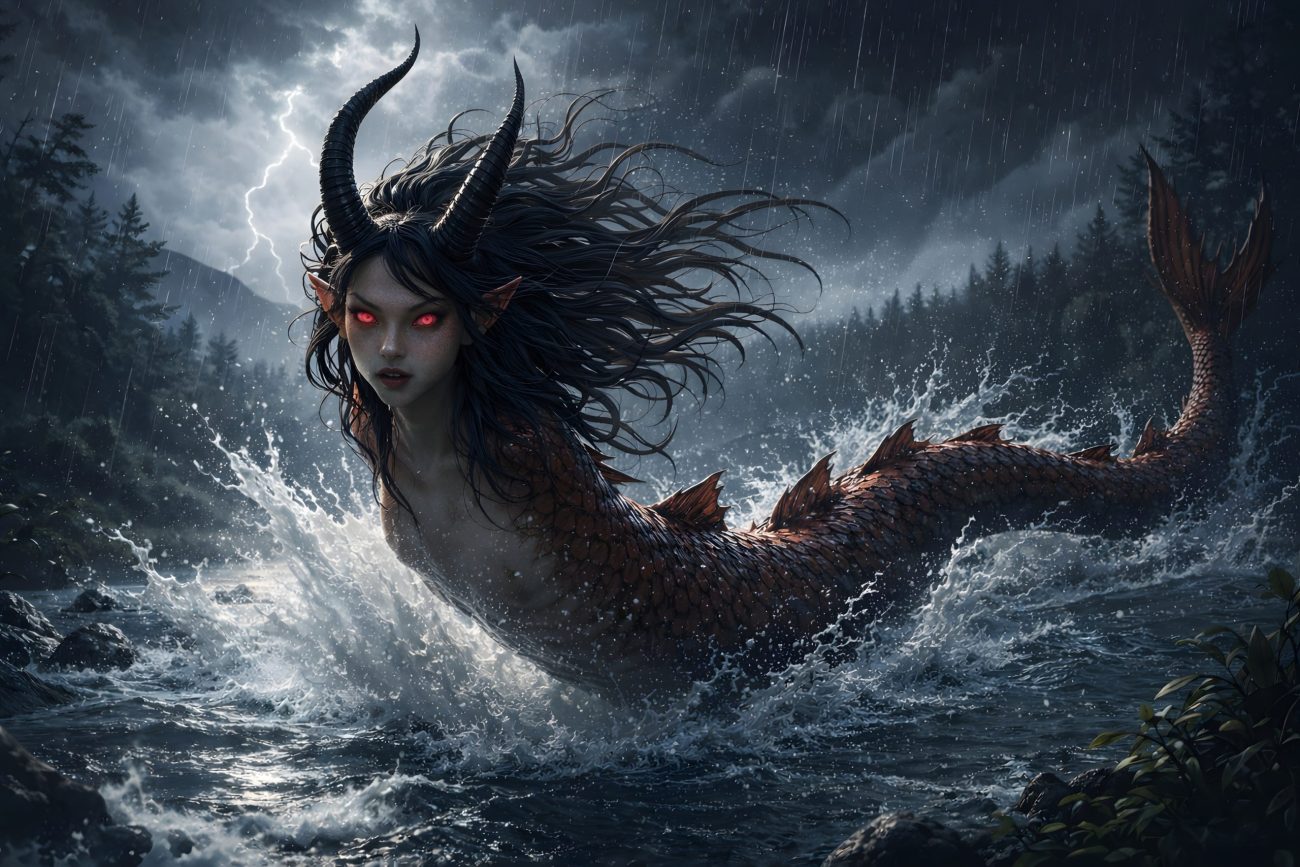
Those who saw it said it rose from the sea like a woman from the waist up, but vast and unsettling in form. Its chest was heavy, its arms long, and its hair streamed down wet over its shoulders. Its head and neck resembled those of a human, yet its face was coarse and fearsome, with a wide mouth, heavy cheeks, and a low brow. Its hands were large, and the fingers were joined together by webbing like the feet of seabirds.
Below the waist, it was wholly a fish, covered in scales with fins and a powerful tail.
The margyg was said to appear rarely, and almost always before a great storm. Sailors would spot it rising above the waves, holding a fish in its hands.
If it swam toward a ship, tossing the fish toward the vessel or playing with them as it approached, the crew believed disaster was coming and feared they would not survive the storm.
But if the margyg ate the fish, or threw them away from the ship and turned aside, the sailors took heart. Though the storm might still strike, they believed they would live through it.
For this reason, the margyg was not merely a monster of the sea, but a sign — a creature whose brief appearance foretold the fate of those who sailed beneath the darkening sky.
Sources
Bestiary.us contributors. (n.d.). Margjug. In Bestiary.us, from https://www.bestiary.us/margjug/
Along the wide waters of the Mekong River, people speak of a being who rises when evening falls and the river turns to silver under the moon.
She is called Haan Phaayaan.
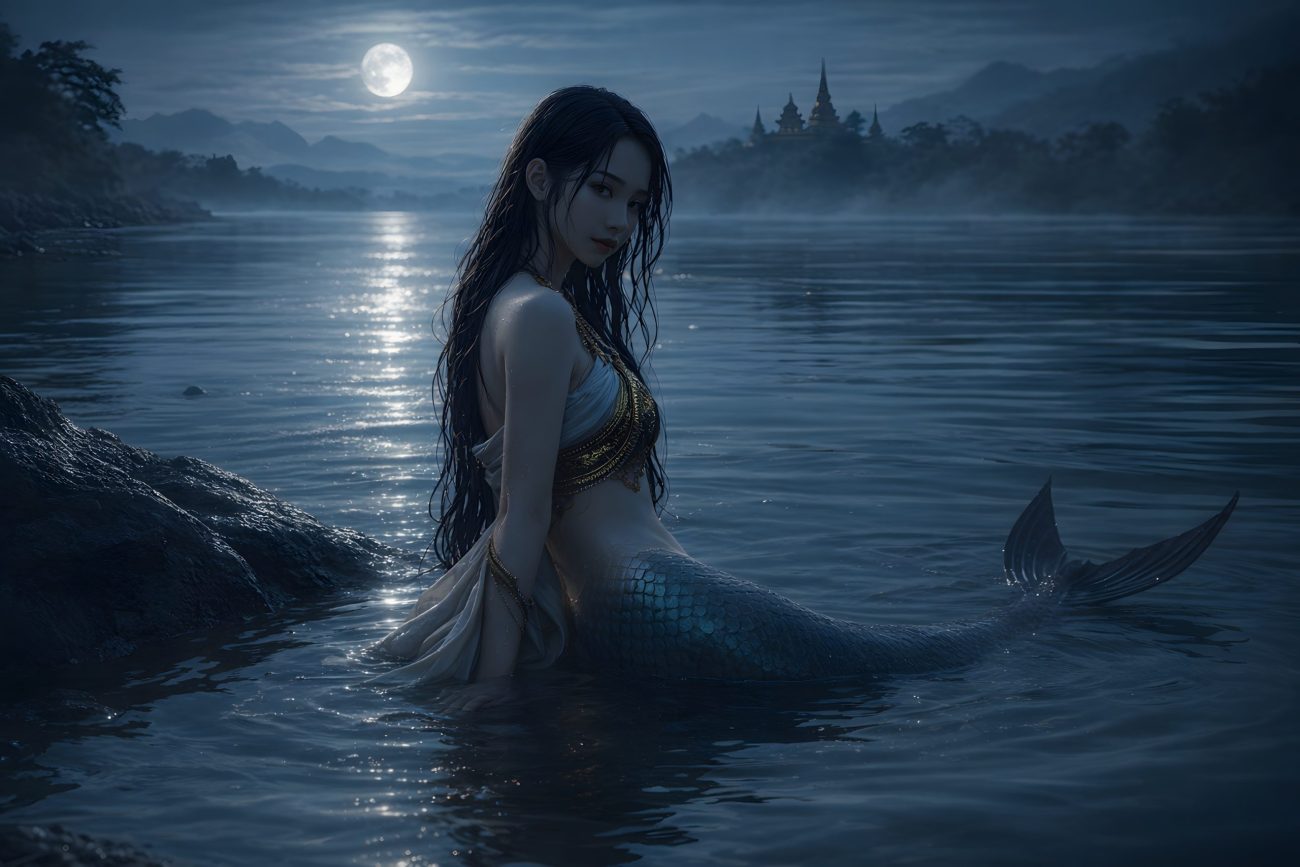
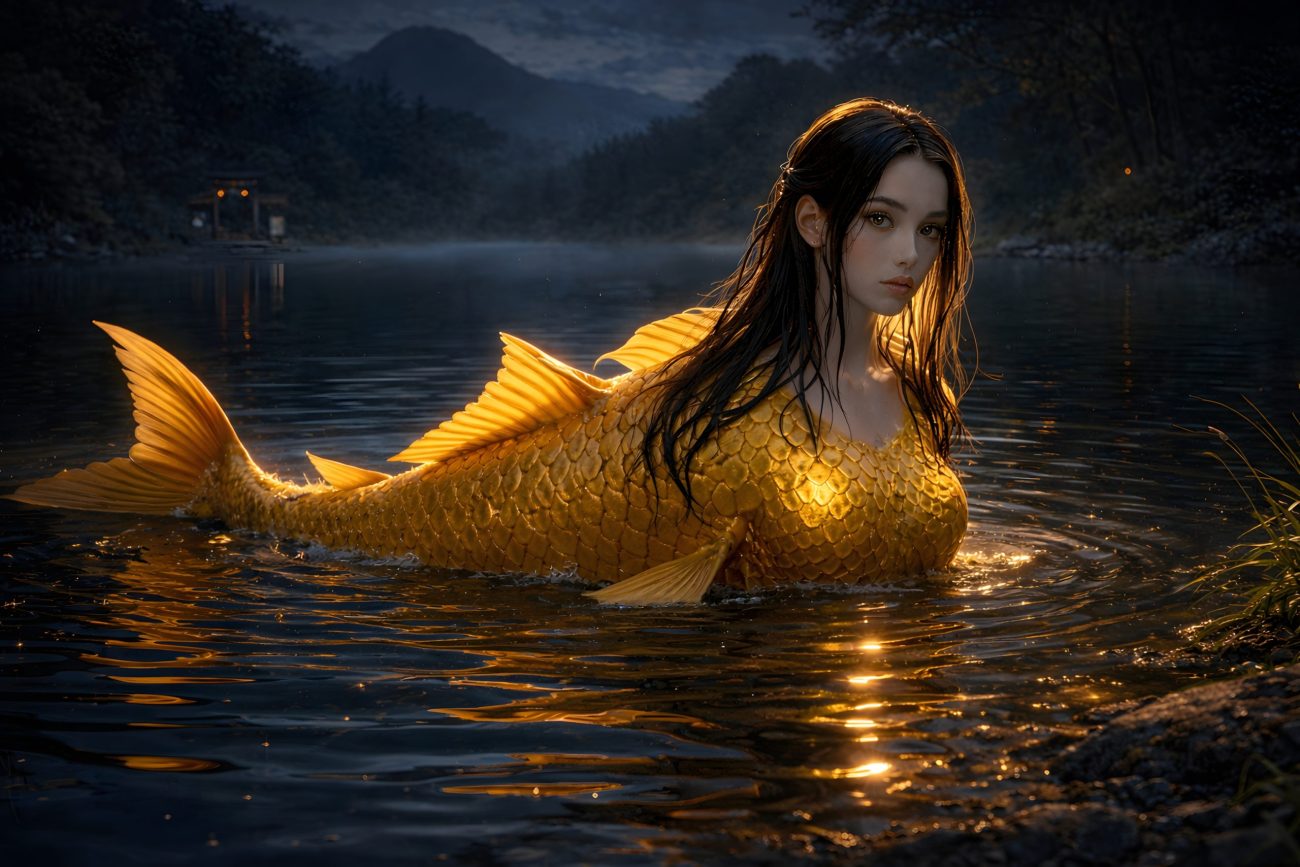
Fishermen say that on quiet nights, when the current slows and the air grows heavy, a figure can sometimes be seen rising from the dark water. She appears as a beautiful woman of the river, her form half human and half aquatic, her hair wet and shining as she sits upon rocks or drifts near the shore.
Those who see her are said to feel a strange pull toward the water. Travelers resting by the banks, and fishermen alone in their boats, have told of hearing a soft voice or song carried over the river’s surface. Some follow the sound, thinking it comes from another person nearby, only to find the river empty.
Others say the Haan Phaayaan watches silently, slipping beneath the water if approached, leaving only ripples behind.
For this reason, many along the Mekong treat the river with caution after sunset. For while the water gives life and food, it is also the home of the unseen — and on certain nights, the Mekong Mermaid is said to rise once more from the depths, watching those who pass along her river.
On the quiet shores of Little Exuma lies a small beach known as Pretty Molly Bay. The sand there is pale and soft, and the water lies calm, but the place carries an old story the island has not forgotten.
Long ago, there lived a young woman called Molly. Some say she was enslaved and suffered greatly in life. One night she drowned in the waters of the bay, and after her death her spirit did not leave the place.
In one telling, Molly returned as a ghost. People claimed that on certain nights a woman could be seen walking along the shore, pale in the moonlight, wandering the beach where she died. Those who glimpsed her said she moved silently, as if still searching for something lost.
In another telling, Molly did not remain a ghost. Instead, the sea took her and changed her. She rose again from the water as a mermaid, young and beautiful, living beneath the waves of the bay. Fishermen and villagers said she could sometimes be seen in the water at dusk, watching from the shallows before slipping back into the deep.
To this day, the bay carries her name, and some who pass along the quiet beach still watch the water at sunset, wondering whether the figure they glimpse is only the light on the waves — or Pretty Molly herself, still lingering where land and sea meet.
In Slavic lands it was believed that not all who died in water truly left the world. Those who drowned—whether by accident, despair, or violence—might return as restless spirits bound forever to the element that took their lives. Such beings were called Topielce or Utopce.
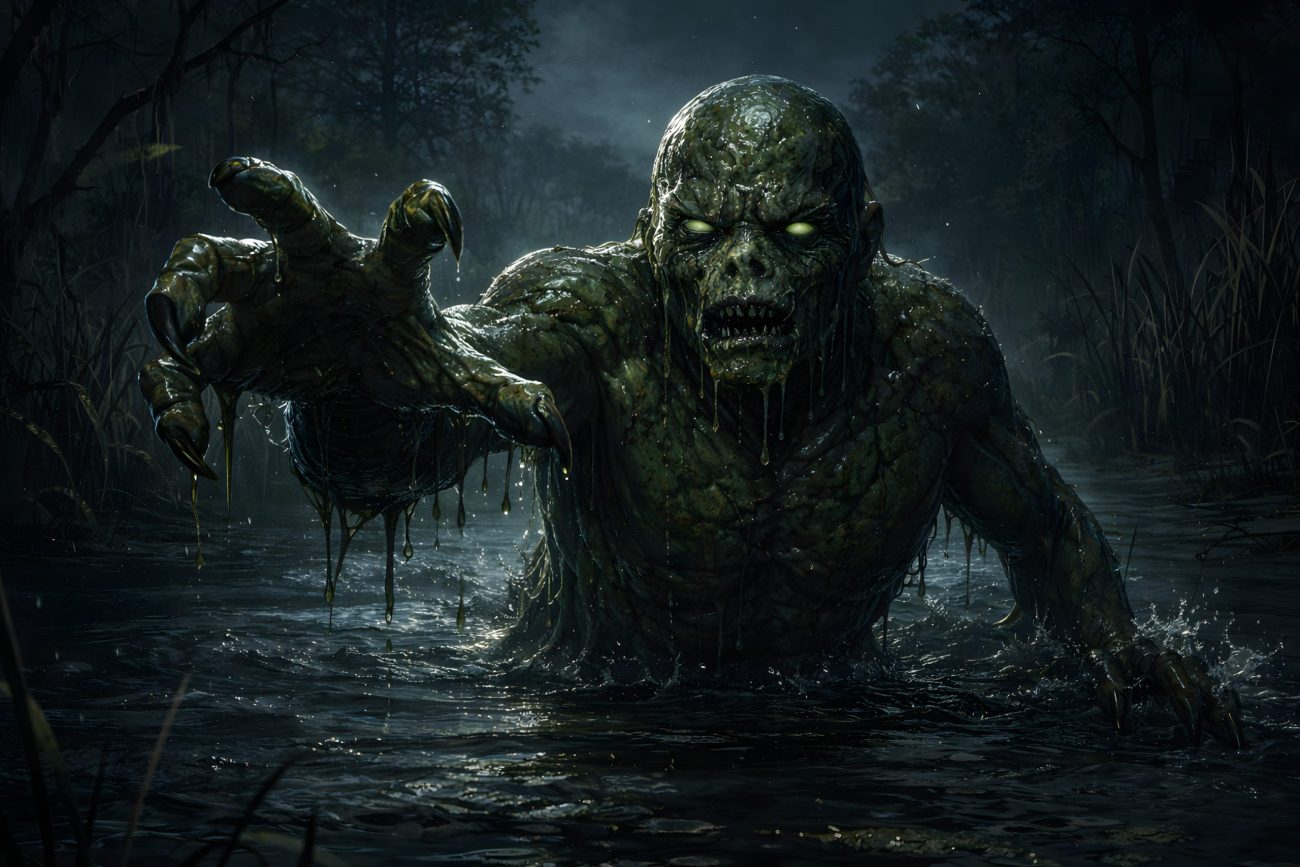
They were said to dwell in lakes, rivers, marshes, and deep ponds, hiding beneath still water or lurking among reeds and mud. The places where they lived were often silent and treacherous, the surface calm while danger waited below.
These spirits did not rest peacefully. Drawn by envy of the living, they were believed to seize people who came too close to the water’s edge. Bathers, fishermen, children playing on riverbanks, even animals drinking at a pond could suddenly be dragged down into the depths. Many said the spirit would clutch its victim with cold hands and pull them under, adding another soul to the water’s domain.
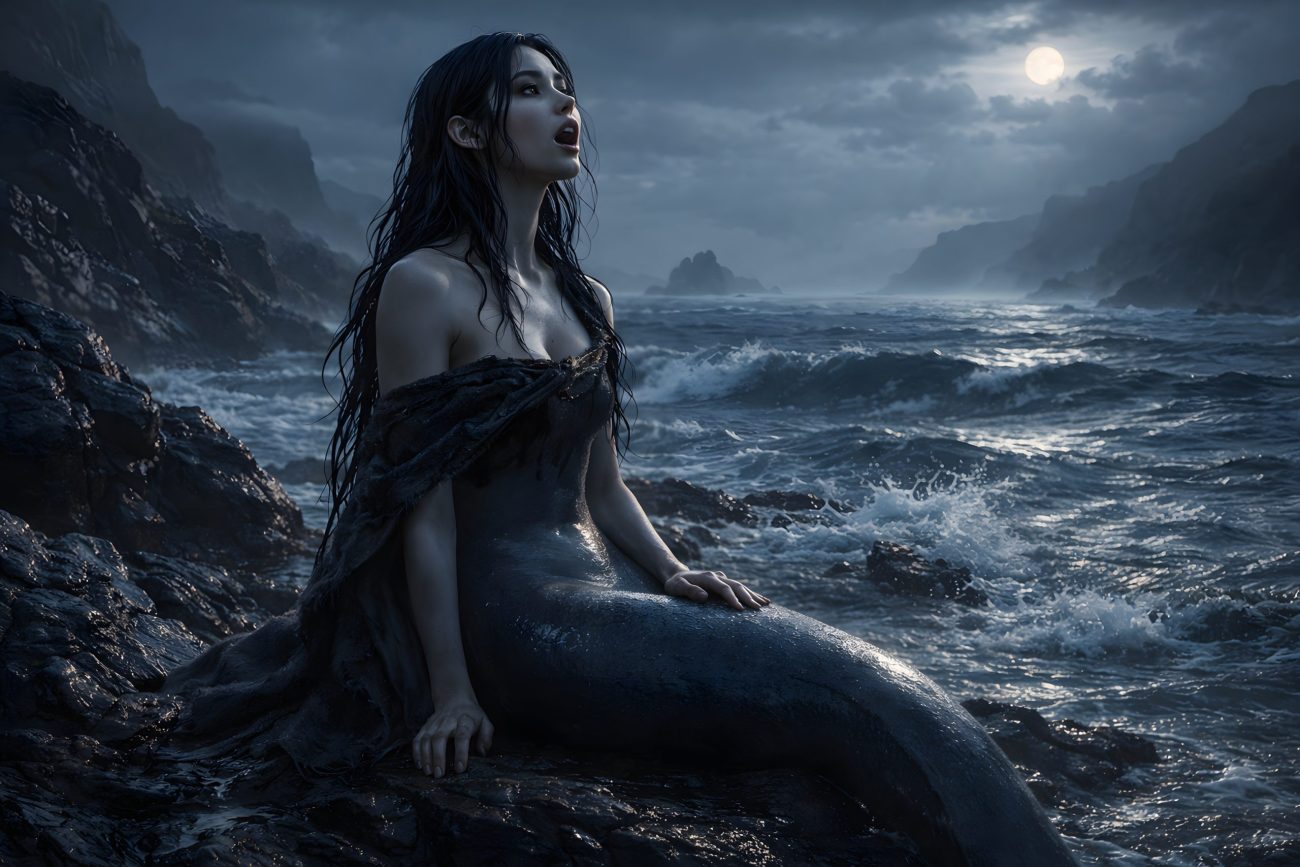
The female forms, called Topielice, were sometimes said to appear near the shore, luring the unwary closer before the water closed over them.
Because of this, people treated lonely waters with caution. They crossed themselves before swimming, avoided marshes at dusk, and warned children never to mock the river. For it was said that beneath the quiet surface, the drowned were waiting—forever bound to the waters that claimed them, and eager to draw the living down to join them.
Sources
Wikipedia contributors. (n.d.). Topielec. In Wikipedia, The Free Encyclopedia. Retrieved February 14, 2026, from https://en.wikipedia.org/wiki/Topielec
Among the Slavs it was said that not all restless spirits wander by day. Some belong to the deep hours of night, when the world is quiet and the living are most vulnerable. One such being was the Północnica — the Midnight Woman.
She was believed to be born from the soul of someone who had lived in great sin, or from a person who had suffered terrible wrongs in life. Such a soul, unable to find peace after death, might return as a malicious spirit. Some said a person could even become such a being while still alive, if their heart was consumed by powerful hatred, grief, or bitterness.
There were darker whispers too. It was said that if, during baptism or on a deathbed, the words of prayer were spoken wrongly, the mistake could doom a soul. A slip of the tongue might bind it to wander as a Północnica.
She was a creature of midnight. When the hour was deepest and the world lay still, she would move unseen through houses and villages. Her nature was not always murderous, but she was spiteful and fond of mischief. She troubled sleepers, stirred unease, and spread fear in the dark hours when no one wished to meet what walked outside.
Thus people spoke her name carefully, knowing that some spirits belong not to the grave, but to the hour when the night is at its blackest.
Sources
Wikipedia contributors. (n.d.). Północnica. In Wikipedia, The Free Encyclopedia. Retrieved February 14, 2026, from https://pl.wikipedia.org/wiki/P%C3%B3%C5%82nocnica
In the lands of the Bakongo it is said that the waters are not empty. Rivers, springs, and pools are watched by spirits called Simbi, beings who belong to both the world of the living and the unseen realm beyond it.
They dwell where water meets earth—at riverbanks, deep pools, waterfalls, and hidden springs. Some appear as beautiful water people like mermaids, rising from the surface with shining skin and long hair. Others take the form of snakes, flashes of fire, or shapes glimpsed only for a moment in clay, gourds, or rippling water. Wherever they dwell, the place becomes sacred.
Those who respect the Simbi may receive their favor. The spirits are said to guard the balance of nature, to protect the land, and to guide those who approach them with reverence. Sometimes they reward a person with wealth or protection, drawing treasures from the depths of the water or revealing hidden paths to fortune.
Stories tell of people who encounter a Simbi beside a river and return with gold, blessings, or healing. But the spirits are not to be taken lightly, for they belong to an older order of the world and must be treated with care.
When the people of Central Africa were carried across the ocean, the Simbi were said to travel with them. In distant lands, the spirits were still believed to live in rivers and marshes. Among the Gullah Geechee people, one tale tells of a girl named Sukey who meets a mermaid called Mama Jo. The water spirit protects her and gives her gold, just as the Simbi were said to bless their followers in the old homeland.
So the Simbi remain—guardians of water, keepers of hidden riches, and watchers at the boundary between this world and the next.
Sources
Wikipedia contributors. (n.d.). Simbi. In Wikipedia, The Free Encyclopedia. Retrieved February 14, 2026, from https://en.wikipedia.org/wiki/Simbi#Sukey_and_The_Mermaid
Tradition / Region: Scottish Mythology Alternate Names: Selkie folk, Seal folk, Haaf-fish (large seals in folklore) Category: Mermaid, Shapeshifter
The Myth
Along the coasts of the Northern Isles it is said that certain seals are not animals at all, but selkie folk—beings who live as seals in the sea and as humans when they shed their skins upon the shore. On quiet nights they come out of the water, remove their seal hides, and dance in human form under the moon.
Many tales tell of men who find one of these skins and hide it. When the selkie woman returns and cannot find her seal coat, she is trapped on land. The man forces her to become his wife, and though she lives with him and may bear his children, her heart is always with the sea. She spends her days gazing toward the waves, longing for the place she came from.
Years may pass this way, until one day she discovers the hidden skin—sometimes by chance, sometimes with the help of a child who unknowingly reveals its hiding place. The moment she touches it, she runs to the shore, puts it on, and slips back into the water. However much she loved her children, she does not return. Some say the children later see a great seal watching them from the sea, crying out softly as if in farewell.
There are also stories of male selkies. In human form they are said to be strikingly handsome and dangerously charming. They come ashore to seek out lonely women, especially those whose husbands are long at sea. A woman wishing to summon one might weep into the ocean, and the selkie would rise to her. From such unions children might be born, sometimes marked by webbing between their fingers or toes.
Other tales speak of seals that are killed by fishermen, only for their bodies to change into human form. Without their skins, these seal-people cannot return to their underwater homes. In one story, a stranded fisherman is carried safely back to shore by a grieving selkie in exchange for the return of a stolen skin, for without it the creature could never go back to the sea.
Thus the selkie folk are remembered as beings of two worlds—living in the deep, walking the shore in borrowed human shape, and forever drawn back to the water that is their true home.
Gallery
Sources
Wikipedia contributors. (n.d.). Selkie. In Wikipedia, The Free Encyclopedia. Retrieved February 14, 2026, from https://en.wikipedia.org/wiki/Selkie
Tradition / Region: Japanese Mythology Alternate Names: Terukagoyo; Terikabugyo-san (local name of the sacred carp) Category: Mermaid, Carp
The Myth
In the year 1646, a kind man named Otani Jinnai lived in Matsue with his wife Oryo. The couple longed for a child, and after many years of disappointment they prayed at temples and shrines throughout the land. At last they heard that Ogamiyama Shrine on Mount Oyama in Izumo was famed for granting children, and so they climbed the mountain to pray there.
As they descended, a thick fog suddenly swallowed the path. Out of the mist appeared a beautiful young woman who guided the lost couple safely down the trail. When she learned they had prayed for a child, she handed Jinnai a small bottle of water. She explained that it was sacred water made from dew gathered near Akamatsu Pond and offered at the shrine on New Year’s Day, and that drinking it would surely bring them the blessing they sought. Oryo drank it at once, feeling a strange certainty that their wish would be fulfilled. When they looked again, the girl had vanished.
The following year, Oryo gave birth to a daughter. The child was named O-Chiyo, and she grew into a girl of uncommon beauty and intelligence. When she reached sixteen, Jinnai’s nephew Tamaki asked for her hand in marriage. Though O-Chiyo felt troubled and uncertain, she could not bring herself to refuse her parents, and the engagement was arranged.
Before the wedding date was set, O-Chiyo made a request. She wished to visit Ogamiyama Shrine once more to report her coming marriage to the gods. Her parents agreed, and she set out for Mount Oyama with her nurse, Osuma. After offering her prayers at the shrine, the two began their return journey and passed by Akamatsu Pond—the very place where the mysterious girl had once given Jinnai the sacred water.
O-Chiyo stood gazing into the water for a long time. Then she walked to the edge and bent down. Suddenly steam rose from the pond, and her expression grew grave. She turned to Osuma, thanked her gently, and spoke in a calm voice. She said that although she had lived as a human, it had only been a temporary form. In truth she was a carp of that region, and the pond was her real home.
She gave Osuma a letter for her parents and words of gratitude, then leapt into the water and vanished. As Osuma cried out in shock, a huge golden carp surged to the surface. The creature turned toward her, and its face was unmistakably that of O-Chiyo. Overcome, Osuma fell to her knees in prayer as the carp slipped back beneath the water.
When Osuma returned and told Jinnai and Oryo what had happened, they were filled with grief. In the letter, O-Chiyo explained that she was the sacred carp Terukagoyo and could never marry a human. She thanked them for raising her and said that if they ever wished to see her, they need only call her name by the pond.
Jinnai remembered hearing of a sacred carp said to dwell in Akamatsu Pond, and he realized that the gods of Mount Oyama had given that spirit to him as a daughter. He built a small shrine and placed O-Chiyo’s letter there. Soon after, he and his family went to the pond and called her name three times from the shore. A thunderous roar answered from beneath the water, but she did not appear.
From that time on, visitors to the pond began calling the carp’s name in the same way. The shrine became a place where young men and women prayed for blessings in love, and in the region the carp themselves came to be respectfully called Terikabugyo-san.
Tradition / Region: Japanese Mythology Alternate Names: Kaidzu-nin; sometimes simply called a mermaid or sea-being Category: Mermaid
The Myth
In Echigo Province, near the lagoon of Fukushimagata, strange lights began appearing over the water at night. From within the glow came a woman’s voice calling across the shore, echoing over the waves and unsettling the nearby villages. People whispered that something not of this world had come up from the sea, and most were too frightened to go near it.
At last a ronin named Shibata Dan, who was training as a warrior, resolved to witness the being for himself. Carrying a torch, he went to the water’s edge and waited. Before long, a radiant figure rose from the sea and faced him. It spoke calmly, introducing itself as Umidebito, a dweller of the sea.
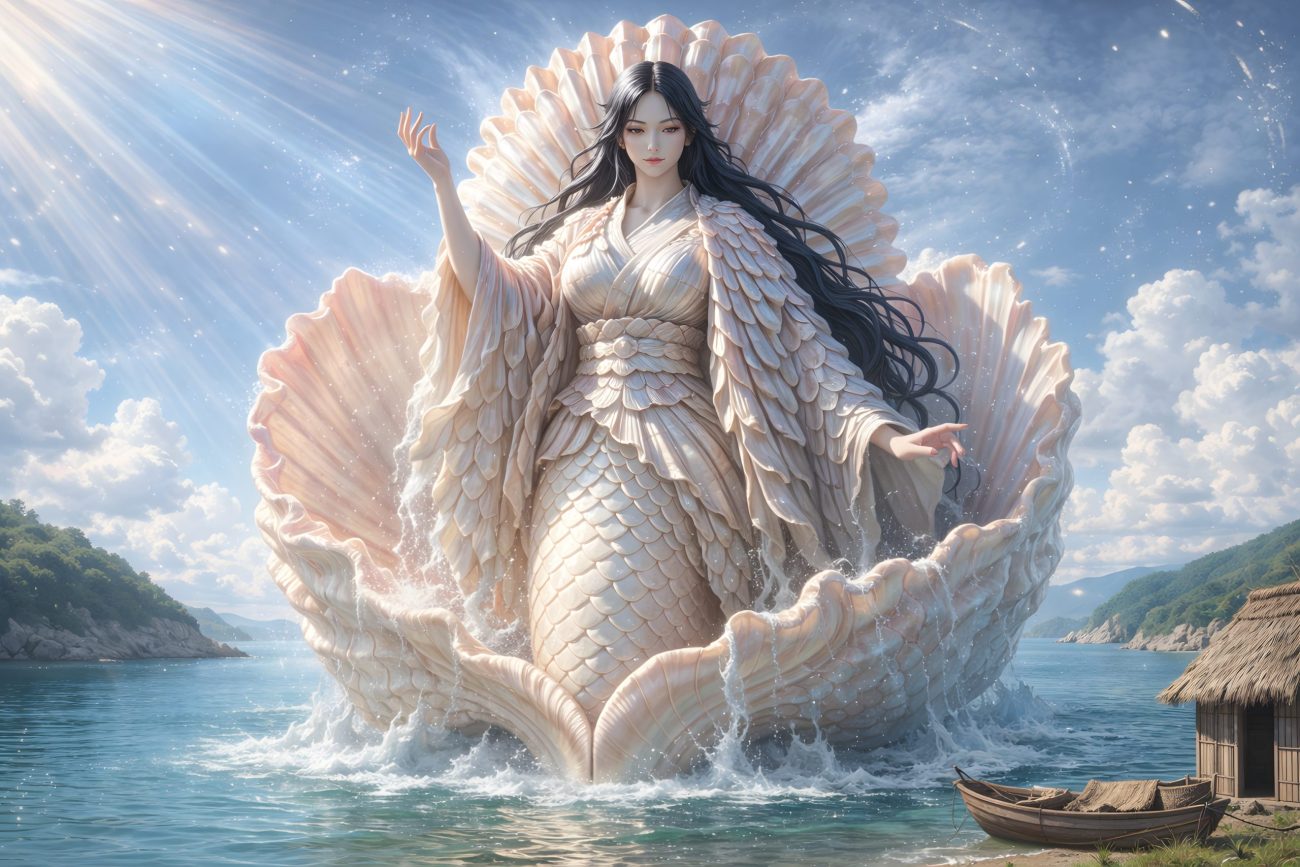
Its form was uncanny. From the head to the chest it resembled a human woman, but below that its body became scaled and unnatural, long and folding like some creature of the deep. The lower half of its body rested within a great conch shell, which floated upon the surface as if it were a small boat.
Umidebito then delivered its prophecy. It declared that the land would enjoy five years of rich harvests, but after that a terrible sickness would spread in the twelfth month, a plague so vast that it would kill most of the world’s people. It warned that the only way to avoid this fate was to paint its image, place the picture in one’s home, and pray to it each morning and evening.
When the message was finished, the being withdrew. The light faded, the sea closed over it, and Umidebito vanished into the darkness of the lagoon. Afterward, tales of the sea-woman spread, and images of her form were copied and kept by those who feared the coming disease.
Tradition / Region: Japanese Mythology Alternate Names: Hachimangū no kannushi no musume Sato Category: Mermaid
The Myth
In Hizen Province there once lived a girl named Sato, the daughter of the chief priest of a Hachiman shrine. When she was seventeen years old, she drowned in a large pond, and her body was never recovered. The villagers mourned her, and with time the story faded into memory.
Years later, on the twenty-sixth day of the second month in 1819, something strange occurred. The waters of the pond stirred, and Sato’s body rose from the depths.
She was no longer human.
Her form had become long and fish-like, covered in scales, with flippered limbs, a human face framed by long hair, and two horns upon her head. From her abdomen hung three shining jewels.
When people gathered in fear and wonder, she spoke:
“I am a messenger from the gods. For eight or nine years there will be a rich harvest. But after that, a great illness will come, and thirty to fifty out of every hundred people will die. Those who see my image will be spared from this calamity.”
As she finished speaking, the sky darkened. Black clouds gathered, rain fell in torrents, and the waters of the pond surged upward.
Then Sato rose into the sky and vanished.
Afterward, her likeness was copied and spread among the people, who kept her image as a charm against disease, remembering the drowned girl who returned from the water as a messenger of the gods.