Tsemaus

Tradition: Canadian Mythology
Alternative Names: Narhnarem-Tsemaus, Wi’git, Weegyet, Snag, Supernatural Snag
Category: Whale


The Myth

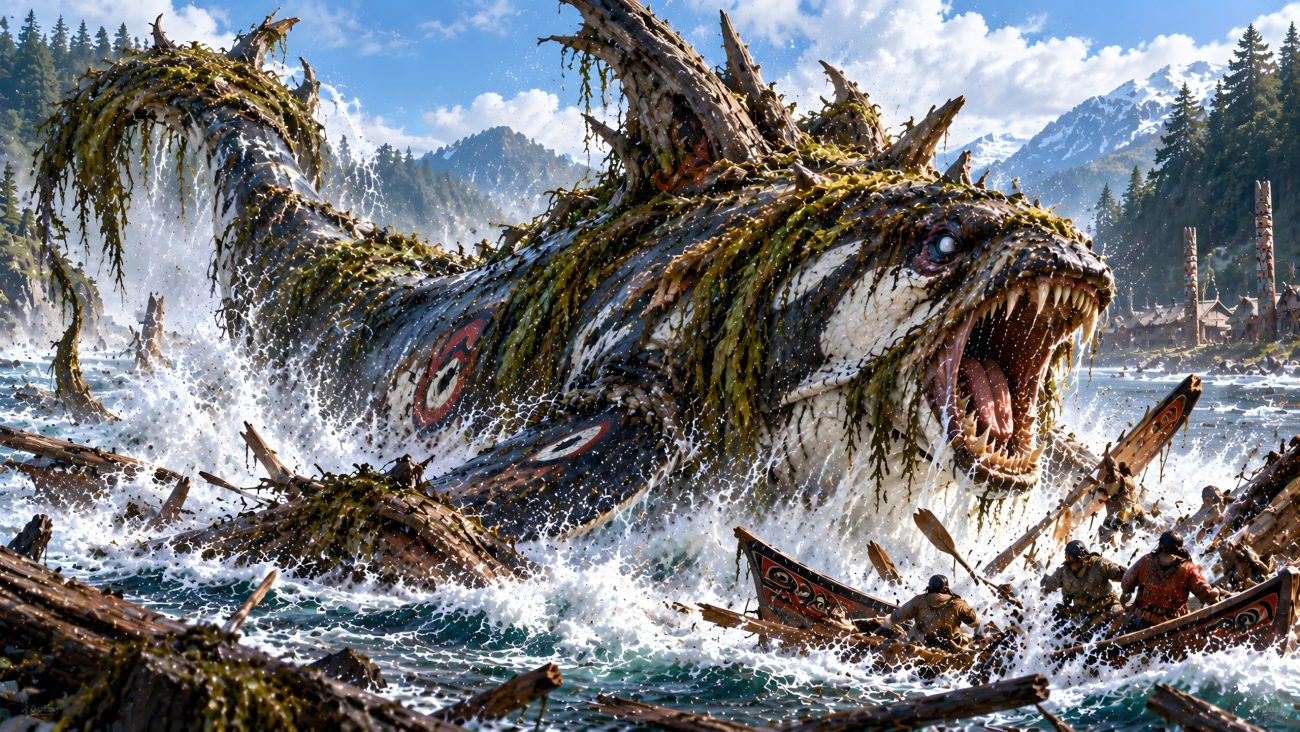
The Tsemaus is a supernatural creature from the folklore of the Pacific Northwest, particularly among the Tsimshian and Haida peoples around the mouth of the Skeena River. It personifies river snags, floating logs, and other hazards of the water. Its appearance varies, but it usually has a snag-like dorsal fin or takes the form of a snag itself. It may resemble a dead log with a swimming tail, a sea lion, a grizzly bear, a frog covered in seaweed, or a hybrid of a bear, raven, and killer whale. Some accounts even describe it as a canoe or schooner.

The Tsemaus uses its dorsal fin to destroy boats and can swim upstream through log jams. When angered, it leaps onto canoes and smashes them apart or creates enormous waves that capsize vessels. It drowns people, who then become killer whales.

The creature is associated with Raven the trickster, and the name Wi’git or Weegyet connects it to one of Raven’s many forms. The creator and trickster Nanki’islas also assumed the form of a Tsemaus. The creature appears as a crest on the totem poles of coastal clans.


Sources

“Tsemaus.” A Book of Creatures, October 16, 2015. https://abookofcreatures.com/2015/10/16/tsemaus/
Skötumóðir

Tradition: Icelandic Mythology
Alternative Names: Skate Mother
Category: Whale


The Myth

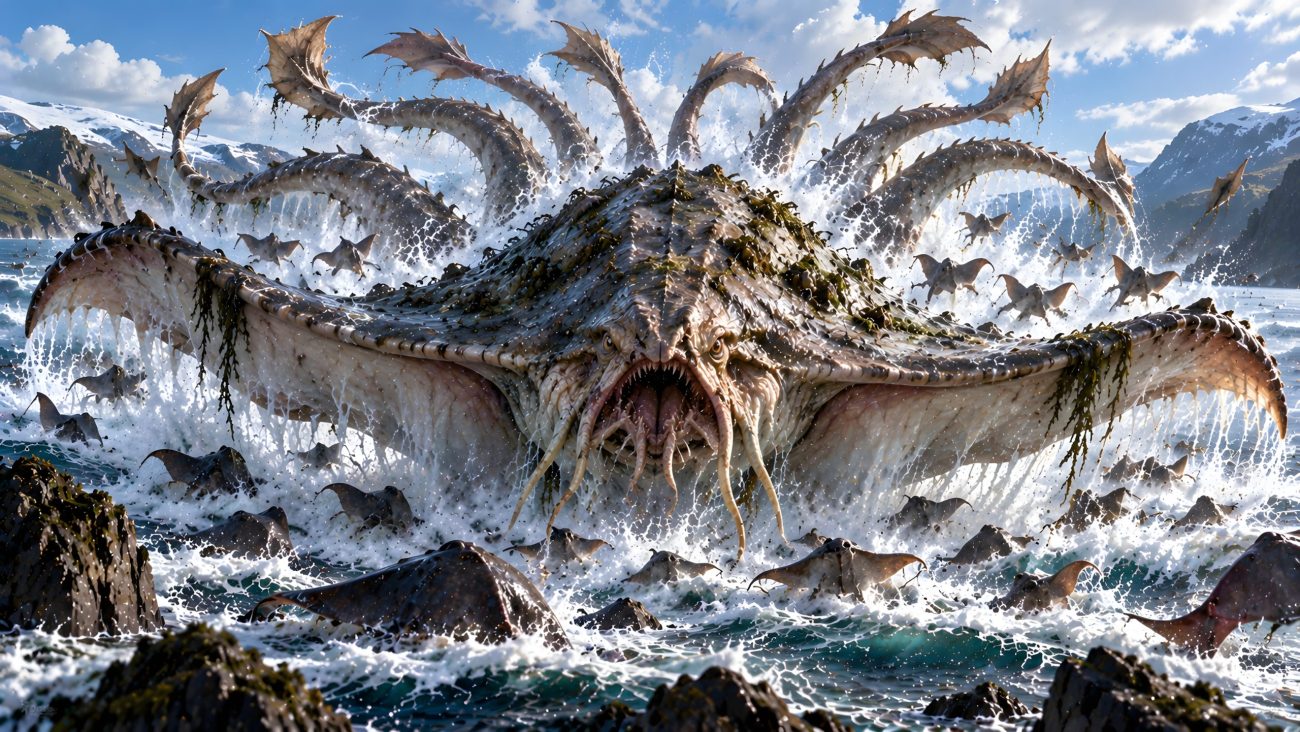
The Skötumóðir is an enormous, poisonous creature resembling a skate or ray. Like other Icelandic fish mothers, it is not always described as a skate itself; some accounts portray it as an evil whale resembling one. It has a back like a mud-covered island and nine tails. Unlike ordinary skates, it can appear inland, in freshwater, and even on dry land.

A swarm of skates always swims around a Skötumóðir. When fishermen catch these smaller fish, the sea appears to grow shallower as the Skate Mother rises towards the surface. It eventually hooks its wings over the sides of the fishing boat and drags it beneath the waves. To escape, the fishermen must immediately cut off the creature’s wings with a sharp implement.

An enormous skate believed to be a Skötumóðir was one of three monsters that terrorised travellers around Lagarfljót, where it waited near ferry crossings. A powerful sorcerer pinned it to the bottom of the river, where it was said to remain unless it had escaped.


Sources

“Skötumóðir.” A Book of Creatures, September 18, 2016. https://abookofcreatures.com/2016/09/18/skotumodir/


Trolual

Tradition: Norwegian Mythology
Alternative Names: Devil Whale
Category: Whale


The Myth

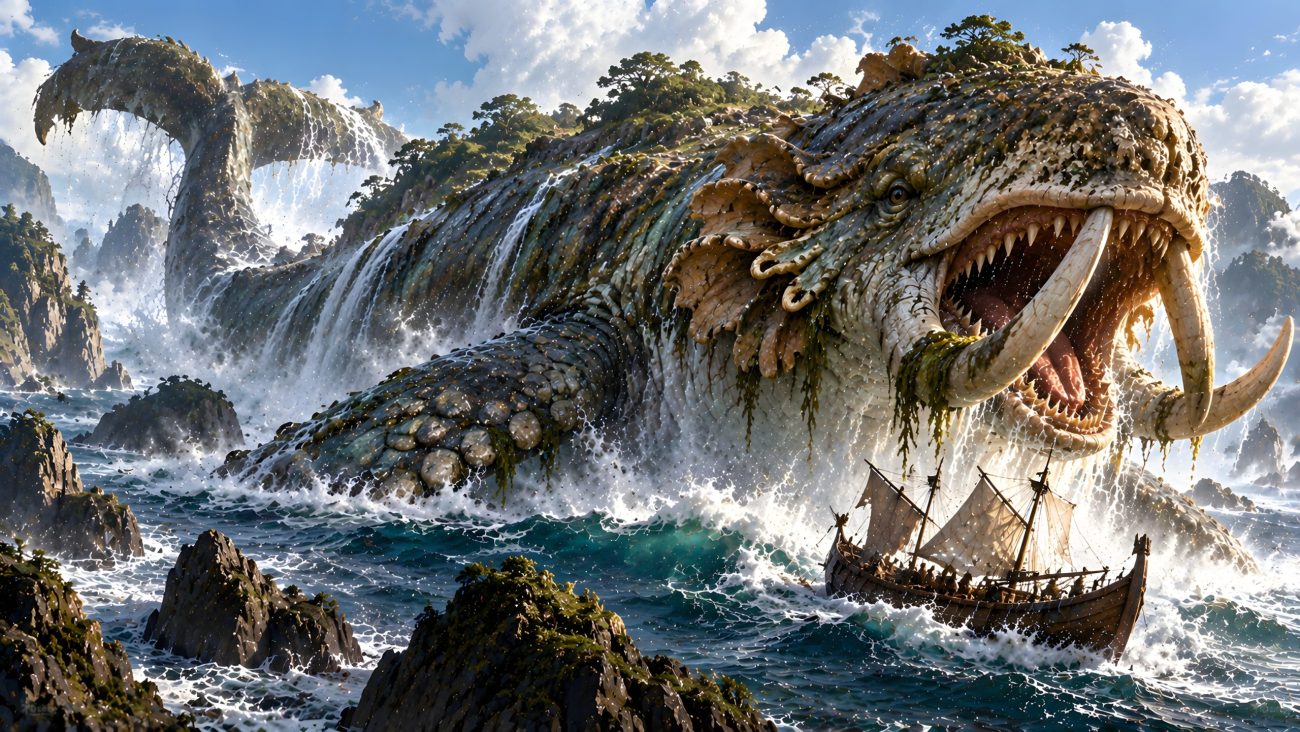
The Trolual is an enormous whale depicted on ancient ocean maps, particularly in the northern Atlantic around Scandinavia. It has prominent tusks, frills, paws, and large scales covering its body. These whales are said to be as large as mountains, with vegetation sometimes growing on their backs.

When a Trolual sleeps on the surface of the ocean, it resembles a small island. Unwary sailors may land on its back, walk around, or even build a fire before the whale awakens and dives beneath the waves, drowning anyone who remains aboard. Troluals also attack ships directly, crushing and overturning them.

Sailors can distract a Trolual by sounding trumpets, whose noise startles and confuses it, or by throwing barrels into the sea. While the whale plays with the objects, the ship can escape. Despite their enormous size, Troluals are exploited by humans, and according to Münster, Icelanders use their bones to build houses.

The Trolual appears in the tale of Alector, where one emerges off the coast of the Asian Tangut Empire and ravages harbours every full moon. It is eventually defeated and killed with the help of a magical flying hippopotamus.


Sources

“Trolual.” A Book of Creatures, June 8, 2015. https://abookofcreatures.com/2015/06/08/trolual/


Sverðhvalur

Tradition: Icelandic Mythology
Alternative Names: Sverðfiskur, Swordwhale, Swordfish, Brúnfiskur
Category: Whale


The Myth

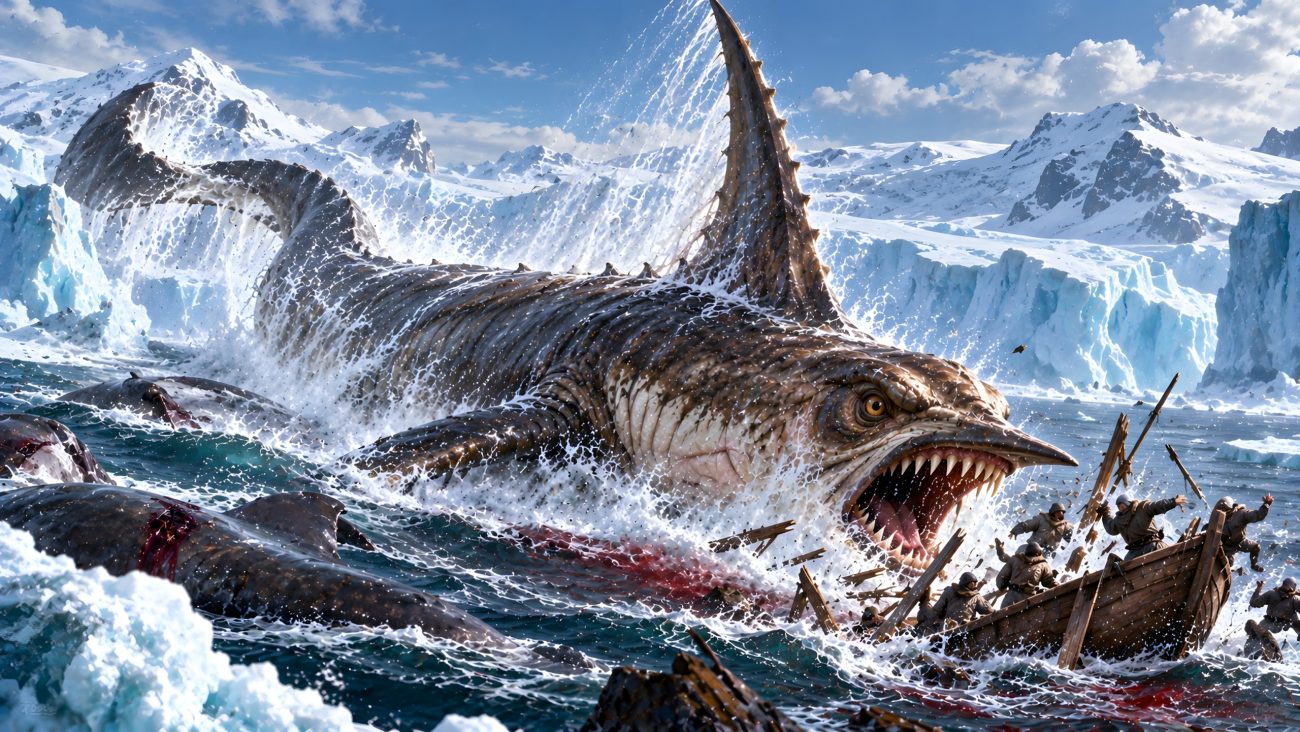
The Sverðhvalur is a monstrous whale from Icelandic folklore, roughly the size of a sperm whale. Its most distinctive feature is a sharp, bony dorsal fin measuring between 1.5 and 6 metres tall. It has an owl-like face, a pointed snout, a large mouth filled with vicious teeth, and short, heavy spouts. Its colour is described as either brown or grey. It swims rapidly and strikes the water with its fin when agitated.

One of the illhveli, or evil whales, the Sverðhvalur is a dangerous predator whose bladed fin can cut open the bellies of other whales. It swims beneath them, making crisscrossing slashes, and its attacks can drive whales to beach themselves to escape. It feeds only on the tongues of its cetacean prey, leaving the rest of their bodies to rot. It attacks boats in a similar manner, piercing hulls with its dorsal fin or slicing through smaller vessels and their crews. The blue whale, or steypireyður, is its mortal enemy.

The Sverðhvalur is sometimes accompanied by a smaller whale that swims beneath its pectoral fin and feeds on its leftovers. However, larger ships can also injure or frighten it. One trading vessel travelling from eastern Iceland to Copenhagen discovered a large fish’s tusk embedded in its hull after feeling a powerful tug beneath the water. In another encounter off Eyjafjörður, a Sverðfiskur pursued a boat until a gun was fired into its open mouth, causing it to abandon the chase.

The creature is believed to have originated from accounts of the killer whale, which, like the Sverðhvalur, has been associated with attacks on whales and ships using its fins. The names Sverðfiskur and Sverðfiskr have also been used for swordfish, sawfish, and killer whales.


Sources

“Sverðhvalur.” A Book of Creatures, February 12, 2016. https://abookofcreatures.com/2016/02/12/sverdhvalur/


Bakekujira

Tradition: Japanese Mythology
Alternative Names: Hone Kujira, Bone Whale
Category: Whale


The Myth

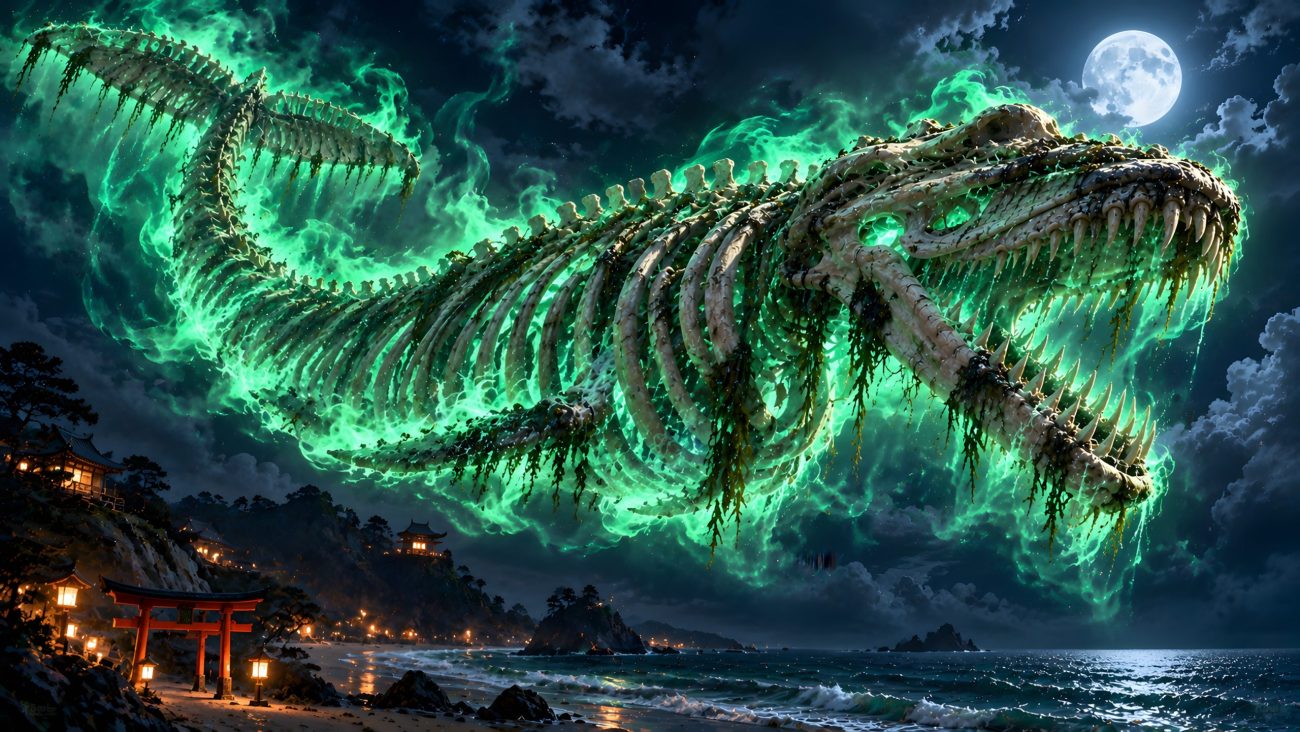
The Bakekujira is a gigantic whale skeleton that swims near the surface of the sea, rising as it did in life to breathe. It appears on rainy nights near coastal whaling villages in the Sea of Japan and is accompanied by eerie birds and strange fish.

According to legend, the souls of whales killed by humans become Bakekujira, seeking revenge against those who took their lives. Anyone who witnesses one is afflicted with a terrible curse that they carry back to their village. The curse brings famine, plague, fires, and other disasters.

One rainy night, fishermen on the Shimane Peninsula spotted an enormous white shape swimming offshore. Believing it to be a whale, they gathered the villagers, armed themselves with spears and harpoons, and sailed out to hunt it. However, none of their weapons struck the creature. Looking closer, they realised that it was a gigantic skeleton without any flesh.

Suddenly, the sea filled with strange fish, while unfamiliar birds swarmed across the sky. The skeletal whale turned out to sea and disappeared into the current, taking the strange creatures with it. The terrified villagers recognised it as a Bakekujira, a vengeful ghost whale. Although it was never seen again, other villages in Shimane suffered its curse, experiencing devastating fires and infectious diseases.


Sources

“Bake Kujira.” Yokai.com. https://yokai.com/bakekujira/


Hrosshvalur

Tradition: Icelandic Mythology
Alternative Names: Horse-Whale, Monoculus
Category: Whale


The Myth

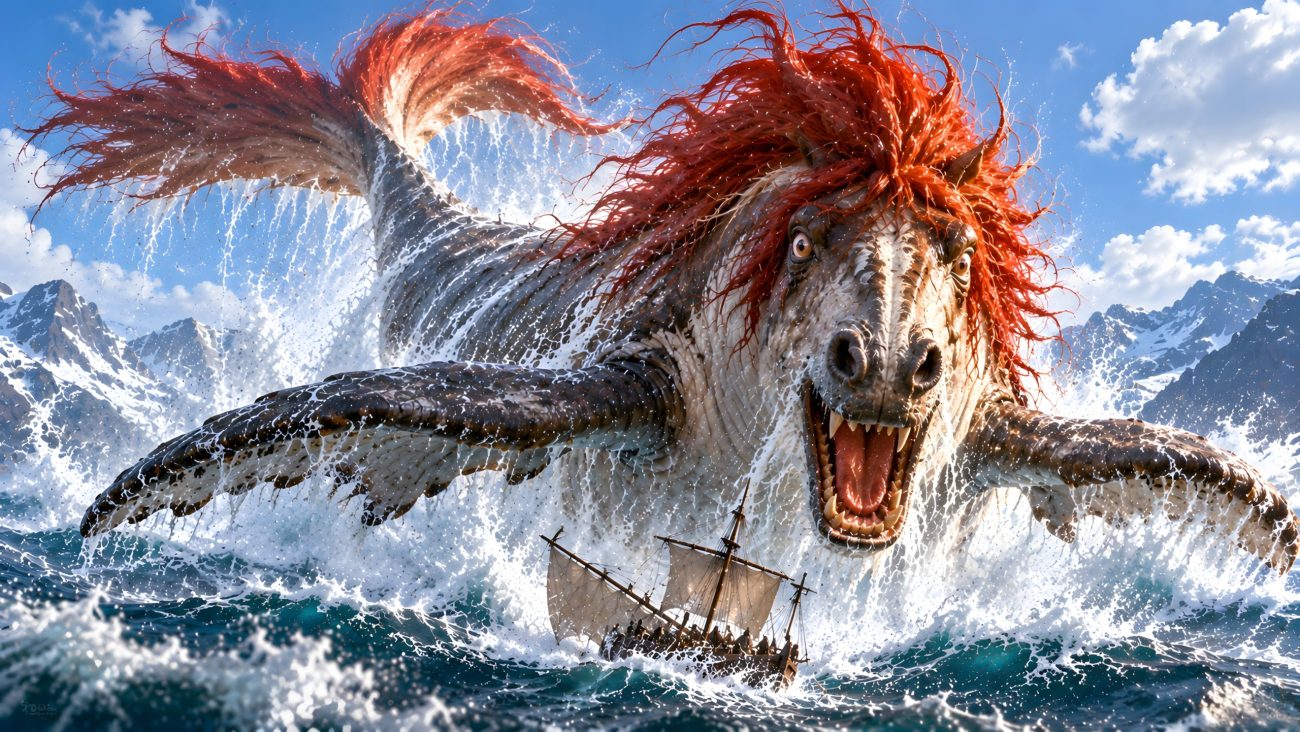
The Hrosshvalur is a monstrous whale from Icelandic mythology, growing between 15 and 40 metres long. It has a horse-like head, enormous eyes, a flowing red mane, and a horse’s tail. Its body is covered in fine fur, its back may be dappled, and it makes a sound resembling a horse neighing. It also has a foul smell and internal organs resembling those of a horse. Its enormous eyes distinguish it from other evil whales and have earned it the nickname Monoculus, meaning “One-Eyed.”

One of the most feared illhveli, or evil whales, the Hrosshvalur is notorious for destroying ships. It charges through the waves at high speed, holding its head above the water with its mane trailing behind. It sinks vessels by leaping onto them or pressing its weight against them until they capsize. It can also whip its tail to create enormous waves and is considered a portent of bad weather. Its flesh is inedible and disappears when cooked, and its consumption was forbidden by law. Sailors sometimes use euphemistic names to avoid attracting its attention.

The Hrosshvalur has several weaknesses. Although it is not as easily distracted as some other evil whales, its enormous eyes are particularly vulnerable. In one thirteenth-century tale, a Hrosshvalur that surfaced beside a ship was driven away by a barrage of heavy objects. In another story, it attacked the heroes Hjalmper and Olvir but was defeated with the help of a Skeljungur, a Vagnhvalur, and two vultures. A cutlass thrown into one of its eyes weakened it, allowing the other creatures to tear it apart.

The Hrosshvalur is also associated with sorcery and witchcraft. Its size and ferocity made it a suitable form for sorcerers and witches seeking to cause destruction. In the Kormaks saga, the witch Dorveig transforms herself into a Hrosshvalur to attack the brothers Kormakr and Dorgils. They recognise her by her enormous eyes and drive her away by throwing a javelin into her back.

The Hrosshvalur is generally believed to have originated from descriptions of the walrus, whose name is thought to derive from hval-hross, meaning “whale-horse.” However, Icelandic accounts distinguish the two animals, describing the Hrosshvalur and the walrus as separate creatures.


Sources

“Hrosshvalur.” A Book of Creatures, September 4, 2015. https://abookofcreatures.com/2015/09/04/hrosshvalur/


Skeljúngur

Tradition: Icelandic Mythology
Alternative Names: Shell Whale, Svarfhvalur, Iron Whale, Hnúfubakur
Category: Whale


The Myth

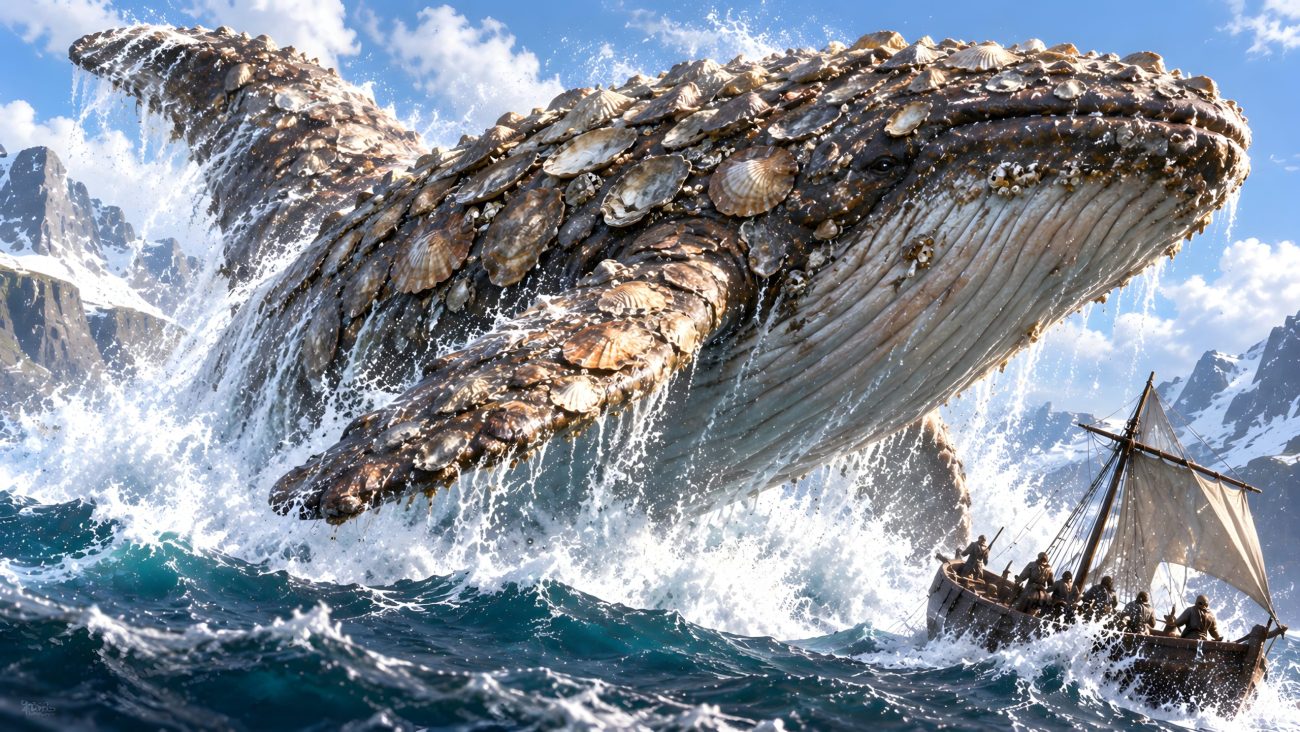
The Skeljúngur is an Icelandic whale measuring between 20 and 45 metres long. It has a fat body, short flippers, no dorsal fin, and is covered entirely in shells that rattle as it swims. The shells make it itchy, causing it to rub its head against rocks in deep coastal waters. Despite its portly appearance, it swims quickly and is known as the “tiger whale.” It dives and sleeps vertically, with its head sticking out of the sea. Whether it has teeth or baleen is unclear.

One of the illhveli, or evil whales, the Skeljúngur is unusual because its flesh is edible and safe to eat. However, it is dangerous to ships, positioning itself in their path and continuing to obstruct them when captains attempt to avoid it. Ships that sail directly onto the whale are thrown into the air, killing everyone aboard. It attacks vessels with its fins and tail, and its shell-covered body protects it against most attacks. It may also pretend to be dead to lure prey within reach. The whaling ship Minerva, off Grímsey, once believed it had killed a Skeljúngur, only for the whale to recover and destroy the boat sent to finish it off.

Skeljúngurs hate the sound of iron being ground or filed. Hearing it drives them into a frenzy, causing them to beach themselves to escape the noise. This aversion gives rise to the alternative name Svarfhvalur, meaning “iron whale.” Despite their hostility towards humans, Skeljúngurs have occasionally helped them. A young one once aided Hjalmper and Olvir in battle against a vicious Hrosshvalur. Skeljúngur is also used as another name for the humpback whale, or Hnúfubakur.


Sources

“Skeljúngur.” A Book of Creatures, December 14, 2015. https://abookofcreatures.com/2015/12/14/skeljungur/


Raudkembingur

Tradition: Icelandic Mythology
Alternative Names: Red Comb, Red Crest
Category: Whale


The Myth

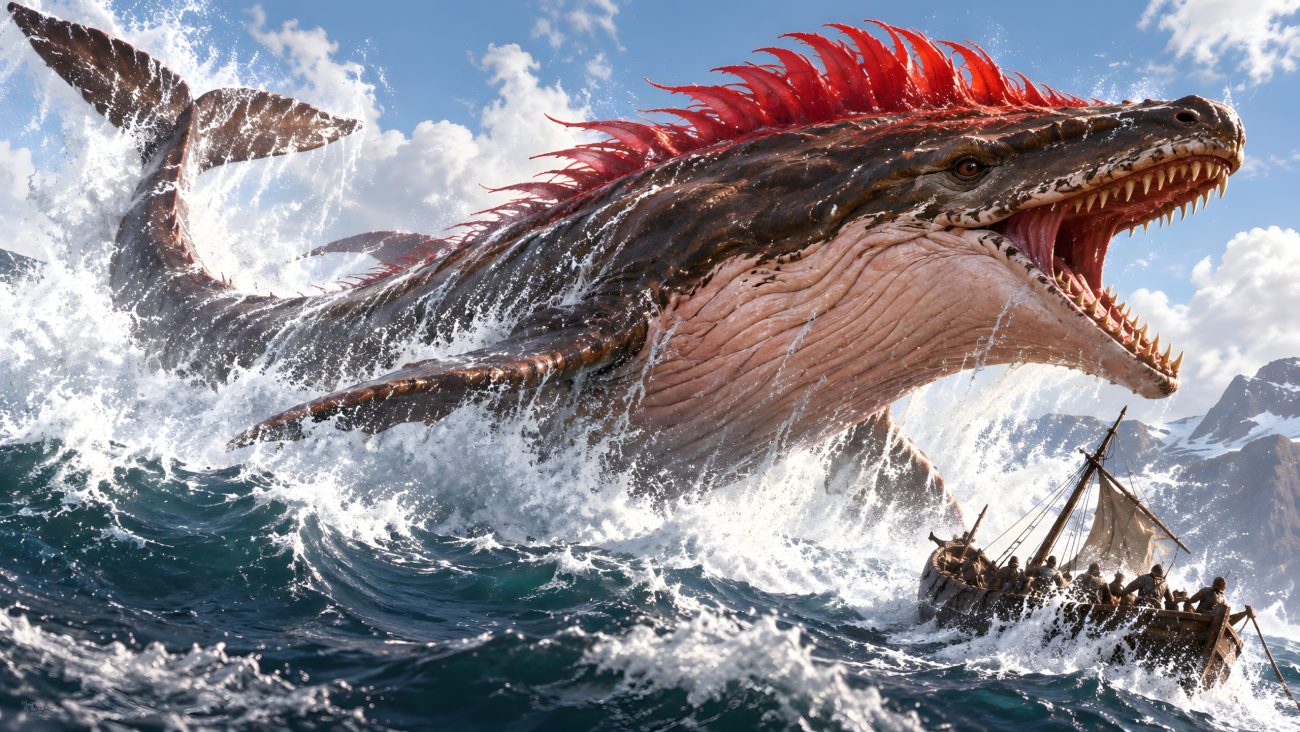
The Raudkembingur is a monstrous whale from Icelandic mythology. It has an elongated, streamlined body measuring 10–20 metres long, with a coffee-brown back, a pink belly, and a bright red crest resembling bristly hair, a horse’s mane, or a row of small fins. Its head has a reptilian appearance, with sharp teeth in both jaws. It swims extremely fast, producing enormous amounts of foam and an ominous neighing sound.

One of the most savage of the illhveli, or evil whales, the Raudkembingur is notorious for attacking and destroying boats. It sometimes pretends to be dead, floating on the surface until a boat approaches, then leaping onto the vessel and drowning everyone aboard. Beluga whales and narwhals follow behind it, feeding on the remains.

The Raudkembingur is so consumed by destruction that it may die of frustration if it fails to destroy a boat during the day. In one tale, a boat escaped by throwing a piece of wood dressed in clothes into the sea. The whale mistook it for a person and repeatedly tried to drown it.

The creature can also pursue its prey until it dies of exhaustion. In one story, a Raudkembingur chased a boat commanded by Eyvindur Jónsson off Fljót. The crew escaped to Saudanesvik, and the whale died, turning the sea red. The boat was subsequently named Hafrenningur, meaning Ocean Runner.

Another tale tells of a cruel young man from Hvalsnes who was cursed by elves and transformed into a red-headed whale. He terrorised Faxafjörður and Hvalfjörður before dying of exhaustion in Hvalvatn Lake while pursuing a priest. Its bones are said to remain there.


Sources

“Rauðkembingur.” A Book of Creatures, July 31, 2015. https://abookofcreatures.com/2015/07/31/raudkembingur/


Inugami Gyōbu

Tradition: Japanese Mythology
Alternative Names: Inugami Gyōbu, Yamaguchi Reishin, Lord Inugami
Category: Marten


The Myth

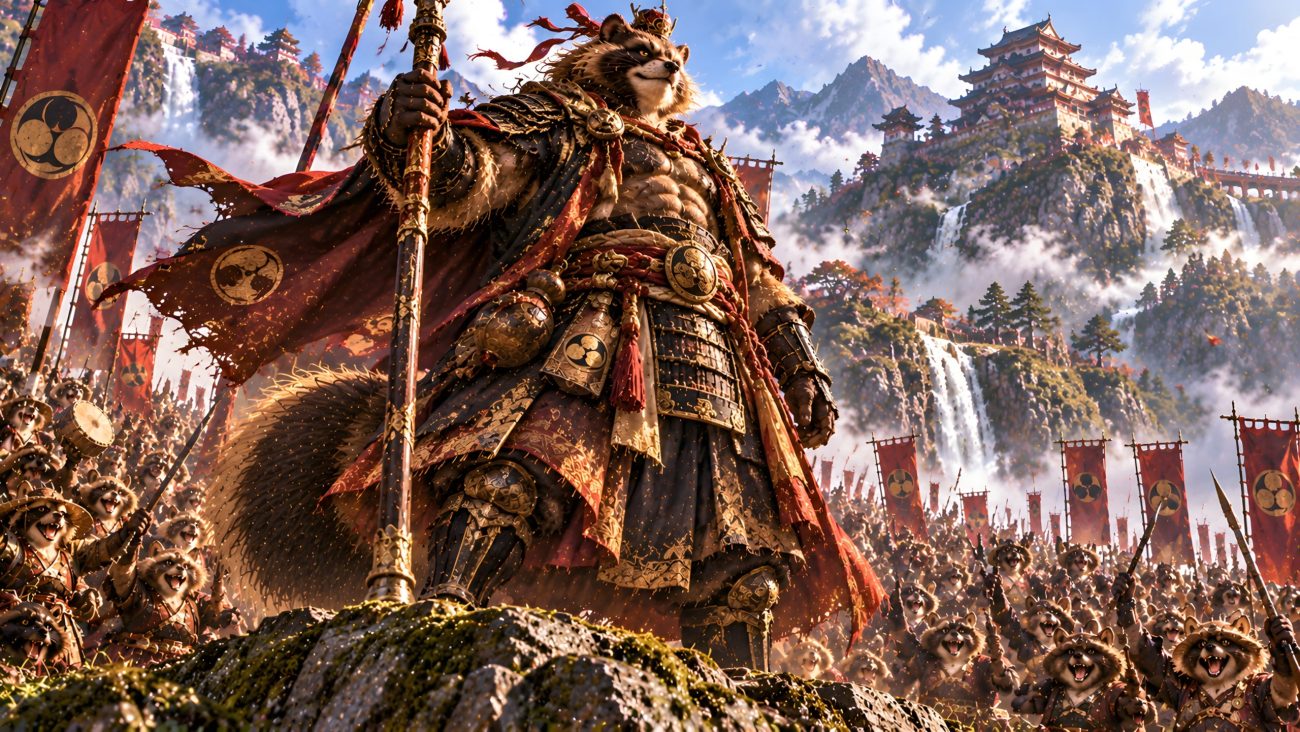
Inugami Gyōbu is a powerful shape-shifting tanuki and the supreme leader of the raccoon dogs of Iyo Matsuyama, in present-day Ehime Prefecture, Japan. Possessing extraordinary supernatural powers, he commands eight hundred and eight tanuki known collectively as the Eight Hundred and Eight Tanuki. His home is a rocky cavern in the mountains of Kuma, from where he is said to have guarded Matsuyama Castle for many years. He was regarded as a formidable supernatural guardian whose influence extended throughout the surrounding region.

During a succession dispute within the Matsuyama domain, Inugami Gyōbu became entangled in a political conspiracy. Following a confrontation and subsequent pact with the wandering samurai Gotō Kogenta, he reluctantly agreed to assist those plotting a rebellion. This brought him into conflict with the forces supporting the legitimate authorities. Inugami Gyōbu and his numerous followers were eventually defeated by Inō Budayū, a renowned warrior from Hiroshima who sided with the defenders of the domain. He sealed the tanuki leader and his followers within the mountains of Kuma.

Despite his involvement in the conspiracy, Inugami Gyōbu was not simply destroyed as a defeated monster. His long service guarding Matsuyama Castle was remembered, and a shrine was established in his honor. He came to be worshipped as Yamaguchi Reishin, allowing the powerful tanuki guardian to retain a place of reverence even after his downfall.


Sources

“Inugami Gyōbu.” 新版TYZ 妖怪図鑑 (New TYZ Yokai Encyclopedia). https://tyz-yokai.blog.jp/archives/1010654423.html


Korōri

Tradition: Japanese Mythology
Alternative Names: Kororijū, Cholera Beast, Tiger-Wolf-Tanuki
Category: Marten


The Myth

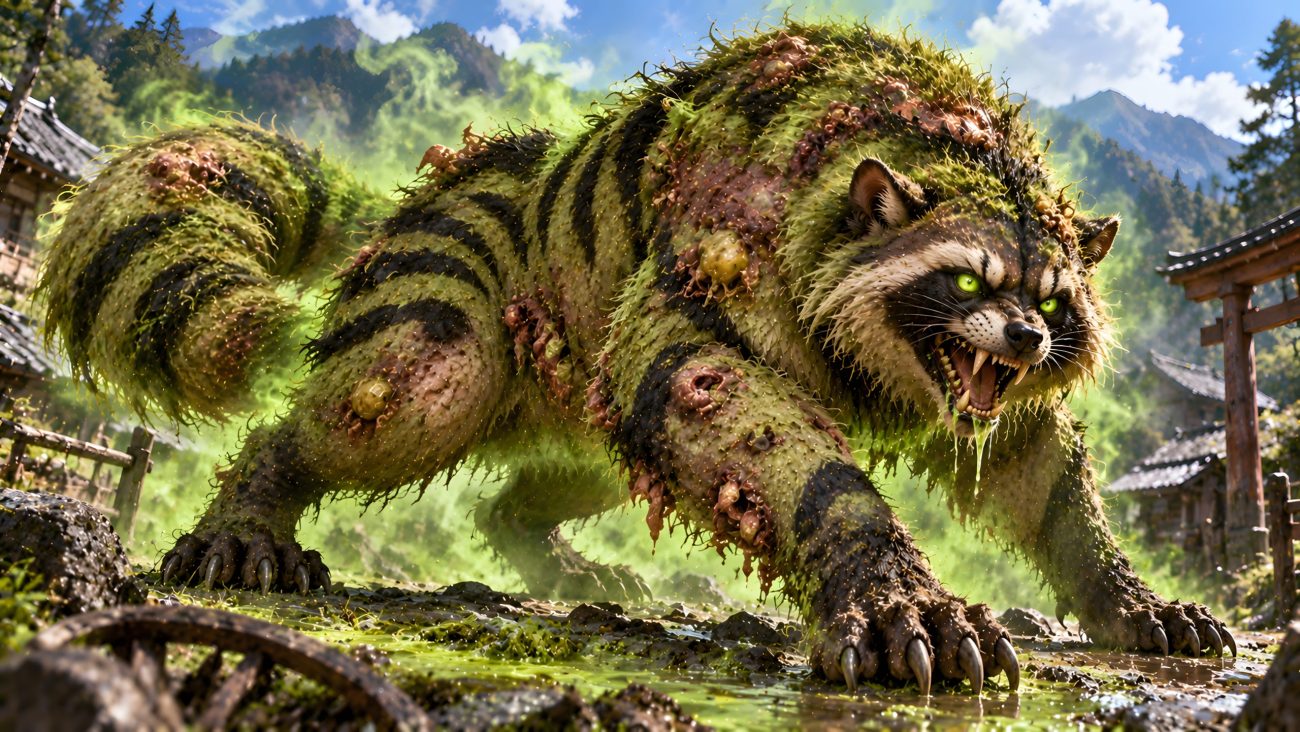
The Korōri is a monstrous creature said to have spread cholera during the epidemics that devastated Japan in the late Edo and early Meiji periods. It is a chimera composed of three animals reflected in its name: a tiger, a wolf, and a tanuki, or Japanese raccoon dog. It generally resembles a tanuki, but its body bears tiger-like stripes and its face has the ferocious jaws of a wolf. The creature was associated with infected homes, where it supposedly brought the deadly disease to the people living inside.

Korōri were said to lurk around houses afflicted by cholera, sometimes fleeing after the inhabitants recovered. Those who died from the illness were believed to attract the creatures, which were reportedly seen feeding on their corpses. During the cholera outbreak of 1862, sightings allegedly became increasingly common. One story tells of a recovering samurai who spotted a strange, weasel-like beast near his home and beat it to death with a piece of firewood. He then roasted and ate the animal, while other families in the area subsequently reported similar creatures lurking around their infected homes. Some accounts even claimed that Korōri emerged from the bodies of cholera victims.

The creature arose from the terror surrounding cholera, an illness whose invisible cause was not understood by most people at the time. The Japanese word korori was used for the disease, and one way of writing it combined the characters for tiger, wolf, and tanuki. This spelling inspired the imagined beast, turning the fear of a devastating epidemic into a visible monster. An 1877 newspaper account explicitly described Korōri as an imaginary representation of the disease’s horrors rather than a real animal. In this sense, the creature embodied the dread of cholera itself.


Sources

“Korōri.” Yokai.com. https://yokai.com/korouri/