Tradition: Icelandic Mythology
Alternative Names: Horse-Whale, Monoculus
Category: Whale
The Myth
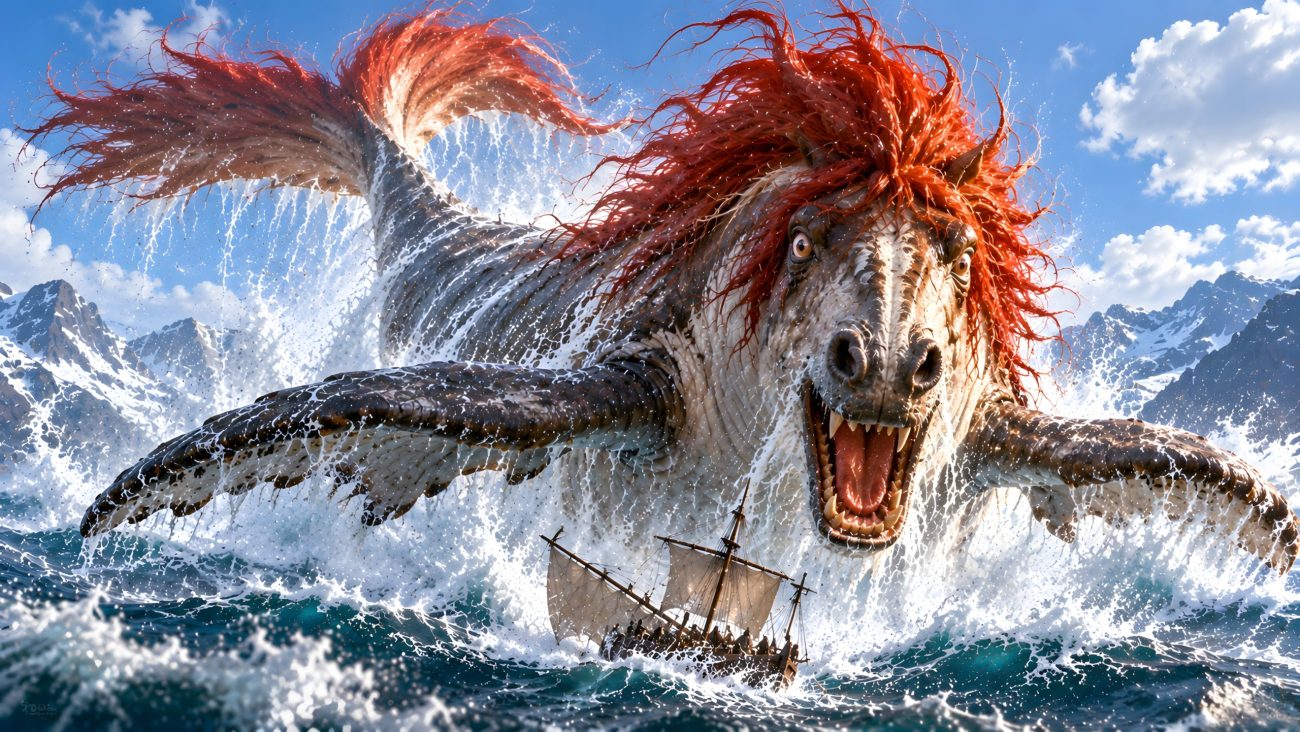
The Hrosshvalur is a monstrous whale from Icelandic mythology, growing between 15 and 40 metres long. It has a horse-like head, enormous eyes, a flowing red mane, and a horse’s tail. Its body is covered in fine fur, its back may be dappled, and it makes a sound resembling a horse neighing. It also has a foul smell and internal organs resembling those of a horse. Its enormous eyes distinguish it from other evil whales and have earned it the nickname Monoculus, meaning “One-Eyed.”
One of the most feared illhveli, or evil whales, the Hrosshvalur is notorious for destroying ships. It charges through the waves at high speed, holding its head above the water with its mane trailing behind. It sinks vessels by leaping onto them or pressing its weight against them until they capsize. It can also whip its tail to create enormous waves and is considered a portent of bad weather. Its flesh is inedible and disappears when cooked, and its consumption was forbidden by law. Sailors sometimes use euphemistic names to avoid attracting its attention.
The Hrosshvalur has several weaknesses. Although it is not as easily distracted as some other evil whales, its enormous eyes are particularly vulnerable. In one thirteenth-century tale, a Hrosshvalur that surfaced beside a ship was driven away by a barrage of heavy objects. In another story, it attacked the heroes Hjalmper and Olvir but was defeated with the help of a Skeljungur, a Vagnhvalur, and two vultures. A cutlass thrown into one of its eyes weakened it, allowing the other creatures to tear it apart.
The Hrosshvalur is also associated with sorcery and witchcraft. Its size and ferocity made it a suitable form for sorcerers and witches seeking to cause destruction. In the Kormaks saga, the witch Dorveig transforms herself into a Hrosshvalur to attack the brothers Kormakr and Dorgils. They recognise her by her enormous eyes and drive her away by throwing a javelin into her back.
The Hrosshvalur is generally believed to have originated from descriptions of the walrus, whose name is thought to derive from hval-hross, meaning “whale-horse.” However, Icelandic accounts distinguish the two animals, describing the Hrosshvalur and the walrus as separate creatures.
Sources
“Hrosshvalur.” A Book of Creatures, September 4, 2015. https://abookofcreatures.com/2015/09/04/hrosshvalur/