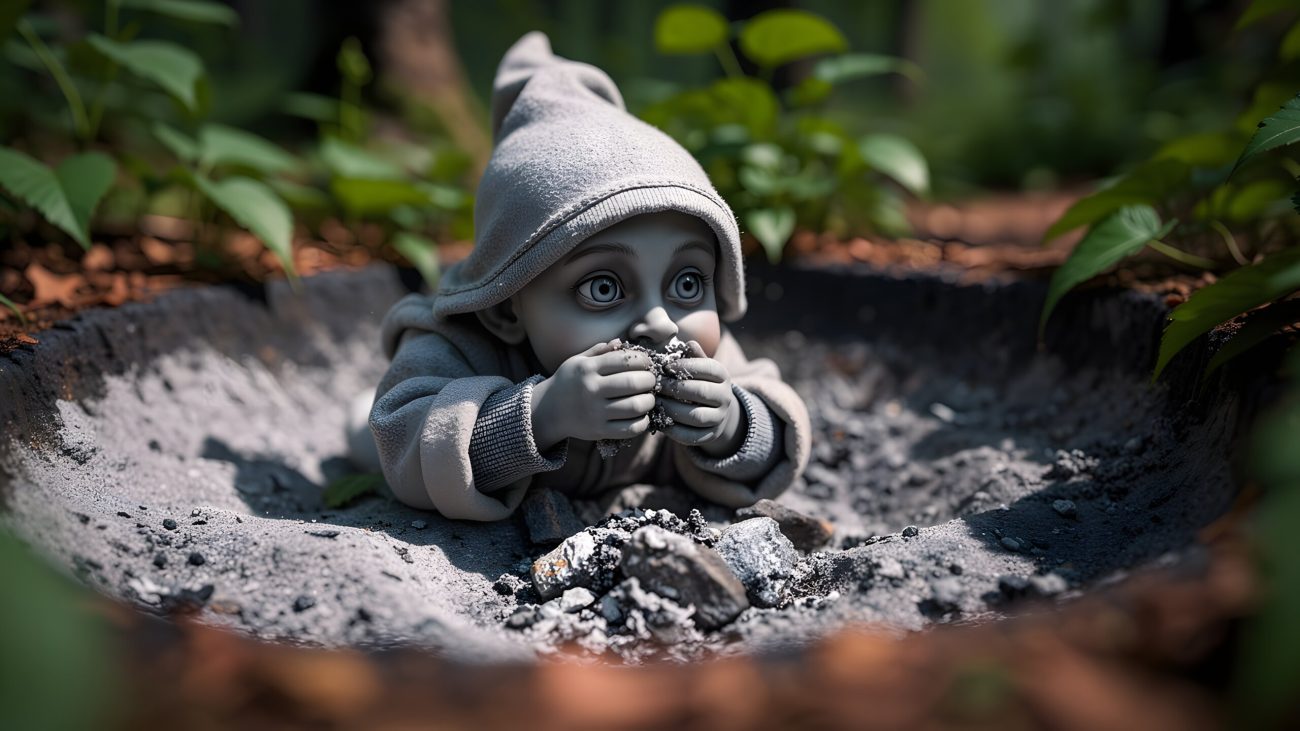
Kotern Gnome

Tradition / Region: Luxembourg Mythology
Alternate Names: Gnomes of the Hangels, Kontern Gnomes
Category: Gnome


The Myth

In the land near the village of Kontern, on the slopes known as the Hangels, there were once small gnomes who lived beneath the earth in hidden grottoes.

They were quiet and unseen by most, dwelling in underground chambers carved into the hills. The people of Kontern believed these little beings were tireless workers, always busy in their hidden world beneath the soil. Wherever they lived, prosperity seemed to follow. Fields grew well, homes prospered, and the land felt blessed.

It was said that their presence brought good fortune and abundance to everything around them. Though they rarely revealed themselves, their work could be felt in the thriving land and the luck enjoyed by the people above.

Even after they were no longer seen, stories of the industrious gnomes of the Hangels continued to be told in Kontern, remembering the time when the hills themselves were said to shelter these small bringers of blessing.


Gallery


Sources

sagen.at contributors. (n.d.). Die Wichtelcher auf der Hangels bei Kontern. In sagen.at, from https://www.sagen.at/texte/sagen/luxemburg/Wichtlein_Hangels.html


Interpretive Lenses

Religious Readings
  • Christian Ascetic Deep Dive
Philosophical Readings
  • Nietzschean Deep Dive
Psychological Readings
  • Jungian Deep Dive
Esoteric Deep Dive
  • Hermetic Deep Dive
Political / Social Readings
  • Marxist Deep Dive
Other
  • How to Invite The Kotern Gnome

Melusina of the Bock Rock

Tradition / Region: Luxembourg Mythology
Alternate Names: Melusina, Melusine of Luxembourg, Water Nymph of the Alzette
Category: Mermaid, Shapeshifter, Nymph


The Myth

Long ago, Count Siegfried, a noble knight, became lost while hunting and came upon a deep valley where the Bock rock rises above the Alzette River. There he heard a wondrous song and saw a beautiful maiden seated upon the ruins of an ancient castle. She was Melusina, a water nymph of the valley. When she noticed him, she veiled her face and vanished with the setting sun.

The vision never left Siegfried’s mind, and he returned again and again to the valley. At last he met the maiden once more and confessed his love. Melusina agreed to marry him, on the condition that she would never be forced to leave the rock and that he must never seek her presence on Saturdays, when she wished to be alone. Siegfried swore to honor this oath.

To bring her home, he exchanged his lands for the barren Bock rock and, with supernatural help, built a great castle upon it. He married Melusina, and they lived happily together, and she bore him seven children. Yet each Saturday she withdrew to her chamber and locked herself away.

After many years, stirred by the suspicions of others, Siegfried resolved to learn her secret. One Saturday he crept to her door and looked through the keyhole. Inside he saw Melusina bathing in a wave-filled chamber, combing her long golden hair. But below her waist her body ended in a monstrous fishtail that lashed the water. With a cry of horror, he revealed himself. At once Melusina sank into the depths of the rock and was lost to him forever.

After her disappearance, a white figure was sometimes seen at night rocking her youngest child. It is said that Melusina still appears every seven years above the Bock rock in human form, begging to be freed. If no one rescues her, she cries out that not yet seven years have passed and sinks back into the stone.

Once, a soldier on night watch encountered her. She told him that to free her he must stand behind the altar in the Dominican church at midnight for nine consecutive nights. On the tenth night she would appear as a fiery serpent holding a key in her mouth, which he must take with his own mouth and throw into the Alzette River. Only then would she be redeemed and the ancient fortress rise again.

The soldier kept the vigil for eight nights but arrived late on the ninth. That night terrible roaring was heard around the Bock rock, and the chance of her redemption was lost.

Since then Melusina is said to circle the rock and cry out whenever danger threatens the city. Every seven years she is believed to make a single stitch on a mysterious garment she is weaving from flax that grows upon the bare rock. When the garment is finished, she will be freed — but it is said that the city itself will then fall into ruin.

And so Melusina remains bound beneath the Bock to this day, waiting for the one who will finally release her.


Gallery


Sources

sagen.at contributors. (n.d.). Melusina. In sagen.at, from https://www.sagen.at/texte/sagen/luxemburg/Melusina.html


Interpretive Lenses

Religious Readings
  • Christian Ascetic Deep Dive
Philosophical Readings
  • Nietzschean Deep Dive
Psychological Readings
  • Jungian Deep Dive
Esoteric Deep Dive
  • Hermetic Deep Dive
Political / Social Readings
  • Marxist Deep Dive
Other
  • How to Invite The Melusina of the Bock Rock

Mélusine

Tradition / Region: French Mythology, Luxembourg Mythology
Alternate Names: Melusine, Melusina
Category: Mermaid


The Myth

Mélusine is a female freshwater spirit associated with holy wells and rivers. She is usually depicted as a beautiful woman with the lower body of a serpent or fish. Some depictions give her wings, two tails, or both. Her legends are particularly associated with northern and western France, Luxembourg, and the Low Countries.

In the literary tradition recorded by Jean d’Arras in 1393, Mélusine is the eldest of three daughters born to Pressine, a fairy, and Elinas, the King of Albany. When Elinas breaks his promise never to see Pressine while she is giving birth to or bathing their children, Pressine leaves him and takes her daughters to the Isle of Avalon.

On her fifteenth birthday, Mélusine learns why her mother abandoned their father. Seeking revenge, she persuades her sisters to help her imprison Elinas and his riches inside a mountain. Pressine is furious that her daughters have punished their father and imposes different punishments upon them. Mélusine is banished from Avalon and cursed to take the form of a two-tailed serpent from the waist down every Saturday. If a man marries her, he must promise never to see her on that day. Should he keep his promise, she can live contentedly with him. If he breaks it, she will remain a serpent and appear in her monstrous form to the noble family, lamenting for three days whenever a descendant dies or the family’s fortress changes hands.

Mélusine settles in a forest near Coulombiers, by a stream close to Poitiers. There she encounters Raymondin, Count of Poitiers, who is distraught after accidentally killing his uncle. She comforts him, and they eventually marry after he agrees never to see her on a Saturday.

For ten years, Raymondin honours his promise. During this time, Mélusine bears him ten sons and oversees the construction of magnificent castles, bringing her husband wealth, lands, and power. Some versions describe their sons as physically deformed, although their parents love them.

Eventually, Raymondin’s family encourages him to grow suspicious of Mélusine’s private activities on Saturdays. He breaks his promise and secretly watches her bathing, discovering that her lower body has taken the form of a serpent. He initially conceals what he has seen. However, after one of their adult sons murders his brother, Raymondin publicly blames Mélusine and calls her a serpent.

Mélusine transforms into a dragon, gives Raymondin two magical rings, and flies away, never to be seen again in public. According to the tale, she returns at night to nurse her two youngest children, who are still infants.

Mélusine’s story became associated with several European ruling dynasties. Medieval literature and folklore claimed that the House of Lusignan, the House of Anjou and its descendants the Plantagenets, and the Limburg-Luxemburg dynasty descended from her. Her legend combines motifs of water nymphs, mermaids, guardian spirits, fairies, and supernatural women whose mysterious nature becomes a source of conflict when their human partners violate a forbidden condition.


Sources

Wikipedia contributors. (n.d.). Melusine. In Wikipedia, The Free Encyclopedia. Retrieved February 14, 2026, from https://en.wikipedia.org/wiki/Melusine



Hangel Gnome

Tradition / Region: Luxembourg Mythology
Alternate Names: —
Category: Gnome


The Myth

On the hanging slopes known as the Hangels near Kontern, people once believed that small gnomes lived hidden away in underground grottoes. These little folk were never loud or boastful, but their presence was felt everywhere. Where they lived, the land prospered, work went smoothly, and good fortune seemed to settle like a quiet blessing.

The Hangel gnomes were known above all for their tireless industriousness. Night after night, unseen by human eyes, they labored beneath the earth, tending to their hidden dwellings and quietly influencing the world above. Fields grew better, households flourished, and misfortune kept its distance wherever the gnomes remained undisturbed.

Though no one could say exactly when they vanished, the stories insist that something was lost when they did. The Hangels became silent, and the easy flow of luck faded. Even so, the people of Kontern still remember that their hills were once home to diligent little beings who worked in secret and filled the land with prosperity simply by dwelling beneath it.


Gallery


Sources

SAGEN.at contributors. (n.d.). Wichtlein (Hangels). In SAGEN.at, from https://www.sagen.at/texte/sagen/luxemburg/Wichtlein_Hangels.html


Interpretive Lenses

Religious Readings
  • Christian Ascetic Deep Dive
Philosophical Readings
  • Nietzschean Deep Dive
Psychological Readings
  • Jungian Deep Dive
Esoteric Deep Dive
  • Hermetic Deep Dive
Political / Social Readings
  • Marxist Deep Dive
Other
  • How to Invite The Hangel Gnome

Burggruef Gnome

Tradition / Region: Luxembourg Mythology
Alternate Names: Wichtel
Category: Gnome


The Myth

In the town of Grevenmacher, people once believed that small gnomes lived in the Burggruef, the old castle moat. These beings were not hidden enemies or frightening spirits, but friendly little folk who moved easily between their own hidden dwelling and the world of humans.

The gnomes were said to walk openly among the townspeople, helping where they could and bringing quiet good fortune. Unlike many other little folk, they were not feared or avoided. Instead, they were loved, welcomed, and spoken of with warmth. Their presence was believed to bring harmony to the town, as if the land itself was content.

Over time, the gnomes of the Burggruef faded from sight. Whether they withdrew deeper into the earth or simply left when belief in them waned was never known. Yet the memory remained: that once, in the castle moat of Grevenmacher, small hidden beings lived close to humanity, and for a time, both worlds shared the same ground in peace.


Sources

SAGEN.at contributors. (n.d.). Wichtlein (Grevenmacher). In SAGEN.at, from https://www.sagen.at/texte/sagen/luxemburg/Wichtlein_Grevenmacher.html


Eisenbach Gnome

Tradition / Region: Luxembourg Mythology
Alternate Names: Wichtelcher of Eisenbach
Category: Gnome


The Myth

In the time before the land around Eisenbach was cultivated, when forest and wilderness covered everything, the area was said to be inhabited by the Wichtelcher. These little people were no more than a foot and a half tall, yet they were skilled and diligent beyond their size.

They lived beneath the ground in underground chambers, carved and arranged by their own hardworking hands. Stone walls and rooms formed their dwellings, shaped into homes that mirrored those of humans, only smaller and hidden from sight. Though they kept themselves unseen, their presence was known through the order and care of the spaces they built.

As the land was cleared and fields were formed, the Wichtelcher withdrew, sinking back into the earth or leaving the area altogether. Yet they did not vanish without a trace. Remains of stonework were said to still be visible in certain places, fragments of their underground homes exposed where the soil had shifted or been cut away.

These stones served as quiet proof, for those who believed, that before human hands shaped Eisenbach, the Little Ones had already lived and labored beneath its ground.


Gallery


Sources

SAGEN.at contributors. (n.d.). Wichtlein (Eisenbach). In SAGEN.at, from https://www.sagen.at/texte/sagen/luxemburg/Wichtlein_Eisenbach.html


Interpretive Lenses

Religious Readings
  • Christian Ascetic Deep Dive
Philosophical Readings
  • Nietzschean Deep Dive
Psychological Readings
  • Jungian Deep Dive
Esoteric Deep Dive
  • Hermetic Deep Dive
Political / Social Readings
  • Marxist Deep Dive
Other
  • How to Invite The Eisenbach Gnome

Wahlhausen Gnome

Tradition / Region: Luxembourg Mythology
Alternate Names: Wichtelcher of op dem Heidenhäuschen
Category: Gnome, Cave dweller


The Myth

Near Wahlhausen, on a mountain whose foot meets the Ur River, there is a place known as op dem Heidenhäuschen. Long ago, people believed this hill was not solid earth alone, but hollowed beneath by an underground dwelling.

Within that hidden space lived very small people, the Wichtelcher. They were said to inhabit rooms beneath the soil, sheltered from sight, living quietly below the fields. The place where they lived now lies under cultivated land, ploughed and walked upon, yet never entirely at rest.

Old villagers remembered that stone walls were once uncovered in the ground there—traces of something built, then buried again by time and soil. Even in more recent years, the land showed signs of what lay below. While people were working the rock nearby and paused to eat, the ground suddenly sank beneath them, dropping about the depth of a shoe, as if the earth itself had given way into a hollow space.

Such moments were taken as reminders that the Wichtelcher had not been a story alone. Though unseen, their former homes were believed to remain beneath the hill, fragile and empty now, but still capable of shifting the ground above. The place kept its quiet reputation, a reminder that beneath ordinary fields, the Little Ones were once said to live.


Sources

SAGEN.at contributors. (n.d.). Wichtlein (Wahlhausen). In SAGEN.at, from https://www.sagen.at/texte/sagen/luxemburg/Wichtlein_Wahlhausen.html


Waldbillig Gnome

Tradition / Region: Luxembourg Mythology
Alternate Names: Wichtelcher of Belliger Seitert
Category: Gnome


The Myth

Near Waldbillig, in front of the Belliger Seitert forest, there lies a field once owned by Theodor Broos. Those who worked the land noticed strange things beneath the soil: carefully worked stones, set as if by deliberate hands, and an ash pit like the kind found in old farmhouses.

These discoveries stirred an old memory. The grandfather of the family had often said that this place was once the home of the Wichtelcher, little earth folk who lived hidden beneath the field. They were said to be no taller than one or two shoes, small enough to pass unseen, yet capable of shaping stone and arranging their dwellings with care.

The Wichtelcher were believed to live much like humans, with hearths, ashes, and shelters of their own, but all concealed underground. When the land was still quiet and lightly worked, they remained there. As time passed and the fields were turned more deeply, they withdrew, leaving behind only stones and traces of their former homes.

Though no one sees them now, the field is still spoken of with a certain respect. The worked stones and the ash pit are taken as signs that the little people once lived there, reminding those who know the story that the land around Waldbillig was not always empty beneath the surface.


Gallery


Sources

SAGEN.at contributors. (n.d.). Wichtlein (Waldbillig). In SAGEN.at, from https://www.sagen.at/texte/sagen/luxemburg/Wichtlein_Waldbillig.html


Interpretive Lenses

Religious Readings
  • Christian Ascetic Deep Dive
Philosophical Readings
  • Nietzschean Deep Dive
Psychological Readings
  • Jungian Deep Dive
Esoteric Deep Dive
  • Hermetic Deep Dive
Political / Social Readings
  • Marxist Deep Dive
Other
  • How to Invite The Waldbillig Gnome

Wichtelchesleh Gnome

Tradition / Region: Luxembourg Mythology
Alternate Names: Wichtelcher of A Kungen
Category: Gnome


The Myth

Between Greisch and Tüntingen lies a meadow known as A Kungen, a quiet place bordered by stone and grass. In old times, the rocks there were believed to be inhabited by ancient male elves, small beings bound to the earth itself.

These beings were called the Wichtelchesleh, named after the stony ground in which they lived. They were never seen openly, yet their presence was known to those who worked the land. Stones would shift when no one touched them, and faint sounds were sometimes heard from within the rock, as if something small and living moved beneath the surface.

The Wichtelchesleh were thought to dwell deep inside the stones, emerging only when the meadow was empty and silent. Like many hidden folk, they avoided human eyes and withdrew if disturbed. Their world existed alongside the human one, separated by nothing more than a thin layer of earth and stone.

As fields were changed and the land grew busier, the Wichtelchesleh faded from memory. Yet the name of the place remains, a reminder that once, beneath the rocks of A Kungen, the Little Ones were believed to live.


Gallery


Sources

SAGEN.at contributors. (n.d.). Wichtelcher (Greisch). In SAGEN.at, from https://www.sagen.at/texte/sagen/luxemburg/wichtelcher_Greisch.html


Interpretive Lenses

Religious Readings
  • Christian Ascetic Deep Dive
Philosophical Readings
  • Nietzschean Deep Dive
Psychological Readings
  • Jungian Deep Dive
Esoteric Deep Dive
  • Hermetic Deep Dive
Political / Social Readings
  • Marxist Deep Dive
Other
  • How to Invite The Wichtelchesleh Gnome

Junglinster Gnome

Tradition / Region: Luxembourg Mythology
Alternate Names: Wichtelcher, Heinzelmännchen
Category: Gnome


The Myth

In the lands around Junglinster, small hidden folk known as the Wichtelcher were once said to live close to humans, though rarely seen by them. They dwelled not in houses, but in quiet places where field, forest, and village met: the forest of Echels between Gonderingen, Junglinster, and Burglinster; the field called Gêschelt near Gonderingen; and the marshy ground of Bruchlach near Junglinster.

The Wichtelcher were tireless workers. At night, when human voices faded and lamps went dark, they emerged to tend fields, repair tools, and set right what had been left unfinished. By morning, tasks were mysteriously complete, as if done by invisible hands. No thanks was spoken aloud, for gratitude shown too directly might drive them away.

They lived close to the earth, slipping easily between soil, roots, and stone. When the land was disturbed or their places cleared away, they vanished without complaint, retreating deeper into the ground or leaving the area altogether. No one ever saw them depart; one day the help simply stopped.

Even after they were gone, people remembered the Wichtelcher as quiet helpers of an older time, beings who worked alongside humanity without reward, bound to the forests and fields as long as those places remained whole.


Sources

SAGEN.at contributors. (n.d.). Wichtelcher (Junglinster). In SAGEN.at, from https://www.sagen.at/texte/sagen/luxemburg/wichtelcher_Junglinster.html