Tenchishindousai

Tradition / Region: Japanese Mythology
Alternate Names: Tenshin Dōsai; Shindōsai
Category: Fish


The Myth

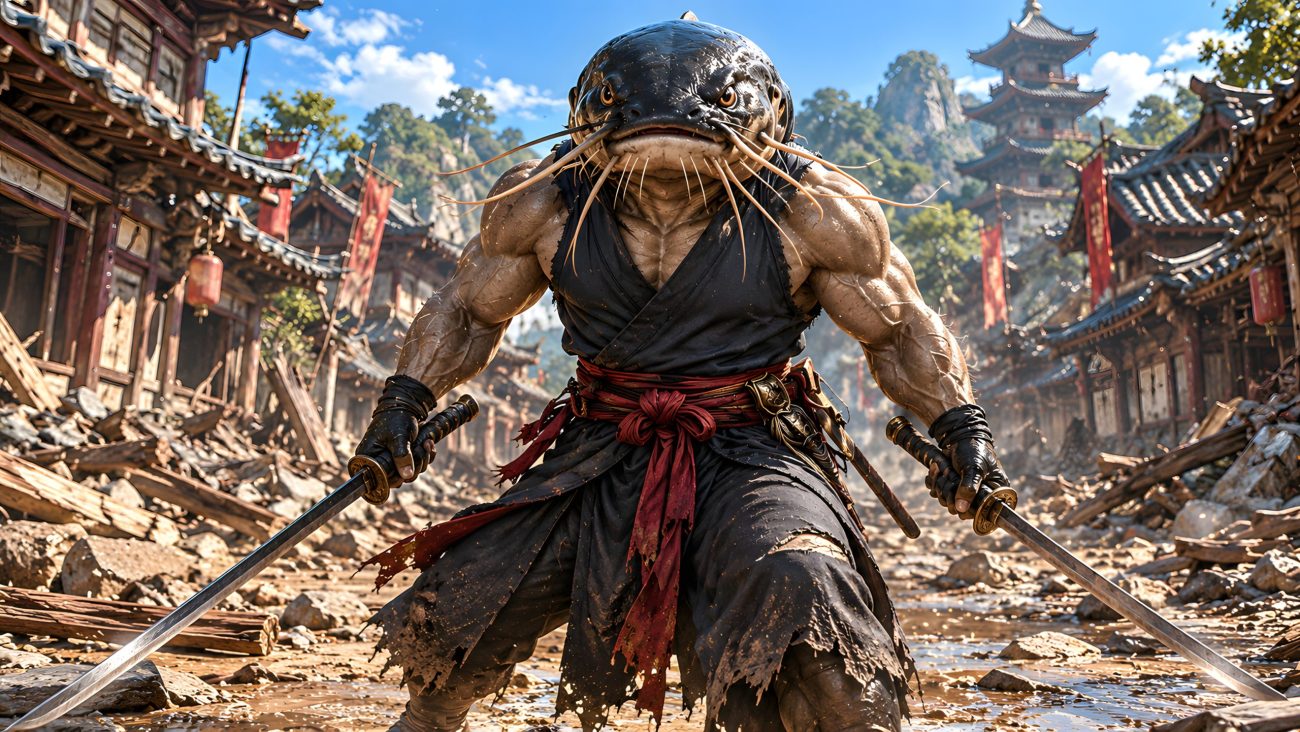
One night, during the Ansei era, a wandering rōnin arrived at a guardhouse in Edo and begged for shelter and food. He was tall, powerfully built, and strange in appearance, like a man hardened by severe training. The guards refused him, saying the guardhouse was not a place for lodging, and told him to seek an inn elsewhere.

At this, the man’s face grew pale.

He declared, “I am Tenchishindousai. There is none who does not know my name. Yet because the land has been calm for many years, people have grown contemptuous. They catch my kin, roast them, stew them, and kill them without cause. I have come to avenge them.”

He spoke of his journey: how he had shaken people to death at temple gatherings, how he had passed through province after province—mountains, capitals, and ports—causing the earth to tremble beneath his feet. Now, he said, he had arrived in Edo.

When the guards realized he claimed to be the Earthquake itself, they tried to seize him. Enraged, Tenchishindousai vanished on the spot.

At once, heaven and earth roared. The ground convulsed violently. Houses collapsed, storehouses fell, fires erupted across the city, and countless people were crushed or burned. Amid the devastation, Tenchishindousai spoke again, saying that the gods were absent from the land—and that if the deity who pins the earth were to arrive, the destruction would grow even greater.

With that, he fled north.

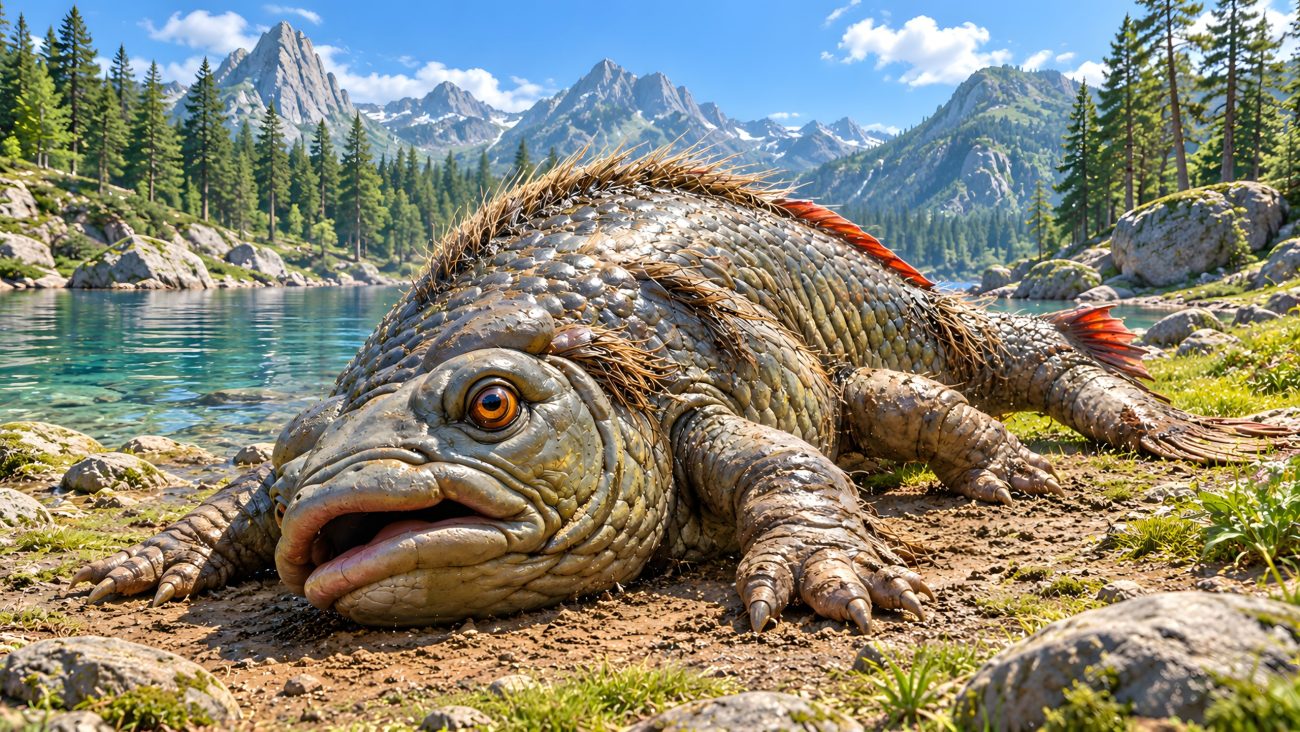
Those who saw his true form said his face was that of a giant catfish, the ancient creature that writhes beneath the land and shakes the world when angered. Thus the people believed the great earthquake was not chance, but revenge—carried out by Tenchishindousai, the living will of the trembling earth.


Sources

TYZ-Yokai Blog contributors. (n.d.). 添地震大歳 (Tenchishindōsai). In TYZ-Yokai Blog, from https://tyz-yokai.blog.jp/archives/1069000650.html
Hyakutou

Tradition / Region: Buddhist Lore, Japanese Mythology
Alternate Names: Hyaku-headed Fish
Category: Fish


The Myth

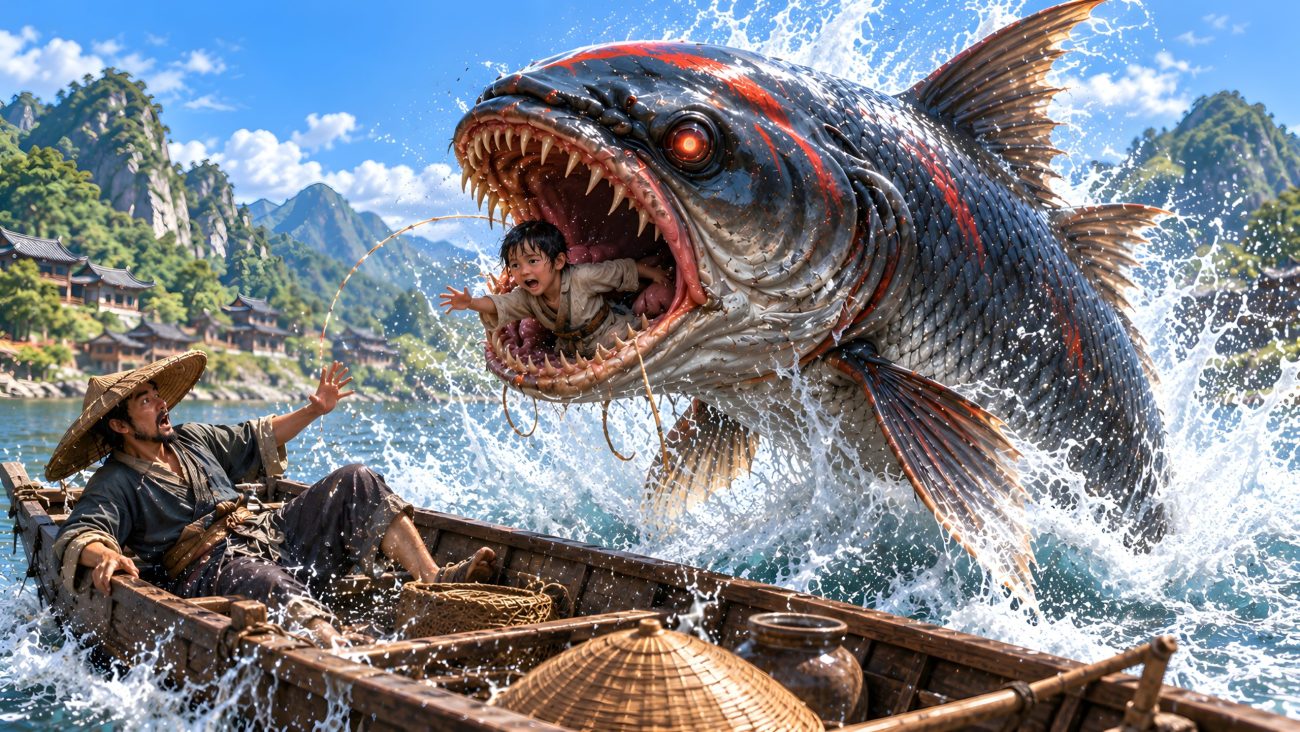
Long ago, Shakyamuni Buddha traveled with his monks along the banks of a great river. There, fishermen hauled up an enormous fish from the water. It was so vast that hundreds of people were needed to drag it ashore. When the crowd gathered, they saw that the fish bore the heads of one hundred beasts—camel, cow, horse, boar, sheep, dog, and many more—each head crying out in suffering.

The Buddha approached the fish and spoke to it. He asked where the one who had guided it now resided. The fish answered that she had fallen into the hell of unending torment. Those who heard this trembled, and Ananda asked the Buddha what sin could have brought such a fate.

The Buddha then told of the fish’s former life.

In an earlier age, there lived a brilliant youth born into a learned family. Though gifted with wisdom, he followed his mother’s urging to deceive his teacher. When he failed to complete his studies, he returned to the monk who had taught him and repaid kindness with cruel words, mocking and humiliating the one who had guided him, likening his teacher’s head to that of an animal.

For these words, heavy karma was formed.

After death, the mother fell into hell, and the son was reborn as a monstrous fish, bearing upon his body the animal heads he had spoken in insult. Each head was the echo of a word once uttered in contempt.

When asked whether the fish could escape this form, the Buddha answered that even across vast ages and countless rebirths, such punishment was not easily shed. Words spoken in cruelty return in kind, and speech, like action and thought, shapes destiny.

Thus the Hyakutou is remembered—a living sermon of flesh and scale, drifting through the waters, bearing one hundred faces of suffering as the weight of its past words.


Gallery


Sources

TYZ-Yokai Blog contributors. (n.d.). ヒャクトウ (Hyakutou). In TYZ-Yokai Blog, from https://tyz-yokai.blog.jp/archives/1022878715.html


Interpretive Lenses

Religious Readings
  • Christian Ascetic Deep Dive
Philosophical Readings
  • Nietzschean Deep Dive
Psychological Readings
  • Jungian Deep Dive
Esoteric Deep Dive
  • Hermetic Deep Dive
Political / Social Readings
  • Marxist Deep Dive
Other
  • How to Invite The Hyakutou

Akugyo

Tradition / Region: Japanese mythology
Alternate Names: Daigyo; Raichōgyo
Category: Fish, Mermaid, Yokai


The Myth

In the seas near Kibi Province, sailors spoke in fear of the Akugyo, the Evil Fish. Vast beyond measure, it rose from the depths to overturn ships as easily as toys, devouring the sailors who fell screaming into the water.

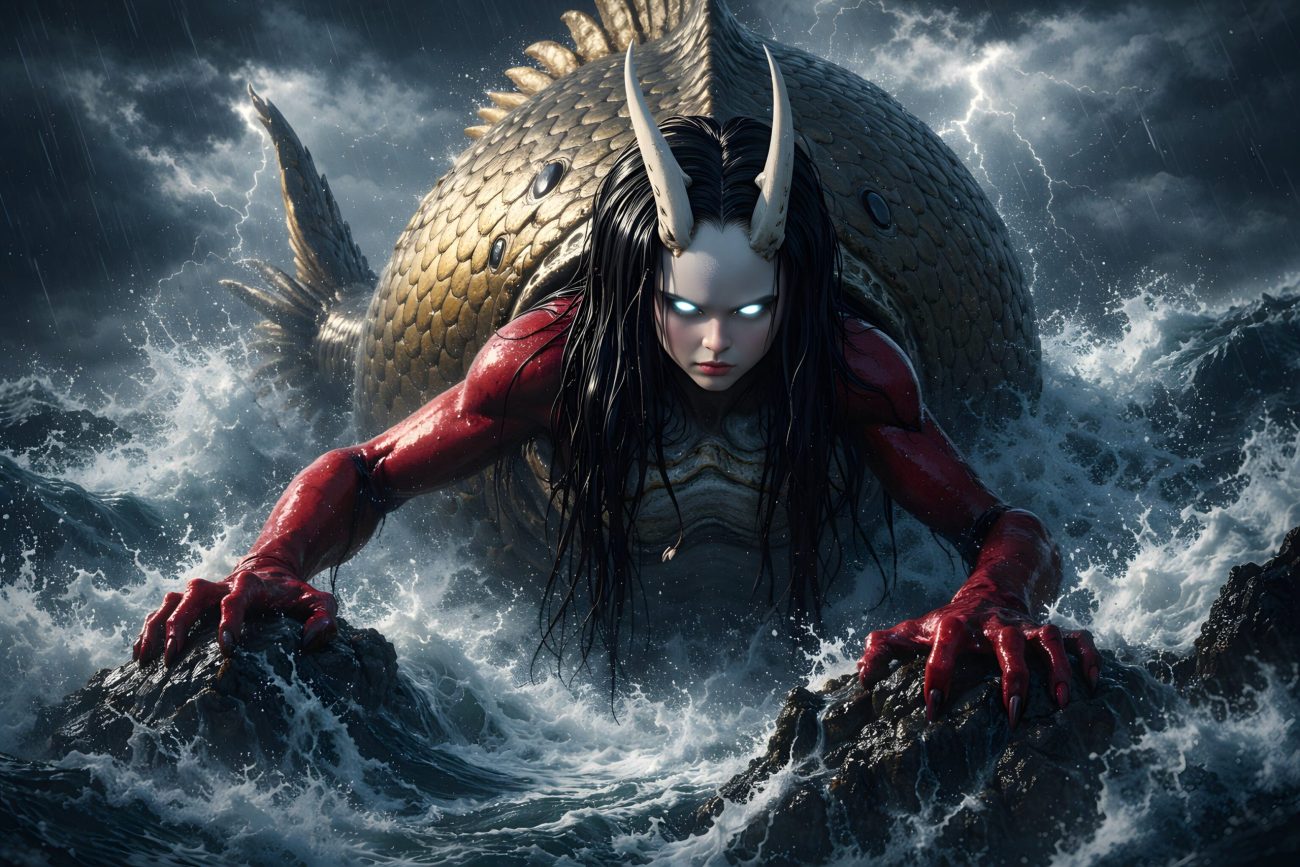
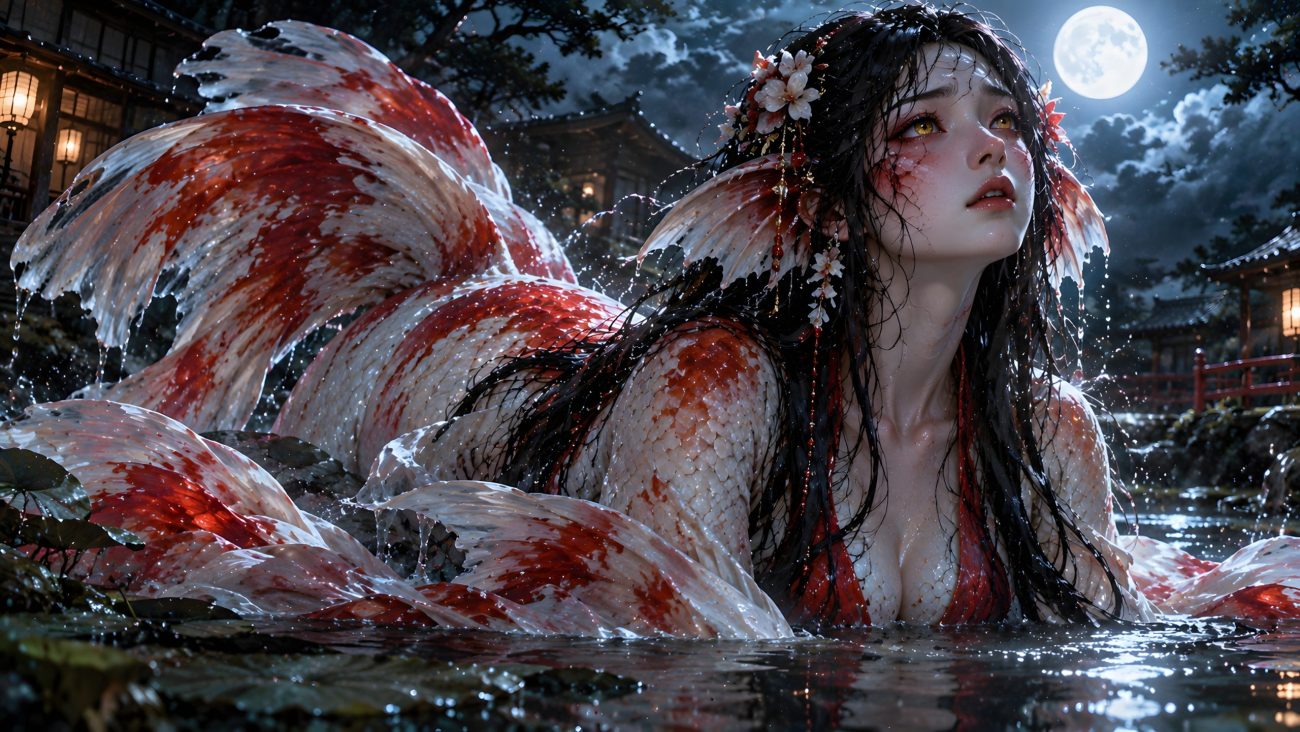
Some Akugyo breathed fire from their mouths, scorching ships before dragging them under. Others resembled enormous ningyo, their bodies covered in gold and silver scales that gleamed beneath the waves. There were also Akugyo shaped like colossal mermaids, bearing two white horns like those of an oni sprouting from their heads. Fishermen dreaded these monsters, for a boat could become trapped between the creature’s massive fins, leaving the crew helpless as the Akugyo fed.

In the sixth month of 1805, an Akugyo appeared off the coast of Echigo Province. Its body stretched more than eleven meters in length, and its horns were longer than a man’s arm. The terror it caused was so great that the Lord of Kaga dispatched a vast force—fifteen hundred men and four hundred fifty cannons—to hunt it down. After a great battle at sea, the monster was finally slain.

Another tale tells of Izutsuya Kanroku, a famed taiko drummer from Kaga. While crossing the Sea of Japan, his boat suddenly came to a halt. Beneath it lay the back of an Akugyo, and the vessel had become lodged upon the monster’s body. Believing death inevitable, Kanroku took up his drum and played with all the strength he had left. His drumming thundered across the sea and sky, echoing like a storm.

Moved—or perhaps startled—by the sound, the Akugyo shifted. The boat slipped free, and Kanroku escaped unharmed.

Thus the Akugyo remains a creature of terror and wonder: a destroyer of ships, yet sometimes driven away by courage, sound, and human resolve.


Sources

Wikipedia contributors. (n.d.). Akugyō. In Wikipedia, The Free Encyclopedia, from https://en.wikipedia.org/wiki/Akugyo


Tomoe

Tradition / Region: Japanese Mythology
Alternate Names: —
Category: Fish


The Myth

In Kawachi Province there lies a deep pool known as Uchisuke-ga-fuchi, whose waters were said never to dry. On its bank lived a fisherman named Uchisuke, a solitary man who made his living by catching carp.

One day, Uchisuke caught a female carp of uncommon dignity, marked by patterns unlike any he had seen before. Instead of selling it, he kept the fish. As years passed, a tomoe crest appeared upon its scales, and the carp grew strangely attached to him. It began to respond when called by name, lingered near him like a companion, and in time even left the water to sleep in his house and share his meals.

For eighteen years Uchisuke kept the carp in a tank. By then it had grown to the size of a young girl of fourteen or fifteen.

At last, Uchisuke married. One night, while he was away fishing, a beautiful woman wearing a pale blue kimono patterned with rising waves burst into the house. She spoke to the new wife with fury, saying that she had known Uchisuke for many years and was even carrying his child. Burning with resentment at being cast aside, she ordered the wife to return to her parents’ home at once, warning that if she did not, a great wave would rise within three days and drag the house into the pond.

Terrified, the wife fled and told Uchisuke what she had seen. He laughed it off, saying that such a woman could never have desired him, and that it must have been an illusion. As dusk fell, he returned to the pond in his boat.

Suddenly the water surged. Seaweed parted, and a massive carp leapt into the boat. From its mouth it spat out a small being shaped like a human child, with hair upon its head, yet with scales upon its body. Then the carp plunged back into the depths and vanished.

Uchisuke fled in terror. When he returned home and looked into the fish tank, Tomoe was gone.

After this, the villagers spoke among themselves and said, “In all things, it is not good for humans to keep living creatures too close to them.”


Sources

TYZ-Yokai Blog contributors. (n.d.). 巴御前 (Tomoe). In TYZ-Yokai Blog, from https://tyz-yokai.blog.jp/archives/1010655112.html


Mohana

Tradition / Region: Japanese Mythology
Alternate Names: Monohana
Category: Fish


The Myth

During the reign of Emperor Go-Kōgon, there lived a loyal samurai named Karakoto Uraemon, a retainer of the Shinano guardian Ogushi Jirozaemon. He dwelled with his lawful wife, San, beside the banks of the Chikuma River. Though their life was peaceful, sorrow lingered in the household, for San bore no children despite many years of marriage. Uraemon prayed daily to gods and Buddhas, begging for an heir.

Around this time, goldfish newly arrived from Ming China were admired as rare wonders. Uraemon purchased a pair at great cost for his lord, who rewarded him with a fine sword. The goldfish multiplied, and some were given back to Uraemon, who raised them with devotion until their colors shone red, white, and gold.

Still childless, Uraemon took a concubine, seeking only kindness of heart. He chose a young woman of seventeen, raised in the capital, modest in appearance yet naturally beautiful. He named her Mohana—Weed Flower—and gave her a room in the house. There was no jealousy between San and Mohana, and when Mohana soon became pregnant, joy filled the household.

Soon after, Uraemon was summoned to Kamakura on duty. Before leaving, he told the two women only this: to care well for the goldfish until his return.

While Uraemon was away, San encountered a man named Furutori Minobunta, a handsome but violent youth living nearby. He whispered poison into her ears, claiming that Mohana and Uraemon had long been lovers and were plotting to murder San. At first she doubted him, but forged letters bearing her husband’s hand shattered her trust. Consumed by jealousy and rage, San fell into a secret relationship with Minobunta, who fed her lies and guided her thoughts toward murder.

One day, San lured Mohana—eight months pregnant—into the storehouse. There she abused her, gagged her, stripped her, bound her with rough rope, and beat her with bamboo. Mohana’s face swelled and her body bled, yet she could not scream. For three days she hung there, starving and weak, like a hungry ghost.

At last she escaped and crawled to the goldfish tank, pressing her mouth to the water in desperate thirst. Her cry drew San and Minobunta. Minobunta kicked her, tearing open her womb, and from it a living boy crawled out. Driven mad with jealousy, San strangled the child at once.

Mohana screamed in agony, spat blood, and died.

Her blood flowed into the tank. A fierce wind arose, and the water churned. The goldfish absorbed the blood, their bodies turning the deep crimson of human flesh. Their eyes burned with fury, their bellies swelled, and they thrashed wildly, spitting water as if crying out in wrath.

Minobunta hid the bodies beneath the floor and fled with San into the night. Only a young maid witnessed the truth. Mohana and her child were later buried in secret by Uraemon’s brother.

Unaware, Uraemon labored faithfully in Kamakura. One night, passing a Jizō hall, he saw a woman in white cradling a child. Though gaunt, the face was unmistakably Mohana’s. Shaken, he soon learned the truth by letter and rushed home.

The goldfish swam strangely around him, as if bearing Mohana’s resentment. Uraemon prayed for her soul and released the fish into a temple pond. Through Buddhist teaching, Mohana’s spirit found enlightenment, but the goldfish remained as a warning of cause and effect.

Uraemon became a wandering avenger, seeking Minobunta and San. He eventually met Minobunta on a rainy night, and after a fierce clash, was trampled to death amid pursuing men and horses.

Long after, it is said, the blood-marked goldfish spread through the land, their lineage preserved as living reminders of grief, jealousy, and karmic retribution.


Sources

TYZ-Yokai Blog contributors. (n.d.). 毛羽毛現 (Mōhana). In TYZ-Yokai Blog, from https://tyz-yokai.blog.jp/archives/1037132429.html


Furukawa Namazu

Tradition / Region: Japanese Mythology
Alternate Names: Furukawa Catfish
Category: Fish


The Myth

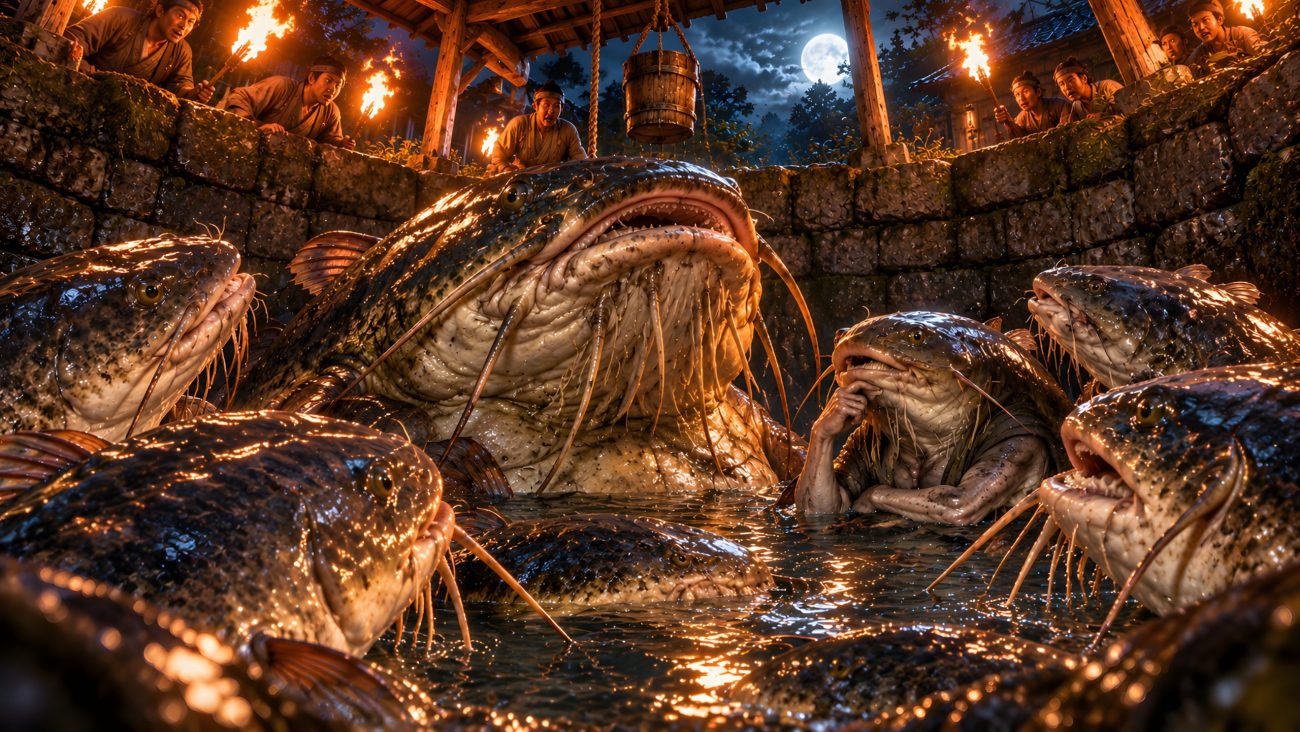
In the Furukawa River area of Iguchi, there were many ancient wells whose origins were long forgotten. Each of these wells was said to be home to a great catfish, known as the master of the well.

One day, the young men of the village gathered together and spoke of a plan to catch these catfish. Among them sat a single young man no one recognized, who listened quietly as they talked.

That night, carrying torches, the young men went to the old wells to carry out their plan. Yet when they arrived, something was wrong. Though every well was known to have its master, not a single catfish could be found.

As they searched in confusion, one young man leaned over a large old well. Suddenly, he screamed. Startled, the others rushed to look inside, and there they saw many masters of the wells gathered together in one place.

The strangers’ secret had been revealed. One of the catfish had disguised itself as a human, slipped into the village, and overheard their discussion. The masters of the Furukawa wells had assembled to speak of the danger.

From that time on, it is said that the people of this region never again tried to catch catfish from wells.


Sources

TYZ-Yokai Blog contributors. (n.d.). 一つ目小僧 (Hitotsume-kozo). In TYZ-Yokai Blog, from https://tyz-yokai.blog.jp/archives/1010655102.html


Oarfish

Tradition / Region: Japanese Mythology
Alternate Names: Dragon Palace Guard Sword, Sea Messenger
Category: Fish


The Myth

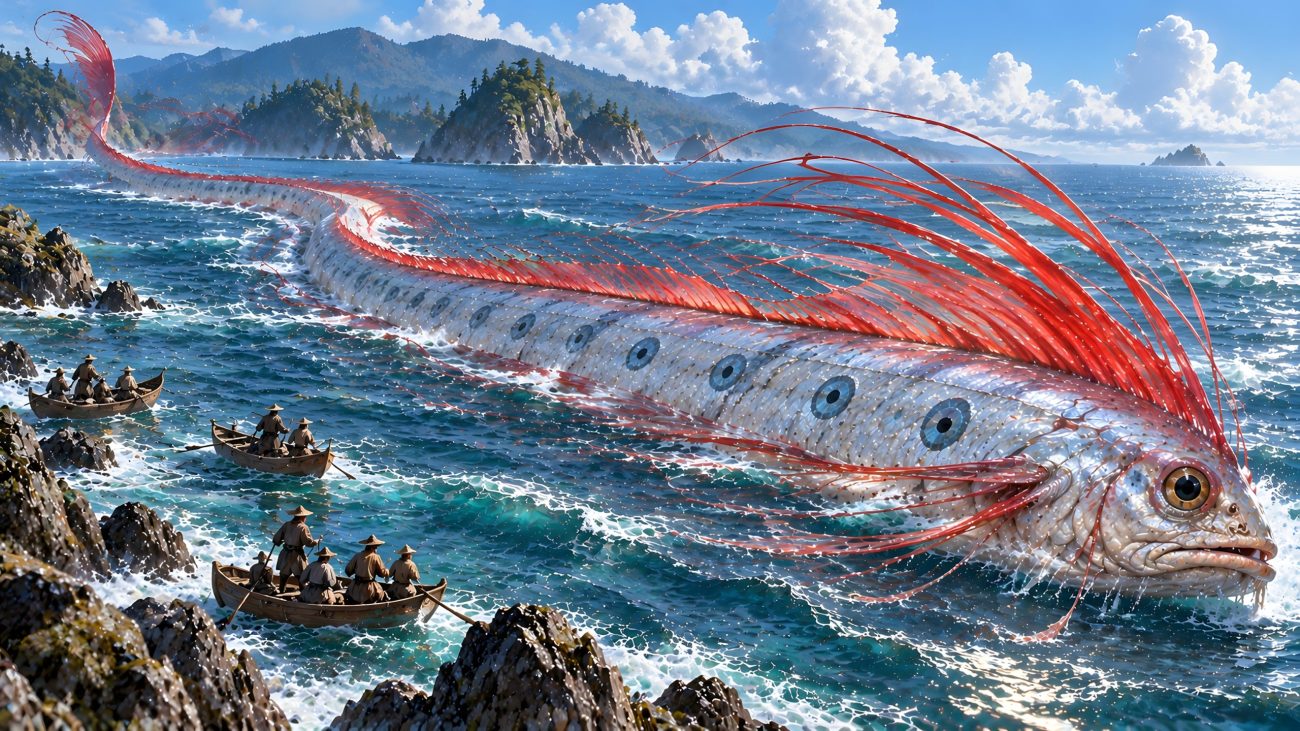
In the deep and distant seas lives an immense, slender fish known as the Oarfish, sometimes called the Messenger of the Dragon Palace. Its body is long and pale like polished silver, marked with strange circular patterns, and crowned with vivid red fins that trail behind it like a flowing mane. When it rises from the depths, it moves with slow, solemn grace, as though carrying a message from another world.

The oarfish is rarely seen. It normally dwells far below the surface, beyond the reach of ordinary fishermen. When it does appear near the shore, people believe it is not by chance. Its emergence is taken as a sign—a warning from the sea itself. The sight of its red crest cutting through the water is said to foretell great disturbances: earthquakes, storms, or upheavals hidden beneath the waves.

Because of its size and otherworldly appearance, the oarfish has long been regarded as a strange being rather than a mere fish. Those who encounter it often describe it as unfamiliar and unsettling, a creature that does not belong to the human world. Some say it glides just above the water’s surface, its fins spreading wide like wings, as though it could lift itself into the air.

The oarfish is also linked to tales of beings from the sea depths—palace guardians, messengers, and even merfolk. Its flowing red fins and pale body resemble the descriptions of sea spirits and mysterious women of the ocean, and it is sometimes said that the oarfish travels between the Dragon Palace beneath the sea and the world above, carrying omens rather than words.

Though it does not attack humans, its presence inspires unease. To see an oarfish is to be reminded that the sea has its own will, its own hidden realms, and its own warnings. When it appears, people watch the water closely, knowing that something unseen is stirring in the depths.


Sources

TYZ-Yokai Blog contributors. (n.d.). 山姥 (Yama-uba). In TYZ-Yokai Blog, from https://tyz-yokai.blog.jp/archives/1077741626.html


Amitabha Fish

Tradition / Region: Japanese Mythology
Alternate Names: Amida Fish
Category: Fish


The Myth

Long ago, far to the southwest of the land of Shushishi, there lay an island where more than five hundred families lived by fishing. The people depended entirely on the sea, and their days were spent casting nets and hauling in their catch.

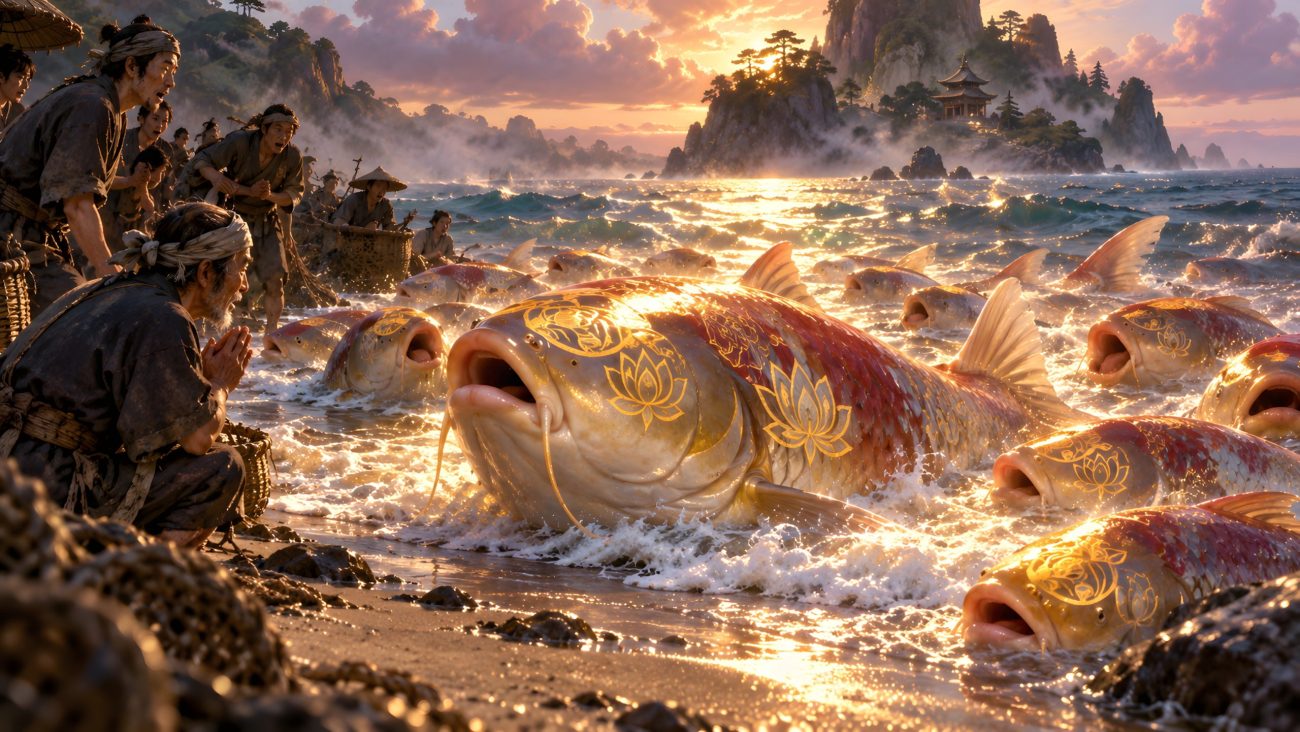
One day, an extraordinary event occurred. From the sea came countless large fish, swimming all the way onto the shore. The islanders were overjoyed and rushed to the beach, expecting a great bounty. As they gathered, they heard something strange: each fish made a sound like a human voice, repeatedly calling out, “Amida Buddha, Amida Buddha.”

The people, unfamiliar with Buddhist teachings, did not understand the meaning of the words. They simply named the creatures Amitabha Fish, after the sound they made. They soon noticed that whenever the name was spoken aloud, more fish would approach the shore. Discovering this, the islanders began chanting the name again and again, using it to lure the fish closer.

The fish did not flee. They allowed themselves to be taken and killed. When the people ate their flesh, they found it astonishingly delicious. Those who chanted the name of Amida Buddha fervently said the taste was rich and sweet, while those who chanted only weakly found the meat bitter and sharp. Entranced by the flavor, the islanders began chanting the sacred name constantly, driven by both pleasure and habit.

In time, an elder—one of the first to eat the Amitabha Fish—passed away. Three months later, he appeared on the shore riding a purple cloud, his body shining with radiant light. He spoke to the people, saying:

“After my death, I was reborn in the Pure Land. This came to pass because I delighted in the flesh of the Amitabha Fish and chanted the name of Amida Buddha. That great fish was none other than Amida Buddha himself, taking pity on our ignorance. He transformed into a fish, guided us to chant his name, and even offered his own body as food. Because of the bond formed through this act, I was reborn in the Pure Land.”

He then said that anyone who doubted his words should look upon the remains of the fish.

After the elder vanished, the people examined the discarded bones of the Amitabha Fish. They found that every bone had transformed into a lotus flower.

Filled with awe and remorse, the islanders abandoned killing and devoted themselves entirely to chanting the name of Amida Buddha. In time, each of them was reborn in the Pure Land. The island was left empty and silent, its former inhabitants gone, leaving only the shore where the sacred fish had once gathered.


Sources

TYZ-Yokai Blog contributors. (n.d.). 狐火 (Kitsunebi). In TYZ-Yokai Blog, from https://tyz-yokai.blog.jp/archives/1065099106.html


Nuegyo

Tradition / Region: Japanese Mythology
Alternate Names: Nue
Category: Fish, Cat


The Myth

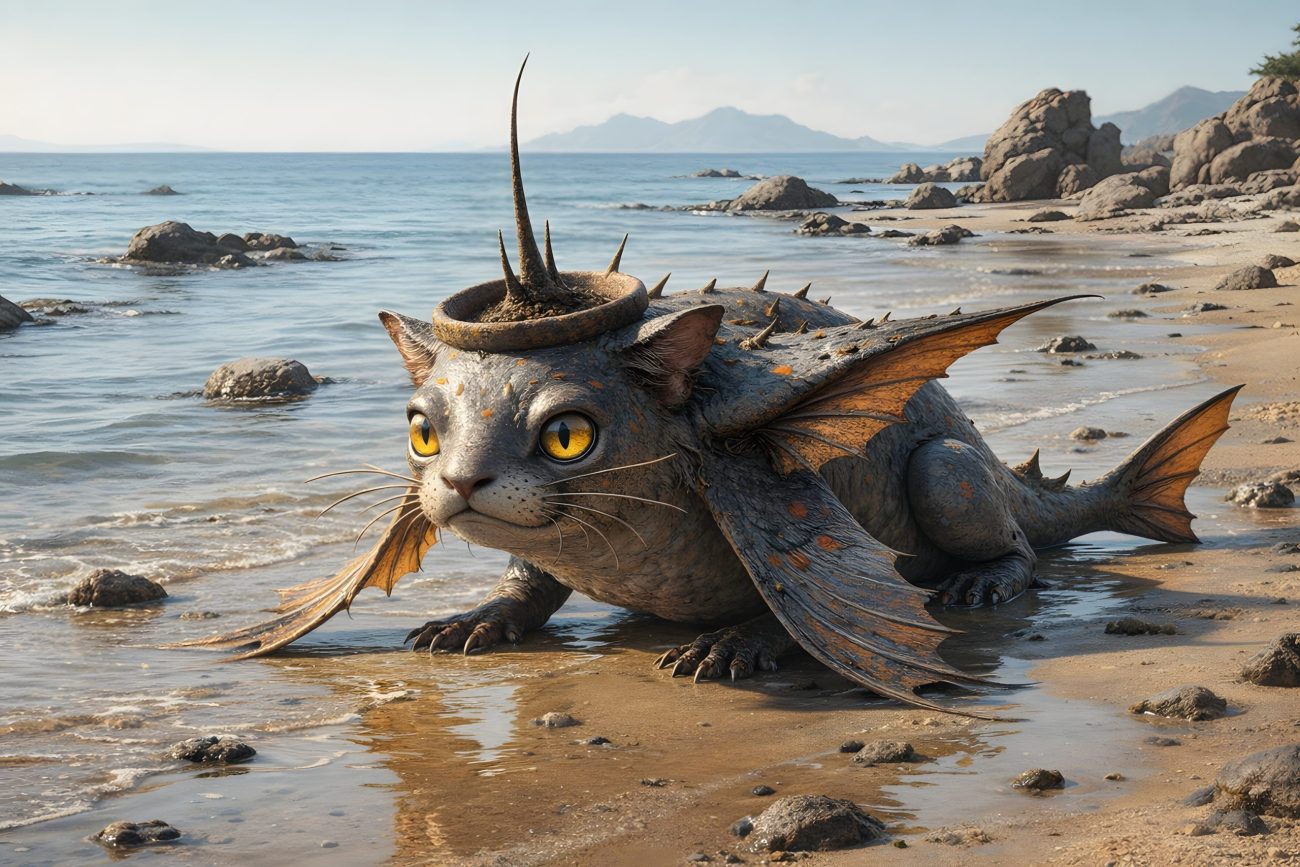
Nuegyo is a strange and unsettling fish said to appear in the seas off the coast of Japan. Those who encountered it did not recognize it as any known creature of the ocean, and even experienced fishermen were unable to name it.

The Nuegyo is said to be about the length of a man’s forearm. Its skin is rough, like that of a shark, while its head resembles that of a cat. Atop its head rests a hard, bowl-shaped mass, like stone. Its nose and mouth are also catlike, and from both sides of its jaw protrude sharp, bone-like spines several inches long. A thin spine rises from the top of its head, giving it an even more unnatural appearance.

Its body is shaped somewhat like that of a gurnard, but its fins are long and soft, extending all the way toward the tail. These fins are wide and flexible, like the wings of a bat. When spread open, they form a fan-like shape. It is said that the Nuegyo can use these fins as wings, rising above the surface of the sea and gliding through the air.

Because of its bizarre combination of features—part fish, part beast, and capable of flight—people began to call it Nuegyo, likening it to the legendary Nue, a creature made of mismatched forms. Whether it truly flies or merely skims the waves is unknown, but the Nuegyo is remembered as a sea being that does not fully belong to water or sky, and whose appearance defies ordinary understanding.


Sources

TYZ-Yokai Blog contributors. (n.d.). 座敷童子 (Zashiki-warashi). In TYZ-Yokai Blog, from https://tyz-yokai.blog.jp/archives/1010654392.html


Senzanri

Tradition / Region: Japanese Mythology
Alternate Names: Thousand Mountain Carp
Category: Fish


The Myth

The Senzanri is a strange and transformative carp, said to be capable of leaving the water and becoming a creature of the mountains.

According to the story, a boy named Torakichi spoke of this being from his own experience. He said that when certain substances were mixed into water or shaped like fish and placed in old ponds, crucian carp would appear in great numbers. These carp were not ordinary fish. Among them were those that would later become Senzanri, carp that transform and give birth after leaving the water.

It is commonly said that carp climb waterfalls and become dragons, but Torakichi explained that this belief misunderstands what truly happens. The carp do not become dragons. Instead, using the force they gather while leaping up waterfalls, they launch themselves into the mountains. There, far from rivers and ponds, the transformation begins.

Once on land, the carp rolls about in grassy places. As time passes, its body becomes rounder and harder, forming a shell. Hair grows between its scales. Its fins change into four limbs, and the creature begins to crawl like a land animal. Though its shape changes, its inner body remains that of a carp.

In this form, the Senzanri lives in mountain pools, where it gives birth to offspring known as mountain-burrowing carp. These young inherit the strange nature of their parent, belonging neither fully to water nor to land.

The Senzanri is thus a creature that bridges worlds: born as a fish, transformed by the mountains, and living a life hidden from ordinary human sight.


Sources

TYZ-Yokai Blog contributors. (n.d.). 雪女 (Yuki-onna). In TYZ-Yokai Blog, from https://tyz-yokai.blog.jp/archives/1010654386.html