Okita

Tradition: Japanese Mythology
Alternative Names: Okita, おきた
Category: Ghost


The Myth

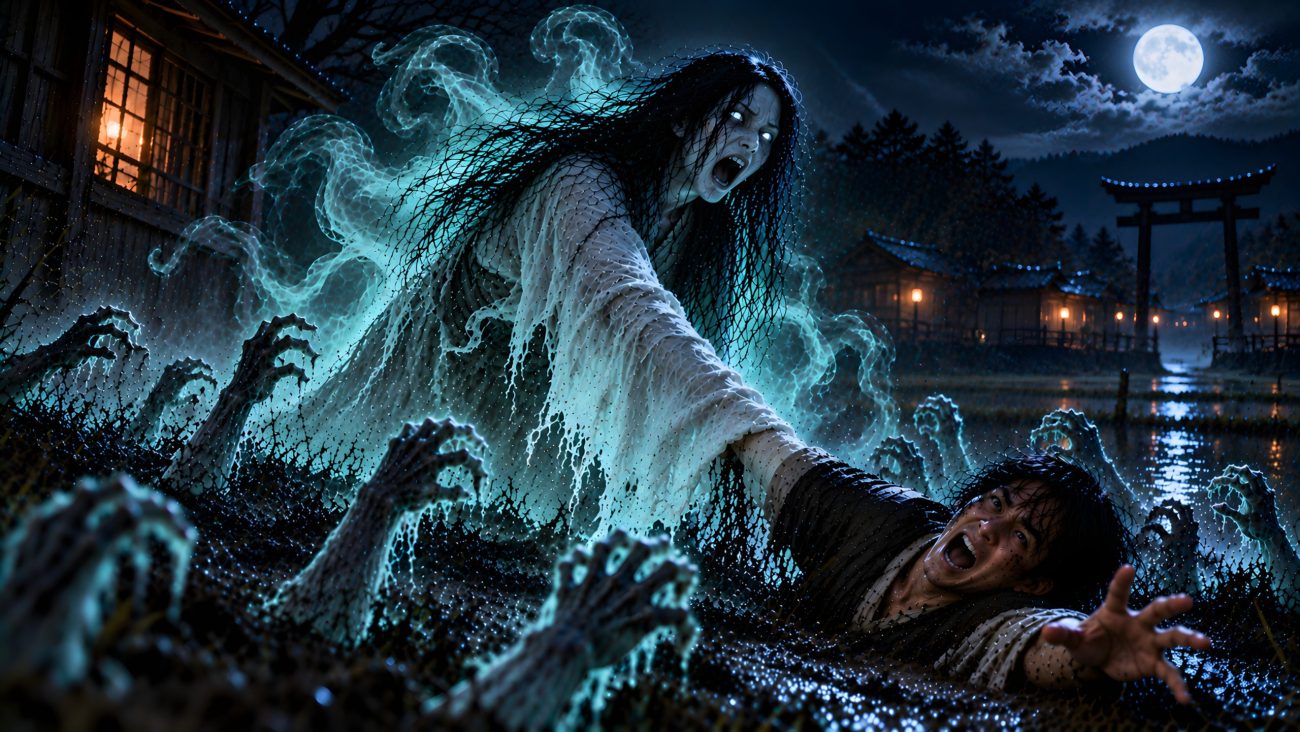
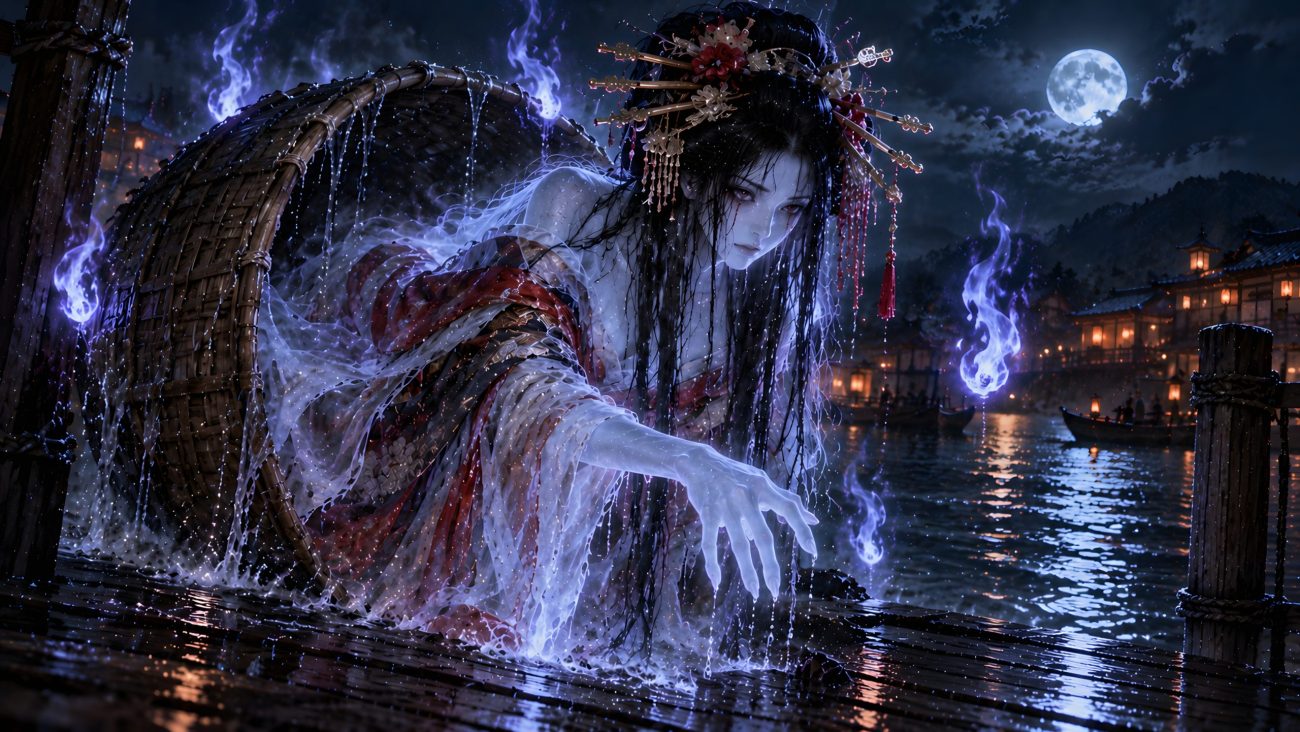
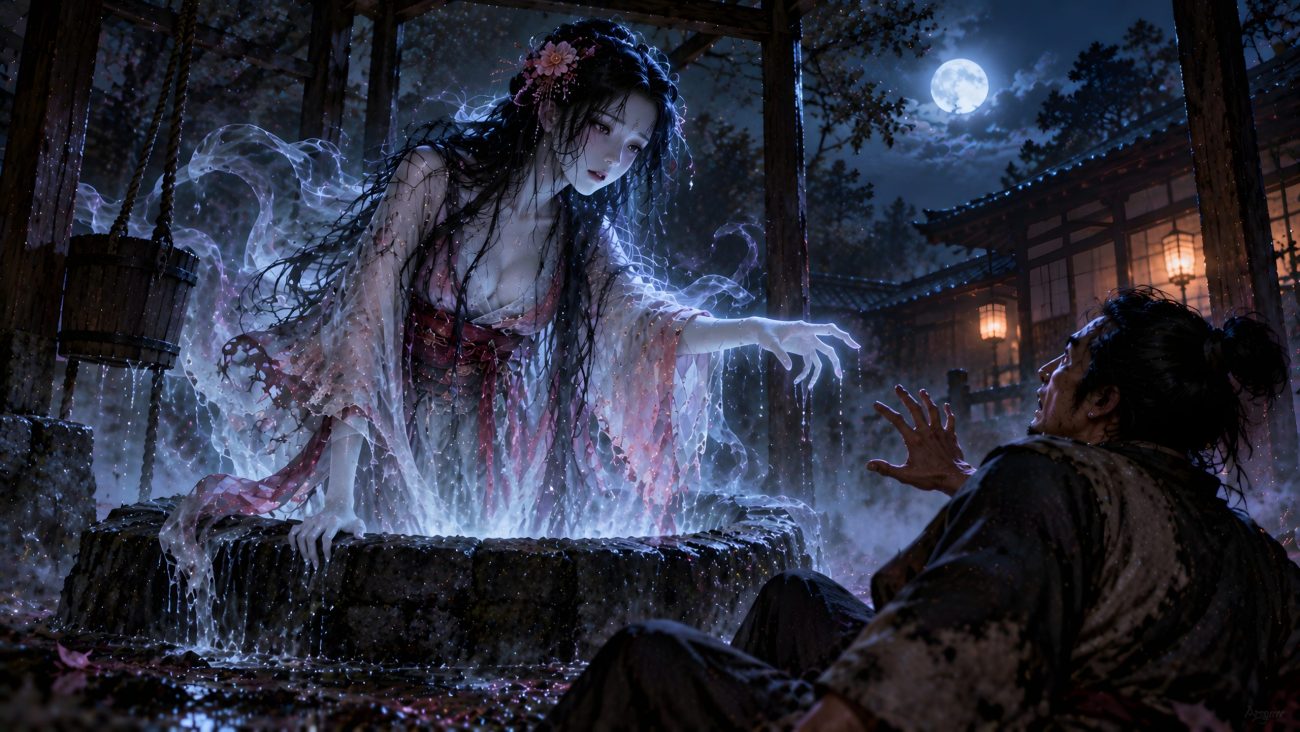
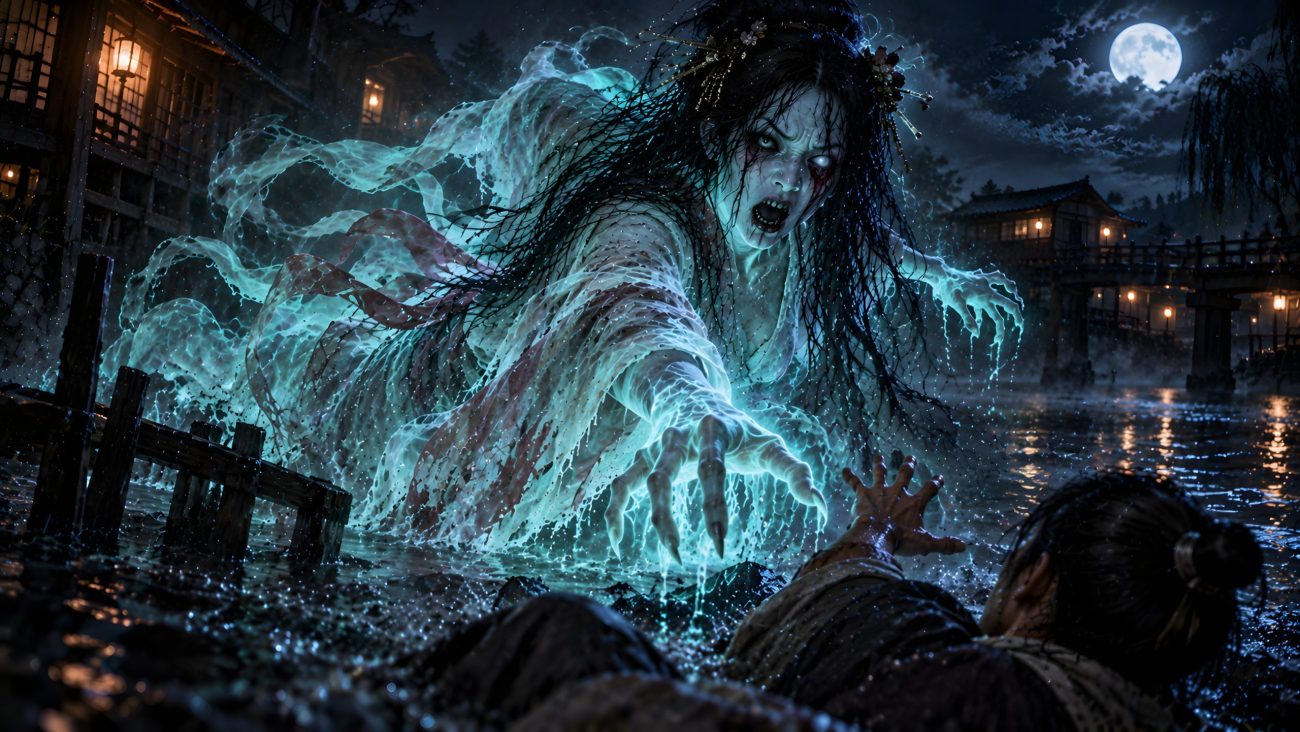
Okita is a tragic woman whose story appears in Tsuruya Nanboku’s illustrated supernatural novel Kaidan Iwakura Mannojō. She is the daughter of Chōshichi, who runs an establishment in Osaka associated with performers who specialize in female impersonation in Kabuki theatre. Okita falls deeply in love with Iwakura Mannojō, a female impersonator who becomes her husband. Despite her devotion, Mannojō is a reckless man who wastes money on drinking and gambling, repeatedly demands money from her, and eventually abandons her while travelling to perform in the provinces. Okita remains faithful and works hard to support herself, but her husband’s debts leave her homeless and destitute. Her only comfort comes from Matasuke, a former servant who helps her financially, and her beloved cat, which mysteriously brings her small silver coins.

Mannojō eventually travels to Echigo, where he begins an affair with Otaka, the daughter of a retainer named Yanagawa Geki. Geki learns Mannojō’s identity and schemes to elevate his own position by falsely presenting him as the missing second son of the Asai family. To clear the way for Mannojō’s new marriage, he sends Okita a letter claiming that her husband has died. Devastated by the news, Okita becomes ill, loses sight in one eye, and spends her days praying. When she finally learns the truth, her grief turns into overwhelming hatred. As she combs her hair, great clumps fall out before her, and she becomes consumed by a desire for revenge. She wanders about in a deranged state, asking for the way to Echigo, before disappearing. On the forty-ninth day after her disappearance, Matasuke discovers a woman’s skull in the Yodo River, with a large, one-eyed eel occupying its eye socket. The eel speaks in Okita’s voice, revealing that she drowned and remains trapped between life and death. She begs Matasuke to have her remains buried and Buddhist prayers performed, but declares that she cannot rest until her vengeance against Mannojō is complete.

Okita’s curse soon reaches Mannojō and Otaka. Her cat appears at their drinking party carrying a false Buddhist memorial tablet and scratches Mannojō’s face. When the tablet is placed against Otaka’s face, it sticks fast, and both suffer grotesque swelling and a mysterious illness. They become increasingly isolated as their servants flee, while Mannojō suffers visions of Okita and attacks those around him in fits of madness. Otaka eventually gives birth to a monstrous, one-eyed eel, which Geki secretly throws into a stream. The family’s misfortunes culminate in violence and betrayal, and Geki kills Mannojō and Otaka while attempting to conceal his own wrongdoing. At Mannojō’s funeral, a terrifying creature known as a Kasha descends amid a storm and seizes the corpse. Although the story does not explicitly identify the creature as Okita’s cat, the narrative suggests that her beloved animal may have transformed into the corpse-stealing monster. Geki is eventually captured after Matasuke exposes the truth, and the corrupt schemes surrounding Mannojō’s false identity are brought to an end. With the return of the Asai family’s stolen heirloom dagger, Okita’s brutal revenge finally concludes.


Sources

“Okita.” 新版TYZ 妖怪図鑑 (New TYZ Yokai Encyclopedia). https://tyz-yokai.blog.jp/archives/1060178316.html
Osawa

Tradition: Japanese Mythology
Alternative Names: Oosawa, おおさわ
Category: Ghost


The Myth

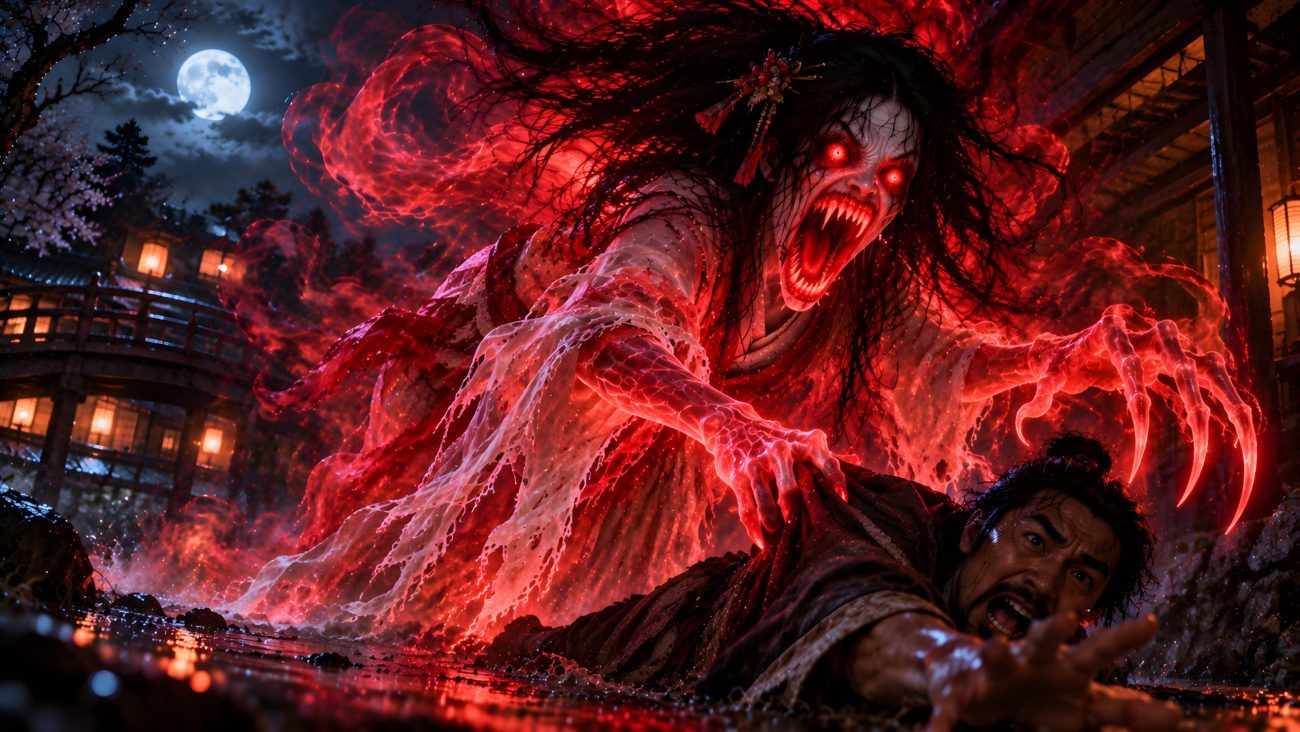
Osawa is a tragic woman whose vengeful spirit appears in the Japanese supernatural novel Kinsei Kaidan Shimoyo Hoshi, written by Ryūtei Tanehiko and illustrated by Katsushika Hokusai in 1808. The story takes place during Japan’s Bunmei era (1469–1487) and features a character based on Oiwa, the famous vengeful spirit of Japanese ghost lore. Osawa is the daughter and heiress of the Murota family. Although she possesses a pure heart, she is considered exceptionally ugly, with short, curly hair, rough skin, a crooked nose, prominent cheekbones, mottled teeth, and a voice compared to a wolf howling at the moon. She marries Takanishi Ihei, a rōnin from Bōshū, but he resents the marriage and eventually becomes devoted to Hanako, a beautiful woman with whom he had once shared a close relationship.

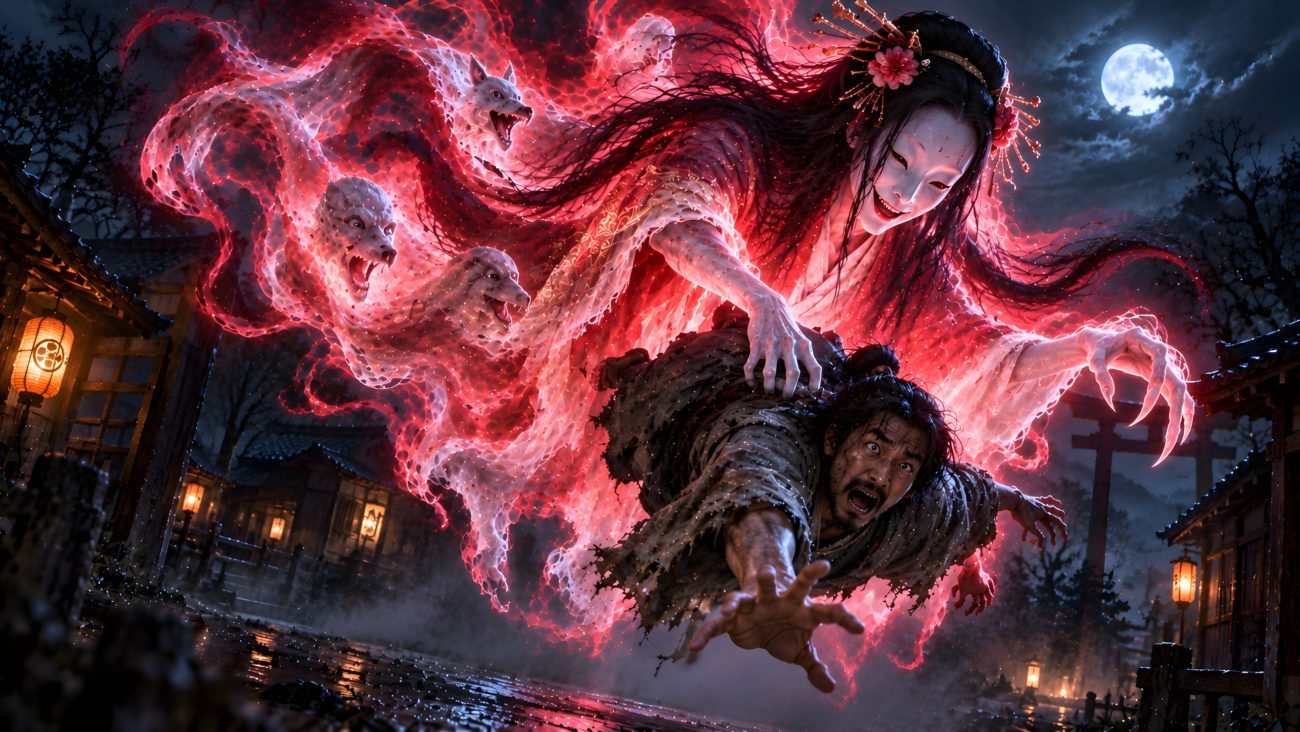
Ihei conspires with an accomplice to rid himself of Osawa. He pretends to be impoverished, sells her possessions, neglects their home, and falsely accuses her of infidelity before casting her out. Despairing at her treatment, Osawa throws herself into a stream. Ihei subsequently marries Hanako, but on their wedding night strange events begin to occur. Insects repeatedly extinguish their lamp, and a small snake falls from the ceiling. Ihei suspects that Osawa’s vengeful spirit has taken the form of the snake. It repeatedly returns, eventually carrying Hanako’s hairpin in its mouth, before vanishing into a shadowy flame. The couple later have children, but Osawa’s spirit continues to haunt those connected with her suffering, possessing people, causing madness, and bringing death and misfortune upon the families involved.

Osawa’s revenge grows increasingly terrifying. She appears as a pale woman with disheveled hair, manifests as ghostly fire, and confronts Ihei with a cold hand that seizes his collar. Her spirit can vanish and reappear elsewhere, while attempts to attack her prove futile, as though striking through mist. Snakes, hairpins, rats, and other uncanny manifestations become instruments of her curse. Ihei eventually develops a festering wound and confesses that his mistreatment of Osawa has brought these calamities upon him. His daughter Omura is also tormented by the spirit, and Ihei ultimately dies when a sash transforms into a snake and strangles him. Osawa’s haunting continues in the surrounding region, where ghostly fires and the sounds of an unseen carriage inspire fear. The apparitions finally cease after the Buddhist abbot Shōkai builds a mound for Osawa and chants sutras. In the story’s conclusion, Osawa’s accumulated grudges are finally released, and her spirit begins to find a path toward salvation through Buddhist prayer and mourning.


Sources

“Osawa” 新版TYZ 妖怪図鑑 (New TYZ Yokai Encyclopedia). https://tyz-yokai.blog.jp/archives/1038485591.html


Ushirogami

Tradition: Japanese Mythology
Alternative Names: 後神, うしろがみ, Behind Spirit
Category: Ghost


The Myth

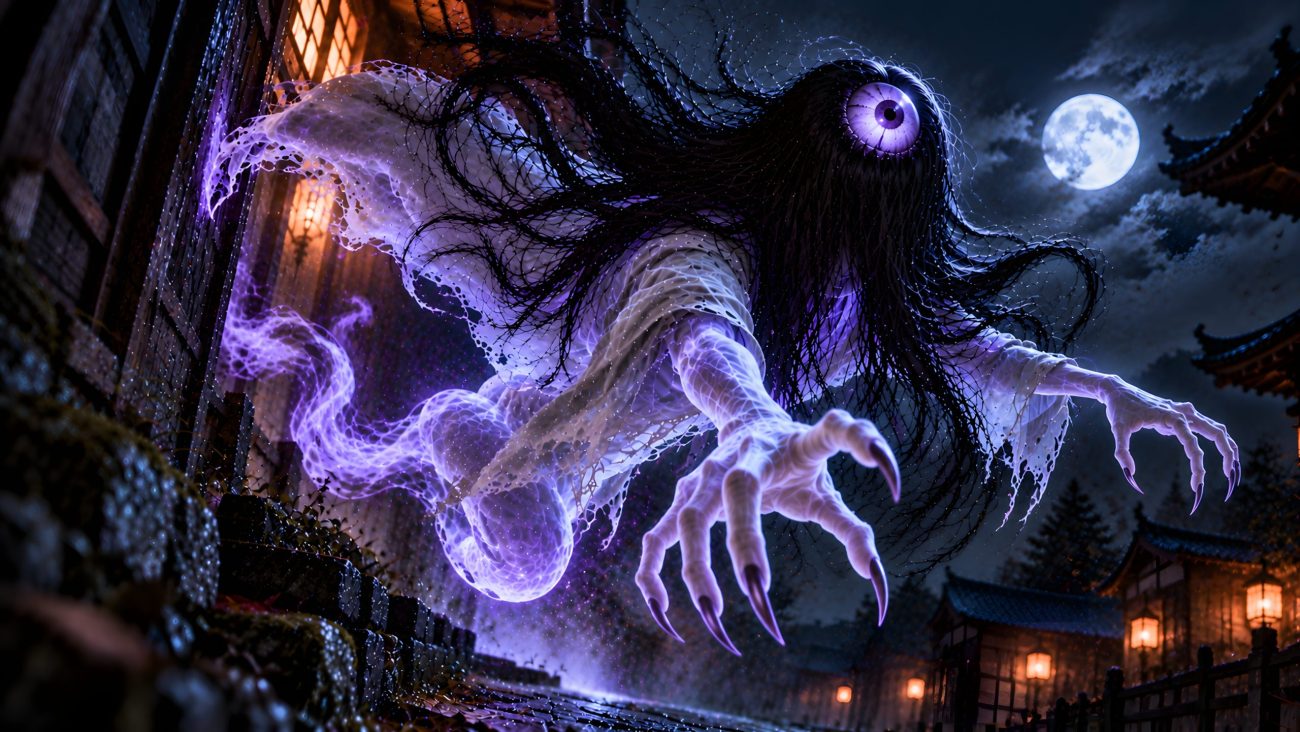
Ushirogami, whose name translates as “Behind Spirit,” is a Japanese supernatural being associated with cowardice and fear. It resembles a ghost with long black hair and a single large eyeball on the top of its head. Rather than having feet, it possesses a long, twisting body that allows it to leap high into the air. Ushirogami is considered a kind of okubyōgami, a spirit that causes cowardice or specifically preys upon those who are already timid.

The Ushirogami’s favorite trick is to sneak up behind unsuspecting people and frighten them. It tugs at the hair on the backs of their necks, then vanishes as soon as they turn around to discover who touched them. Sometimes it presses icy hands against their necks or breathes hot air onto them. The spirit particularly enjoys targeting cowardly young women walking alone at night. It may suddenly untie their hair, let it fall loose, or run its hands through it until it becomes tangled. It can also summon powerful gusts of wind to blow umbrellas away, leaving its victims startled and unsettled.

The Ushirogami’s name contains a wordplay that connects its supernatural behavior with human reluctance. The Japanese word ushiro means “behind,” while kami means “spirit” in this context. However, ushirogami also refers to the hair at the back of the neck. The expression ushirogami wo hikikaeru, meaning to have the hair at the back of the neck pulled, describes the painful reluctance of someone who must do something they desperately wish to avoid. As they search for an excuse to escape, they may look back as though something were pulling them away. By tugging at this hair, the Ushirogami gives physical form to the feeling of cowardice and hesitation. It can therefore be understood both as an external spirit that instills fear and as a personification of a person’s own reluctance to face something they dread.


Sources

“Ushirogami.” Yokai.com. https://yokai.com/ushirogami/


Obake

Tradition: Japanese Mythology
Alternative Names: Bakemono (化け物), お化け
Category: Ghost


The Myth

Obake and bakemono are terms used in Japanese folklore for supernatural beings associated with transformation and shapeshifting. Their names refer to things that change form. Although they are sometimes translated as ghosts, they primarily describe living creatures or supernatural entities that temporarily transform into different shapes. In a secondary sense, obake can also refer to the spirit of a deceased human, making it a synonym for yūrei.

The true form of an obake or bakemono may be an animal, a plant spirit, or even an inanimate object. Foxes known as kitsune, raccoon dogs called bake-danuki, badgers known as mujina, and supernatural cats called bakeneko are all associated with transformation. Plant spirits such as kodama may also fall within this broad category, while objects believed to develop souls are known as tsukumogami.

A bakemono may disguise itself as a human or appear in a strange and frightening shape. Examples include the one-eyed childlike hitotsume-kozō, the towering ōnyūdō, and the faceless noppera-bō. In common usage, obake and bakemono can refer to a wide range of bizarre apparitions and supernatural beings, making them broadly similar to the term yōkai.

The concept of obake also spread into Hawaiian local culture through the influence of Japanese communities. Japanese supernatural stories became part of local folklore, including tales of the water-dwelling kappa and faceless apparitions known as noppera-bō. In Hawaii, these faceless ghosts are also called mujina, a name confusion associated with a story by Lafcadio Hearn in which a badger transforms into a faceless being. Hawaiian folklorist Glen Grant further documented reports of supernatural incidents, including many involving Japanese-style obake.


Sources

“Obake.” Wikipedia: The Free Encyclopedia. Wikimedia Foundation. Accessed October 16, 2026. https://en.wikipedia.org/wiki/Obake


Jibakurei

Tradition: Japanese Mythology
Alternative Names: 地縛霊, Earth-Bound Spirit, Land-Bound Ghost
Category: Ghost


The Myth

Jibakurei are spirits of the dead believed to remain bound to a particular place, such as a piece of land or a building. They may be unable to accept their own death or may not realise that they have died. Other spirits remain in a location because of a special attachment or unresolved reason connected to that place.

According to descriptions of these spirits, a sudden death caused by war, an accident, or a disaster may leave the deceased unable to accept what has happened. Strong emotions, such as hatred, can also keep a spirit tied to the place where it died. Some accounts describe spirits of people who died by suicide as unaware of their death, repeatedly reenacting the act. Until they become conscious of their death, these spirits are believed to remain bound to the location as Jibakurei.


Sources

“地縛靈 (Dìbǎlíng).” Chinese Wikipedia. Wikimedia Foundation. Accessed October 16, 2026. https://zh.wikipedia.org/wiki/%E5%9C%B0%E7%B8%9B%E9%9D%88


O-Chiyobon’s Ghost

Tradition: Japanese Mythology
Alternative Names: O-Chiyobon’s Ghost
Category: Ghost


The Myth

O-Chiyobon’s ghost is a female spirit who appears in the supernatural world of Kegawa Daiko-den, a tale by Jippensha Ikku. After leaving Hell and returning to the world of the living, the ghost becomes lost on a mountain path. She discovers the illuminated home of Momonjii, a kindly monster who rents out underground holes to other supernatural creatures, and asks him for shelter and a cup of tea. Momonjii welcomes her inside and learns that she has returned to the living world to haunt a man against whom she holds a grudge. However, the man has moved to the foot of the mountain, and while searching for him, she lost her way. Momonjii offers to let her stay at his home and use it as a base for her nightly visits. The ghost happily accepts, asking him to find a strong companion who can help frighten her enemy, since she is too weak and timid to terrify him alone.

Meanwhile, Momonjii has been sheltering O-Chiyobon, a strange-looking woman whom he rescued from the drunken and violent monster Shiradawashi. After Momonjii and O-Chiyobon become lovers, Shiradawashi storms into the house carrying a huge log, furious that his woman has been taken from him. Momonjii retaliates with an axe, and the other monsters living in his rented holes intervene to settle the fight. After Shiradawashi is thoroughly beaten, Momonjii decides that he must compensate for his mistreatment of O-Chiyobon. He therefore gives the visiting ghost to Shiradawashi as his wife, forgiving his overdue rent and promising that he will never have to pay rent again. Although Shiradawashi complains that his new wife is too beautiful for a monster, he accepts the arrangement because of the financial benefits. He soon becomes unable to resist her charms and spends every night with her.

The ghost, however, finds life with Shiradawashi unbearable. Although she dislikes having a monster for a husband, she endures his advances because she still hopes to use his strength to take revenge on the man she hates. Eventually, her suffering becomes so great that she wishes she could return to Hell, but she no longer knows the way. Unable to escape, she abandons her desire for revenge and begins devoutly chanting the name of Amida Buddha, hoping to reach the Pure Land and find peace. In Hell, Enma, the King of the Underworld, grows furious that the ghost has failed to return and sends a troop of demons to bring her back. When they arrive to seize her, Shiradawashi fiercely fights the demons, throwing and striking the powerful beings in an attempt to keep his wife.

During the fierce battle, a purple cloud suddenly descends from the sky, and Amida Buddha appears within it. Addressing the ghost with a playful pun involving kinako mochi, he invites her to leave Hell behind and enter the Pure Land. Through the power of her sincere devotion, the ghost achieves salvation and escapes her suffering forever. Shiradawashi is left without a wife, and his story continues until he eventually becomes involved in a conflict between a tanuki and a fox, where he meets his end at the hands of O-Chiyobon.


Sources

“居候幽霊 (Isōrō Yūrei).” 新版TYZ 妖怪図鑑 (New TYZ Yokai Encyclopedia). https://tyz-yokai.blog.jp/archives/1072132463.html


Sara-kazoe

Tradition: Japanese Mythology
Alternative Names: Plate Counter, Sara-kazoe
Category: Ghost


The Myth

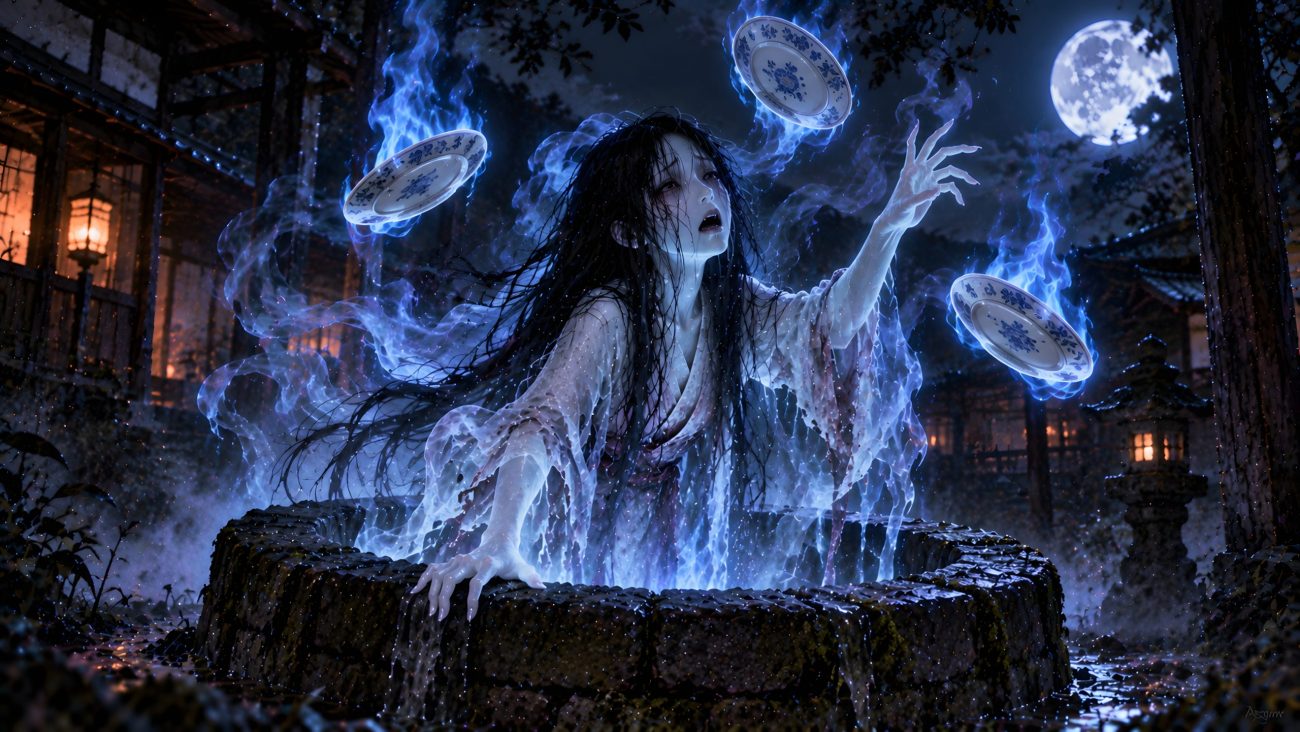
Sara-kazoe is a ghostly yokai depicted as a woman emerging halfway from an old well, with flames issuing from her body as three plates rise into the air around her. Her terrifying appearance is associated with the tragic tale of a maid who was murdered after accidentally dropping one plate from a set of ten into a well. The woman had been entrusted with the precious plates, and the loss of even one brought terrible consequences upon her.

After her death, the maid’s ghost returned to the well every night. There, she counted the plates aloud, slowly numbering them from one to nine before breaking into a sorrowful cry, unable to reach the missing tenth plate. Her nightly lament became an eerie reminder of the injustice done to her, and her spirit remained bound to the well where her life had ended.

The legend of Sara-kazoe is associated with the famous Japanese ghost story of Okiku from Banshū Sarayashiki, the tale of the Plate Mansion of Banshu. The old well in Banshu is identified as the place connected with the haunting, where the murdered maid’s spirit continues to count the plates. Through her repeated cries and fiery apparition, Sara-kazoe embodies the suffering of a wronged woman whose death left her trapped in an endless cycle of grief.


Sources

“皿数え (Counting Plates).” 新版TYZ 妖怪図鑑 (New TYZ Yokai Encyclopedia). https://tyz-yokai.blog.jp/archives/1067140521.html


Daki no O-Hyaku

Tradition: Japanese Mythology
Alternative Names: Daki no Obyaku, Hyakuno O-Hyaku
Category: Ghost


The Myth

Daki no O-Hyaku was a notorious villainous woman whose name was associated with the legendary Chinese temptress Daji, the infamous consort of King Zhou of the Shang dynasty. In Japanese tales, O-Hyaku was portrayed as a beautiful and ruthless woman whose ambition, seduction, and cruelty brought ruin to the men and households around her. Her story became especially infamous through tales of murder, betrayal, robbery, and schemes to seize the wealth and power of the Satake family of Akita.

In the popular stories, O-Hyaku was born as the sister of a fisherman named Shinsuke and entered domestic service at the home of Tokubei, a wealthy shipowner in Naniwa. After becoming his mistress, she revealed her cruel nature by accusing his pregnant wife, Otaka, of infidelity and driving her from the household. O-Hyaku then indulged in a life of luxury until Tokubei’s business collapsed. The pair travelled to Edo, where O-Hyaku met Hikogorō, a notorious bandit, abandoned Tokubei, and became Hikogorō’s lover. She established a geisha house in Fukagawa and sometimes performed as a geisha under the name Kosan.

When O-Hyaku later encountered Tokubei, who had fallen into poverty and become a ragpicker, she pretended to calm his anger and lured him to a deserted reclaimed area of Fukagawa. There she stabbed him in the stomach with a large kitchen knife and pushed him into a pond. When he struggled to rise, she kicked him back into the water until he died. As she prepared to leave, Tokubei’s ghost appeared before her as a pale blue ball of fire, hovering around her in silent accusation. Rather than show fear, O-Hyaku mockingly told the spirit to illuminate her way home like a paper lantern. His ghost became one of the most chilling signs of the wickedness attributed to her.

O-Hyaku’s ambitions grew beyond personal wealth. She joined forces with Nakagawa Chūdai, an official serving the Satake family in Edo, and plotted to corrupt the family lord, Satake Sakyō-no-daibu, by encouraging him to indulge in alcohol and pleasure until he became incapable of ruling. Their ultimate goal was to seize the wealth and power of the Akita domain. Other tales accuse O-Hyaku of deceiving a blind travelling entertainer named Omine, selling her daughter, and arranging for Hikogorō’s men to murder her. She was also said to have escaped exile on Sado Island, extorted money from wealthy farmers near Niigata, and eventually become a pirate commanding numerous followers. Her schemes ultimately failed, and she was cornered by her pursuers.

Behind O-Hyaku’s transformation into a monster of cruelty lay the vengeance of a supernatural sea creature. Long before, Tokubei’s father, Tokuzō, had been sailing aboard the Satake family’s ship, the Sen-nichimaru, when a violent storm arose and a giant sea monk, or umibōzu, appeared offshore. Tokuzō courageously borrowed the lord’s sword and cut the monster down with a single stroke. The slain creature’s vengeful spirit flew inland and possessed O-Hyaku, transforming her from a naturally gentle woman into a figure consumed by lust and wickedness. At the end of the turmoil, when O-Hyaku was surrounded and could no longer escape, an enormous monk-like figure rose behind her, towering to an impossible height. Declaring that the vengeance had run its course and that the events should serve as a warning to future generations, the giant vanished. Freed from the sea spirit, O-Hyaku returned to her former gentle nature and was captured without resistance. In one version, she repented of her crimes and accepted death at the hands of Tokubei’s son, believing this was the only fitting end for her. She died at the age of twenty-five.


Sources

“妲己のお百 (Dakki no O-Hyaku).” 新版TYZ 妖怪図鑑 (New TYZ Yokai Encyclopedia). https://tyz-yokai.blog.jp/archives/1060567084.html


Shikishima

Tradition: Japanese Mythology
Alternative Names: Kuruwa Bunko Shikishima Monogatari
Category: Ghost


The Myth

Shikishima is a beautiful courtesan who was kidnapped as a young child and sold to the pleasure quarters of Yoshiwara. Despite her frail health, she rises to become a high-ranking courtesan at the Miuraya brothel. With only three months remaining on her contract, she dreams of freedom but is troubled by her love for Fujishiroya Jūzaburō, a man who is already married. Her life takes a terrible turn when she is falsely accused of stealing valuables from sleeping customers. The real culprit, the greedy madam Otsume, conspires with the servant Genshiro to frame Shikishima and conceal their own misdeeds. When Shikishima refuses to confess, she is brutally tortured. Her young daughter Wakano is brought in and tortured alongside her, forcing Shikishima to accept the blame in an attempt to spare the girl further suffering.

Afterward, Shikishima discovers that the accusation was part of a larger plot to silence her because she knew of the secret affair between Genshiro and Otama, the wife of the Miuraya’s owner. Genshiro intends to kill her to protect their secret. As Shikishima lies dying, she curses her tormentors and vows to make them understand the consequences of their actions. Genshiro mocks her challenge to return as a ghost before cutting her throat with a dagger. He makes it appear that she has eloped and fled the brothel, stuffs her body into an old wicker basket, and throws it into the sea. A mysterious flame rises from the water, and Shikishima’s vengeful spirit begins to haunt Genshiro. Her ghost glares at him with burning resentment, appearing alongside eerie, shadowy flames and pursuing him wherever he goes.

Shikishima’s spirit eventually appears in a wicker basket that rises from the water, revealing her seemingly fresh corpse with its eyes suddenly opening to glare at her murderers. She accuses Genshiro of falsely framing her and condemning her to a horrible death. Even when he challenges her to kill him, her ghost refuses to leave, declaring that she cannot abandon a land filled with hatred without taking revenge. She also visits Jūzaburō in a dream, asking him to care for their daughter and promising that they will be reunited as husband and wife in the afterlife. Before disappearing, she entrusts her daughter’s future to him. Guided by the revelations of her spirit, Jūzaburō and Shikishima’s allies begin uncovering the truth and bringing those responsible for her death to justice. The shadowy flame that accompanies the revenge finally goes out when Otama is beheaded, marking the end of Shikishima’s haunting.


Sources

“敷島 (Shikishima).” 新版TYZ 妖怪図鑑 (New TYZ Yokai Encyclopedia). https://tyz-yokai.blog.jp/archives/1077741624.html


Otsuta

Tradition: Japanese Mythology
Alternative Names: Otsuya
Category: Ghost


The Myth

Otsuta, also known as Otsuya, is the daughter of a fishmonger who becomes a concubine in the household of the samurai Isobe Kazuenosuke. Favored for her beauty, she becomes entangled in a conspiracy led by the wicked retainer Iwagami Godayu and his son Tenzo, who seek to control the Isobe family. When Otsuta overhears their secret plans to poison their rivals, Tenzo decides to silence her. He first attempts to force himself upon her, but she refuses him. When Monzaburo intervenes and helps her escape, Tenzo accuses them both of adultery to conceal his own crimes.

Otsuta attempts to defend her innocence before Kazuenosuke, but Tenzo’s lies and accusations turn her master against her. She is tortured, falsely accused of breaking a precious family teacup, and forced to drink poisoned water. As she writhes in agony, Otsuta swears that she will soon return to take revenge. Tenzo mockingly challenges her to come back as a ghost, claiming that he has never encountered one outside a play. Kazuenosuke then strikes her repeatedly with his sword, and her body is thrown into a well where a former master had also murdered a concubine. Soon afterward, rain and wind extinguish the lights, and Otsuta’s ghost appears amid smoke and a sudden burst of flame before vanishing.

Otsuta’s spirit later appears to Monzaburo as he prepares to commit seppuku after being falsely accused of adultery. She stops him and reveals the conspiracy of the Iwagami father and son, explaining the truth she had been prevented from telling while alive. Although she has returned from the dead, Otsuta declares that she does not hate Kazuenosuke. Grateful because the money she earned in his service once helped save her family from debt, she intends to remain in the world of the living to protect his household. Monzaburo promises to safeguard her family, and Otsuta’s ghost disappears with a joyful expression. Her revelations help expose the conspiracy, leading to the downfall of the villains and the restoration of justice.


Sources

“おつた (Otsuta).” 新版TYZ 妖怪図鑑 (New TYZ Yokai Encyclopedia). https://tyz-yokai.blog.jp/archives/1077741622.html