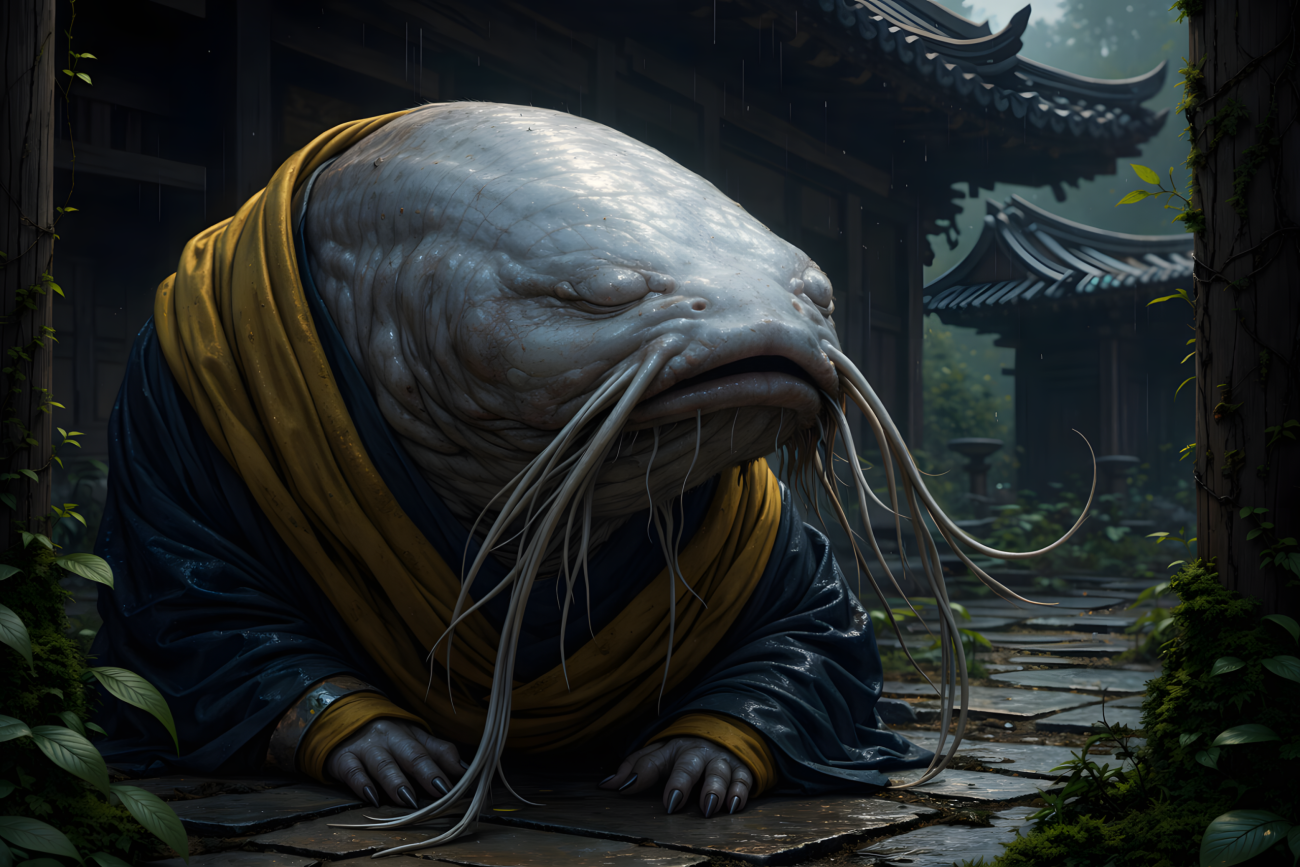
Amitabha Fish

Tradition / Region: Japanese Mythology, Budhist lore
Alternate Names: Amida Fish
Category: Fish


The Myth

Long ago, far to the southwest of the land of Shushishi, there lay an island where more than five hundred families lived by fishing. The people depended entirely on the sea, and their days were spent casting nets and hauling in their catch.

One day, an extraordinary event occurred. From the sea came countless large fish, swimming all the way onto the shore. The islanders were overjoyed and rushed to the beach, expecting a great bounty. As they gathered, they heard something strange: each fish made a sound like a human voice, repeatedly calling out, “Amida Buddha, Amida Buddha.”

The people, unfamiliar with Buddhist teachings, did not understand the meaning of the words. They simply named the creatures Amitabha Fish, after the sound they made. They soon noticed that whenever the name was spoken aloud, more fish would approach the shore. Discovering this, the islanders began chanting the name again and again, using it to lure the fish closer.

The fish did not flee. They allowed themselves to be taken and killed. When the people ate their flesh, they found it astonishingly delicious. Those who chanted the name of Amida Buddha fervently said the taste was rich and sweet, while those who chanted only weakly found the meat bitter and sharp. Entranced by the flavor, the islanders began chanting the sacred name constantly, driven by both pleasure and habit.

In time, an elder—one of the first to eat the Amitabha Fish—passed away. Three months later, he appeared on the shore riding a purple cloud, his body shining with radiant light. He spoke to the people, saying:

“After my death, I was reborn in the Pure Land. This came to pass because I delighted in the flesh of the Amitabha Fish and chanted the name of Amida Buddha. That great fish was none other than Amida Buddha himself, taking pity on our ignorance. He transformed into a fish, guided us to chant his name, and even offered his own body as food. Because of the bond formed through this act, I was reborn in the Pure Land.”

He then said that anyone who doubted his words should look upon the remains of the fish.

After the elder vanished, the people examined the discarded bones of the Amitabha Fish. They found that every bone had transformed into a lotus flower.

Filled with awe and remorse, the islanders abandoned killing and devoted themselves entirely to chanting the name of Amida Buddha. In time, each of them was reborn in the Pure Land. The island was left empty and silent, its former inhabitants gone, leaving only the shore where the sacred fish had once gathered.


Gallery


Sources

TYZ-Yokai Blog contributors. (n.d.). 狐火 (Kitsunebi). In TYZ-Yokai Blog, from https://tyz-yokai.blog.jp/archives/1065099106.html


Interpretive Lenses

Religious Readings
  • Christian Ascetic Deep Dive
Philosophical Readings
  • Nietzschean Deep Dive
Psychological Readings
  • Jungian Deep Dive
Esoteric Deep Dive
  • Hermetic Deep Dive
Political / Social Readings
  • Marxist Deep Dive
Other
  • How to Invite The Amitabha Fish

Nuegyo

Tradition / Region: Japanese Mythology
Alternate Names: Nue
Category: Fish, Cat


The Myth

Nuegyo is a strange and unsettling fish said to appear in the seas off the coast of Japan. Those who encountered it did not recognize it as any known creature of the ocean, and even experienced fishermen were unable to name it.

The Nuegyo is said to be about the length of a man’s forearm. Its skin is rough, like that of a shark, while its head resembles that of a cat. Atop its head rests a hard, bowl-shaped mass, like stone. Its nose and mouth are also catlike, and from both sides of its jaw protrude sharp, bone-like spines several inches long. A thin spine rises from the top of its head, giving it an even more unnatural appearance.

Its body is shaped somewhat like that of a gurnard, but its fins are long and soft, extending all the way toward the tail. These fins are wide and flexible, like the wings of a bat. When spread open, they form a fan-like shape. It is said that the Nuegyo can use these fins as wings, rising above the surface of the sea and gliding through the air.

Because of its bizarre combination of features—part fish, part beast, and capable of flight—people began to call it Nuegyo, likening it to the legendary Nue, a creature made of mismatched forms. Whether it truly flies or merely skims the waves is unknown, but the Nuegyo is remembered as a sea being that does not fully belong to water or sky, and whose appearance defies ordinary understanding.


Gallery


Sources

TYZ-Yokai Blog contributors. (n.d.). 座敷童子 (Zashiki-warashi). In TYZ-Yokai Blog, from https://tyz-yokai.blog.jp/archives/1010654392.html


Interpretive Lenses

Religious Readings
  • Christian Ascetic Deep Dive
Philosophical Readings
  • Nietzschean Deep Dive
Psychological Readings
  • Jungian Deep Dive
Esoteric Deep Dive
  • Hermetic Deep Dive
Political / Social Readings
  • Marxist Deep Dive
Other
  • How to Invite The Nuegyo

Senzanri

Tradition / Region: Japanese Mythology
Alternate Names: Thousand Mountain Carp
Category: Fish, Mountain dweller, Carp


The Myth

The Senzanri is a strange and transformative carp, said to be capable of leaving the water and becoming a creature of the mountains.

According to the story, a boy named Torakichi spoke of this being from his own experience. He said that when certain substances were mixed into water or shaped like fish and placed in old ponds, crucian carp would appear in great numbers. These carp were not ordinary fish. Among them were those that would later become Senzanri, carp that transform and give birth after leaving the water.

It is commonly said that carp climb waterfalls and become dragons, but Torakichi explained that this belief misunderstands what truly happens. The carp do not become dragons. Instead, using the force they gather while leaping up waterfalls, they launch themselves into the mountains. There, far from rivers and ponds, the transformation begins.

Once on land, the carp rolls about in grassy places. As time passes, its body becomes rounder and harder, forming a shell. Hair grows between its scales. Its fins change into four limbs, and the creature begins to crawl like a land animal. Though its shape changes, its inner body remains that of a carp.

In this form, the Senzanri lives in mountain pools, where it gives birth to offspring known as mountain-burrowing carp. These young inherit the strange nature of their parent, belonging neither fully to water nor to land.

The Senzanri is thus a creature that bridges worlds: born as a fish, transformed by the mountains, and living a life hidden from ordinary human sight.


Gallery


Sources

TYZ-Yokai Blog contributors. (n.d.). 雪女 (Yuki-onna). In TYZ-Yokai Blog, from https://tyz-yokai.blog.jp/archives/1010654386.html


Interpretive Lenses

Religious Readings
  • Christian Ascetic Deep Dive
Philosophical Readings
  • Nietzschean Deep Dive
Psychological Readings
  • Jungian Deep Dive
Esoteric Deep Dive
  • Hermetic Deep Dive
Political / Social Readings
  • Marxist Deep Dive
Other
  • How to Invite The Senzanri

Uso no Seire

Tradition / Region: Japanese Mythology
Alternate Names:
Category: Yōkai, Fish, Monk, Catfish


The Myth

Uso no Seirei is a yōkai depicted in the Bakemono Emaki (Monster Picture Scroll) preserved in the Kawasaki City Museum.

It appears in the form of a bald monk-like figure. Its face has no eyes, no nose, and no mouth. From where its face should be, long whiskers grow, resembling those of a catfish. The creature wears a kimono patterned with images believed to represent the uso, the bullfinch.

The spirit stands silently, without expression or speech. Its lack of facial features gives it an unsettling presence, as though it exists without identity or emotion. The bullfinch pattern upon its robes marks its nature, binding it to the idea of the uso itself.

Uso no Seirei does not act violently, nor does it chase or attack. It simply appears, featureless and mute, a quiet and uncanny figure among the monsters of the scroll.


Gallery


Sources

Tyz-Yokai Blog contributors. (n.d.). [Title of entry]. In TYZ-Yokai Blog, from https://tyz-yokai.blog.jp/archives/1010653494.html


Interpretive Lenses

Religious Readings
  • Christian Ascetic Deep Dive
Philosophical Readings
  • Nietzschean Deep Dive
Psychological Readings
  • Jungian Deep Dive
Esoteric Deep Dive
  • Hermetic Deep Dive
Political / Social Readings
  • Marxist Deep Dive
Other
  • How to Invite The Uso no Seire