Chiyou

Tradition / Region: Chinese Mythology
Alternate Names:
Category: Cow, God


The Myth

In the ancient age before the rise of dynasties, when the tribes of the world still fought for dominion, there ruled a powerful leader named Chiyou, chief of the Nine Li.

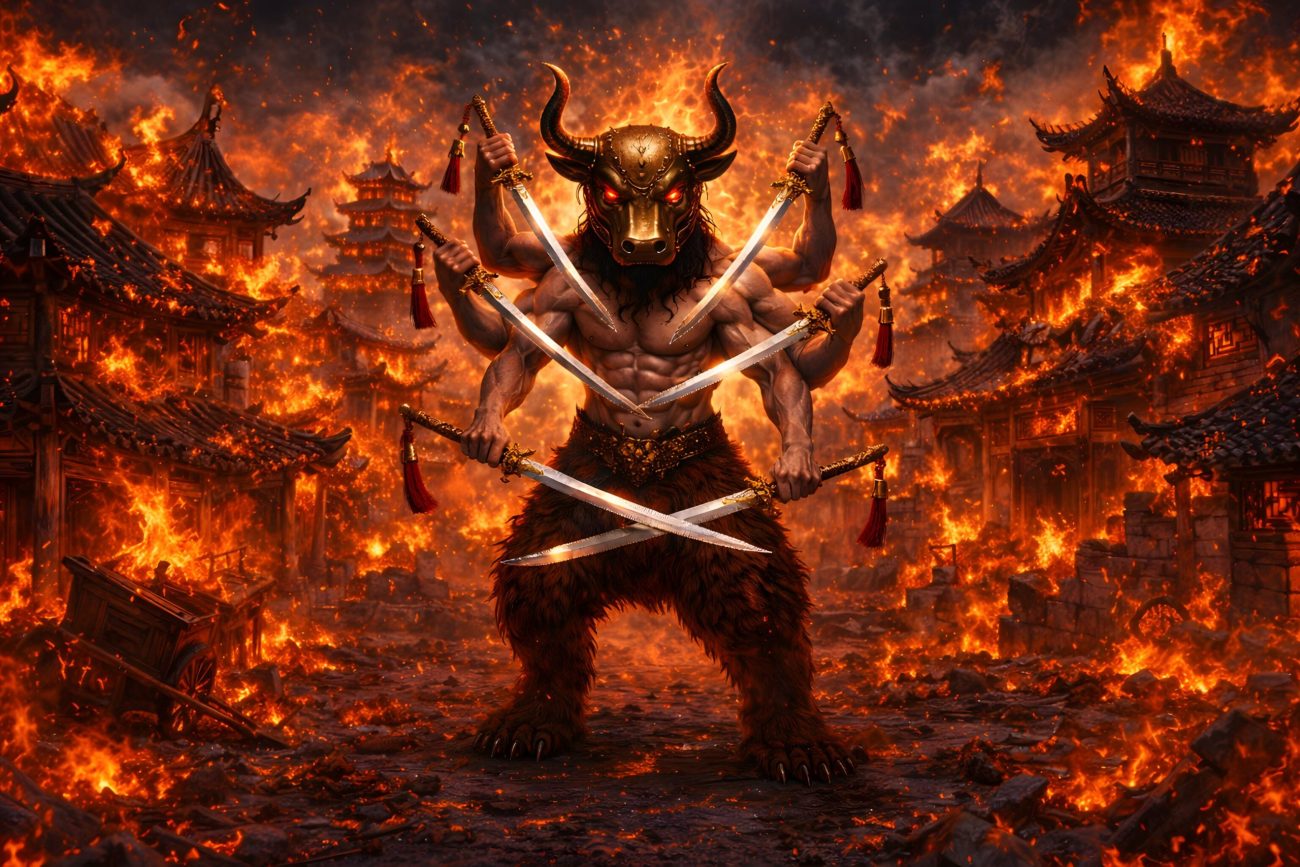
From birth he was unlike other men. His body was human, but his head was that of a bull, crowned with great horns. His brow was said to be as hard as bronze or iron, and his strength was immense. Some said his limbs were like those of a beast, and that he carried many weapons, wielding them with unstoppable force. Wherever he marched, it was as though a great animal thundered across the land.

Chiyou led his people into battle as a bull lowers its head before the charge. He possessed knowledge of ancient magic and commanded the powers of wind and storm. In war he called down rain and thick, blinding fog that swallowed entire armies.

At the great Battle of Zhuolu, he used this power against the Yellow Emperor. A vast mist covered the battlefield so that soldiers wandered helplessly, unable to find their way. Under this shroud Chiyou fought fiercely, supported by his many followers, whether counted as eighty-one brothers or eighty-one tribes bound to him.

Yet in the end the Yellow Emperor overcame him through skill and divine aid. Chiyou fell, and the power of his people was broken.

Though defeated, he was not forgotten. In later times warriors honored him as a spirit of battle, remembering the bull-headed lord whose strength shook the earth and whose fury in war was like that of a charging ox.


Gallery


Sources

Wikipedia contributors. (n.d.). Chiyou. In Wikipedia, The Free Encyclopedia, from https://en.wikipedia.org/wiki/Chiyou


Interpretive Lenses

Religious Readings
  • Christian Ascetic Deep Dive
Philosophical Readings
  • Nietzschean Deep Dive
Psychological Readings
  • Jungian Deep Dive
Esoteric Deep Dive
  • Hermetic Deep Dive
Political / Social Readings
  • Marxist Deep Dive

Báihǔ

Tradition / Region: Chinese mythology
Category: Tiger, Deity


The Myth

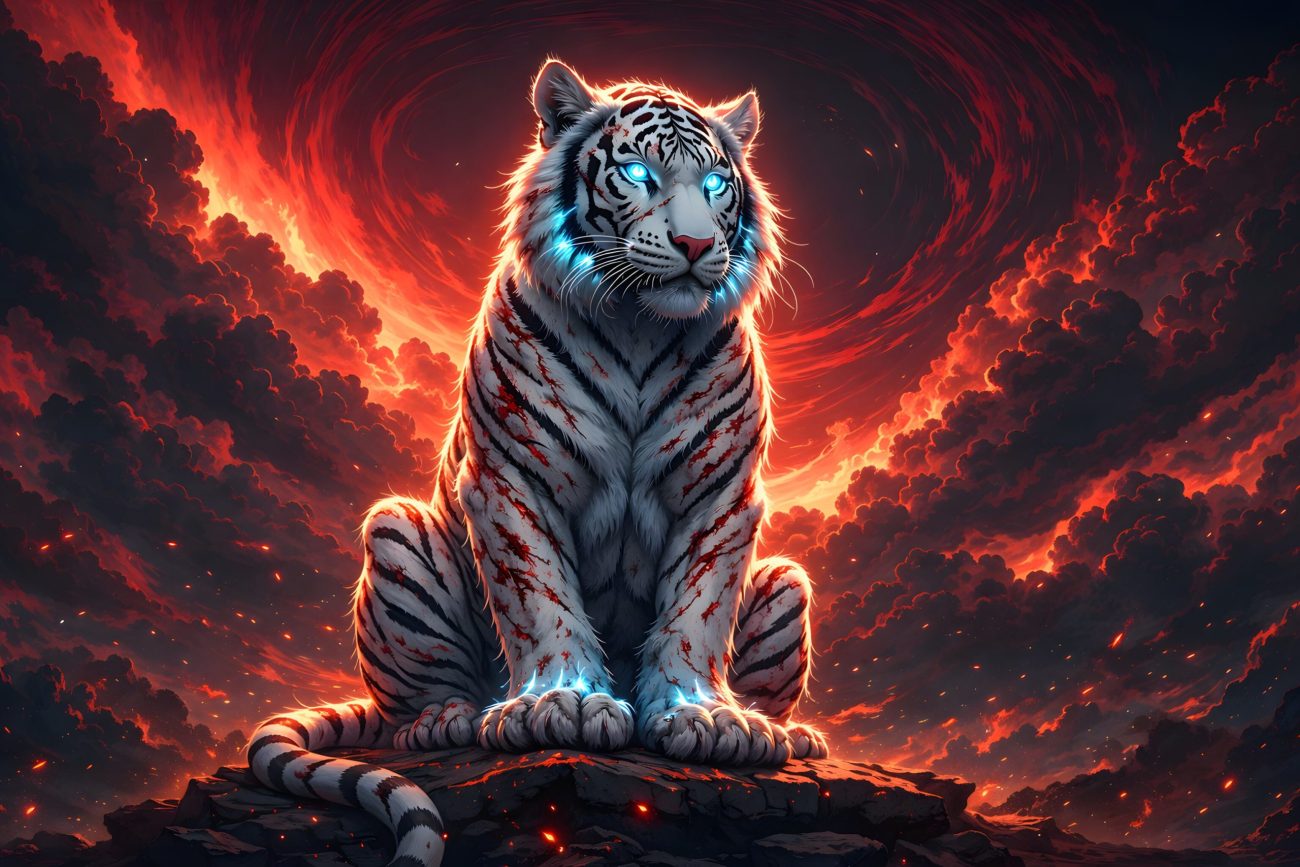
Báihǔ, the White Tiger, is the celestial guardian of the western sky and one of the Four Symbols that structure the cosmos in ancient Chinese thought. More than a constellation, Báihǔ is a living spirit of heaven, born from early star worship and later integrated into Daoist cosmology. In classical texts it is known by many sacred titles—Jianbing, Dijun, Shengjiang, Shenjiang, and Buguijiang—each emphasizing its role as commander, judge, and enforcer of cosmic order.

The White Tiger governs the west, the element of metal, and the season of autumn, embodying discipline, justice, and controlled violence. Its form is mapped across seven constellations—Kui, Lou, Wei, Mao, Bi, Zi, and Shen—which together were understood as a celestial army. These stars did not merely mark time; they represented moral law, hierarchy, and readiness to act when order was threatened.

Báihǔ is revered as a god of war and punishment, overseeing weapons, soldiers, and righteous conflict. It protects those who act with virtue and courage, while striking down evildoers who disrupt harmony. Though fierce and terrifying, the White Tiger is not a force of chaos. It is both shield and blade: capable of averting disasters, granting prosperity, blessing marriages, and guarding the just—yet merciless toward corruption and moral decay.

Its worship flourished during the Han dynasty, when shrines were raised in places such as Weiyang, and specific festival days were dedicated to honoring its power. Long before imperial China, tribes such as the Qiang and Rong venerated the White Tiger, and later peoples—including the Yi, Bai, Buyi, and Tujia—claimed descent from it. In these traditions, Báihǔ descends to earth as a celestial king, fathering seven sons and seven daughters, anchoring human lineages to the heavens.

To behold Báihǔ in the western sky was never a neutral act. It was both reassurance and warning. Its presence affirmed that justice was being watched, that virtue had cosmic backing, and that imbalance would be corrected. Striped across the heavens and mirrored in human conduct, the White Tiger stands as an eternal reminder that order is maintained not only through mercy, but through the disciplined force that defends it.


Interpretive Lenses

Religious Readings
Philosophical Readings
Psychological Readings
Esoteric Deep Dive
  • Hermetic Deep Dive
Political / Social Readings
Other