Tradition / Region: Japanese Mythology Alternate Names: — Category: Cat
The Myth
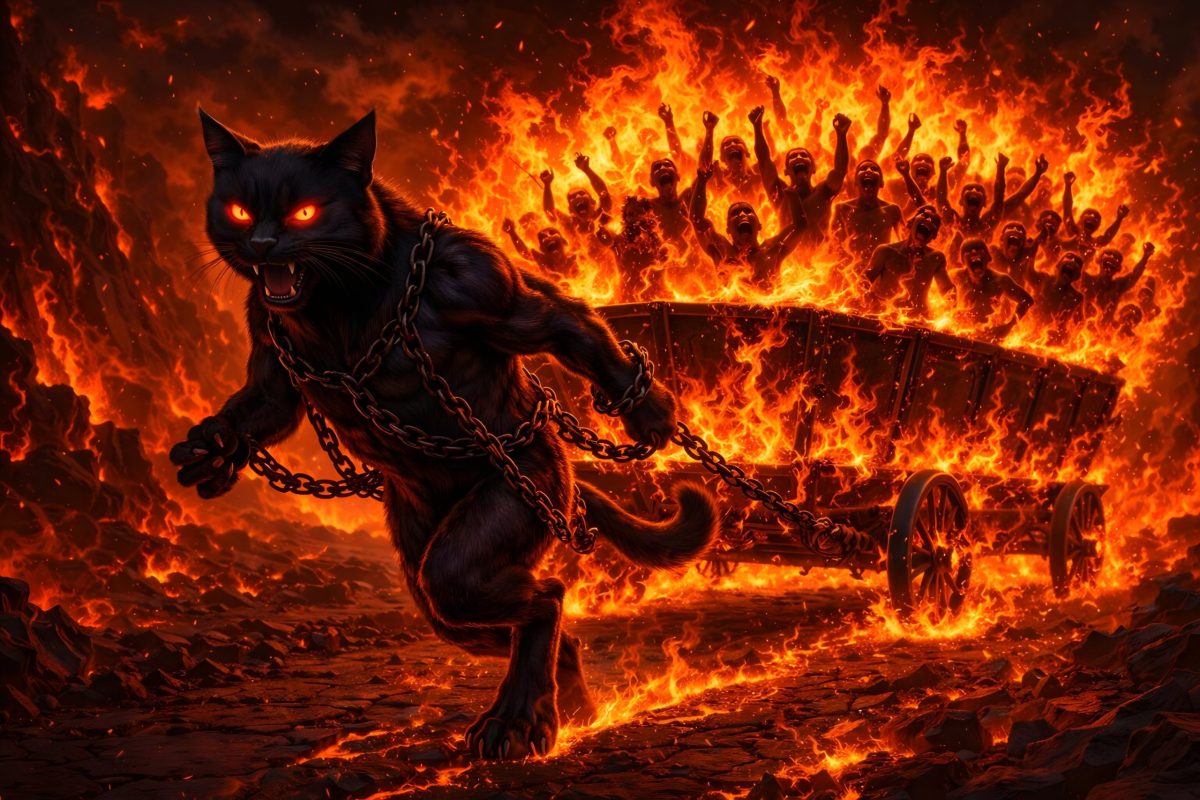
The Kasha is a cat-like yokai associated with death and the punishment of wrongdoers. It is said to carry away the corpses of those who committed crimes, and is often depicted grasping a body while connected to a flaming chariot or fire.
The Kasha appears when a person who has committed wrongdoing dies. It takes the corpse and carries it away, acting as an agent of karmic consequence rather than human judgment. It is portrayed as a cat-like being that may stand upright and seize the body, sometimes shown with a chariot of fire. Images of the Kasha appear in works such as death scrolls and mandalas, where it is shown taking the dead away. Its form varies by region, sometimes more monstrous and sometimes more cat-like, but it is consistently associated with the removal of sinful corpses and the inevitability of moral consequence.
Tradition / Region: Luxembourg Mythology Alternate Names: New Year’s Water Spirit, Alzette Bridge Cat Category: Cat
The Myth
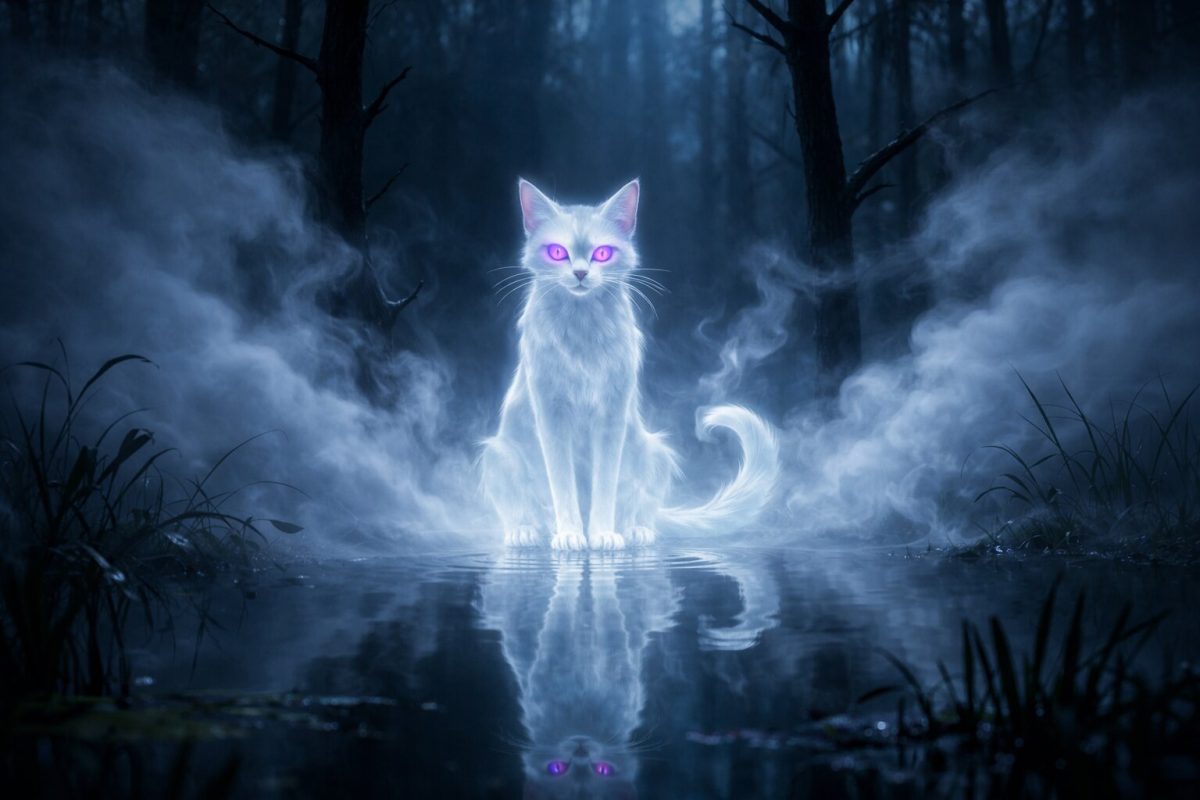
Each year on New Year’s Eve, the water spirit of the Alzette River is said to appear in Ettelbrück in the form of a white cat on the bridge.
One year, a man crossing the bridge that night encountered the animal, which followed him through the deep snow. He hurried home, but the strange creature followed him into the house. No matter how often he tried to drive it out, it kept reappearing in the room.
At last he went to bed and tried to sleep, but the cat sat before him and cried out in a pitiful voice. When the clock struck one, the animal suddenly vanished. In the morning, however, the man discovered that his face had been badly scratched.
People said that the water spirit itself had visited him in the form of the white cat.
In the meadowlands below the village of Budersberg, a snow-white cat is said to appear on certain nights.
It is sometimes seen where the stream called the Gessel flows into the Brüllchen, but most often it shows itself in the middle of the marsh known as the Fäschtemsmoore. There it moves silently through the darkness and then vanishes again, leaving no trace behind.
Thus the people spoke of the white cat that haunted the meadows and marshes below Budersberg.
Nuegyo is a strange and unsettling fish said to appear in the seas off the coast of Japan. Those who encountered it did not recognize it as any known creature of the ocean, and even experienced fishermen were unable to name it.
The Nuegyo is said to be about the length of a man’s forearm. Its skin is rough, like that of a shark, while its head resembles that of a cat. Atop its head rests a hard, bowl-shaped mass, like stone. Its nose and mouth are also catlike, and from both sides of its jaw protrude sharp, bone-like spines several inches long. A thin spine rises from the top of its head, giving it an even more unnatural appearance.
Its body is shaped somewhat like that of a gurnard, but its fins are long and soft, extending all the way toward the tail. These fins are wide and flexible, like the wings of a bat. When spread open, they form a fan-like shape. It is said that the Nuegyo can use these fins as wings, rising above the surface of the sea and gliding through the air.
Because of its bizarre combination of features—part fish, part beast, and capable of flight—people began to call it Nuegyo, likening it to the legendary Nue, a creature made of mismatched forms. Whether it truly flies or merely skims the waves is unknown, but the Nuegyo is remembered as a sea being that does not fully belong to water or sky, and whose appearance defies ordinary understanding.
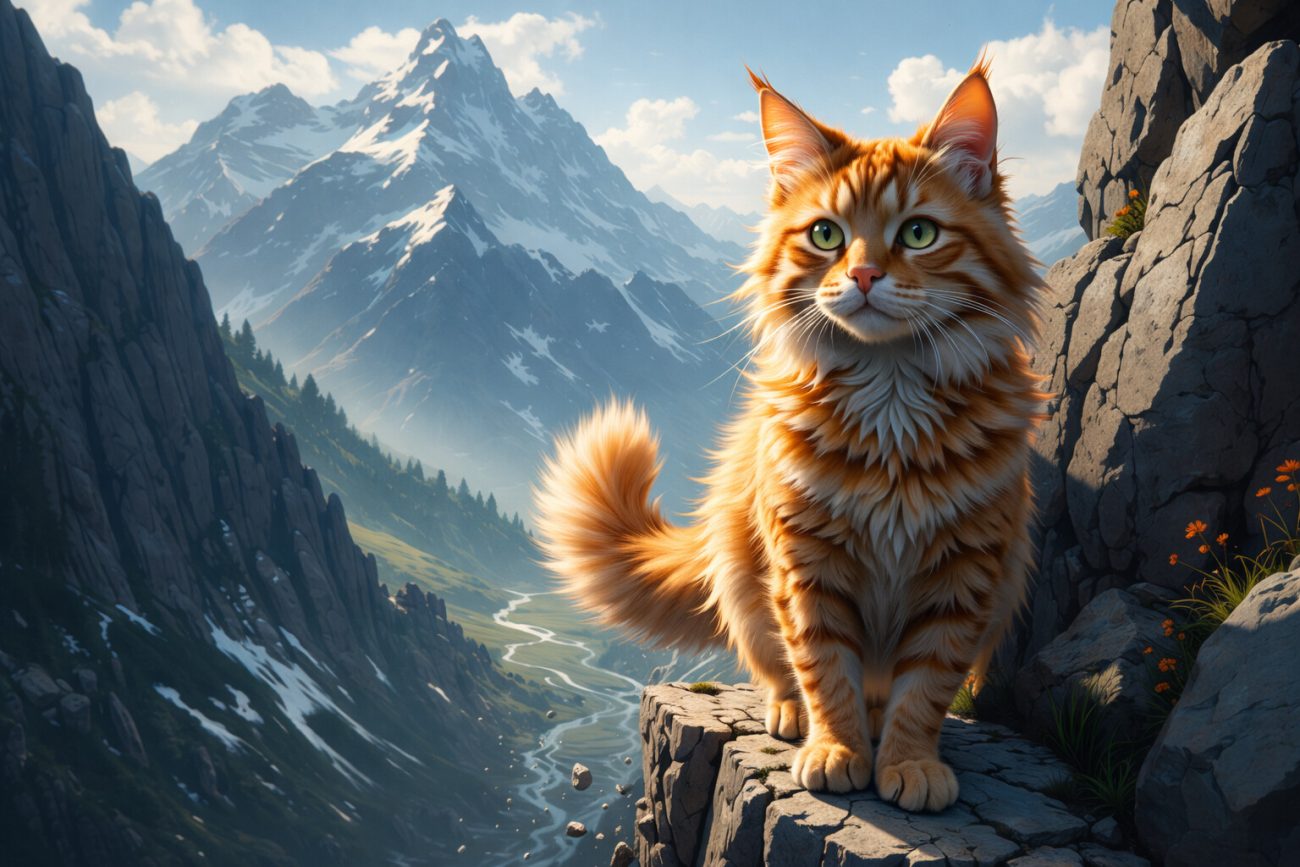
In the old Norse lands, where mountains rose sharply from forest and stone, people believed that not every path was meant for human feet. Some heights belonged to other beings—watchers who moved where men could not follow. Among them was the Skogkatt, a forest cat spoken of not as an animal, but as a fairy creature shaped by the land itself.
The Skogkatt was said to dwell in the mountains, not in villages or hearth-lit halls. Forests marked its boundary, cliffs its true home. Where rock faces rose sheer and unforgiving, the Skogkatt climbed without hesitation. Places that halted hunters, travelers, and even other animals offered it no resistance. Its movement defied expectation, as though the mountain itself allowed its passage.
This ability was not admired for grace, but respected for its meaning. In Norse belief, skill without purpose was rare. To climb where others could not was not merely strength—it was permission. The Skogkatt did not struggle against the mountain; it belonged to it. It left no tracks, no broken stone, no trail to follow. Where it went, humans were reminded of their limits.
Unlike house cats, the Skogkatt was never tame. It was not kept, trained, or claimed. To encounter one was not ownership, but coincidence—a brief crossing between human movement and something older. It did not linger, and it did not respond to being seen. Its presence was not an invitation, but a warning.
The mountains themselves shaped the creature’s meaning. In Norse thought, high places were realms of endurance, silence, and judgment. Storms gathered there without warning. Paths vanished beneath snow and stone. That the Skogkatt moved freely among these dangers marked it as a being unafraid of isolation, thriving where dependence failed.
Later generations would wonder whether the Skogkatt lived on in flesh rather than story, embodied in the great forest cats of Norway—powerful climbers with thick coats and unshakable balance. But folklore does not concern itself with proof. What mattered was not whether the Skogkatt endured, but what it taught.
Through the Skogkatt, people learned that the land does not yield itself equally to all. Some beings walk where others must stop. To follow blindly is to fall. Wisdom lies in knowing when a path is not meant for you.
And so the Skogkatt remains where it has always been—high above the treeline, moving along stone faces untouched by human hands. A quiet presence in the mountains, reminding those below that not every height is meant to be conquered, and not every creature is meant to come down.