Tradition: Greek Mythology
Alternative Names: Faunus (Roman equivalent), Inuus
Category: Sheep, Deity
The Myth
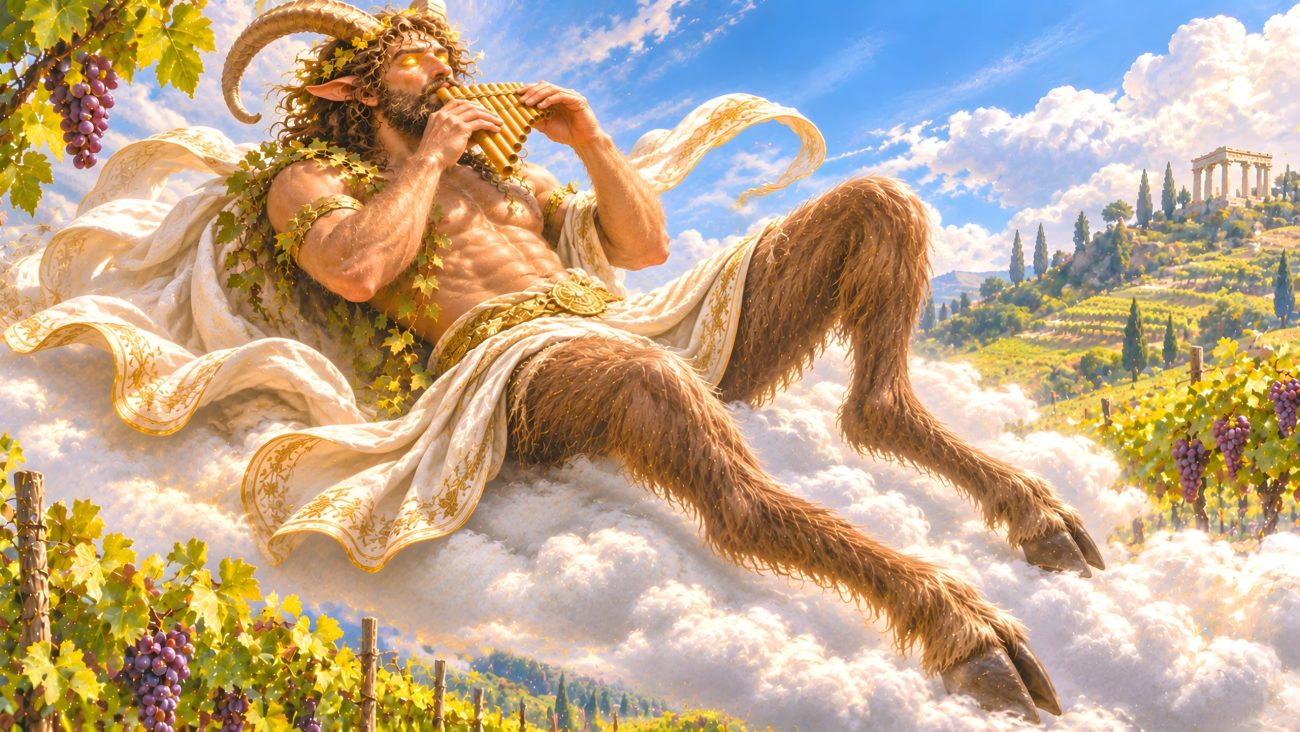
Pan is a Greek god of the wild, shepherds, flocks, rustic music, and the nymphs. Originating in Arcadia, he is associated with forests, fields, wooded valleys, fertility, and spring. He has the hindquarters, legs, and horns of a goat, resembling a faun or satyr. In Roman mythology, he was frequently identified with Faunus and associated with the woodland deity Silvanus and the god Inuus.
One of Pan’s most famous stories concerns the origin of his panpipes. The nymph Syrinx, daughter of the river god Ladon, fled from Pan when he pursued her. She escaped by asking her sister nymphs for help, and they transformed her into reeds. When the wind blew through them, they produced a plaintive melody. Unable to identify which reed had once been Syrinx, Pan cut several reeds into different lengths and joined them together to create his musical instrument, which he named after her.
Pan was also associated with the nymph Echo. In one account, Echo rejected his advances, angering the god, who instructed his followers to kill her. Her body was torn apart and scattered across the earth, while Gaia received her remains. Echo’s voice survived, repeating the final words spoken by others. Other traditions describe Pan as falling in love with Echo, with some accounts making them the parents of Iambe and Iynx.
Another nymph, Pitys, was also loved by Pan. In one version, she transformed into a pine tree to escape him. In another, Pan and Boreas competed for her affection. Boreas uprooted trees to impress her, but Pitys chose Pan. Boreas then pursued her and threw her from a cliff, after which Gaia transformed her into a pine tree.
Pan was renowned for his sexual appetite and was often depicted with an erect phallus. One story tells how he seduced the moon goddess Selene by disguising himself with a sheep’s fleece. Another account describes him teaching his rustic son Daphnis, born to Hermes, how to play the panpipes.
Pan was also associated with sudden, overwhelming fear. His angry cries, particularly when his afternoon rest was disturbed, were believed to inspire panic in isolated places. During the battle between the gods and the Titans, Pan supposedly frightened the attackers with a terrible screech, helping the gods achieve victory. According to another tradition, he inspired panic among the Persian forces during the Battle of Marathon, thereby assisting the Athenians.
Pan also challenged Apollo to a musical contest. Pan played his pipes before the mountain god Tmolus, who served as judge, while Apollo performed on his lyre. Tmolus declared Apollo the winner, and nearly everyone agreed, except King Midas. Apollo punished Midas for his poor judgment by transforming his ears into those of a donkey.
Pan was also connected with the myth of Aegipan, a goat-god associated with the constellation Capricornus. During Zeus’s battle with Typhon, Aegipan and Hermes recovered Zeus’s stolen sinews from the Corycian Cave. Some traditions identify Aegipan with Pan, while others describe Aegipan as Pan’s father or son.
Sources
Wikipedia contributors. (n.d.). Pan (god). Wikipedia. https://en.wikipedia.org/wiki/Pan_(god)#Mythology