Tradition: Chinese Mythology, Japanese Mythology
Alternative Names: Wei Qingzhi’s Daughter
Category: Sheep
The Myth
The story of Wei Qingzhi’s daughter appears in the Mingbao Ji, a collection of Buddhist tales from Tang-dynasty China. It was later quoted in works such as the Fayuan Zhulin and Taiping Guangji, and versions also appeared in Japanese collections, including the Konjaku Monogatarishū and the Uji Shūi Monogatari.
During the Zhenguan era of the Tang dynasty (627–649), a man named Wei Qingzhi served as a senior official in the Prince of Wei’s administration. He and his wife had a beautiful daughter who died when she was little more than ten years old. Her parents were devastated by her death.
Two years later, Wei Qingzhi prepared to travel to a distant place. His family arranged a meal to inform their relatives of his departure, and a servant purchased a sheep at the market for the occasion.
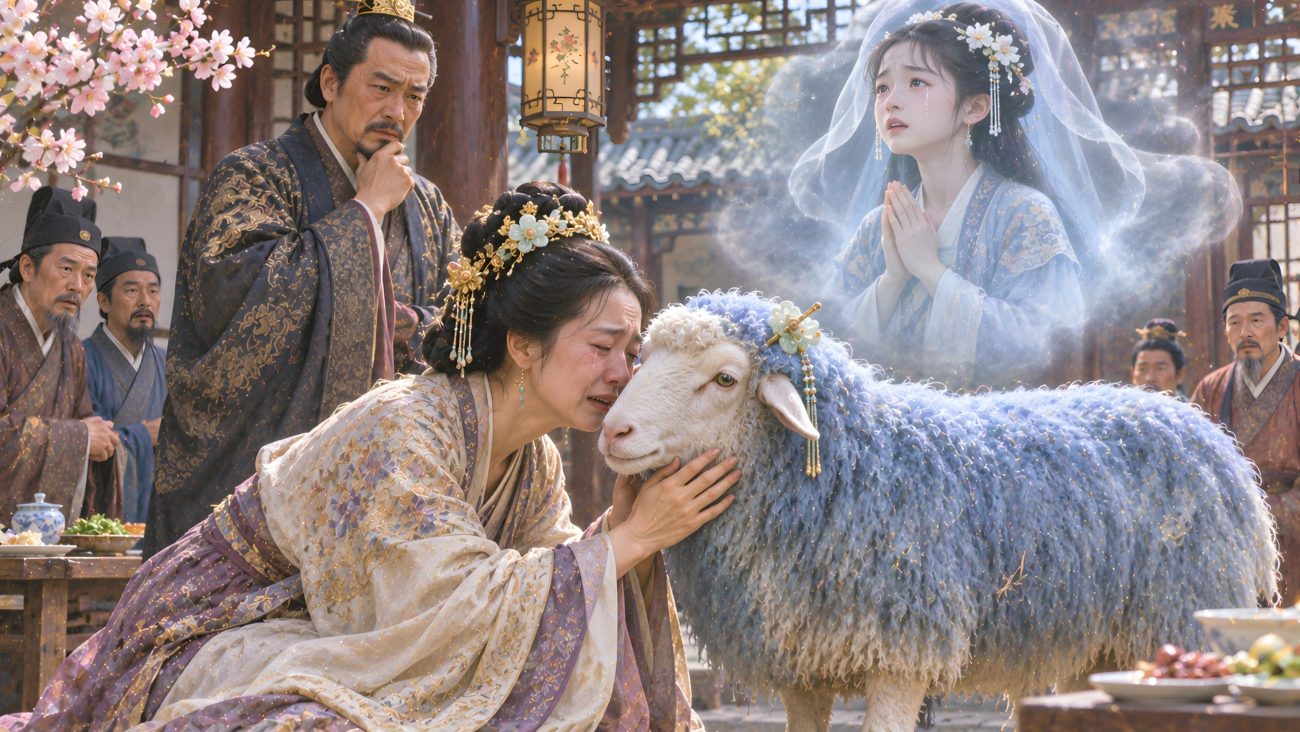
The night before the sheep arrived, Wei Qingzhi’s wife dreamed of her deceased daughter. The girl wore the same clothes she had worn in life: a blue garment, a white covering over her head, and a jade hairpin in her hair. Weeping, she explained that when she had been alive, her parents had indulged her wishes. She had freely spent their possessions and given things to others without telling them, believing that she was not committing theft. As a result of these actions, she had been reborn as a sheep and was destined to be killed at her parents’ house the following day. She begged her mother to spare her life.
When the mother awoke, she was overcome with grief for her daughter’s fate.
The following morning, she recognised the sheep that had been bought for the feast. Its body was blue, and its white head bore markings resembling a hairpin. She ordered that it must not be killed. However, Wei Qingzhi became irritated by the delay in preparing the meal and secretly instructed the servants to have the sheep cooked.
The sheep was tied by the head and hoisted up in preparation for slaughter. At that moment, guests arrived at the house and saw what appeared to them to be a beautiful young girl hanging with a rope attached to her hair. The girl cried out that she was the family’s daughter, now transformed into a sheep, and begged them to save her. The guests urged that the animal must not be killed and went to inform Wei Qingzhi of what had happened.
While they were away, the cook, fearing the master’s anger, killed the sheep without permission. The cook heard only an animal bleating, but the guests heard the cries of a young girl.
The sheep was prepared as steamed and roasted dishes for the feast. The guests refused to eat and left. When Wei Qingzhi asked what had happened, one of them explained the entire story.
Overcome with grief and remorse, Wei Qingzhi wept bitterly. According to the tale, he eventually fell ill and died without ever undertaking his journey.
Sources
Tyz-Yokai. (n.d.). Ikeishoku. https://tyz-yokai.blog.jp/archives/1018147119.html