Tradition: Egyptian Mythology
Alternative Names: Khnemu, Chnum, Chnoubis
Category: Sheep, Deity
The Myth
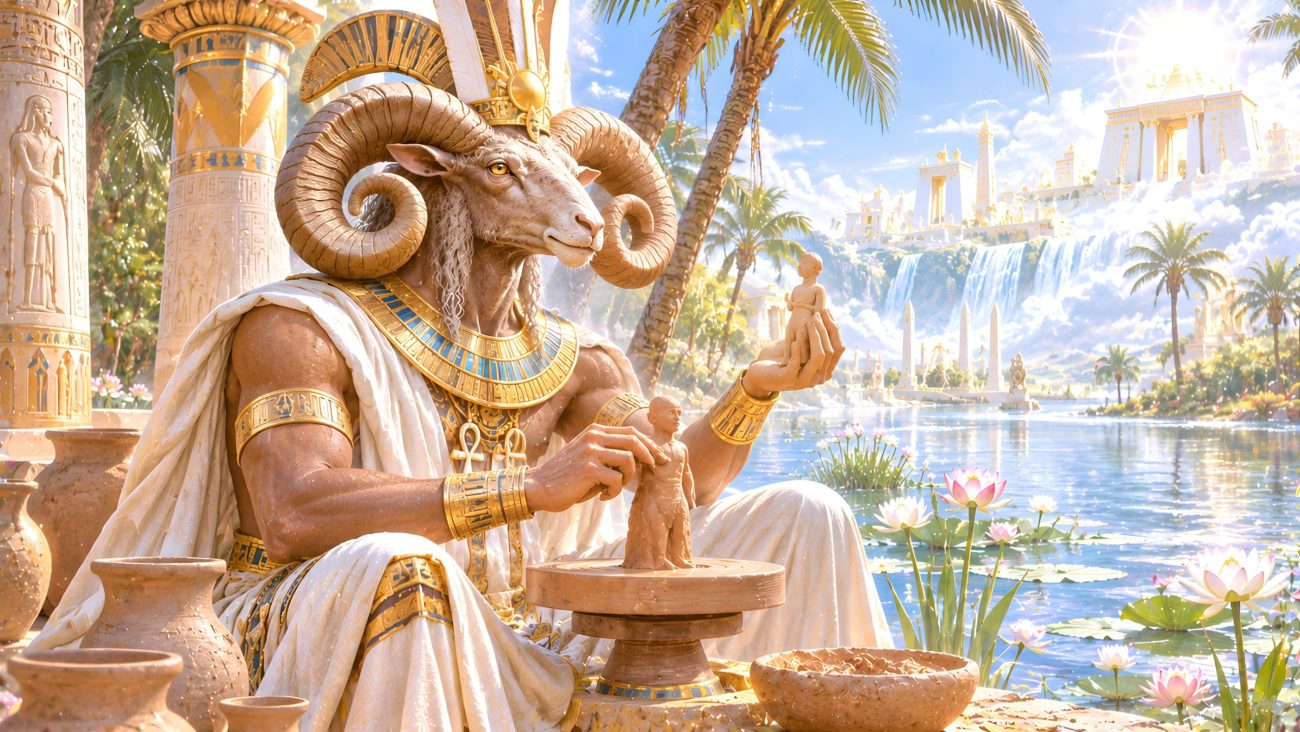
Khnum is an ancient Egyptian god associated with the Nile River, its annual inundation, and the creation of living beings. He was commonly depicted with the head and horns of a ram, although some representations show him with a crocodile’s head. He could wear the atef crown adorned with two feathers or the white crown of Upper Egypt.
Khnum was originally associated with the Nile cataract and was responsible for regulating the river’s annual flood, whose waters brought life-giving water and fertile silt to the surrounding lands. He was believed to control the inundation flowing from the caverns of Hapi, the deity who embodied the flood.
As a creator god, Khnum fashioned human bodies from clay on a potter’s wheel and placed them in their mothers’ wombs. He also formed each person’s ka, the life force in ancient Egyptian belief. His creative role eventually expanded, and he was described as the creator of other deities and the animal kingdom.
Khnum was worshipped from the First Dynasty through the Greco-Roman period. His early cult centre was Herwer in Middle Egypt, while Elephantine Island became a major centre of his worship during the New Kingdom. There, he formed a divine triad with the goddesses Satis and Anuket and held the title of overseer of the First Cataract of the Nile. He was also worshipped at Esna, south of Thebes.
Khnum’s ram imagery was associated with fertility, rebirth, regeneration, and resurrection. His horns were initially depicted as horizontally spiralled, resembling those of an extinct breed of North African sheep, but later representations adopted the downward-curving horns associated with Amun.
Sources
Wikipedia contributors. (n.d.). Khnum. Wikipedia. https://en.wikipedia.org/wiki/Khnum