Tradition: Egyptian Mythology
Alternative Names: Menhit, Menchit, Menkhet
Category: Lion
The Myth
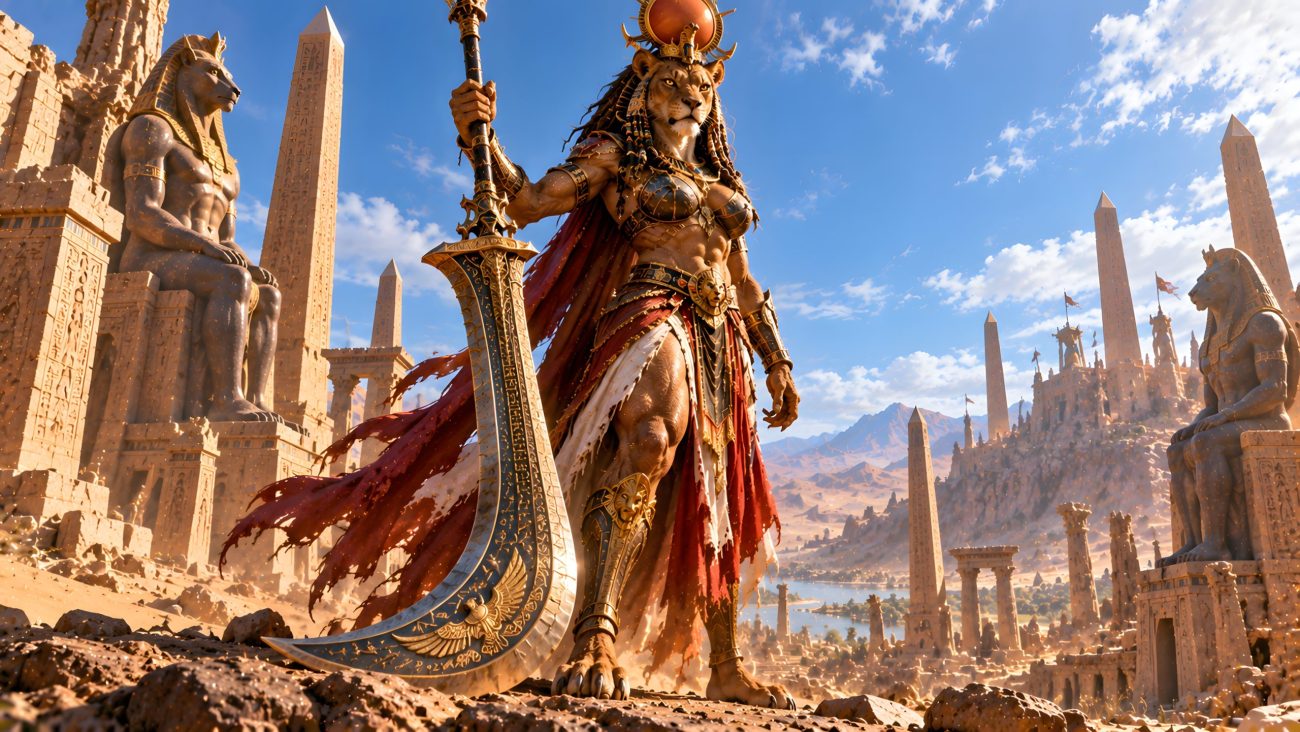
Menhet was a lion goddess of Nubian origin whose name means “the one who sacrifices.” She was also known as “the slaughterer,” reflecting her fierce nature as a goddess of war. She was believed to lead the pharaoh’s troops into battle, bringing her destructive power against Egypt’s enemies. Menhet was depicted as a woman with the head of a lion, wearing a solar disc crowned with the royal uraeus, the sacred cobra associated with kingship and divine protection. Despite her fearsome appearance, she also possessed calmer aspects, being associated with the Nebty, the “Two Ladies” who represented the pharaoh’s rule over Upper and Lower Egypt, and with the north wind.
Menhet was closely connected with several other Egyptian goddesses, including Neith, an ancient goddess of war, with whom she was associated at Esna. She was also linked to the “Eye of Ra,” a powerful manifestation of the sun god’s divine authority, and was compared with Tefnut, Sekhmet, and Hathor. These associations connected Menhet with both the destructive force of divine anger and the protection of the established cosmic and royal order.
Her family relationships varied according to the place where she was worshipped. In Upper Egypt, Menhet was regarded as the wife of Khnum and the mother of Heka, while at Thinis she was the consort of Anhur, also known as Onuris. In Heliopolis she was identified with Isis, and at Leontopolis she was considered an aspect of Tefnut. The myth of the distant goddess who fled to Nubia and was brought back by Shu and Thoth may originally have concerned Menhet and Anhur, whose name means “he who brings back the distant one.” Through these different traditions, Menhet embodied the fierce, protective power of the lioness and the divine forces that upheld the pharaoh’s rule.
Sources
“Menhit.” Ancient Egypt Online. https://ancientegyptonline.co.uk/menhet/