Oto Akuka

Tradition / Region: Japanese Mythology
Alternate Names:
Category: Demon, Cow, Pig


The Myth

Oto Akuka is a demon recorded only once, in a single old Japanese scroll. Beyond this appearance, nothing more is known. There are no surviving stories, no extended legends, and no later mentions of the creature.

In the scroll, Oto Akuka is shown with blue skin and a beast-like face. Its head is bald and crowned with two horns, and its nose appears crushed, giving it the resemblance of a cow or a pig. The demon is depicted kneeling on the ground. One hand is pressed firmly against the floor, while the other supports its body as it vomits.

The image presents Oto Akuka not as a being that attacks others, but as one overcome by what rises within itself. The demon is shown in the moment of release, brought low and humiliated by its own condition. Its punishment is not delivered by an external force, but unfolds openly through its own body, in full view.

Oto Akuka remains an isolated figure in Japanese folklore—a single, unsettling image preserved in a scroll, offering no tale of origin or aftermath, only the enduring vision of a demon brought to shame.


Gallery


Sources


Youkai Gazou Database. (2007).
鬼;オニ,嘔吐;オウトInternational Research Center for Japanese Studies (Nichibunken). Retrieved from https://www.nichibun.ac.jp/cgi-bin/YoukaiGazou/card.cgi?identifier=U426_nichibunken_0080_0008_0005

Also mentioned in my book Legendary and Mythical Cows

Interpretive Lenses

Religious Readings
  • Christian Ascetic Deep Dive
Philosophical Readings
  • Nietzschean Deep Dive
Psychological Readings
  • Jungian Deep Dive
Esoteric Deep Dive
  • Hermetic Deep Dive
Political / Social Readings
  • Marxist Deep Dive
Other
  • How to Invite The Oto Akuka

Shiro (Shirodawashi)

Tradition / Region: Japanese Mythology
Alternate Names: Shirodashi, Shirodawashi (White Scrubber)
Category: Yōkai / Mountain Dweller / Cave Dweller


The Myth

Shiro, also called Shirodawashi, was a yōkai known for his beast-like face, hooves, and a kimono patterned with scrubbing brushes. He lived in a cave near a remote mountain settlement and first appeared as a friendly and helpful figure.

A pair of monsters, Mōryō and his wife Ochiyobon, fled from Ushū to the mountains beyond Hakone and settled in a ruined house. Shiro assisted them in establishing their new home, but his friendliness soon revealed another nature. He was a heavy drinker and a troublemaker who repeatedly visited their house, demanding food, drink, and money.

Shiro became infatuated with Ochiyobon and schemed to take her for himself. One day, he borrowed a padded robe from Mōryō and never returned it. When Ochiyobon came to demand its return, Shiro claimed he had pawned it and left to retrieve it. Instead, he went to Mōryō’s shack armed with a blade and declared that Ochiyobon was now his wife. Intimidated and afraid, Mōryō surrendered, giving Shiro all his possessions, including clothing, bedding, and cosmetics.

When Ochiyobon learned what had happened, she was devastated. Shiro responded brutally, declaring that since she was now his wife, she must submit. Other monsters gathered, and even Momojii, the master of the cave dwellings, appeared. Momojii attempted to restore Ochiyobon to her husband, but Mōryō, fearing public shame, refused reconciliation and announced plans to remarry.

Abandoned, Ochiyobon grew close to Momojii, who treated her with kindness. Enraged, Shiro attacked Momojii with an oak log, but Momojii overpowered him with a massive axe and drove him away. To settle the conflict, Momojii arranged for Shiro to marry a beautiful female ghost.

Despite her beauty, the ghost suffered under Shiro’s relentless desire. Unable to endure him, she abandoned her lingering grudge against the living and wished to return to the underworld. When demons arrived to claim her, Shiro fought them fiercely. During the chaos, the ghost passed on peacefully, leaving the demons with no soul to seize. They attempted to drag Shiro to hell instead, but along the way a mysterious boy appeared and gave Shiro demon-slaying sake. The boy revealed himself to be the tanuki Kakubei, who slew the demons.

Grateful, Kakubei asked Shiro to help abduct the daughter of a fox whose marriage proposal had been rejected. Shiro eagerly agreed and joined the tanuki in attacking the wedding procession, successfully capturing the bride’s palanquin. However, he soon encountered Mikoshi Nyūdō, who defeated him and took him prisoner. Impressed by Shiro’s boldness, Mikoshi Nyūdō eventually released him, predicting he might serve a greater purpose someday.

Later, tanuki thieves stole the White Fox Jewel and entrusted it to Shiro. When monsters and foxes came to retrieve it, they heard a woman’s voice from within Shiro’s cave. Ochiyobon emerged, holding a bloodstained knife and the jewel. Having been disgraced and betrayed, she took revenge by killing Shiro and returning the treasure to its rightful owners.

Thus ended Shirodawashi, remembered as a violent, cunning, and lust-driven yōkai whose ambition and cruelty ultimately led to his downfall.


Interpretive Lenses

Religious Readings
Philosophical Readings
  • Nietzschean Deep Dive
Psychological Readings
  • Jungian Deep Dive
Esoteric Deep Dive
  • Hermetic Deep Dive
Political / Social Readings
  • Marxist Deep Dive
Other
  • How to Invite The Spirit

Zarazarazattara

Tradition / Region: Japanese Folklore (Haibara County, Shizuoka Prefecture)
Alternate Names:
Category: Yōkai / Mountain Dweller


The Myth

In Haibara County, it is told that a man once spent the night alone in a mountain hut, sitting by the hearth to keep warm. As the fire burned low, the hut lay silent except for the crackle of embers.

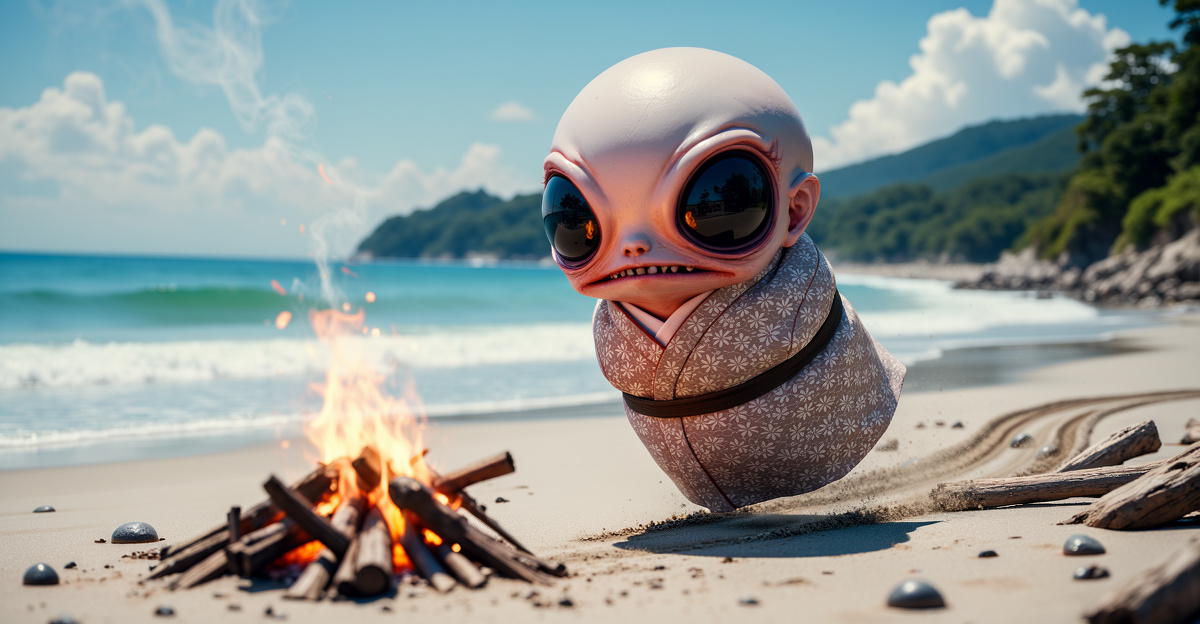
At one point, the man lifted the straw mat that covered the entrance. Suddenly, a round object—shaped much like a pumpkin—rolled inside the hut and came to rest beside the hearth. Startled, the man stared at it, thinking how unsettling the thing looked.

Before he could act, the round object spoke, saying, “It’s nothing. I am Zarazarazattara.”

The man felt an even deeper unease and thought to himself that he wished he had left the hut earlier. Immediately, the creature replied, “Never mind. I’ll be right there.” Realizing that the being responded to his very thoughts, the man became terrified, knowing that even thinking in silence was no protection.

Trying to act without revealing his thoughts, the man decided to tend the fire. He picked up a piece of firewood and snapped it to add fuel to the hearth. By chance, a fragment of the broken wood flew off and struck the creature where its face seemed to be.

At this, Zarazarazattara cried out, “I never thought of that,” and fled the hut at once, disappearing back into the night.

Afterward, the man was left alone by the fire, shaken but unharmed, and the strange yōkai was never seen there again.


Interpretive Lenses

Religious Readings
Philosophical Readings
  • Nietzschean Deep Dive
Psychological Readings
  • Jungian Deep Dive
Esoteric Deep Dive
  • Hermetic Deep Dive
Political / Social Readings
  • Marxist Deep Dive
Other

Oshoné

Tradition / Region: Japanese Folklore (Yatsuka-chō, Matsue City, Shimane Prefecture)
Alternate Names: Osshine (variant pronunciation)
Category: Yōkai / Water Spirit


The Myth

On a bitterly cold day in Yatsuka-chō, a fisherman waited alone in his boat at sea, watching his nets and enduring the freezing wind. As the cold deepened, he began striking a bell-like instrument to keep himself awake. Suddenly, he noticed what appeared to be a large mountain directly in front of him, looming where open water should have been.

Believing the mountain to be some illusion or object washed into the sea, the fisherman rowed toward his shore shack and pulled on the anchor rope to steady himself. Finding nothing amiss, he returned to his work. Though uneasy, he closed his eyes and continued fishing.

After some time, he opened his eyes and saw three children gathered around a bonfire burning on bamboo. The children had no hands and no feet, yet they moved about the fire as if untroubled. Realizing what he was seeing, the fisherman thought of an old tale he had heard and understood that these beings were Oshoné, a strange yōkai known from local stories.

Acting quickly, the fisherman threw shushumi leaves into the fire. As the leaves crackled and snapped loudly, Oshoné was startled. In confusion and fear, the creature scattered, fleeing with a lantern and vanishing into the pine trees of the nearby mountain.

After that night, the fisherman never saw Oshoné again, but the story remained along the waters of Yatsuka-chō, told as a strange encounter with a yōkai that appeared by the sea, took the form of limbless children, and vanished when frightened by sudden noise and flame.


Interpretive Lenses

Religious Readings
Philosophical Readings
  • Nietzschean Deep Dive
Psychological Readings
  • Jungian Deep Dive
Esoteric Deep Dive
  • Hermetic Deep Dive
Political / Social Readings
  • Marxist Deep Dive
Other

Moku Musume

Tradition / Region: Japanese Mythology (Gunma–Nagano, Usui Pass)
Alternate Names: Shumoku Musume
Category: Yōkai / Mountain Dweller / Shark


The Myth

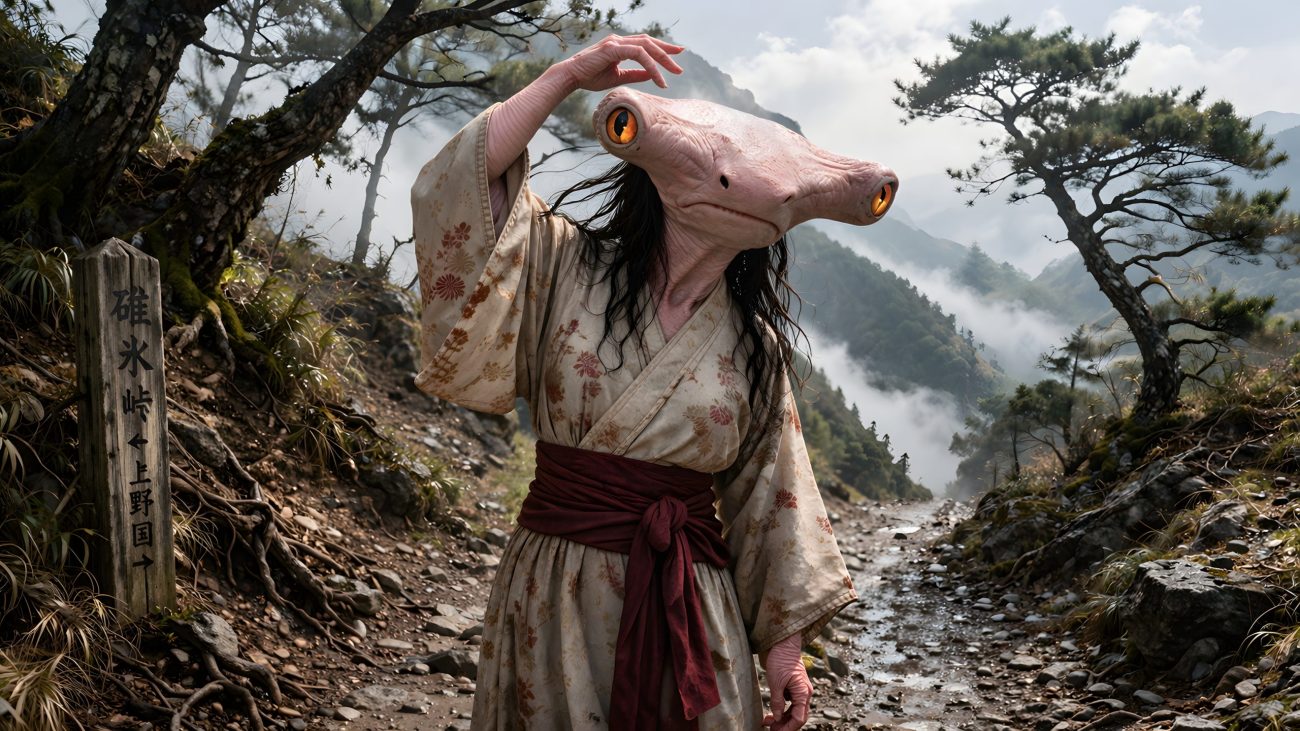
Moku Musume, also known as Shumoku Musume, is a yōkai known from monster paintings and traditional karuta cards. Her appearance is immediately recognizable and unlike that of any ordinary being. Her head is shaped like a shumoku, a T-shaped Buddhist mallet used to strike bells in temples. On each end of this T-shaped head are eyes, giving her vision to both sides, and her face resembles that of a hammerhead shark.

She is depicted as a female figure whose body is otherwise human, with the strange hammer-shaped head defining her supernatural nature. Because of this form, she is sometimes associated visually with Buddhist ritual objects, though her exact behavior is not described in surviving sources.

One karuta card explicitly names her as the “Shumoku Musume of Usui Pass,” suggesting that she was believed to appear at Usui Pass, the mountainous route connecting present-day Gunma and Nagano Prefectures. Travelers passing through the pass would have regarded the area as dangerous and uncanny, and the presence of Moku Musume was tied to this liminal mountain road.

Beyond her appearance and place-name association, little is recorded of her actions. She endures primarily as a visual yōkai, preserved through paintings and cards, her strange hammer-shaped head marking her as a being that belongs neither fully to the human world nor to the ordinary realm of spirits.


Interpretive Lenses

Religious Readings
  • Christian Ascetic Deep Dive
Philosophical Readings
  • Nietzschean Deep Dive
Psychological Readings
  • Jungian Deep Dive
Esoteric Deep Dive
  • Hermetic Deep Dive
Political / Social Readings
  • Marxist Deep Dive
Other
  • How to Invite The Spirit

Me-te

Tradition / Region: Japan
Alternate Names: Te no Me (“Eye of the Hand”)
Category: Yōkai


The Myth

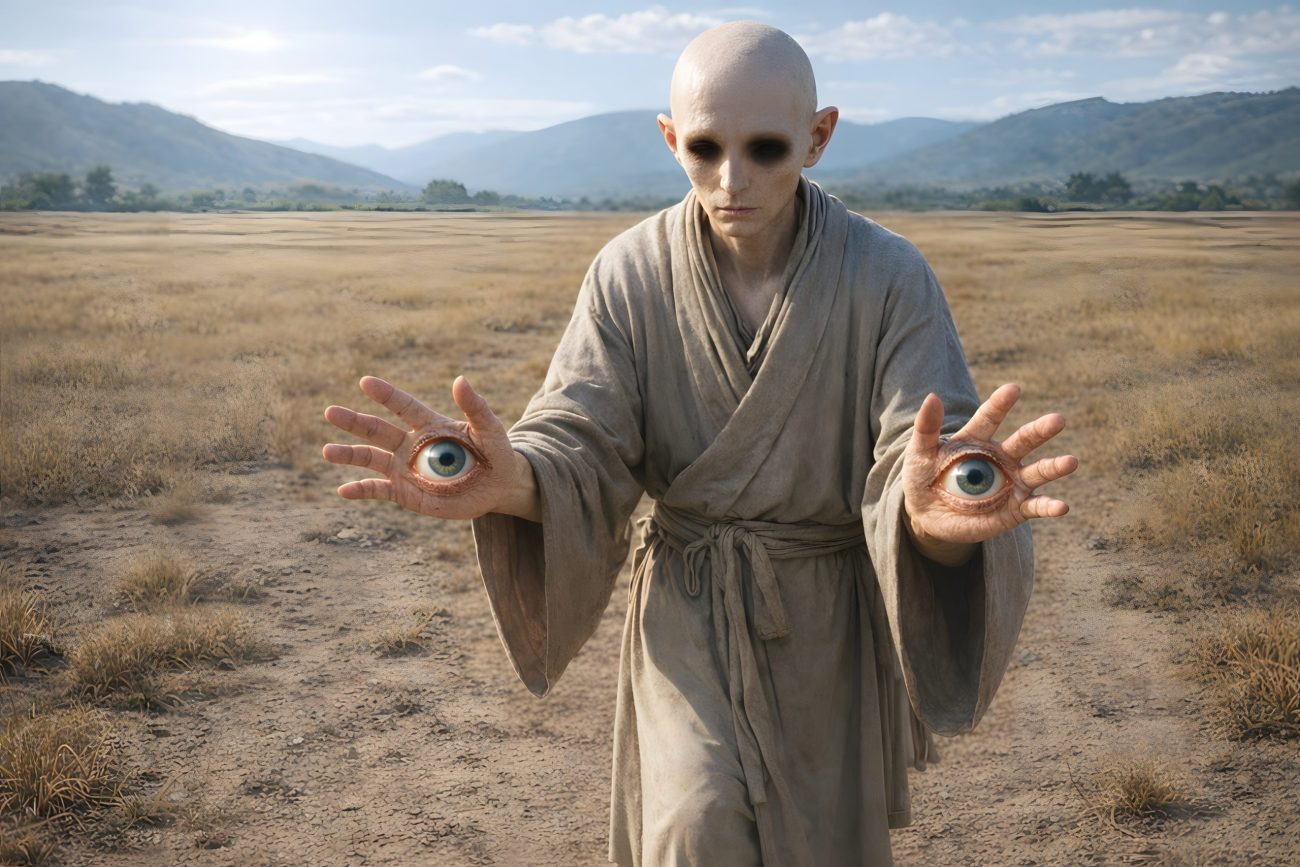
Me-te is a yōkai known from writings attributed to Sato Arifumi. It is described as a blind creature that wanders through open fields, moving as though it cannot see the world around it.

Despite its blindness, Me-te is extremely dangerous. People are warned never to mock or make light of it. Those who laugh at Me-te or assume it is helpless are said to be punished, for the yōkai will suddenly attack and suck out their eyeballs.

Me-te is also known by the name Te no Me, meaning “Eye of the Hand,” a name that reflects its strange and unsettling nature. In illustrations, it appears in a form similar to figures shown in Gazu Hyakki Yagyō, though it is depicted without wrinkles on the face, and its empty eye sockets are shown through deep shading.

Though little is recorded about its origin or fate, Me-te is remembered as a wandering field yōkai whose apparent weakness conceals a brutal and sudden threat.


Interpretive Lenses

Religious Readings
Philosophical Readings
Psychological Readings
Esoteric Deep Dive
Political / Social Readings
Other

Nurikabe

Tradition / Region: Japan (Edo-period yōkai scrolls)
Alternate Names:
Category: Yōkai / Lion / Dog


The Myth

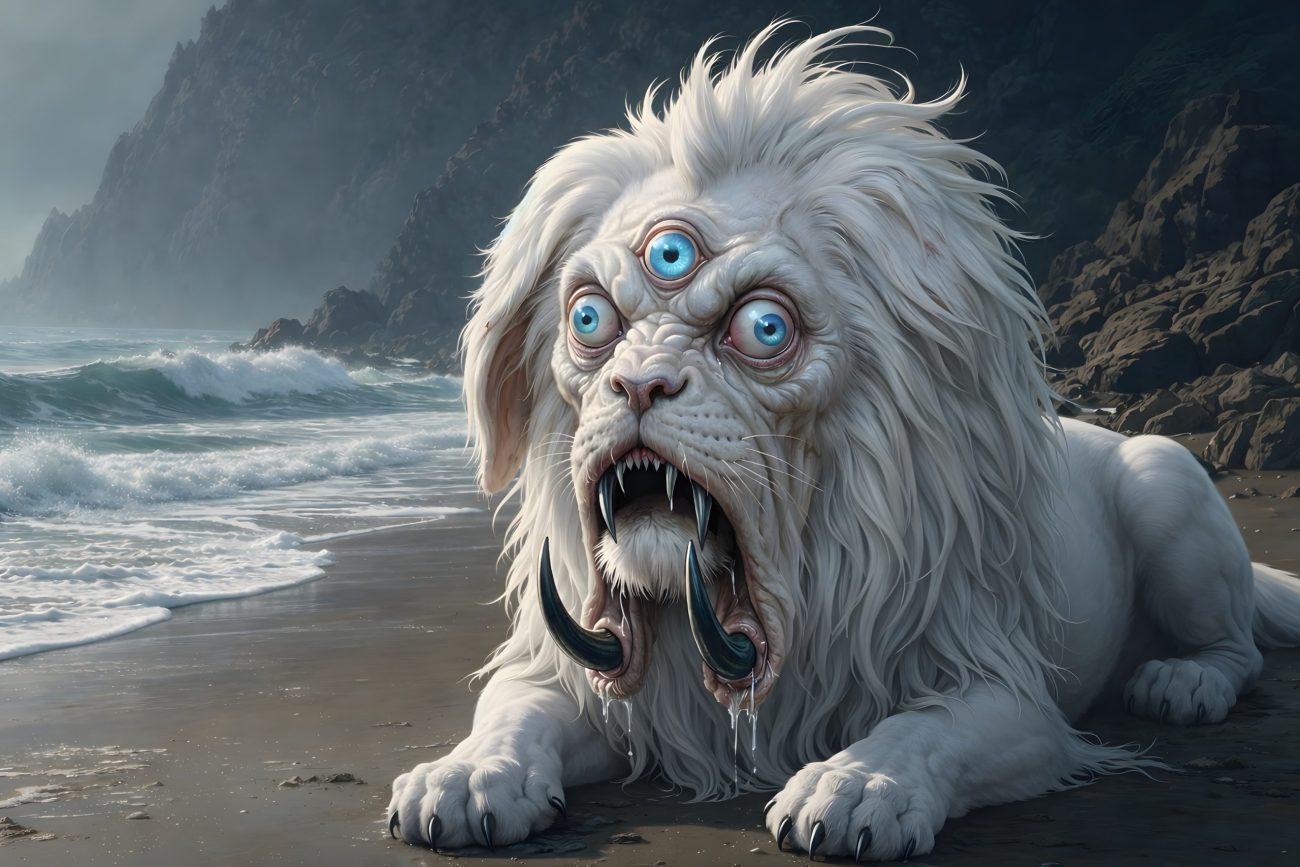
In illustrated yōkai scrolls from Japan, a creature known as the Nurikabe appears in a form unlike the better-known invisible wall of later folklore. This Nurikabe is a tangible beast with four legs and a powerful body. Its most striking feature is its enormous face, which bears three eyes that shine with an unnatural blue light. It has large, drooping ears like those of an elephant and two black tusks that curve outward. Its body is painted white, giving it a ghostly and imposing appearance. Some describe it as resembling a dog or a lion, though it does not fully match any known animal.

In the scrolls where it appears, the Nurikabe is shown near crashing waves. Behind it emerge figures such as Umi-otoko, a human seaman, and Umi-bōzu, a fearsome sea spirit. This setting places the Nurikabe at the boundary between land and sea, standing where the human world meets the supernatural. It does not act directly against the figures shown, but its presence dominates the scene, suggesting a powerful being that guards or obstructs passage.

The scroll depicting this Nurikabe is dated to the early nineteenth century. No clear written legend accompanies it, and its precise origin is unknown. It is uncertain whether this beast represents a specific local tradition or whether it was created by the artist as a yōkai form inspired by existing beliefs. Its connection to the later Nurikabe known for blocking travelers’ paths is not clearly stated in the original material.

As it appears in the scroll, the Nurikabe remains an enigmatic creature: a massive, watchful being standing firm amid waves and spirits, neither clearly hostile nor welcoming, marking a place where movement forward is uncertain and dangerous.


Interpretive Lenses

Religious Readings
Philosophical Readings
Psychological Readings
Esoteric Deep Dive
Political / Social Readings
Other