Saruki

Tradition: Japanese Mythology
Alternative Names: Saruki-oni, Monkey Demon
Category: Monkey


The Myth

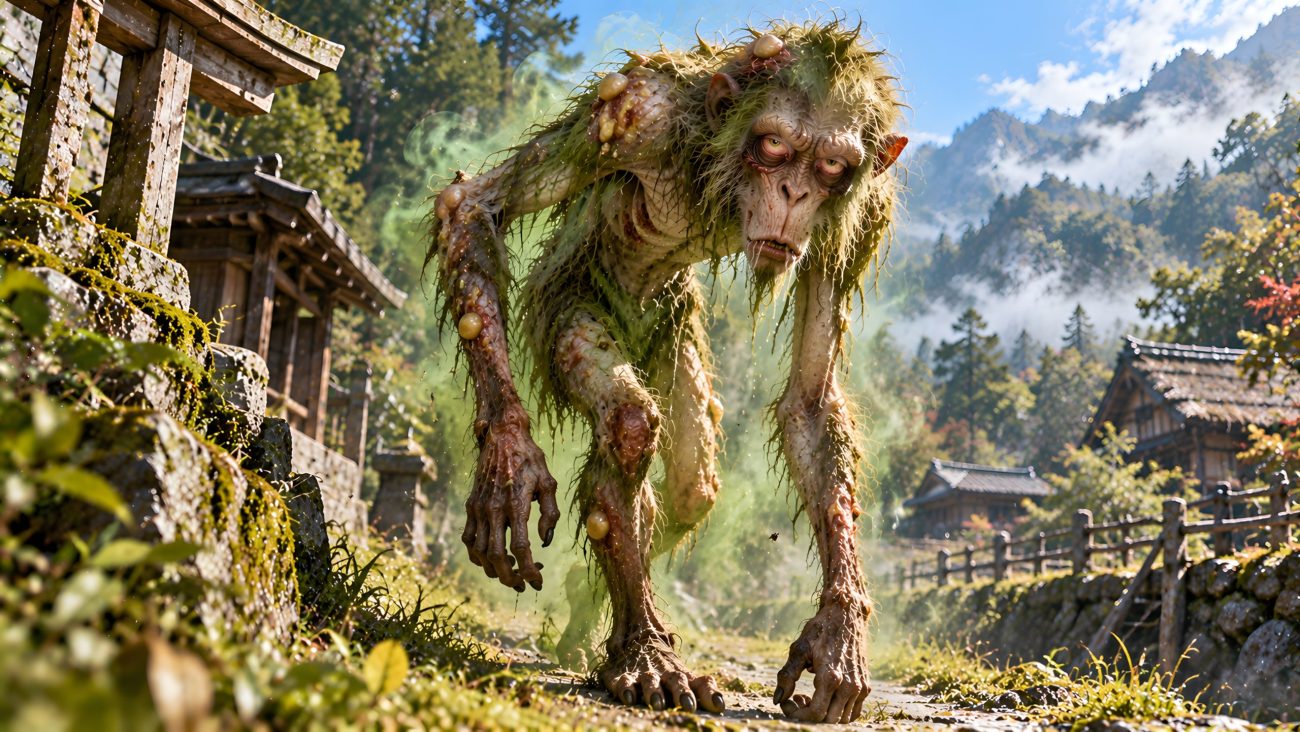
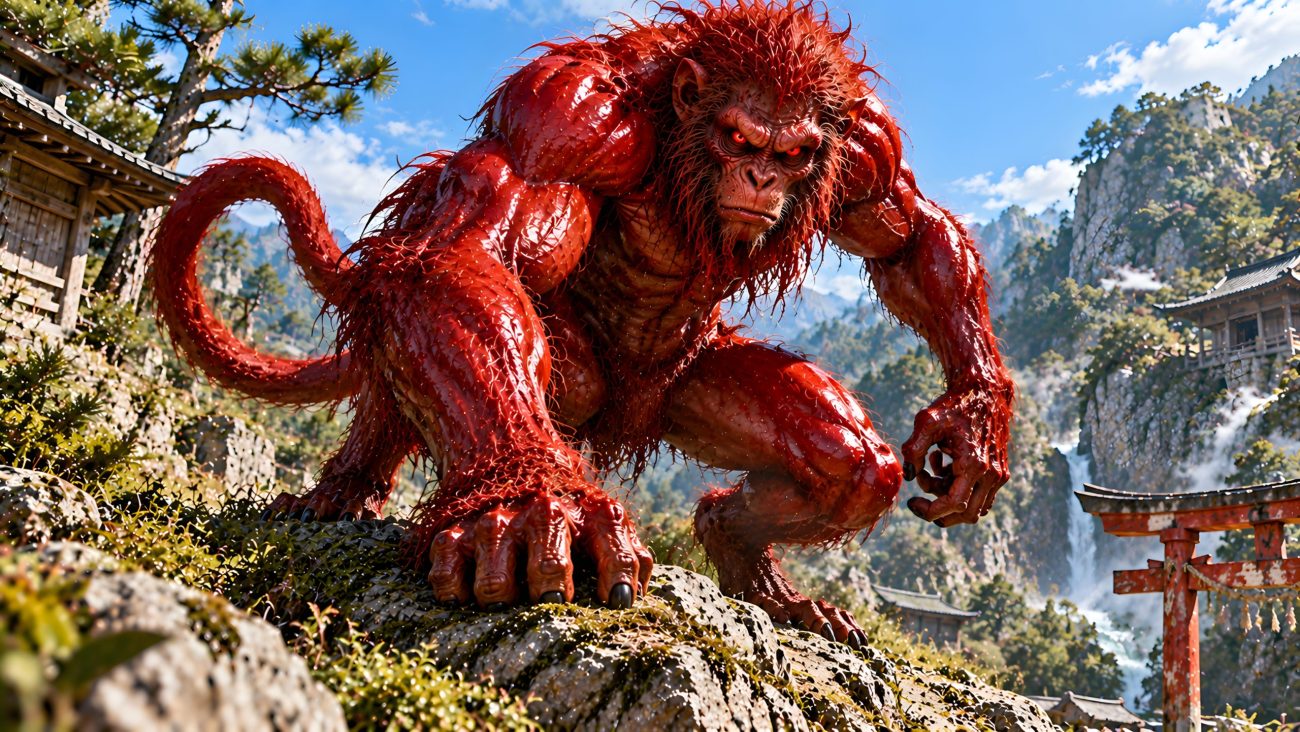
Saruki was a monstrous monkey demon who terrorized the Noto region of Ishikawa Prefecture, Japan. Originally one of the monkeys living on Mount Onishi, it was banished after becoming violent and harming the people who lived at the foot of the mountain. Fleeing into a cave at Iwaido, Saruki established a stronghold and gathered eighteen followers under its command. The demon and its retinue spread terror throughout Oku-Noto, devouring cattle and horses, abducting women and children, and holding drunken feasts atop a great cedar tower near their cave.

The sacred maiden Sugihime of Ohata Shrine in Wajima’s Mitsui district attempted to defeat Saruki with a bow, arrows, and swords, but none of her weapons could penetrate the demon’s defenses. She then travelled to Izumo Taisha during the month when the gods gather there and appealed to the assembled deities for help. An army led by Keta Daimyojin, the great deity of Noto’s Ichinomiya, marched against the monkey demons. Yet their arrows proved useless because Saruki and its followers had coated themselves in lacquer to deflect the missiles. As the gods withdrew to reconsider their strategy, Sugihime heard a mysterious song by the shore: “Wrap yourselves in a thousand bolts of cloth and shoot arrows from the tubes, Princess of the Sacred Cedar.”

Following this advice, the gods concealed themselves beneath a thousand bolts of white cloth and approached Saruki’s tower while the demons were drinking. When Saruki caught another arrow, a second projectile hidden inside a hollow tube shot forward and pierced its eye. As the wounded demon fled, Princess Kamisugi beheaded it with the famous sword Onikirimaru. The divine army then destroyed the remaining followers. Numerous place names around Yanagida Village are associated with the battle, including Atimo, where Saruki was struck in the eye; Obako, where it treated its wound with medicinal herbs; Kurokawa, named for the black blood that stained the ground; and Onizuka, where the gods buried the demon. Iwaido Shrine is also said to have been established to pacify the spirits of the monkeys and demons.


Sources

“Saru-oni.” 新版TYZ 妖怪図鑑 (New TYZ Yokai Encyclopedia). https://tyz-yokai.blog.jp/archives/1048849432.html
Hiderigami

Tradition: Japanese Mythology
Alternative Names: Batsu, Kanbo, Shinchi, 魃, ひでりがみ
Category: Monkey


The Myth

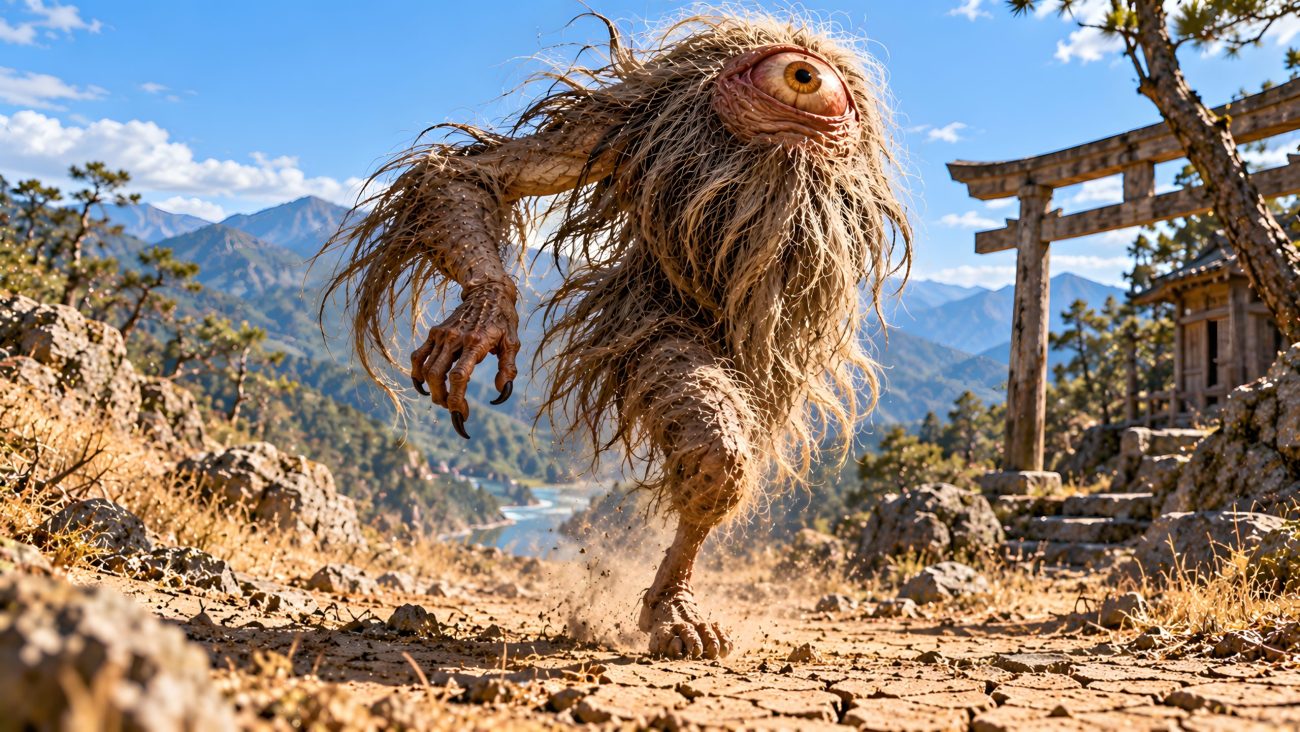
The Hiderigami is a grotesque, hairy humanoid spirit that stands only two to three feet tall. It has a single eye on the top of its head, along with just one arm and one leg. Despite its unusual body, it can run as swiftly as the wind. All Hiderigami are female and inhabit remote mountain regions, rarely venturing into places where humans live.

The Hiderigami is feared for the devastating heat radiating from its body. Wherever it travels, the ground dries out, clouds fail to form, and rain ceases to fall. Its presence can therefore cause drought across a wide area, making it a dangerous spirit even when people never see it. Despite its formidable powers, tradition claims that a Hiderigami can be killed by throwing it into a toilet.

The creature is associated with an ancient Chinese legend concerning the Yellow Emperor’s war against the warlord Chi You. The emperor summoned a powerful goddess named Batsu to help him win the battle. Batsu released her supernatural heat, securing victory, but expended so much power that she could neither return to Heaven nor contain the heat within her body. Wherever she remained, water dried up and rain could not fall. Unable to kill her or send her back to Heaven, the emperor banished her to a distant mountain and forbade her from returning. It remains uncertain whether the Hiderigami descended from Batsu or whether the goddess herself was transformed into this drought-causing spirit.


Sources

“Hiderigami.” Yokai.com. https://yokai.com/hiderigami/


Baiyuan

Tradition: Chinese Mythology
Alternative Names: White Ape, White Gibbon, Bai Yuan, 白猿, 白猨, 白蝯
Category: Monkey


The Myth

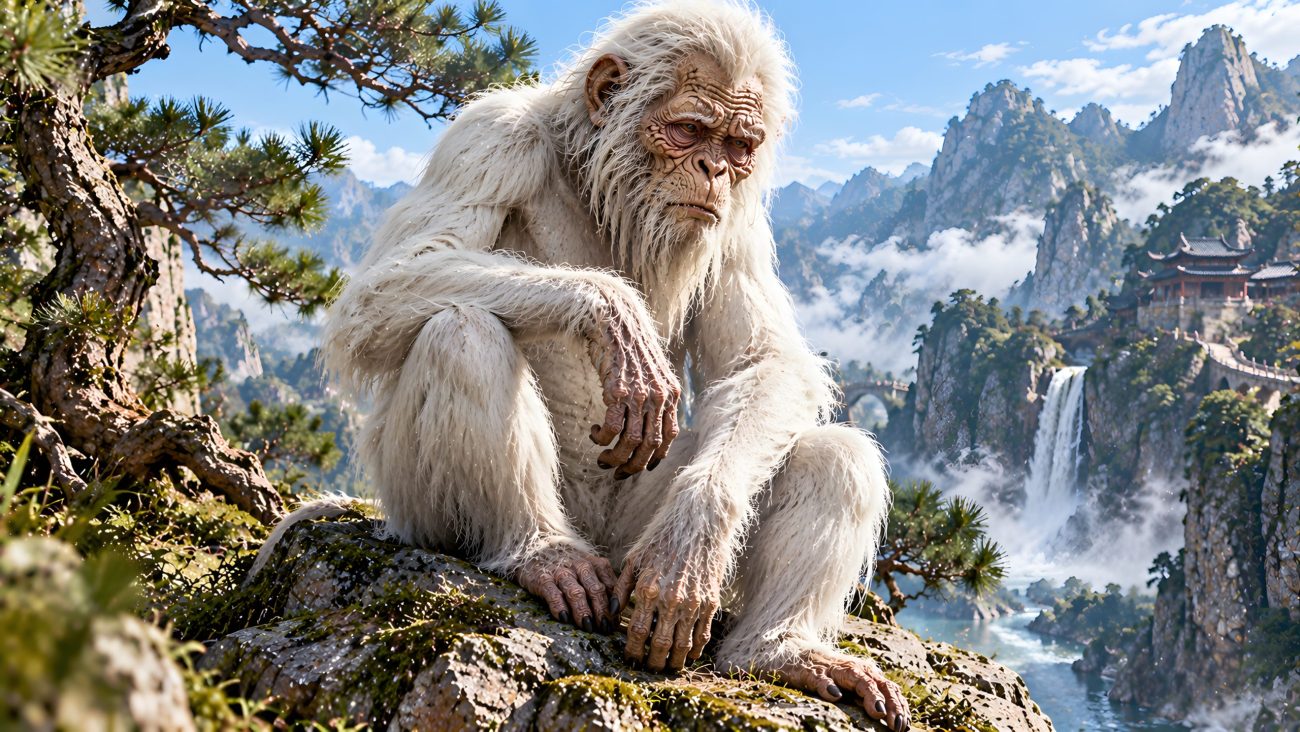
The Baiyuan is a supernatural white ape covered entirely in white fur. In Chinese mythology, apes and monkeys are often treated as similar creatures, and the Baiyuan is portrayed as an intelligent, magical beast capable of cultivating spiritual powers and transforming into other forms. It is associated with extraordinary climbing abilities, a fondness for brewing and drinking alcohol, and an uncontrolled desire for women. Its white hair also symbolizes longevity, and some traditions describe ancient apes transforming into white-haired old men.

According to traditional accounts, apes can undergo extraordinary transformations as they age. The Baopuzi states that a monkey becomes an ape after eight hundred years, an ape becomes a jue after five hundred years, and a jue can live for a thousand years. Another account describes apes transforming into jue after five hundred years and jue becoming old men after a thousand. The Classic of Mountains and Seas also mentions white apes inhabiting Tangting Mountain, alongside unusual trees, precious stones, and gold. In another tale, recorded in the History of the Xia and Shang, Yu the Great and his companions hear mournful cries coming from a forest while working to control the floods; the sound is identified as the call of a white ape.

The Baiyuan is also associated with legendary masters of swordsmanship and magical teachings. In the Spring and Autumn Annals of Wu and Yue, a remarkable swordswoman encounters Yuan Gong, an old ape-like being who challenges her to a duel. Using a bamboo branch as a sword, he exchanges three moves with her before leaping into a tree and transforming into a white ape, thereby acknowledging her skill. In other traditions, a white ape becomes the disciple of the goddess Jiutian Xuannü, learning swordsmanship and supernatural arts. In the Ming-dynasty novel San Sui Ping Yao Zhuan, the Tongbi White Ape cultivates the Dao, receives the name Yuan Gong, and becomes Baiyun Dongjun, the Lord of White Cloud Cave, where he is appointed guardian of a celestial book.


Sources

“Bái yuán” (白猿). Chinese Wikipedia. Wikimedia Foundation. Accessed October 20, 2026. https://zh.wikipedia.org/wiki/%E7%99%BD%E7%8C%BF


Simiot

Tradition: Spanish Mythology
Alternative Names: Simiots
Category: Monkey


The Myth

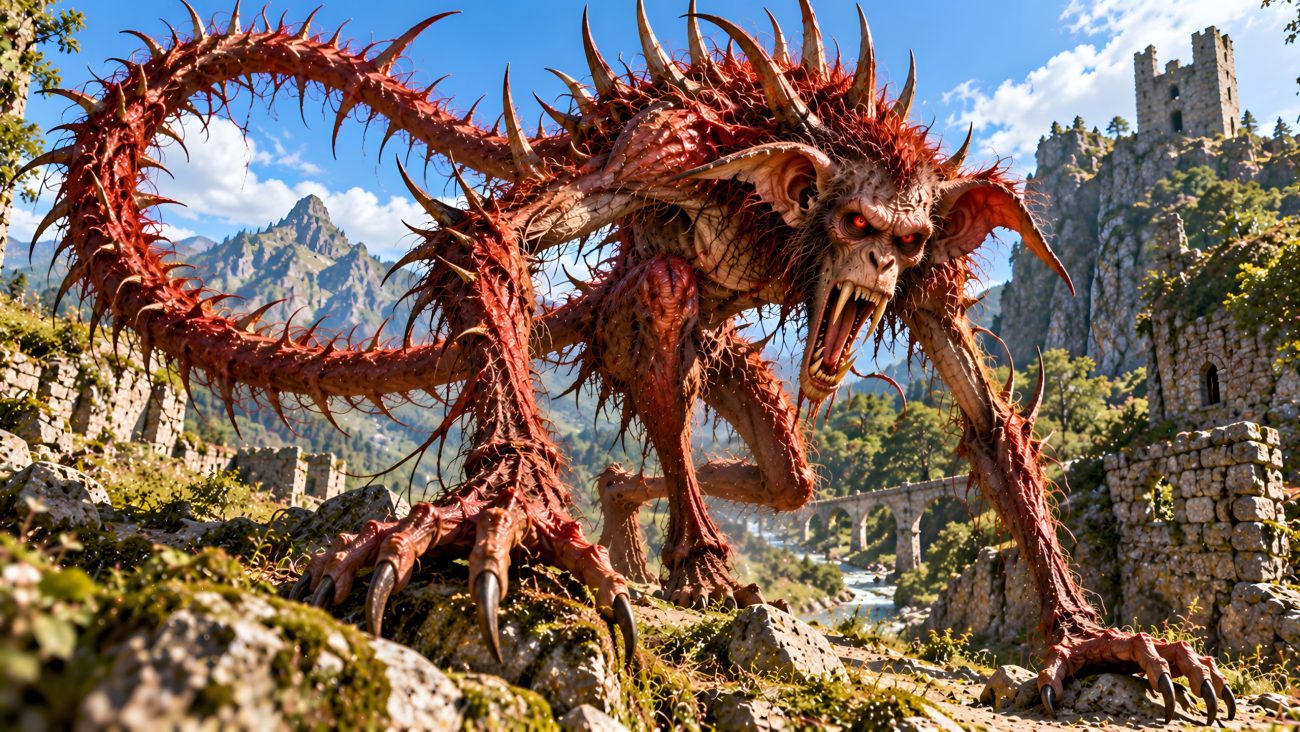
The Simiots are diabolical, monkey-like creatures from the Pyrenees, particularly associated with Arles-sur-Tech in Vallespir and the Haut Empordà region of Catalonia. Their exact appearance is poorly described, but they are portrayed as monstrous apes resembling monkeys, gorillas, baboons, or dog-headed humanoids. Feared as servants of evil, they were blamed for calamities, attacks on people, and the disappearance of children.

According to a legend associated with Saints Abdon and Sennen, the Simiots terrorized the Roussillon region around the year 1000. Droughts and hailstorms destroyed crops, wild beasts attacked people, and the Simiots carried off children to devour them. Arnulphus, the abbot of Arles, travelled to Rome to obtain the relics of Saints Abdon and Sennen. When he returned with the relics and brought them into the church, distant screams were heard as the Simiots fled the region. Centuries later, in 1465, a shepherd named Noguer de Gasnach reportedly caught two witches summoning the creatures to unleash a storm. The saints’ relics were brought out again, preventing the threatened disaster. In remembrance, the inhabitants of Montbolo began offering a Rodella, a candle made from rolled beeswax measuring approximately twenty metres long, every year on July 30.

Other legends describe the Simiots living in the ruins of Rocaberti Castle near La Jonquera. In one tale, a traveller seeking shelter astonished them by blowing on his fingers to warm them, then blowing on hot soup to cool it. Unable to understand why he blew on both cold and hot things, the Simiots suspected him of sorcery and threw him out. The creatures were also associated with the Sanctuary of Núria, which was said to have stood in a place infested with demons, satyrs, and Simiots. According to tradition, a hermit named Amadeu drove these evil beings away by building the sanctuary.


Sources

“Hee-hi Monkey.” 新版TYZ 妖怪図鑑 (New TYZ Yokai Encyclopedia). https://tyz-yokai.blog.jp/archives/1050617498.html


Hīhīzaru

Tradition: Japanese Mythology
Alternative Names: Hīhī Saru, ヒーヒ猿
Category: Monkey


The Myth

The Hīhīzaru is a mysterious supernatural creature from the Mitsu District of Okayama Prefecture, Japan. Little is known about its appearance or origins, and its reputation rests primarily on its disturbing influence over the sick.

According to local accounts, the Hīhīzaru attaches itself to ill people and causes them to become insensitive. Those afflicted by the creature lose their normal sensitivity, although the precise nature and extent of this condition are not described. Beyond this association with illness and diminished sensation, little information about the creature has survived.


Sources

“Hee-hi Monkey.” 新版TYZ 妖怪図鑑 (New TYZ Yokai Encyclopedia). https://tyz-yokai.blog.jp/archives/1050617498.html


Saru-ga-Achi

Tradition: Japanese Mythology
Alternative Names: Saru Kaachi, Saru-ga-Achi, 猿があち
Category: Monkey


The Myth

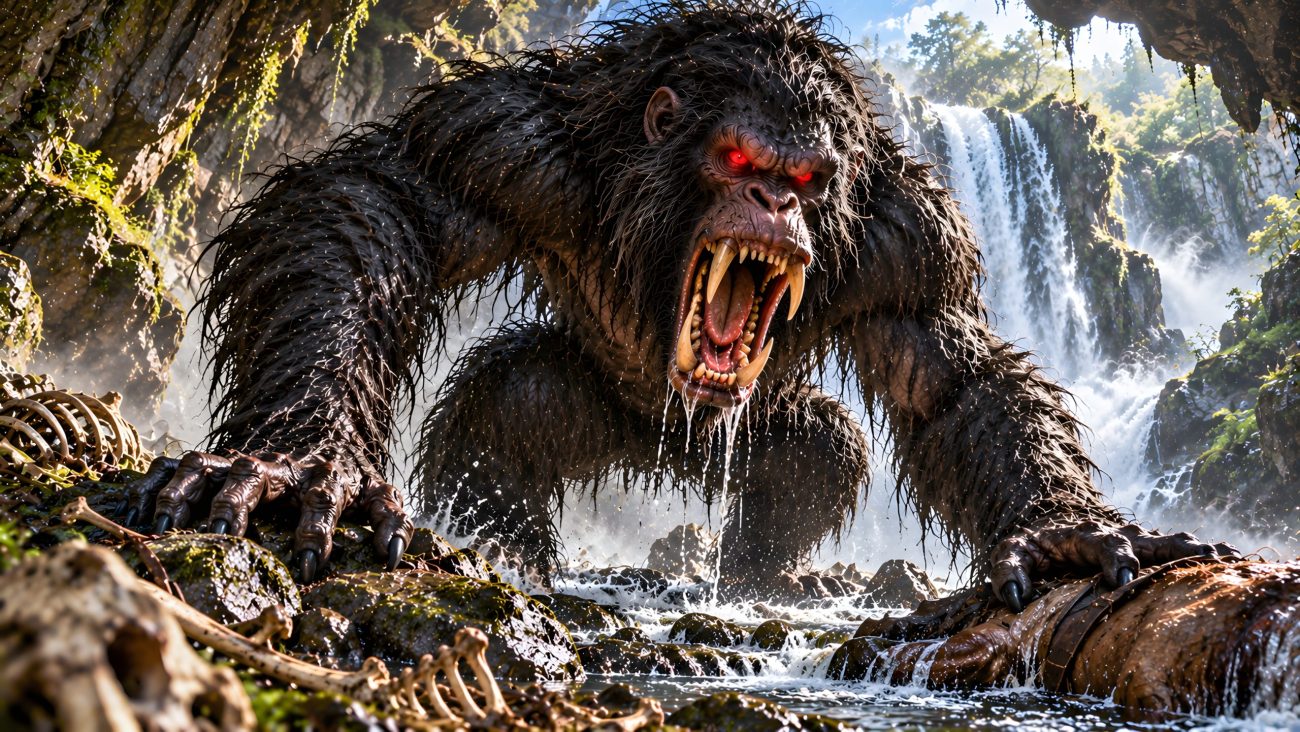
Saru-ga-Achi is a monstrous ape depicted in an account from Ōya Mountain in Shimotsuke Province, Japan. It lurks in a rocky cave near a waterfall, where it attacks horses by biting into their legs. Bones from its previous victims litter the ground around its lair. The name appears to derive from a regional expression meaning something like a strange or monstrous monkey, although another account interprets it as referring to a supernatural creature called an achi.

According to this later interpretation, monkeys grow into hihi as they age. These enormous ape-like monsters stand twice as tall as humans, have long lips and dishevelled hair, run at tremendous speed, and devour people. After several hundred more years, a hihi may die and subsequently return to life, becoming an achi. Such beings possess extraordinary supernatural powers, can communicate with Heaven, transform the forces of yin and yang, and summon clouds and rain.

Around 1199–1201, during the reign of Emperor Tsuchimikado, the warrior Inage Saburō Shigenari of Sagami Province reportedly encountered the Saru-ga-Achi while hunting on Ōya Mountain. By then, the creature’s formerly brown fur had turned yellowish white, and its back was bent. It appeared exhausted and close to death, as though waiting for its final moments. What eventually became of the ancient monster remains unknown.


Sources

“Saru-ga-achi.” 新版TYZ 妖怪図鑑 (New TYZ Yokai Encyclopedia). https://tyz-yokai.blog.jp/archives/1049058496.html


Satori

Tradition: Japanese Mythology
Alternative Names: Kaku, Yamako, Kuronbō, 覚
Category: Monkey


The Myth

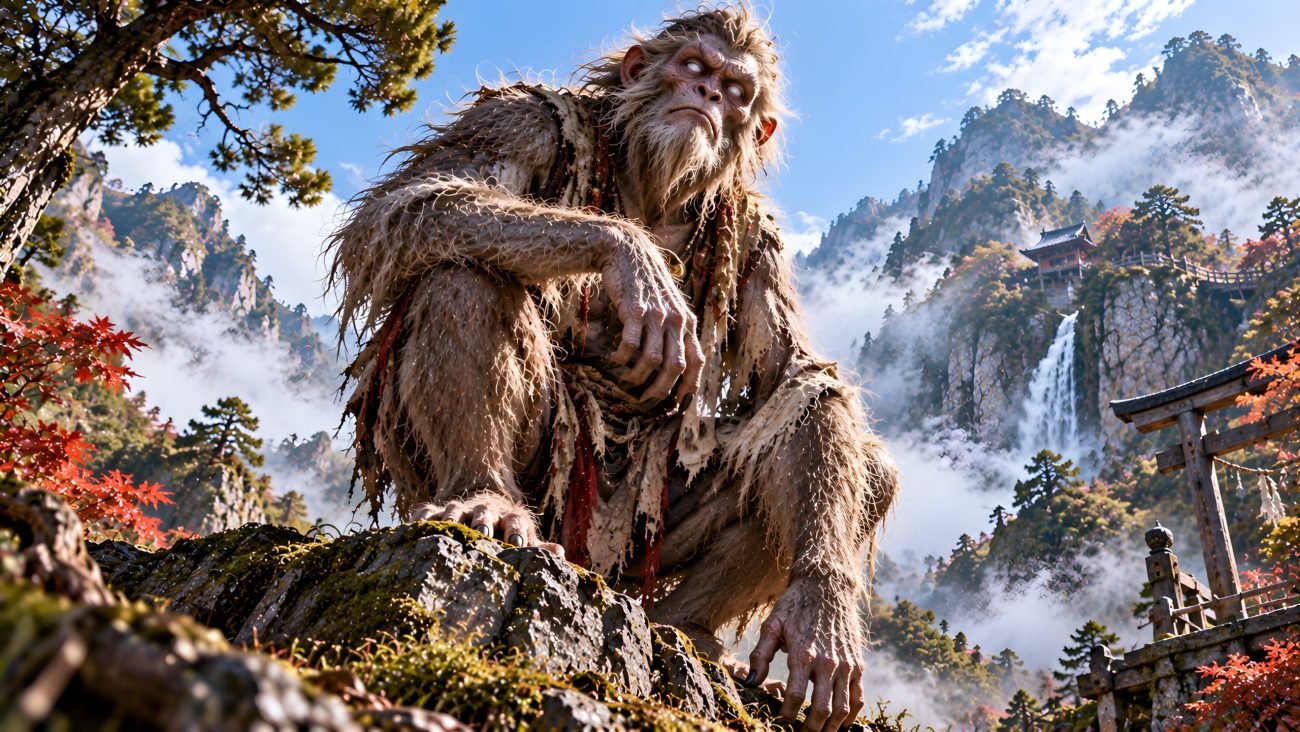
The Satori is an intelligent, ape-like humanoid said to inhabit the remote mountains of central Japan, particularly Gifu. Roughly the size of a human, it resembles an enlarged version of the monkeys native to the region. These strange beings lurk along mountain paths and near isolated huts, where they encounter travelers venturing far from civilization.

Satori are infamous for their uncanny ability to read human thoughts. They can anticipate what a person is about to say and speak those thoughts aloud before the words leave their mouth, making them exceptionally difficult to deceive or escape. They are also dangerous predators, sometimes attacking and eating solitary travelers. In some accounts, they abduct lone women and carry them into the mountains. Despite their apparent intelligence, Satori are easily frightened by unexpected events. A sudden blow or an object striking them can send them fleeing in terror. According to one tradition, a person can escape a Satori by completely emptying their mind, leaving the creature with no thoughts to read and causing it to lose interest.

The name Satori means “enlightenment” in the Buddhist sense, reflecting the creature’s extraordinary ability to perceive the thoughts of others. This connection also appears in the traditional method of escaping one: by emptying the mind of distracting thoughts, a person becomes unreadable to the creature. Satori have also been associated with the Yamako, ape-like beings described in older accounts, and with the Yamabiko, a monkey-like yokai known for imitating human voices. Their shared connection to unusual mental or vocal abilities has led to speculation that these creatures developed from related traditions. Some interpretations suggest that Satori may represent ancient mountain deities transformed into frightening supernatural beings.


Sources

“Satori.” Yokai.com. https://yokai.com/satori/


Yamachichi

Tradition: Japanese Mythology
Alternative Names: Yamajiji, Satorikai, 山地乳
Category: Monkey


The Myth

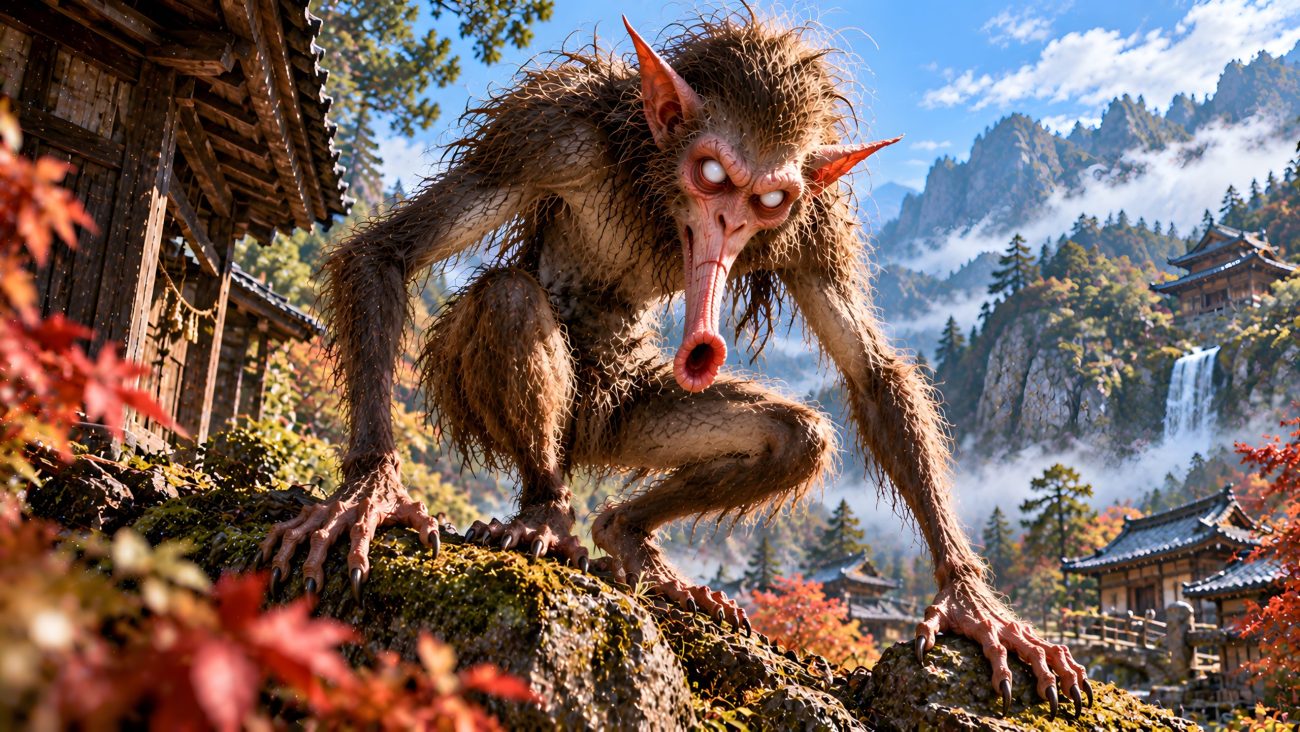
The Yamachichi is a monkey-like yokai that inhabits the secluded mountains of northeastern Japan. It has a pointed mouth and peculiar, sucking lips suited to its unusual way of feeding. Yamachichi are believed to originate from bats: a long-lived bat transforms into a Nobusuma, which eventually becomes a Yamachichi after many more years. Because of its resemblance to the Satori, a supernatural being associated with the mountains, the Yamachichi is sometimes called Satorikai.

These creatures descend from the mountains late at night and enter houses where people are sleeping. They approach their victims and use their pointed lips to suck the breath from their mouths, draining away their life force. Once the victim’s breath has been stolen, the Yamachichi taps them on the chest before fleeing into the darkness. A person whose breath is taken in this way is said to die the following day.

However, the Yamachichi’s power can be reversed if its attack is interrupted. If the sleeping person awakens or another witness catches the creature stealing someone’s breath, the Yamachichi immediately flees. Rather than dying, the intended victim is said to have their lifespan greatly extended. The creature is known primarily from an Edo-period collection of supernatural tales, and little else is known about its origins beyond its association with remote mountain regions.


Sources

“Yamachichi.” Yokai.com. https://yokai.com/yamachichi/


Shoucai Gui

Tradition: Chinese Mythology
Alternative Names: Money-Guardian Ghost, Money Chest Ghost, Flying Ghost, Swift Ghost, Life-Taking Ghost, 守财鬼
Category: Monkey


The Myth

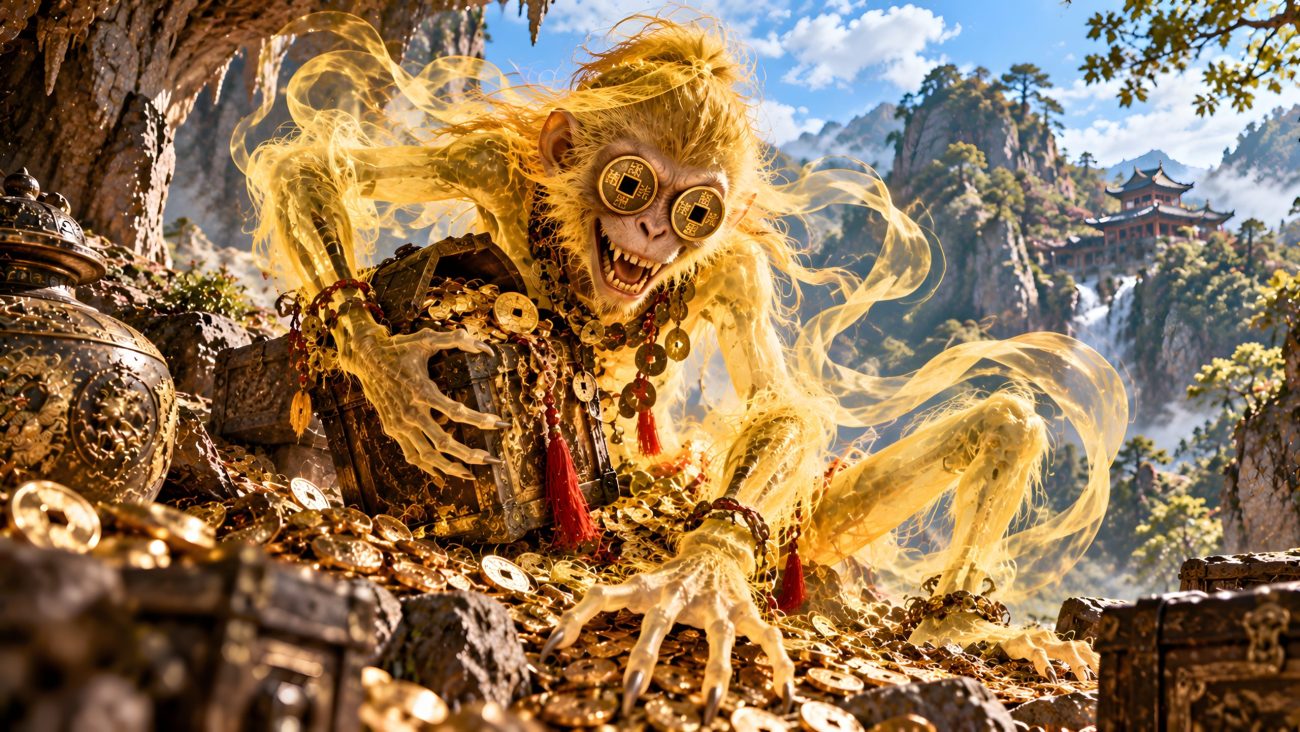
The Shoucai Gui, or Wealth-Guarding Ghost, is a supernatural being associated with the yakshas, a class of spirits known for their connections to treasures and hidden riches. It is also called the Money Chest Ghost, Flying Ghost, Swift Ghost, or Life-Taking Ghost. According to legend, the creature guards a hidden treasure vault, remaining near its riches while waiting for a person destined to discover and claim them.

Despite its association with wealth, the name Shoucai Gui can also refer to a miser: someone who hoards money and refuses to spend it. The creature therefore embodies both the supernatural guardianship of hidden treasure and the human tendency to cling possessively to wealth.


Sources

“Money-Keeping Ghost” (守財鬼). Chinese Wikipedia. Wikimedia Foundation. Accessed October 20, 2026. https://zh.wikipedia.org/wiki/%E5%AE%88%E8%B4%A2%E9%AC%BC


Sarumuko

Tradition: Japanese Mythology
Alternative Names: Saru no Mukosama, Saru no Nyōbō, Monkey Bridegroom, 猿婿入り
Category: Monkey


The Myth

Sarumuko, or the Monkey Bridegroom, is a traditional Japanese folktale found in many regions of Japan. It belongs to the widespread tradition of stories about marriages between humans and supernatural or animal beings. The tale usually begins when a farmer promises his daughter to a monkey in exchange for its help with agricultural work. In some versions, the farmer desperately needs water for his rice fields during a drought. A monkey overhears him wishing that someone would irrigate the fields in return for a daughter’s hand in marriage, and promptly brings water to the fields. In other versions, the monkey plants seeds, weeds the fields, or performs other difficult tasks. Bound by his promise, the farmer must offer one of his daughters to the monkey. The elder daughters refuse, but the youngest agrees to marry it and goes to live in the mountains.

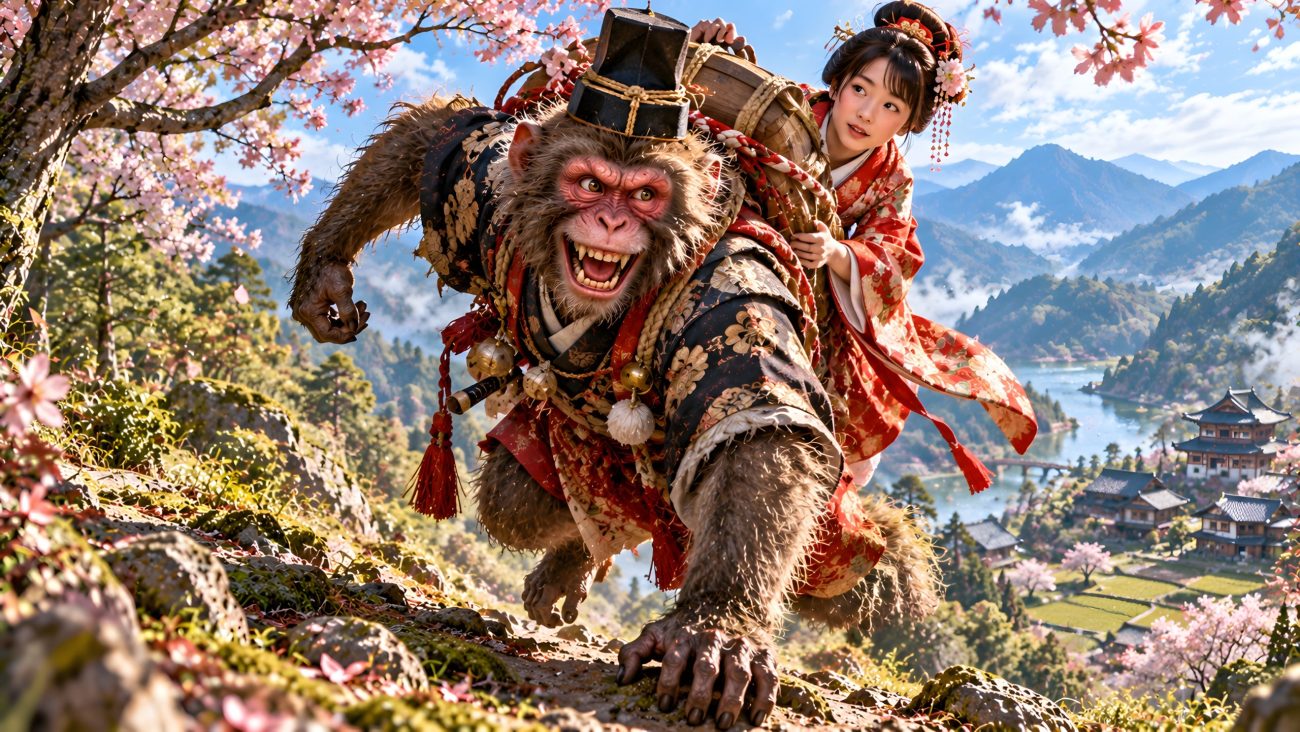
In the eastern Japanese version, the bride is eventually permitted to visit her family during the Girls’ Festival in the third month. Before leaving, she prepares rice cakes and asks her monkey husband to carry a heavy mortar on his back. Along the way, she also asks him to retrieve a branch of mountain cherry blossoms growing beside a deep pool. As the monkey reaches for the branch, the weight of the mortar pulls him into the water, where he drowns. Before dying, he laments that his own death matters less to him than the sorrow his wife will feel. The daughter, however, secretly wishes for the mortar to remain above the monkey and the monkey beneath it, then flees home. Other versions substitute wisteria flowers or persimmons for the cherry blossoms. Some even describe the monkey dressing formally in traditional robes before descending from the mountains to claim his bride.

In western Japan, the daughter often defeats the monkey on the very day of their wedding. She has him carry a large water jar intended as part of her marriage possessions. When they reach a river, she deliberately drops her hairpin or mirror into the water, prompting the monkey to climb in and retrieve it. Water fills the jar on his back, making it impossible for him to escape, and he eventually drowns. In both regional versions, the youngest daughter uses her intelligence to overcome a dangerous marriage imposed upon her and return safely to her family. The story shares themes with the medieval Japanese tale Fujibukuro no Sōshi, in which a farmer’s promise leads to a daughter being taken by a monkey, only for her to be rescued by a skilled archer and his dogs.


Sources

“Sarumuko.” 新版TYZ 妖怪図鑑 (New TYZ Yokai Encyclopedia). https://tyz-yokai.blog.jp/archives/1063422280.html