Hantu Raya

Tradition / Region: Malaysian Mythology
Alternative names: Great Ghost
Category: Ghost


The Myth

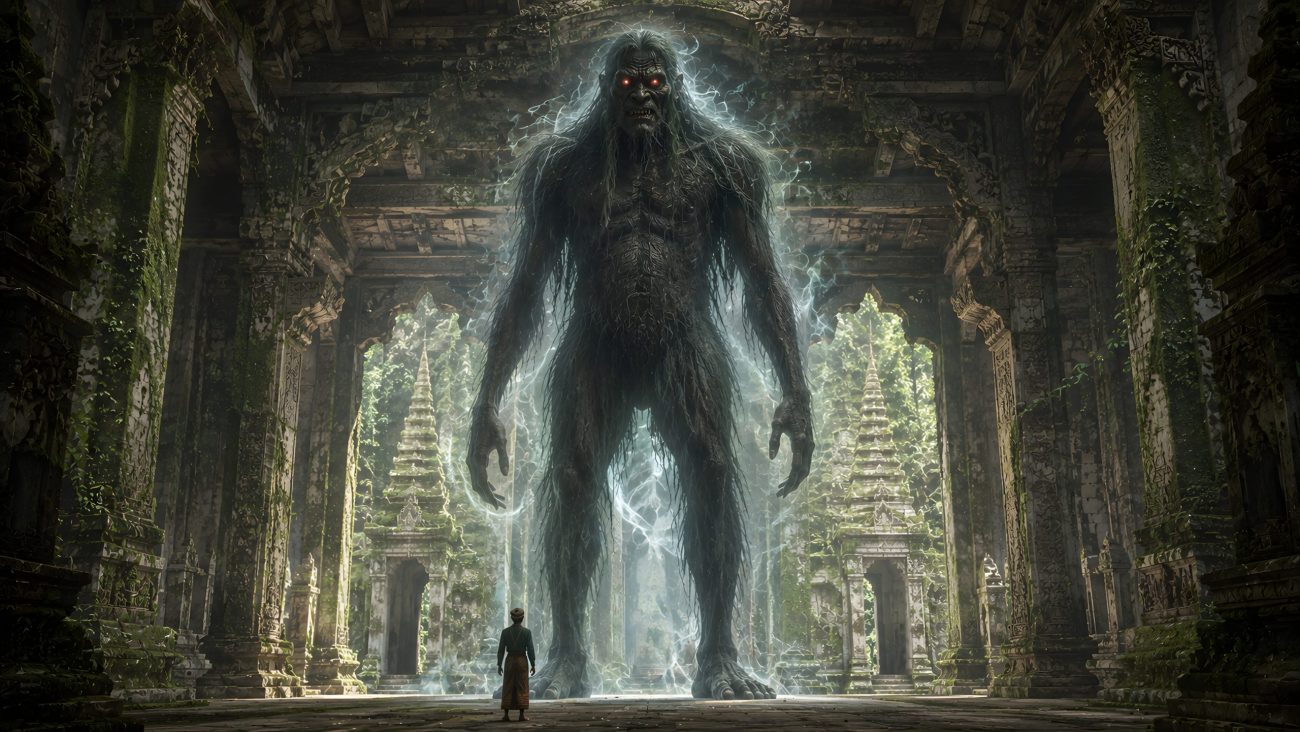
The Hantu Raya is a powerful familiar spirit that serves practitioners of black magic. It usually appears as a towering humanoid with a black, hairy body, rough gray skin, glowing red eyes, long sharp teeth, and a face largely free of hair. One of its most feared abilities is assuming the exact appearance of its master, allowing it to act as a perfect supernatural double.

According to Malay folklore, the Hantu Raya grants extraordinary strength and assistance to the person who controls it. It can perform heavy labor such as farming and clearing fields with superhuman speed, allowing its master to remain elsewhere while the work is completed. Because it can perfectly imitate its owner’s appearance, it can also provide an alibi, remaining at home while the real owner secretly travels, commits crimes, or engages in illicit affairs without arousing suspicion.

The spirit must be carefully maintained through regular offerings known as ancak, consisting of yellow glutinous rice, roasted chicken, eggs, rice flakes, and other foods prepared specifically for spirits. Failure to provide these offerings on time is believed to anger the Hantu Raya, causing it to turn against its master and bring misfortune.

The Hantu Raya has also been blamed for mysterious deaths during childbirth, particularly in times before modern medicine. Such tragedies were sometimes attributed to the invisible influence of the spirit rather than natural causes.

Unlike an ordinary ghost, the Hantu Raya is not simply a wandering spirit but a supernatural servant bound to its master through dark magic. Its immense power makes it one of the most dangerous and coveted spirit familiars in Malay folklore, capable of bringing prosperity and protection when controlled, but ruin if neglected or released.


Sources

Wikipedia contributors. (n.d.). Hantu Raya. In Wikipedia. Retrieved June 27, 2026, from https://en.wikipedia.org/wiki/Hantu_Raya

Hantu Tinggi

Tradition / Region: Malaysian Mythology
Alternative names: Tall Ghost, Bajang Tinggi, Tinggi Puaka, Bapak Hantu, Bapak Jin
Category: Ghost, Giant


The Myth

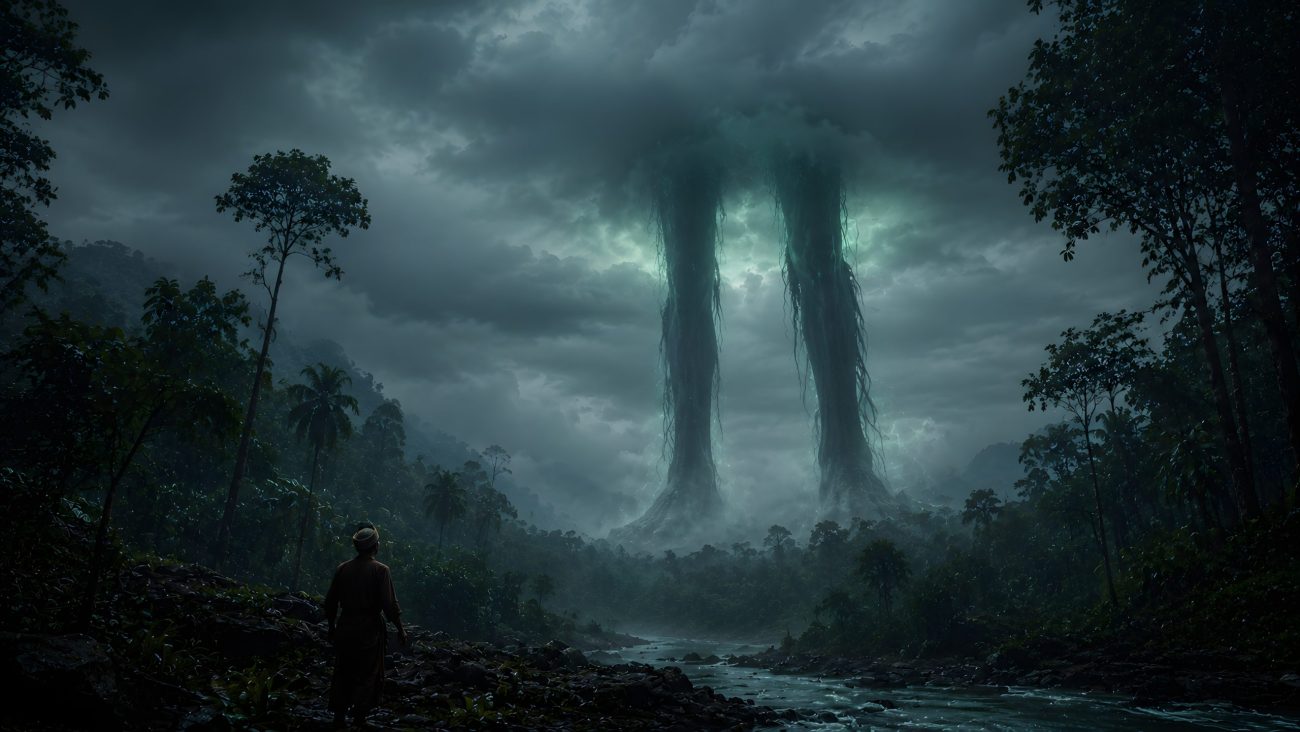
The Hantu Tinggi is a colossal supernatural being whose enormous body towers so high that its upper half disappears into the clouds. Resembling the fearsome Hantu Raya or the Indonesian Genderuwo, it is said to be thousands of times larger than any ordinary spirit. A single strand of hair from its leg is believed to be as thick as a muscular man’s arm.

According to Malaysian folklore, the Hantu Tinggi dwells in remote forests, mountains, and isolated wilderness. It is considered an immensely ancient being, existing since before the arrival of humanity and, in some traditions, even before the creation of Iblis. Because of its unimaginable size, a person may unknowingly walk between its legs or beneath its towering form without immediately realizing what they have encountered.

Looking directly at the Hantu Tinggi is said to bring terrible consequences. Those who meet its gaze may be struck blind, while others suffer broken necks, damaged spines, or become hopelessly lost after being drawn into the Ghaib Realm, the hidden supernatural world inhabited by spirits. For this reason, parents traditionally warned children to avoid lonely forests, hills, and mountains, especially after dark.

Protection against the Hantu Tinggi is believed to come through the recitation of verses from the Qur’an and sincere prayers. Those thought to have been cursed by the giant spirit often seek help from a bomoh, pawang, dukun, imam, or other Islamic spiritual healer to remove its influence.

Although often confused with the Hantu Galah, a bamboo-like forest spirit, the Hantu Tinggi is regarded as a completely different entity. Rather than resembling a living bamboo, it is an unimaginably massive giant whose presence alone inspires awe and terror.

Thus the Hantu Tinggi is remembered as one of Malaysia’s largest and most mysterious supernatural beings—a towering primordial spirit whose head vanishes into the heavens and whose mere gaze can bring ruin to those unfortunate enough to encounter it.


Sources

Wikipedia contributors. (n.d.). Hantu Tinggi. In Wikipedia. Retrieved June 27, 2026, from https://en.wikipedia.org/wiki/Hantu_Tinggi


Kuntilanak

Tradition / Region: Indonesia Mythology, Malaysia Mythology, and Singapore Mythology
Alternative names: Pontianak, Hantu Langsuyar
Category: Ghost


The Myth

The Kuntilanak, known in Malaysia as the Pontianak, is one of the most feared female spirits of Southeast Asia. She appears as a beautiful woman with pale skin, long black hair, red eyes, and a white dress stained with blood. Beneath this alluring form hides a horrifying monster with long fangs and razor-sharp claws.

The spirit is commonly associated with women who died during childbirth or with unborn children that never entered the world. Some traditions describe the Kuntilanak as the daughter of the Langsuir, while others regard her as the restless soul of a woman consumed by rage and sorrow.

She emerges at night, especially during the full moon. Her presence is announced by the cries of an infant, feminine laughter, or the scent of plumeria flowers, which is often followed by the odor of decay. People say that if her laughter sounds distant, she is nearby, but if it sounds close, she is still far away. Dogs howling or whining during the night are also considered signs that she is approaching.

The Kuntilanak uses her beauty to lure unsuspecting victims. Once close, she reveals her true form and tears open their bodies with her claws, devouring their internal organs. Some traditions claim that she especially seeks revenge upon men, while others say she attacks pregnant women and children. In Indonesia, she is also believed to prey upon virgins and young women, sometimes appearing as a white bird whose cry resembles the sound “ke-ke-ke.”

One of her most terrifying forms reveals a hollow cavity in her back, exposing an empty body concealed beneath her beautiful appearance. She may also transform into an owl or a great white bird while searching for prey.

During the day, her spirit is said to dwell within banana trees. According to popular belief, she can be subdued by driving a nail into the back of her neck or the top of her head. Doing so transforms her into a beautiful and obedient woman, remaining harmless for as long as the nail is left in place.

The city of Pontianak in West Kalimantan derives its name from these spirits. Tradition says that when Sultan Syarif Abdurrahman sought to establish the settlement, the area was haunted by Pontianaks. He and his followers drove them away with cannon fire before building a mosque and palace, and bamboo cannons are still fired during celebrations in memory of this event.

Thus, the Kuntilanak remains one of the most dreaded ghosts of Southeast Asia: a white-clad beauty whose laughter echoes through the night and whose monstrous hunger waits behind a lovely face.


Sources

Wikipedia contributors. (n.d.). Kuntilanak. In Wikipedia. Retrieved June 20, 2026, from https://en.wikipedia.org/wiki/Kuntilanak


Pocong

Tradition / Region: Indonesian Mythology and Malaysian Mythology
Alternate Names: Hantu Bungkus
Category: Ghost


The Myth

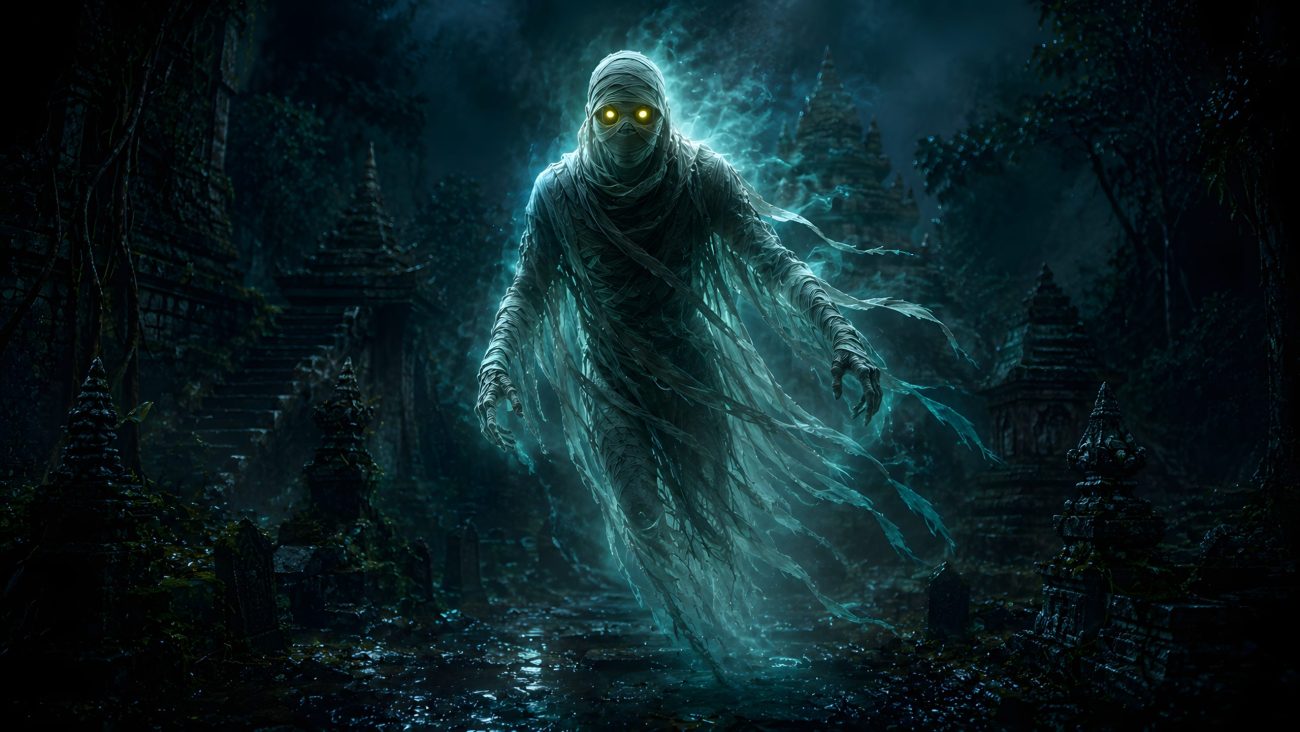
The Pocong is a ghost from Indonesian and Malaysian folklore said to resemble a dead body wrapped tightly in a burial shroud. The spirit is connected to Islamic funeral traditions, where the deceased is wrapped in a white cloth known as a kain kafan before burial. According to the legend, if the ties of the burial shroud are not properly released after burial, the dead may return as a Pocong.

The creature is usually described as pale and corpse-like, wrapped completely in white cloth with knots around the head, neck, and feet. Because its legs are bound together, the Pocong is unable to walk normally and is often said to move by hopping. Other stories describe it floating silently above the ground. Its appearance varies depending on the condition of the corpse. Some Pocongs resemble freshly buried bodies with pale skin and wide staring eyes, while older ones appear skeletal or badly decayed.

Pocongs are believed to appear near graveyards, banana trees, abandoned places, rivers, villages, and the homes they once inhabited. Their behavior is unpredictable. Some legends describe them as harmless spirits seeking prayers or attempting to deliver unfinished messages to the living. Others portray them as terrifying supernatural beings that deliberately frighten or attack humans.

Many regional variations of the Pocong exist throughout Indonesia. One famous version is the Red Pocong, a violent vengeful spirit wrapped in a blood-red shroud. According to folklore, these spirits are created from people who died in anger, betrayal, or murder and returned seeking revenge. They are considered far more dangerous than ordinary Pocongs and are sometimes described as leaders of ghostly colonies.

Another legend tells of the Plastic Pocong, the spirit of a murdered pregnant woman whose corpse was wrapped in plastic before burial due to uncontrollable bleeding. Her ghost was believed to wander because her soul could not rest peacefully.

In East Java, stories spread of the Andong Pocong, a ghostly shrouded figure riding a horse-drawn carriage through the night. According to the tale, the spirit belonged to a young groom who died together with his bride and horse during a violent pursuit after their marriage. The sound of bells from the carriage was said to foretell illness and death.

Some traditions claim Pocongs gather in large colonies, especially near rivers, forests, and banana groves, although many sightings involve solitary spirits wandering alone at night. Because Pocongs can reportedly move through solid objects and suddenly appear or vanish, they are regarded as dangerous supernatural beings that should be avoided rather than confronted.


Sources

Wikipedia contributors. (n.d.). Pocong. In Wikipedia, from https://en.wikipedia.org/wiki/Pocong