Hakumō Hachibi Kitsune

Tradition / Region: Japanese Mythology
Alternate Names: White-Haired Eight-Tailed Fox
Category: Fox


The Myth

In a village east of Incheon, strange events troubled the people for several years. Young men returning from nearby villages often spoke of meeting a beautiful woman on the mountain path at dusk. She appeared suddenly, graceful and calm, yet before anyone could question her, she vanished just as mysteriously. Each time she was seen, chickens from the village also disappeared.

One evening, a man working in a field encountered such a woman. She appeared beside him without warning and spoke gently, saying that traveling alone at night was lonely and asking him to accompany her to a distant village. Glad for company, he agreed and walked beside her.

But before long he collapsed and lost consciousness.

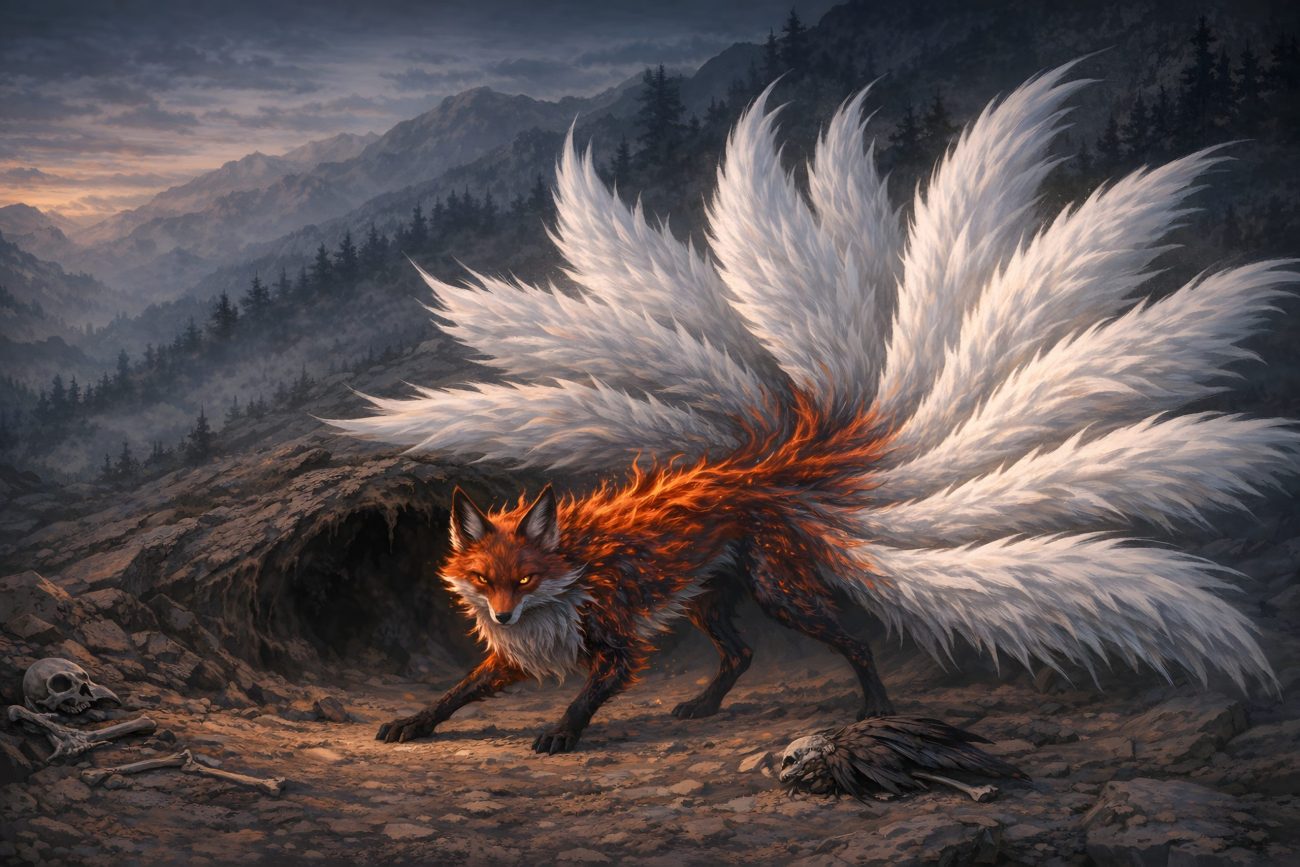
When he awoke, others told him what they had seen. He had wandered toward a hole by the roadside, thrusting his head inside while struggling as though something unseen held him. When the villagers examined the hole, they found it filled with countless bones of chickens and other birds. The tunnel stretched deep into the earth, so far that no one could see its end.

People came to believe that the mysterious woman and the vanishing livestock were connected. The hole was said to be the dwelling of a fox spirit, and the woman herself its human form.

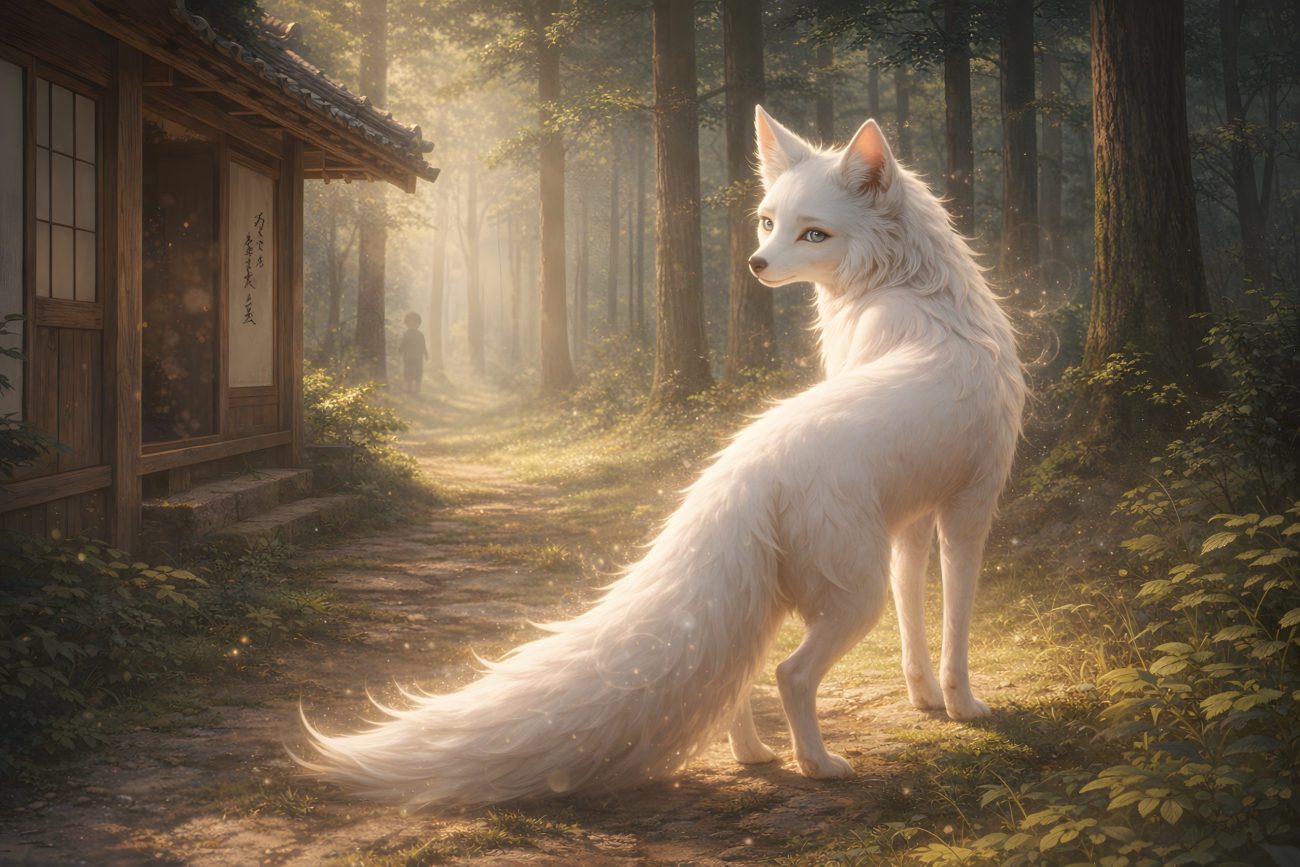
Soon afterward, a witness claimed to have seen the creature directly — a fox with a reddish body and eight tails, each tail shining white as snow. Word spread quickly, and the tale of the White-Haired Eight-Tailed Fox traveled far beyond the village. Some even spoke of organizing a hunt to capture the strange fox alive.

Thus the spirit of the mountain path was remembered as a fox of great age and power, appearing as a beautiful woman by twilight and returning to the earth by night, leaving only bones and rumors behind.


Gallery


Sources

Tyz-Yokai Blog. (n.d.). Hakumō Hachibi Kitsune. Retrieved March 1, 2026, from https://tyz-yokai.blog.jp/archives/1040562430.html.

Interpretive Lenses

Religious Readings
  • Christian Ascetic Deep Dive
Philosophical Readings
  • Nietzschean Deep Dive
Psychological Readings
  • Jungian Deep Dive
Esoteric Deep Dive
  • Hermetic Deep Dive
Political / Social Readings
  • Marxist Deep Dive

Shichibi-Furugitsune

Tradition / Region: Japanese Mythology
Alternate Names: Seven-Tailed Old Fox
Category: Fox


The Myth

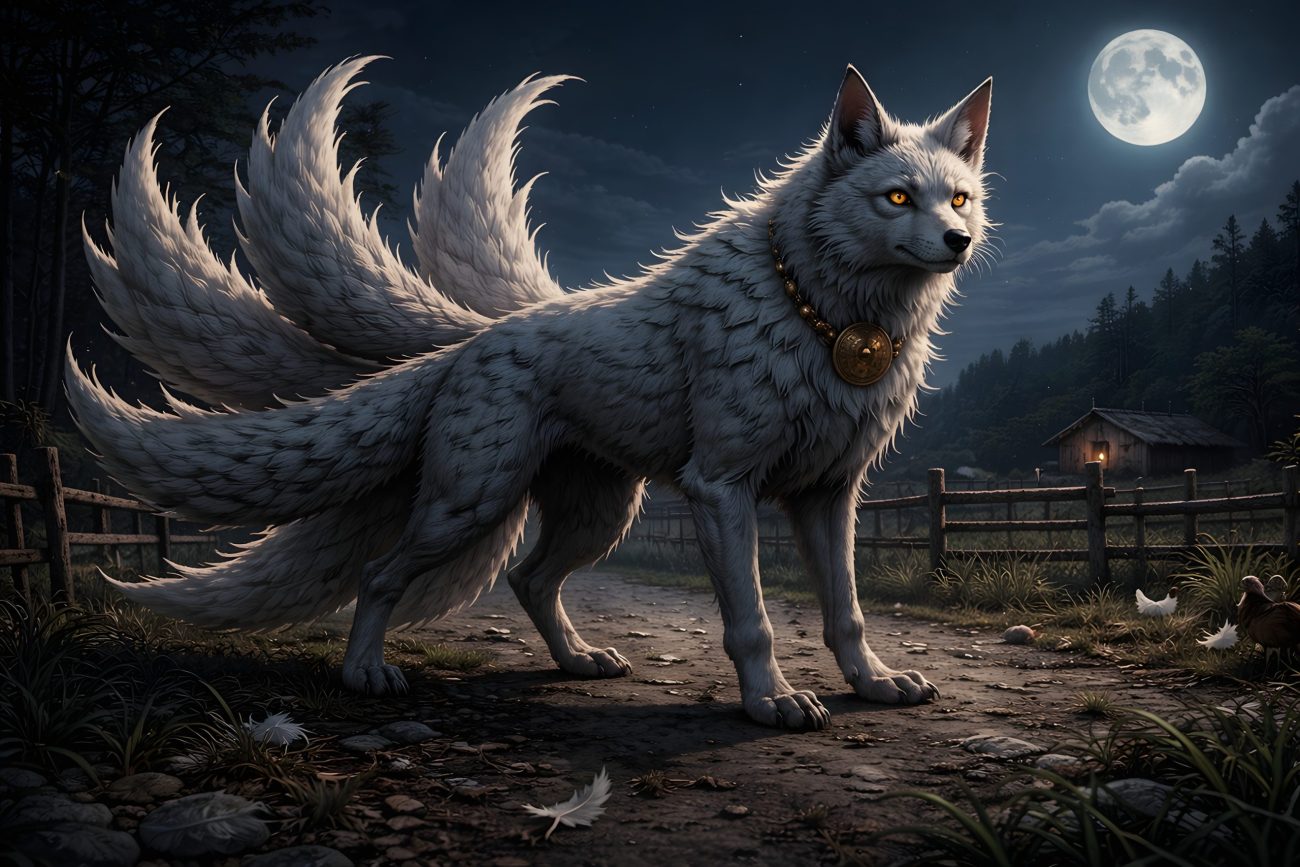
In the Takamatsu area of Shimada Village, farmers began to suffer repeated thefts of chickens and other small livestock. The villagers suspected that a fox or raccoon dog was responsible, but the losses continued, and people grew uneasy.

At last, on the night of May 18th, several young men armed themselves and hid in wait, determined to catch the culprit. They watched through the darkness until, around the second hour of the night, a large fox suddenly appeared.

The men rushed after it and, after a hard chase, managed to capture it. When they finally saw the creature clearly, they realized it was no ordinary animal.

The fox was enormous, nearly twice the size of a normal fox, and its body bore the look of great age. Most striking of all were its tails — seven of them, each forked and spreading like branches. Around its neck was a strange mark shaped like a coin, as though it carried a crest upon its fur.

Those who saw it said the sight recalled the legends of powerful fox spirits, like the golden nine-tailed fox of old tales. The captured creature was whispered to be a furugitsune, an ancient fox that had lived long enough to gain strange power and form.

And so the fox of Shimada Village passed into local memory as a sign that, even in ordinary fields and farms, creatures of great age and mystery might still walk unseen among humans.


Gallery


Sources

Tyz-Yokai Blog. (n.d.). Shichibi-Furugitsune. Retrieved March 1, 2026, from https://tyz-yokai.blog.jp/archives/1039850186.html.


Interpretive Lenses

Religious Readings
  • Christian Ascetic Deep Dive
Philosophical Readings
  • Nietzschean Deep Dive
Psychological Readings
  • Jungian Deep Dive
Esoteric Deep Dive
  • Hermetic Deep Dive
Political / Social Readings
  • Marxist Deep Dive

Akaeri

Tradition / Region: Japanese Mythology
Alternate Names: Aka-eri
Category: Fox


The Myth

Near Sendasuka Nishi on Chiejima Island there once lay a deep and gloomy body of water known as Dongan Pond. Willow trees leaned over its banks, bamboo thickets surrounded it, and the surface of the water shone a murky blue-black. People already whispered that kappa and raccoon dogs haunted the place.

Around the Taishō period, another rumor spread.

A strange being called Akaeri was said to live in the bushes near the pond. Those who claimed to see it described a creature about the size of a ten-year-old child, with a red body and the features of a fox. Yet what made it most unsettling was not its shape, but its posture.

Akaeri did not skulk or creep like an animal. It sat at the edge of the thicket facing the pond, legs crossed and back straight, like a person quietly resting. From a distance it looked almost human, but the red body and fox-like face betrayed its true nature.

The sight of it was so eerie that schoolchildren walking from Nishichiejima to the elementary school avoided the pond entirely, choosing longer routes rather than pass near the bushes. Workers traveling nearby also spoke of it. One plasterer returning each day would say that a strange red creature sat there again, unmoving, watching the water.

Whether it was spirit, fox, or something else, the figure remained part of the pond’s reputation. And long after the stories faded, people still remembered Dongan Pond as a place where something red once sat silently at the water’s edge, waiting in the reeds.


Sources

Tyz-Yokai Blog. (n.d.). Akaeri. Retrieved March 1, 2026, from https://tyz-yokai.blog.jp/archives/1013136220.html.


O-Yoshi

Tradition / Region: Japanese Mythology
Alternate Names: Oyoshi-san
Category: Fox


The Myth

In the village of Takasu there was once a boy named Yoshifumi who fell mysteriously ill. Though he continued to eat, his body weakened day by day, and his behavior became strange.

When his grandmother asked why he was growing so thin, the boy answered, “I don’t eat alone. O-Yoshi eats too.”

Pressed to explain, he spoke calmly of someone called O-Yoshi who lived in the Noba area of Takasu with grandparents and a younger sister named O-Sato. He described their house in detail, even though he had never visited the place.

As the days passed, the boy’s condition worsened. He began to move and speak like a fox, muttering requests such as, “I want fried tofu,” “I want chicken,” and “Please build me an Inari shrine.” His family feared that he had been possessed.

When asked where this fox might be, Yoshifumi replied that it lived in the weeds along the Kokai River near a certain house. His grandmother took him there, and the boy pointed to a small hole hidden beneath the grass, saying, “Grandma, it’s here.” The hole was exactly where he had said.

Fearing for the child, the family made a pilgrimage to Mitake Shrine and returned with a talisman meant to drive fox spirits away. When the charm was brought into the house, Yoshifumi trembled and cried out that he could not stay there and must run away, begging to be allowed to eat.

Soon after, he fell into a deep sleep that lasted several days. When he awoke, the strange behavior was gone, and little by little he recovered completely.

Yet the story spread among the villages, and people spoke uneasily of a fox called O-Yoshi that might still dwell near the riverbank, waiting to enter another child if the chance arose.


Gallery


Sources

Tyz-Yokai Blog. (n.d.). O-Yoshi-san. Retrieved March 1, 2026, from https://tyz-yokai.blog.jp/archives/1010655051.html.


Interpretive Lenses

Religious Readings
  • Christian Ascetic Deep Dive
Philosophical Readings
  • Nietzschean Deep Dive
Psychological Readings
  • Jungian Deep Dive
Esoteric Deep Dive
  • Hermetic Deep Dive
Political / Social Readings
  • Marxist Deep Dive

Ginko

Tradition / Region: Japanese Mythology
Alternate Names: Gingitsune
Category: Fox


The Myth

In forests, fields, mountains, and around temples, there are said to dwell rare fox spirits known as Ginko, the Silver Foxes.

Their fur shines pale like moonlight, and they move quietly through the night as messengers of the goddess Dakini. Unlike wandering fox spirits that trick or deceive, the Ginko are counted among the holy foxes. They are pure beings who serve in the unseen world and carry out the will of their divine mistress.

People say the Silver Foxes embody the power of the moon. Just as the moon reflects light in darkness, the Ginko guide the hidden paths of the night and protect sacred places. They are often spoken of together with their counterparts, the Golden Foxes, who represent the sun. Where one brings the light of day, the other carries the calm glow of night.

Among the sacred fox clans, the Ginko belong to the families of benevolent spirits who dwell close to temples and holy grounds. They are not feared but respected, for they move between the human world and the divine.

Thus the Silver Fox is remembered as a fox of moonlight — a quiet, shining presence in the night, walking the boundaries of shrine and forest in service to the gods.


Gallery


Sources

yokai.com. (n.d.). Ginko. Retrieved March 1, 2026, from https://yokai.com/ginko/?srsltid=AfmBOoq1PBcCaFpbBaPtig5_luguQBQFZxsRhvuLNZmnnO2Xfm_DjteL


Interpretive Lenses

Religious Readings
  • Christian Ascetic Deep Dive
Philosophical Readings
  • Nietzschean Deep Dive
Psychological Readings
  • Jungian Deep Dive
Esoteric Deep Dive
  • Hermetic Deep Dive
Political / Social Readings
  • Marxist Deep Dive

Kitsunebi

Tradition / Region: Japanese folklore
Alternate Names: Fox Lantern, Fox Torch, Kitsunebi
Category: Fox, Flame


The Myth

Across many parts of Japan, people have long spoken of mysterious lights appearing in the night, known as Fox Fire.

These flames are said to be created by foxes. Some believe the fire comes from their breath, glowing as they exhale into the darkness. Others say foxes strike their tails together to spark the light, or that they kindle it from strange materials such as bones. Sometimes the fire appears as floating balls of light that drift across fields and roads.

Because of its steady glow, the light is often called a fox lantern or fox torch. When many of these lights appear at once and move together through the night, people say a fox wedding is taking place somewhere unseen.

One famous tradition tells that at Ōji Inari Shrine in Edo, foxes from across the Kantō region gathered on New Year’s Eve. On that night, countless fox fires were said to dance across the fields as the foxes assembled to receive ranks from their deity. Villagers would watch the number and movement of the lights, believing they foretold whether the coming year would bring a good harvest.

Thus Fox Fire became known as both a sign of the hidden world and a message carried in light — a glow in the night that revealed the unseen presence of foxes and the mysteries that followed them.


Gallery


Sources

Tyz-Yokai Blog. (n.d.). Kitsunebi. Retrieved March 1, 2026, from https://tyz-yokai.blog.jp/archives/1010653498.html


Interpretive Lenses

Religious Readings
  • Christian Ascetic Deep Dive
Philosophical Readings
  • Nietzschean Deep Dive
Psychological Readings
  • Jungian Deep Dive
Esoteric Deep Dive
  • Hermetic Deep Dive
Political / Social Readings
  • Marxist Deep Dive

Kuzunoha

Tradition / Region: Japanese Mythology
Alternate Names: Kuzu-no-Ha
Category: Fox


The Myth

Long ago, in the land of Izumi, there lived a man named Abe no Yasuna. One day he encountered a fox being hunted and chased by men. Moved by pity, Yasuna drove the hunters away and saved the animal’s life.

Not long afterward, Yasuna met a beautiful woman named Kuzunoha. She became his wife, and the two lived happily together. In time, she gave birth to a son, who would grow to be Abe no Seimei, a child of extraordinary intelligence and spiritual power.

For years their household was peaceful. Yet Kuzunoha always seemed to carry a quiet sadness, as though she guarded a secret. One day, while the child was playing, he accidentally glimpsed his mother’s shadow — and saw that it was not fully human. The truth was revealed: Kuzunoha was the fox Yasuna had once saved, who had taken human form out of gratitude and love.

Knowing she could no longer remain among humans once her nature was discovered, Kuzunoha prepared to leave. Before departing, she wrote a farewell poem upon a paper door, telling her husband and child that if they missed her, they should come to the forest of Shinoda.

She then vanished, returning to the wild as a fox.

Yasuna later brought their son to that forest, where the boy is said to have received his first teachings in hidden knowledge. From this beginning, Abe no Seimei grew into one of the greatest masters of onmyōdō, carrying within him the wisdom of both human and fox.

Thus Kuzunoha is remembered not as a trickster, but as a fox spirit of devotion — a mother who crossed the boundary between worlds for love, and whose legacy lived on through her child.


Gallery


Sources

Wikipedia contributors. (n.d.). Kuzunoha. In Wikipedia. Retrieved March 1, 2026, from https://en.wikipedia.org/wiki/Kuzunoha

yokai.com. (n.d.). Kuzunoha. Retrieved March 1, 2026, from https://yokai.com/kuzunoha/?srsltid=AfmBOooL0A8LfeRbnPjmFs8_N3Z4ETbc8ITLHzMNBQPxAXV54g9FzIkj


Interpretive Lenses

Religious Readings
  • Christian Ascetic Deep Dive
Philosophical Readings
  • Nietzschean Deep Dive
Psychological Readings
  • Jungian Deep Dive
Esoteric Deep Dive
  • Hermetic Deep Dive
Political / Social Readings
  • Marxist Deep Dive