Tradition / Region: Iranian Mythology, Persian Mythology
Alternative Name: Mantichore, Martichora
Category: Lion
The Myth
The Manticore is a monstrous creature from Persian mythology later adopted into Greek and medieval European legends. Its name means “man-eater,” reflecting its terrifying appetite for human flesh.
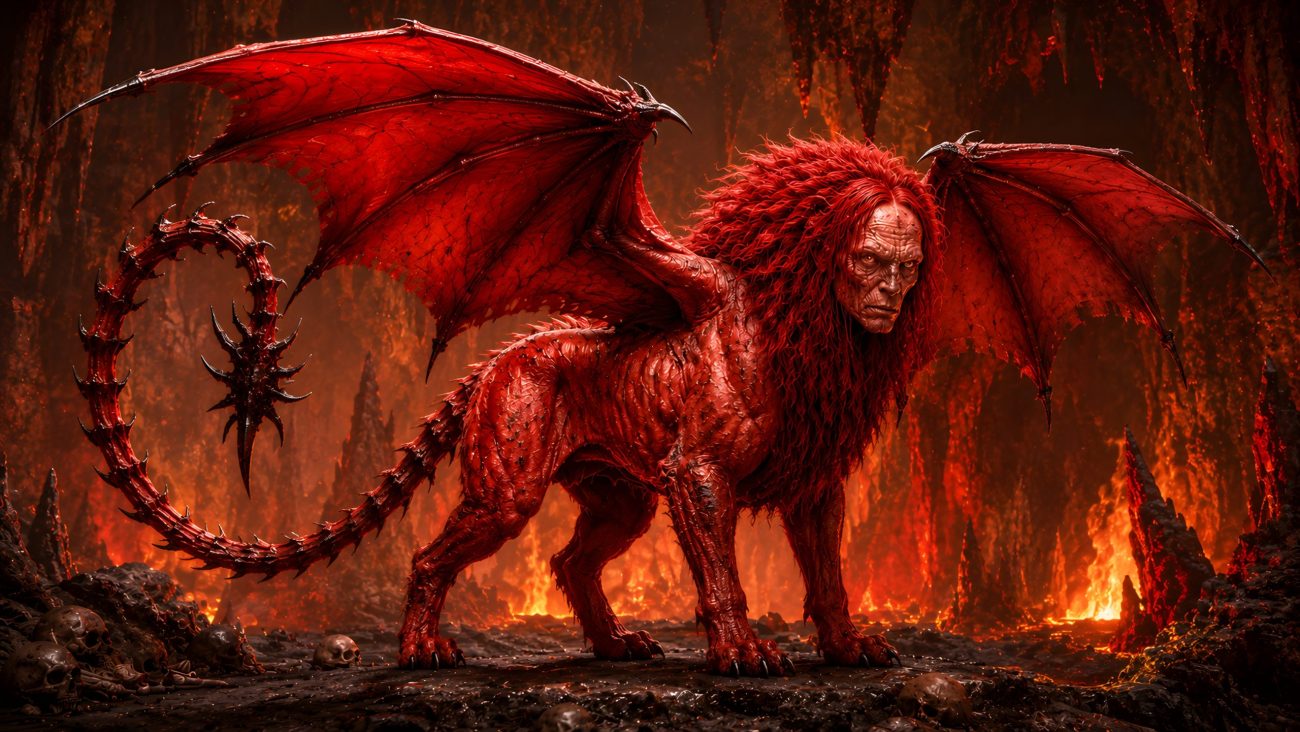
The creature is most commonly described as having the body of a lion, the face of a human, and the tail of a scorpion. Some legends describe the tail as being covered in venomous spines or quills that can be launched like arrows at enemies. It was also said to possess three rows of teeth and a powerful voice resembling a trumpet or pipe.
Ancient writers claimed the manticore lived in India or the distant eastern lands beyond Persia. It was feared as a swift and aggressive predator capable of overpowering humans and animals alike. According to the earliest stories, the beast would devour its victims entirely, leaving no bones behind.
Greek physician Ctesias recorded one of the earliest descriptions of the creature after hearing stories from Persian sources during the Achaemenid Empire. Later Roman writers such as Pliny the Elder repeated and expanded the legend, helping spread the manticore throughout medieval Europe.
During the Middle Ages, the manticore became a common creature in bestiaries and medieval art. Illustrations often portrayed it with a human-like face, massive claws, a lion’s body, and a deadly spiked tail. Some depictions gave it wings or exaggerated monstrous features, though these additions varied between manuscripts.
The manticore eventually became a symbol of savagery, hidden danger, and insatiable hunger in folklore and literature.
Sources
Wikipedia contributors. (n.d.). Manticore. In Wikipedia. Retrieved May 10, 2026, from https://en.wikipedia.org/wiki/Manticore