Az’-i-wû-gûm Ki-mukh’-ti

Tradition / Region: Inuit Mythology
Alternate Names: Walrus Dog
Category: Dog


The Myth

Along the harsh coasts of Alaska, hunters told of a strange and dangerous creature known as the Az’-i-wû-gûm Ki-mukh’-ti, the Walrus Dog.

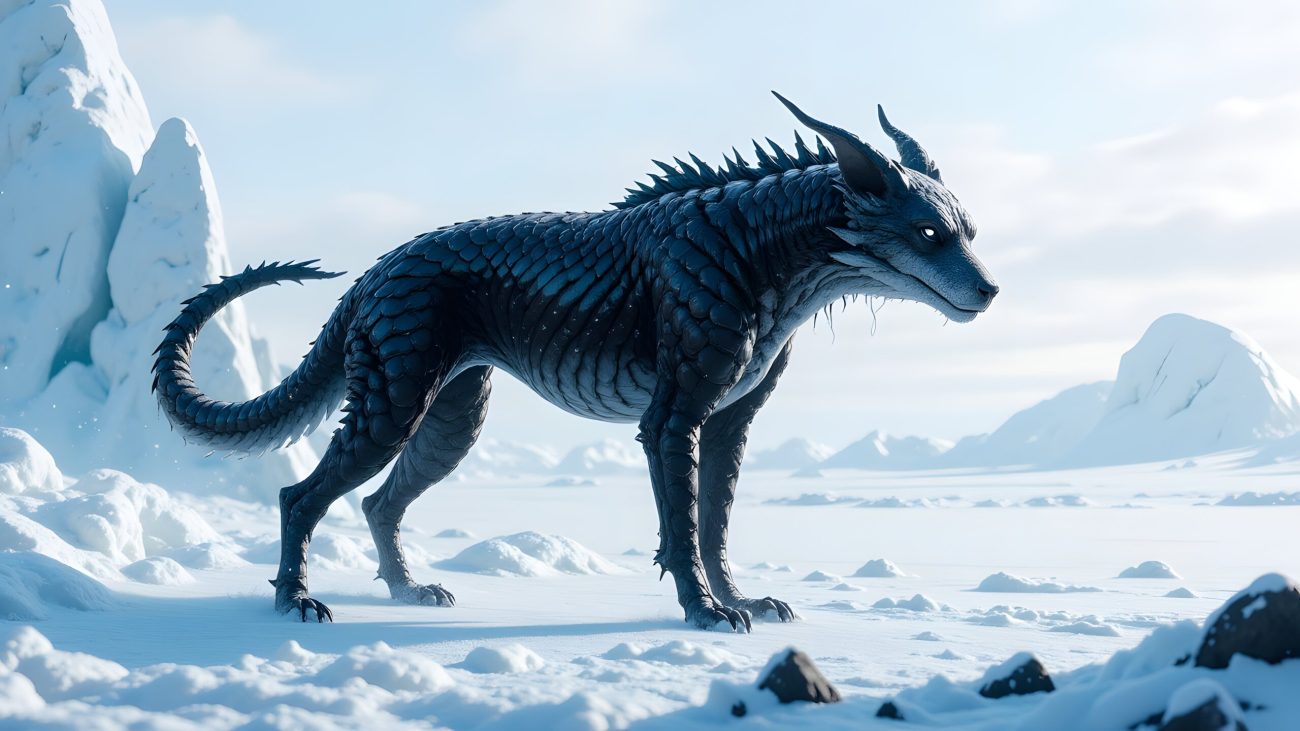
It was said to resemble a large dog in shape, though more slender and elongated than any ordinary animal. Its tail was long and thick with muscle, strong enough to strike with deadly force. Instead of fur, its body was covered in tough black scales, making it nearly impossible to kill except with the finest weapons.

The creature was believed to live among herds of walrus. Though not one of them, it moved with them and seemed to act as their guardian. Because of this, walrus hunters feared encountering it while at sea.

Stories told that the Walrus Dog was one of the creations of Raven, the great being who shaped many animals and spirits of the world. Like many of Raven’s works, it was both part of nature and something beyond it.

Hunters warned that if the creature was disturbed, it could become deadly. Its tail alone could kill a man, and one tale spoke of a time when it attacked an umiak on the water and slew everyone aboard.

Thus the Az’-i-wû-gûm Ki-mukh’-ti was remembered as a powerful spirit-beast of the northern coasts — a scaled dog that guarded the walrus herds and brought danger to those who crossed its path.


Gallery


Sources

A Book of Creatures. (2015). Az’-i-wû-gûm Ki-mukh’-ti. In abookofcreatures.com, from https://abookofcreatures.com/2015/09/25/az-i-wu-gumki-mukh-ti/


Interpretive Lenses

Religious Readings
  • Christian Ascetic Deep Dive
Philosophical Readings
  • Nietzschean Deep Dive
Psychological Readings
  • Jungian Deep Dive
Esoteric Deep Dive
  • Hermetic Deep Dive
Political / Social Readings
  • Marxist Deep Dive

Qiqirn

Tradition / Region: Inuit Mythology
Alternate Names:
Category: Dog


The Myth

The Qiqirn is a spirit-dog spoken of in the traditions of the Inuit of Baffin Island.

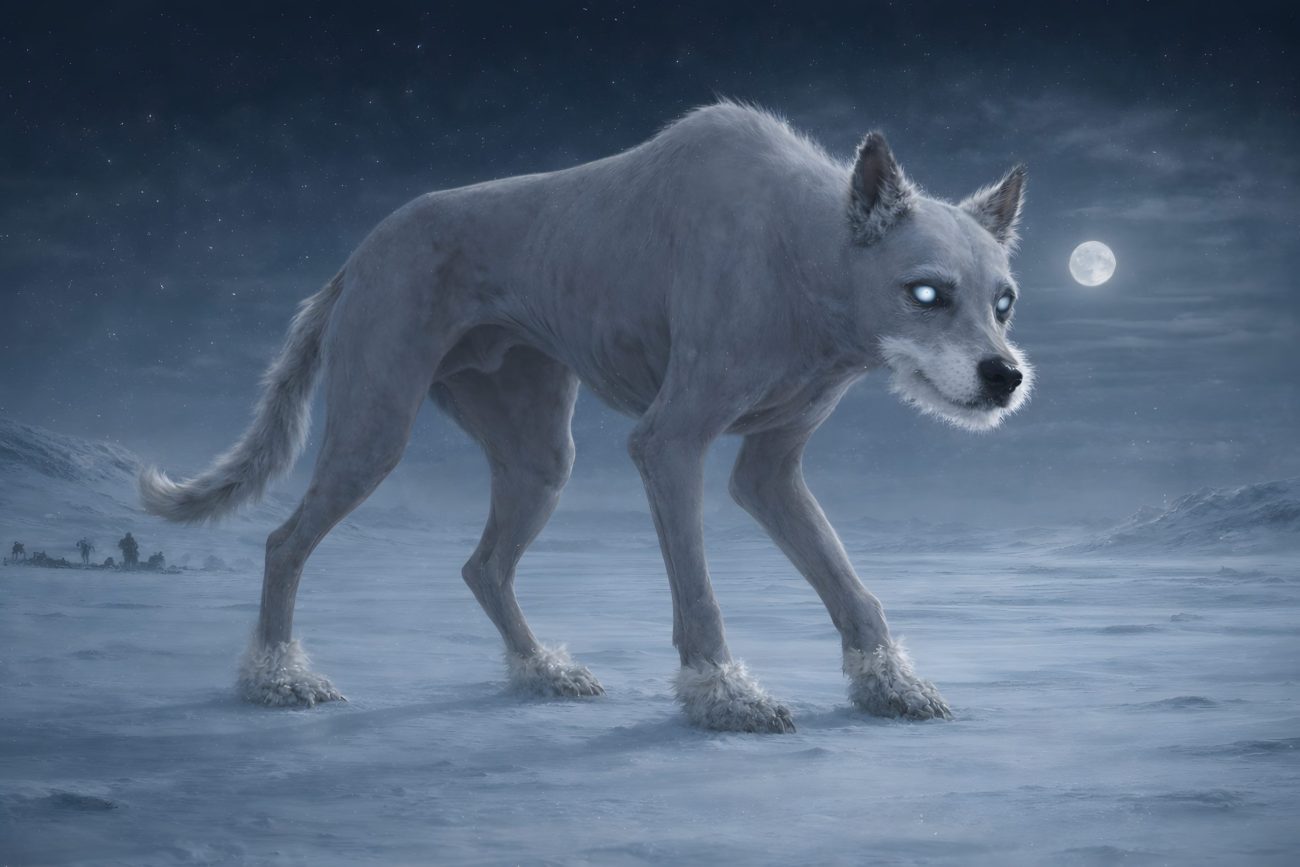
It is said to appear as a large and unnatural animal, almost entirely bald. Only small patches of hair grow upon it — on its feet, around its mouth, and at the tips of its ears and tail. Its body is otherwise bare, giving it a strange and unsettling appearance.

The Qiqirn is feared not because it attacks, but because of the effect its presence has on the living. When it draws near, both men and dogs may suddenly fall into violent convulsions. These seizures can be so severe that they bring death.

Yet the spirit itself is not brave. Though it brings terror, it is said to fear humans. If it is seen by an angakkuq, a shaman, the Qiqirn will not approach but will flee at once, retreating from the power of the one who can see into the spirit world.

Other Inuit stories tell of similar beings, such as malevolent earth spirits that also appear in the shape of hairless dogs. These too belong to the unseen world that moves alongside the world of people, where spirits may wander close enough to be glimpsed, and where their presence can bring danger or misfortune.

So the Qiqirn is remembered as a spirit that walks the boundary between worlds — a strange, silent dog whose appearance alone can shake the living.


Gallery


Sources

Wikipedia contributors. (n.d.). Qiqirn. In Wikipedia, from https://en.wikipedia.org/wiki/Qiqirn


Interpretive Lenses

Religious Readings
  • Christian Ascetic Deep Dive
Philosophical Readings
  • Nietzschean Deep Dive
Psychological Readings
  • Jungian Deep Dive
Esoteric Deep Dive
  • Hermetic Deep Dive
Political / Social Readings
  • Marxist Deep Dive

Adlet

Tradition / Region: Inuit mythology Canadian Mythology, Greenlandic Mythology
Alternate Names: Erqigdlet, Adlit
Category: Dog, Hybrid


The Myth

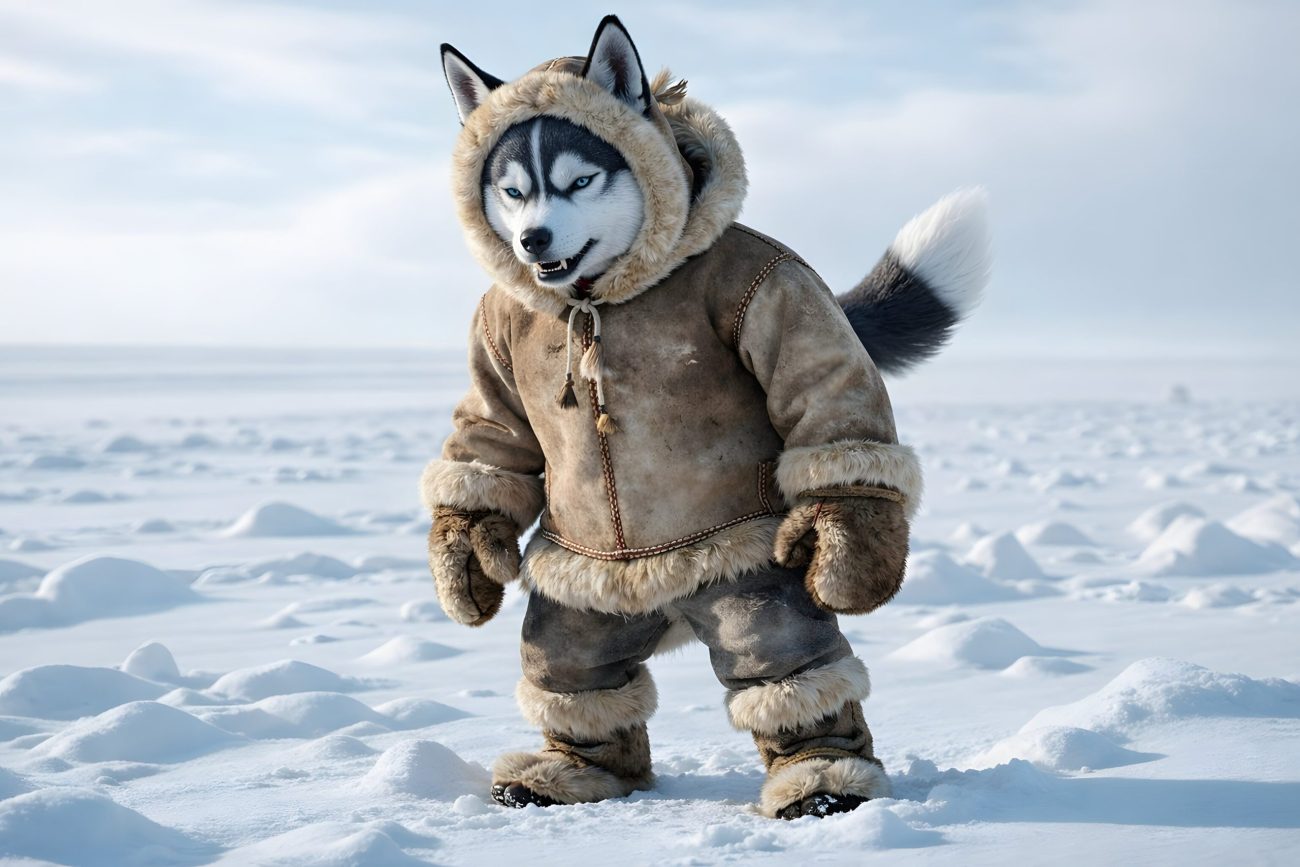
The Adlet are a race of beings spoken of in Inuit tradition. They are said to be taller than ordinary people and to live inland, away from the coast. Their form is half human and half dog: from the waist up they resemble a man, but their lower bodies are those of dogs. They run swiftly across the land and are often remembered as fierce enemies of humankind. In some stories they are cannibals, and encounters with them are dangerous and violent.

Their origin is told in an old story about a young woman named Niviarsiang, who lived with her father, Savirqong. Though many men wished to marry her, she refused every suitor. Because she would not take a husband, people came to call her “she who would not marry.”

At last, instead of choosing a man, she took a dog as her husband. The dog, named Ijirqang, had white and red spots on his coat. From this strange union ten children were born. Five of them were fully dogs, but the other five were unlike any people before them: their upper bodies were human, while their lower halves were those of dogs. These children were the first Adlet.

Ijirqang did not hunt, and the household was soon starving. The hungry children cried constantly, and Savirqong, their grandfather, was forced to bring them food. At last he grew weary of this burden. He carried his daughter, her husband, and their children out to a small island and left them there, saying that he would provide meat if the dog swam to shore each day to fetch it.

To help her husband, Niviarsiang hung a pair of boots around Ijirqang’s neck so he could carry the meat back across the water. The dog swam to shore as instructed. But when he arrived, Savirqong did not fill the boots with food. Instead, he filled them with stones. Weighted down, Ijirqang drowned in the sea.

When Niviarsiang learned what had happened, she sought revenge. She sent her young dogs across the water to attack her father. They gnawed off his hands and feet as punishment for killing their father.

Later, when Niviarsiang herself came near Savirqong in his boat, he seized his chance. He pushed her overboard. She clung to the side, trying to pull herself back in, but he cut off her fingers one by one. As they fell into the ocean, each finger changed form and became a sea creature. From them came the seals and the whales that fill the waters.

Fearing that her father might next destroy her strange children, Niviarsiang sent the Adlet away from the coast and into the interior lands. There they multiplied and became a great inland people.

Her dog children she placed in a makeshift boat and sent them across the sea. It is said that when they reached the far shore, they became the ancestors of distant northern peoples.

From that time on, the Adlet lived inland, remembered as swift, powerful, and dangerous beings whose blood was both human and animal.


Gallery


Sources

Wikipedia contributors. (n.d.). Adlet. In Wikipedia, from https://en.wikipedia.org/wiki/Adlet


Interpretive Lenses

Religious Readings
  • Christian Ascetic Deep Dive
Philosophical Readings
  • Nietzschean Deep Dive
Psychological Readings
  • Jungian Deep Dive
Esoteric Deep Dive
  • Hermetic Deep Dive
Political / Social Readings
  • Marxist Deep Dive