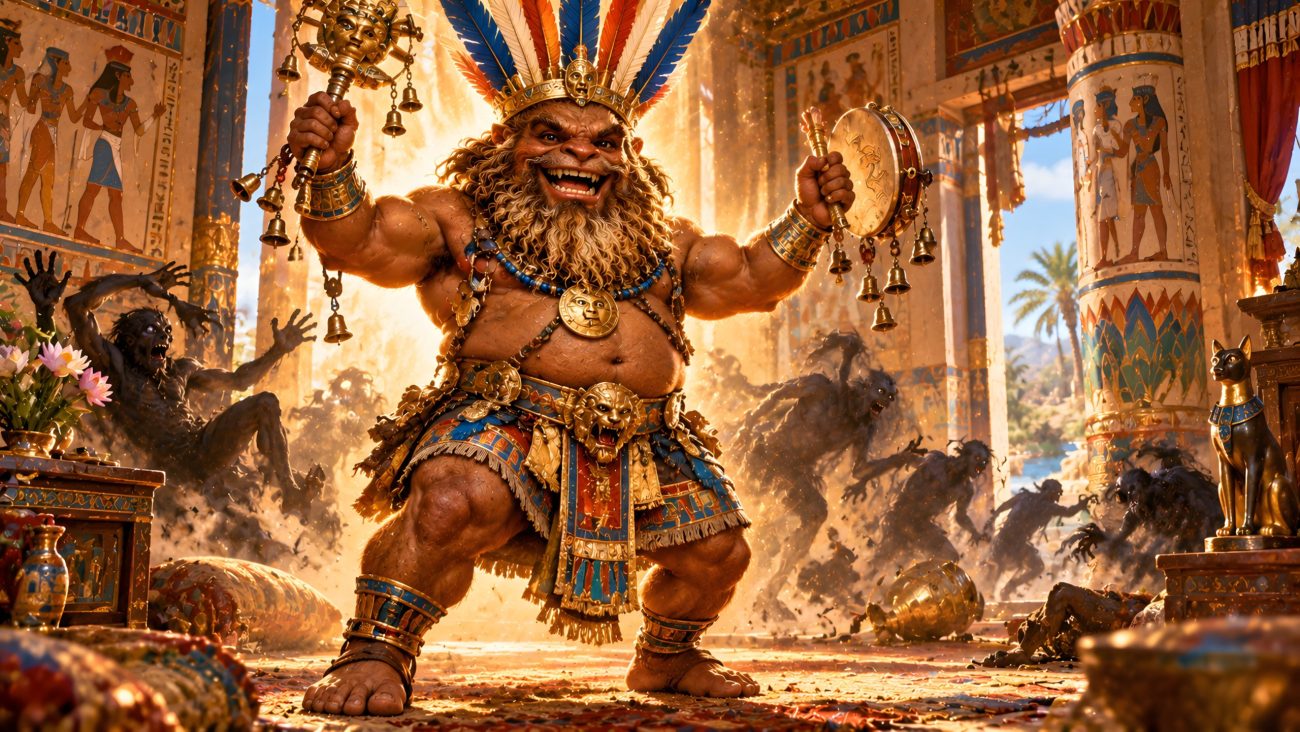
Tradition: Egyptian mythology
Alternative Names: Bisu, Bes, Beset (feminine counterpart)
Category: Dwarf, Deity
The Myth
Bes was a dwarf-like protective deity associated with the household, especially with mothers, children, and childbirth. Unlike most Egyptian gods, who were normally portrayed in profile, Bes was characteristically shown facing directly forward. He had a distinctive dwarf-like body and could appear with feline features, an ostrich-feathered crown, or wearing a soldier’s tunic, giving him the appearance of a fierce little guardian ready to attack anything that threatened the household. His frightening appearance was itself part of his power, allowing him to scare away demons and other harmful spirits.
Bes watched over the home and protected people from supernatural dangers. He was particularly associated with childbirth, where he fought away evil spirits threatening mothers and infants and was present alongside Taweret. He could also kill snakes and guard children. Because he drove away everything harmful, Bes gradually became associated not only with protection but with the pleasant and joyful aspects of life, including music, dancing, and sexual pleasure. His image was therefore kept inside ordinary homes rather than being restricted to temples, appearing on amulets, masks, infant feeding bottles, magical knives, and other objects. People also wore images of Bes as tattoos, particularly dancers, musicians, and servant girls.
Bes and his feminine counterpart Beset were worshipped across a wide area beyond Egypt. Their images eventually spread into Nubia, the eastern Mediterranean, the Aegean world, Phoenician and Cypriot lands, and the Achaemenid Empire, where Bes continued to appear as a protective figure while sometimes being represented in foreign clothing and headdresses. During the Ptolemaic period, chambers at Saqqara were decorated with images of Bes and Beset and were associated with fertility and healing rituals. His protective role remained remarkably persistent, with Bes continuing to appear in Egyptian religious imagery into the Christian period.
Sources
“Bes.” Wikipedia: The Free Encyclopedia. Wikimedia Foundation. Accessed October 4, 2026. https://en.wikipedia.org/wiki/Bes