Tradition / Region: American Mythology
Alternative names: Lynx of Old Man’s Tale
Category: Cat
The Myth
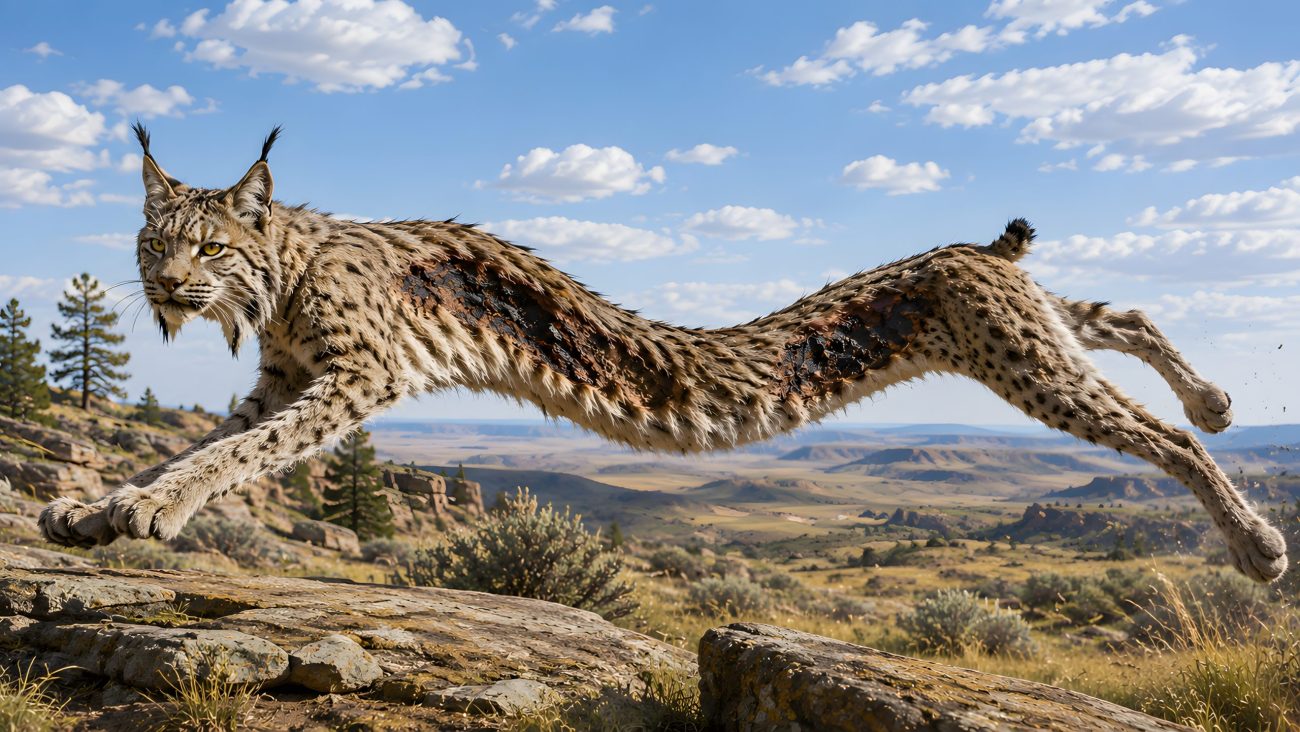
The Stretching Lynx appears as a large wild lynx whose body already resembles that of a modern lynx, though its final appearance is explained through the actions of Old Man, the Blackfoot trickster and culture hero.
One day Old Man encountered a group of squirrels playing a game in hot ashes. The squirrels would bury one another beneath the hot ashes and quickly dig each other out before they were burned. Although they warned Old Man that he would not understand the game, he tricked them into letting him bury them all at once. Instead of rescuing them, he piled on more hot ashes until nearly all the squirrels were roasted alive, sparing only a pregnant squirrel who had begged for mercy.
Old Man built a scaffold from red willow branches and laid the roasted squirrels upon it to cool before eating them. After satisfying his hunger, he lay down to sleep, leaving his Little Brown-Eye to keep watch. While he slept, a lynx quietly approached and devoured every squirrel on the scaffold. Although Little Brown-Eye tried to warn him, Old Man slept through the alarm. Furious when he awoke to find his meal gone, he blamed Little Brown-Eye and burned it with a burning willow stick, creating the origin of the foul-smelling stinking wood.
Old Man then followed the lynx’s greasy tracks until he found it asleep upon a great flat rock. Seizing the animal, he declared that it deserved punishment for stealing his food. He broke off part of its tail, leaving the lynx with its short tail. Standing the animal upright, he grabbed its forelegs and stretched its body until it became long and lean. He then smashed its snout against a rock until it became broad and flat, tore out a handful of hair and fixed it to the animal’s face to create its whiskers, and finally held it over a fire, scorching its sides. These punishments explained why the lynx has its distinctive short tail, flattened face, whiskers, elongated body, and mottled coat.
Afterward, Old Man rested again, but the burn on Little Brown-Eye caused him such discomfort that he repeatedly called for the wind to blow harder to cool it. The wind grew into a violent storm that carried Old Man tumbling across hills and mountains. He grabbed at bushes and trees until only a sturdy birch held firm. When the storm finally subsided, Old Man angrily blamed the birch for ending his wild ride and slashed its bark repeatedly with his knife. According to the tale, the scars still visible on birch trees are the marks left by Old Man’s blade.
Sources
Wissler, Clark, and D. C. Duvall. Mythology of the Blackfoot Indians. Vol. 2, Anthropological Papers of the American Museum of Natural History. New York: The Trustees of the American Museum of Natural History, 1908. Accessed July 28, 2026. https://archive.org/details/mythologyblackf01duvagoog