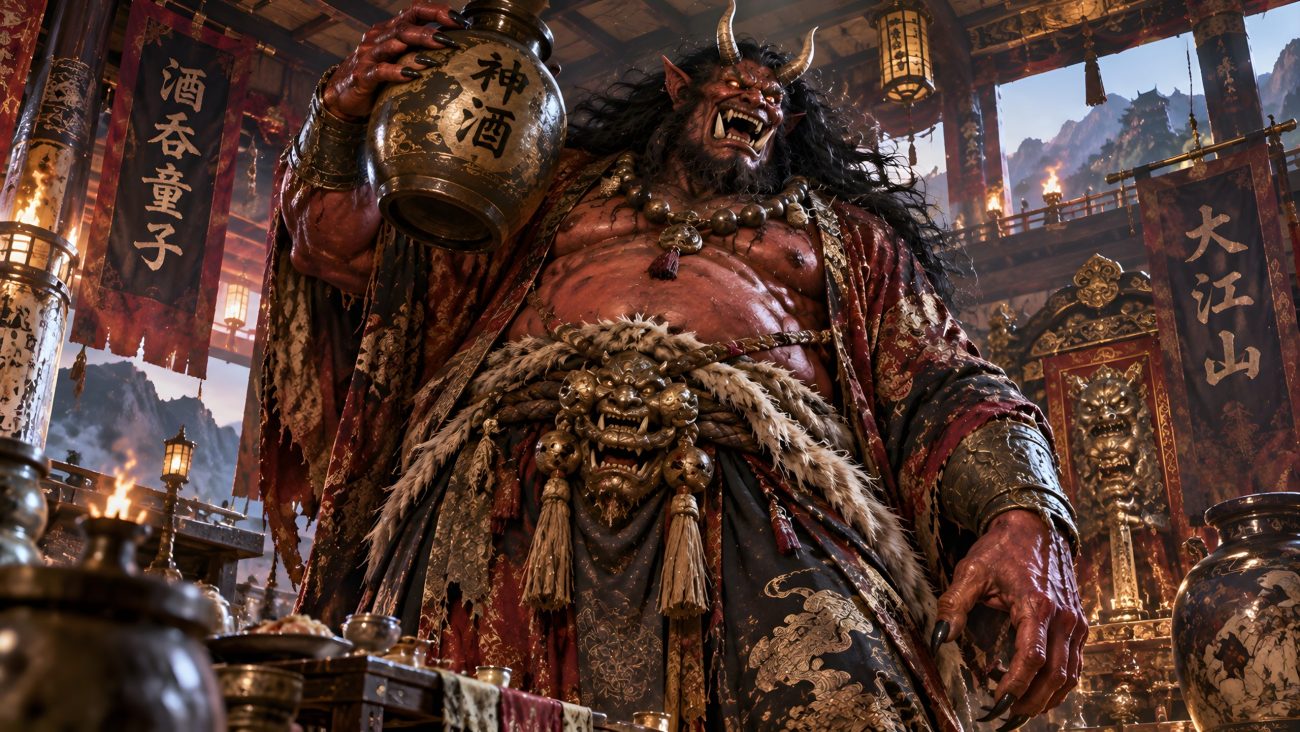
Tradition: Japanese mythology
Alternative Names: Shuten-dōji, Shuten Doji
Category: Demon
The Myth
Shuten-dōji was a powerful demon king who lived on Mount Ōe near Kyoto during the reign of Emperor Ichijō. He appeared at first as a young boy, but his true form was that of a gigantic demon. He was particularly fond of sake and surrounded himself with demons and women whom he had kidnapped from Kyoto.
During the Shōryaku era, people of all social classes and both sexes began disappearing throughout and around the capital. When the court consulted the onmyōji Abe no Seimei, he determined that demons living on Mount Ōe were responsible.
The court first selected samurai to defeat the demons, but they declined the task. The order was therefore given to Minamoto no Yorimitsu, governor of Settsu Province, and Fujiwara no Yasumasa, governor of Tango Province. They prayed at shrines including Hachiman and Sumiyoshi for success before beginning their expedition.
Yorimitsu and Yasumasa were joined by four warriors: Watanabe no Tsuna, Sakata no Kintoki, Usui Sadamitsu, and Urabe no Suetake. Together they traveled toward Mount Ōe.
In the mountains they encountered four unfamiliar old men, who were actually incarnations of Hachiman and other gods. The gods advised the warriors to hide their armor and disguise themselves as mountain ascetics. They also gave them a sacred sake called Divine Transformation Demon Poison Sake.
Further into the mountains, the warriors encountered an old woman washing bloodstained clothing beside a stream. She explained that demons had kidnapped her more than two hundred years earlier. Although she had escaped being eaten, they had forced her to serve them as a laundress ever since. She described the mountains and showed the warriors where the demons’ castle was located.
She also described Shuten-dōji as a demon king who appeared in the form of a child, loved sake, and surrounded himself with women from Kyoto whom he had kidnapped.
Guided by the old woman, Yorimitsu and his companions reached the demon’s castle. Disguised as mountain ascetics, they claimed to be pilgrims and succeeded in gaining Shuten-dōji’s trust.
A great banquet was held. Shuten-dōji refused the sake offered by the disguised warriors, but eagerly drank the special sake given to them by the old man. His demon followers also drank it. As the feast continued, Shuten-dōji told the warriors about his life while his demonic followers entertained the gathering with dengaku and other performances.
While the banquet continued, Yorimitsu and his companions secretly explored the castle. They discovered a prison where the young lord of Mido Nyūdō and other kidnapped people were being held. They also found a terrible pile of corpses, revealing the fate of many of the demon’s victims.
Eventually the poisoned sake took effect. Shuten-dōji returned to his chambers, where beautiful women surrounded him. He revealed his enormous demonic form and fell asleep, weakened by the poison.
When the demons were asleep, Yorimitsu and his warriors launched their attack. They pinned down Shuten-dōji’s enormous body and cut off his head. Even after being severed, the demon’s head remained alive. It flew through the air screaming and attached itself to Yorimitsu’s helmet, refusing to release him.
Tsuna and Kintoki gouged out the demon’s eyes, and Shuten-dōji finally died.
After defeating the demon king, the warriors cremated his body and returned triumphantly to the capital, carrying his head in a palanquin. The head was presented to the regent and chancellor before being placed in the treasure house of Byōdō-in Temple.
Yorimitsu and Yasumasa were rewarded for their victory and appointed Great Generals of the Eastern and Western Barbarians respectively.
In other versions of the legend, Shuten-dōji’s dwelling is placed on Mount Ibuki in Ōmi Province. Other accounts also name powerful demon followers such as Ibaraki-dōji, Kumadōji, and Hoshikuma-dōji, as well as the Four Heavenly Kings who appear at Rashōmon.
Sources
Takahashi, Toshihiro. “酒呑童子 [しゅてんどうじ] (Shuten-dōji).” 新版TYZ 妖怪図鑑 (New TYZ Yokai Encyclopedia). August 3, 2013. https://tyz-yokai.blog.jp/archives/1010654411.html