Tradition / Region: Japanese Mythology
Alternative names: Demon Bear
Category: Bear
The Myth
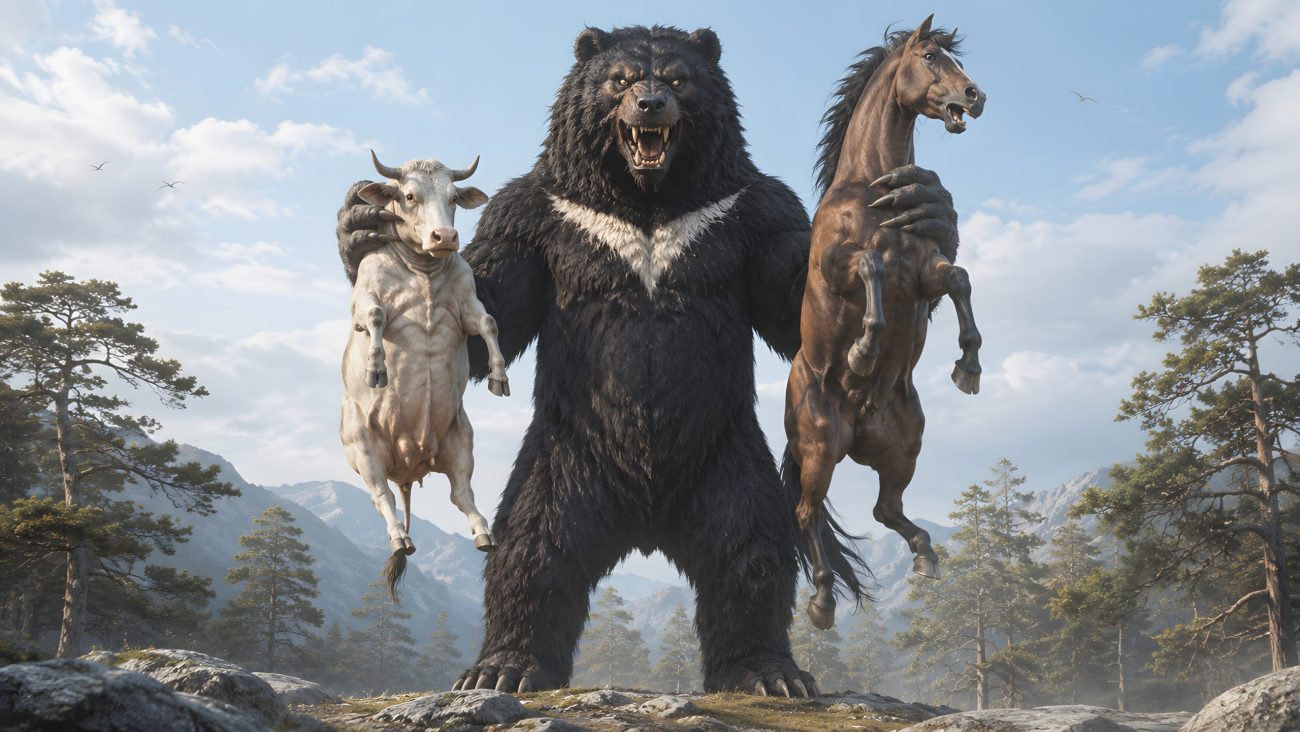
The Onikuma, meaning “demon bear,” is a fearsome yōkai said to originate in the mountain forests of Japan, particularly the Kiso Valley in Nagano Prefecture. It is believed that when an ordinary bear lives for many years, it transforms into an Onikuma, growing far larger than any natural bear and gaining immense supernatural strength.
Unlike ordinary bears, an Onikuma is able to walk upright on two legs. It is powerful enough to move enormous boulders that even groups of men cannot shift, and it can crush small animals with a single blow. Although it lives deep within remote mountain forests and is active mainly at night, it occasionally descends into nearby villages in search of food.
When an Onikuma enters human settlements, it is known for carrying away livestock such as horses and cattle before disappearing back into the mountains. Because of its tremendous strength, encounters with the creature are rare but often deadly, leaving villagers with little choice but to organize dangerous hunts.
Traditional accounts describe a special method for killing an Onikuma. Hunters blocked the entrance to its den with a massive wooden frame covered in wisteria vines. They then forced branches and brush through the narrow openings until the beast’s shelter became completely filled. Eventually the trapped Onikuma burst through the entrance, where hunters waited to attack it with long spears and rifles.
According to legend, several Onikuma were slain during the Kyōhō era (1716–1736). Their hides were said to be so enormous that each one could cover an area of more than six tatami mats. Large boulders scattered throughout the Kiso Valley are also known as “Onikuma stones,” as local tradition claims they were hurled down the mountainsides by these mighty demon bears. In Hokkaido, bears that attacked humans were likewise feared and referred to as Onikuma.
Sources
Foster, M. D. (n.d.). Onikuma. In Yokai.com: The Illustrated Database of Japanese Folklore. Retrieved June 29, 2026, from https://yokai.com/onikuma/.
Wikipedia contributors. (n.d.). Onikuma. In Wikipedia. Retrieved June 29, 2026, from https://en.wikipedia.org/wiki/Onikuma.