Tradition: Japanese Mythology
Alternative Names: 鳴釜, なりがま, Narikama, Kamanari, Ringing Kettle, Crying Kettle
Category: Object
The Myth
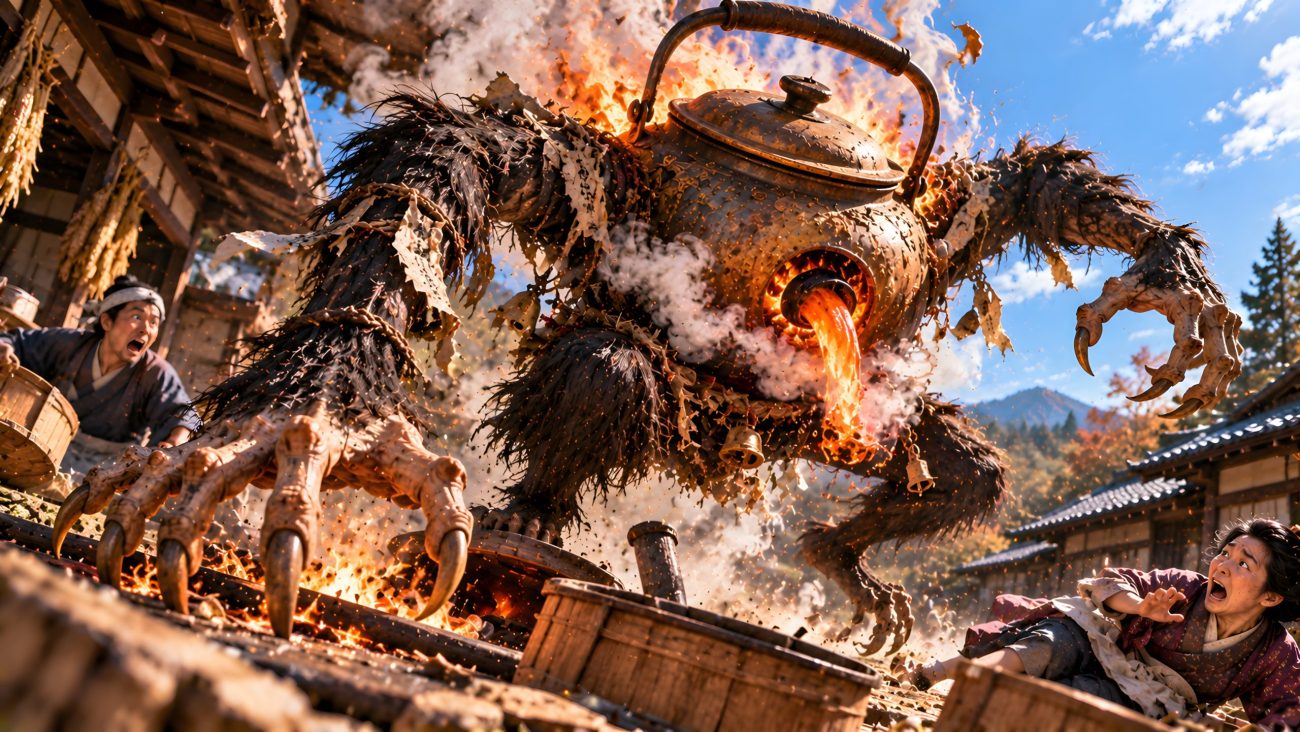
Narigama are tsukumogami associated with kama, the iron kettles and cauldrons traditionally used to cook rice in Japanese kitchens. They are depicted as hairy, animal-like beings with long arms and legs, their bodies covered in dark fur. Flames may lick around the kettle that serves as their head, or they may wear it like a helmet. Narigama frequently appear alongside other tsukumogami in illustrations of the Night Parade of One Hundred Demons, although little is known about their independent behaviour.
The narigama’s most remarkable ability is its power to predict the future. When heated over a fire, it begins to produce unusual sounds as the water inside approaches boiling point. These may resemble ringing, crying, or the calls of an animal. According to tradition, the sounds can reveal whether the weather will be fair or rainy, while an onmyōji or Buddhist priest may interpret them to divine good and bad fortune. Toriyama Sekien included the creature in his Hyakki Tsurezure Bukuro, linking its supernatural ringing to an ancient oni named Renjo. The Edo-period work Kansō Kidan also describes Renjo as a spirit that haunts kettles. According to this account, someone could end the haunting by standing approximately ninety centimetres away and loudly calling the name Renjo. The fire would then descend beneath the house, the disturbance would cease, and the household would enjoy good fortune.
A related tradition survives at Kibitsu Shrine in Okayama Prefecture through the ritual known as narukama, in which priests boil a kettle and interpret the sounds it produces to predict fortune. In this account, the sounds originate from the spirit of an oni named Ura, who once terrorised the region before being slain. Even after death, his severed head continued to cry out, and neither the loss of its flesh nor its burial beneath the shrine’s kitchen silenced it. Eventually, a priestess named Aso hime offered food to the restless spirit, calming it and changing its nature. From then on, Ura’s spirit communicated through the kettle, providing predictions to the shrine’s priests. Sekien may have drawn inspiration from this ritual when creating his own account of the narigama, adapting the story by connecting the creature to ancient Chinese traditions.
Sources
“Narigama.” Yokai.com. https://yokai.com/narigama/