Tradition: Japanese mythology
Alternative names: Namatonukanashi, Namatonganashi, Namatouga Nashi
Category: Cow, Deity
The Myth
Namatonkanashi is an agricultural god from Amami Oshima, recorded in Nagoshi Sagenta’s Nanto Zatsuwa. The name is thought to be a phonetic transcription, while Kanashi or Ganashi is an honorific title used in Amami and the Ryukyu Islands for gods and nobles.
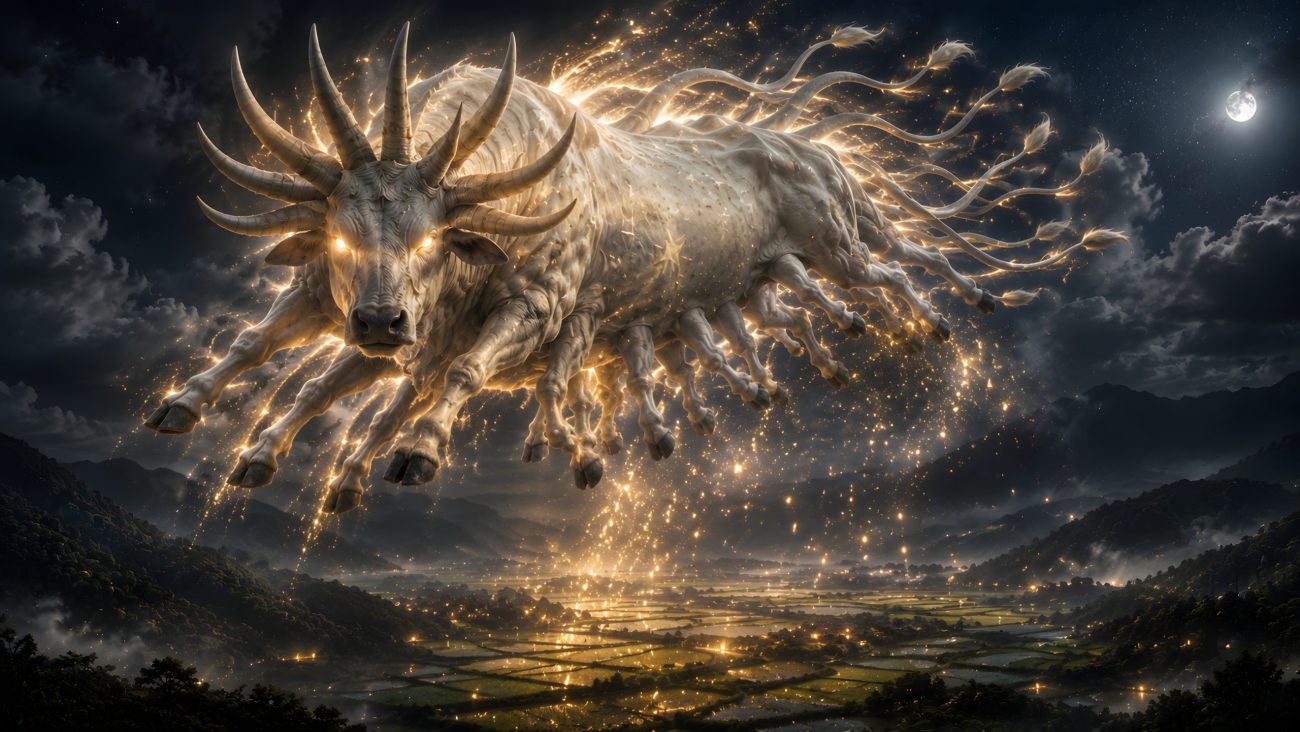
The deity is described as a bizarre and enormous cow, larger than an ordinary cow, with eight horns, eight tails, and sixteen legs—eight at the front and eight at the back. White star-like spots are said to cover its belly and thighs.
Namatonkanashi is a living god worshipped by the islanders. Its cry is compared to the sound of a chaumera, while another account describes its voice as so loud that it could deafen those who heard it.
During festivals, Namatonkanashi is said to wander through areas illuminated by bonfires. In particular, it appears during ceremonies in the Nishi-Magiri and Higashi-Magiri districts. The deity is said to strongly dislike people from mainland Japan approaching it.
When Namatonkanashi appears, the islanders traditionally bow with their heads touching the ground, meaning that they cannot actually see the deity’s complete form. Nagoshi Sagenta, a Satsuma samurai who had been exiled to Amami, did not follow this custom. He observed the supposed visiting deity and concluded that its strange appearance was entirely fabricated.
According to this interpretation, Namatonkanashi was not an actual monstrous cow but part of a ritual performance representing the arrival of a god. The islanders’ hostility toward mainland Japanese observers was therefore connected to their resentment of outsiders reducing their religious ceremonies to their superficial physical details.
A later account in Tonari Nanpo’s Amami Shidan (1933) describes Namatonkanashi as a gigantic ox with eight horns, eight legs, and eight tails. It appears during the welcoming festival on the second day of the second month and the sending-off festival on the fourth day of the fourth month, ceremonies associated with welcoming and sending away the gods of the sea and mountains. Its form can only be seen when illuminated by the festival bonfires.
Sources
Takahashi, Toshihiro. “ナマトンカナシ (Namatonkanashi).” 新版TYZ 妖怪図鑑 (New TYZ Yokai Encyclopedia). July 25, 2021. Accessed August 29, 2026. https://tyz-yokai.blog.jp/archives/1078437910.html