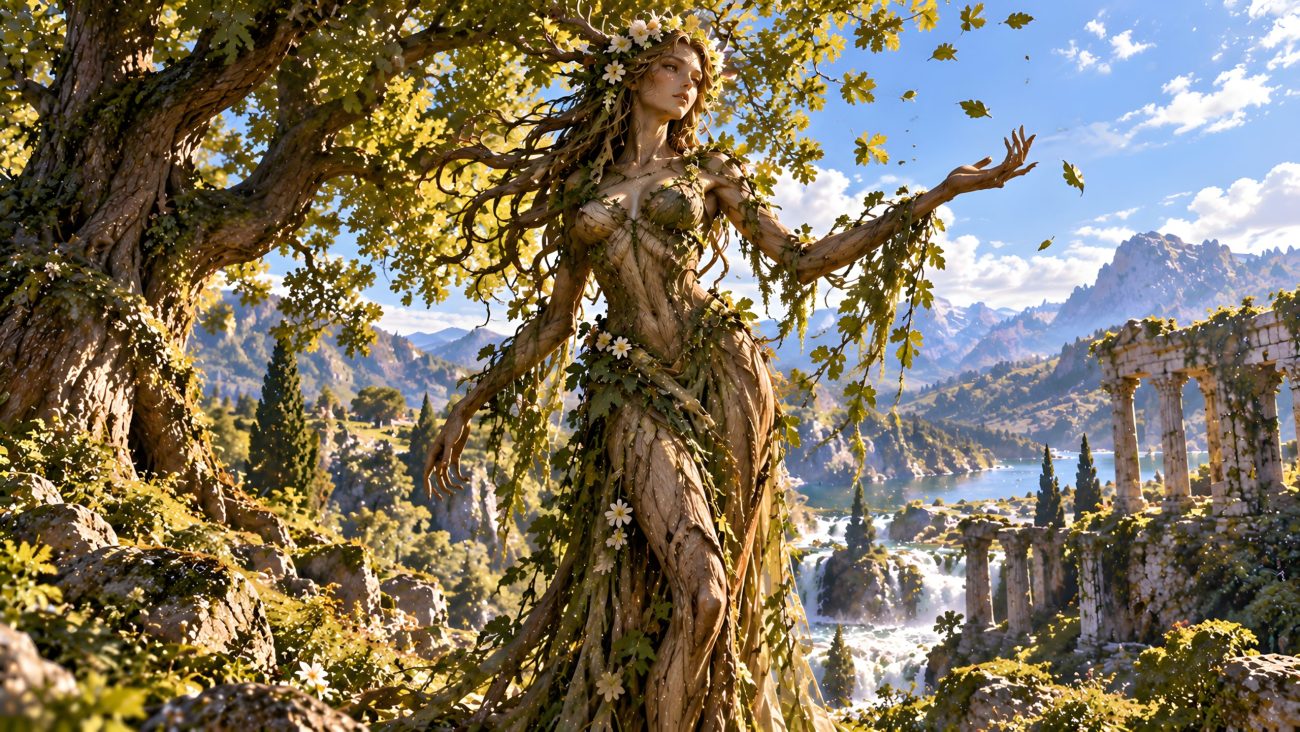
Tradition: Greek mythology
Alternative Names: Hamadryas; Hamadryades (plural)
Category: Nymph
The Myth
The Hamadryads are tree nymphs in Greek mythology whose lives are bound to particular trees. Unlike spirits that merely dwell among the trees, a Hamadryad shares the fate of the tree to which she belongs. If her tree flourishes, she lives; if it is cut down or dies, she perishes with it. For this reason, harming a tree could mean killing the nymph within it, bringing the wrath of the gods upon the person responsible.
The bond between a Hamadryad and her tree was understood to be inseparable. Their name combines the ancient Greek words háma, meaning “together,” and dryás, meaning “tree” or “wood nymph.” Some traditions distinguish Hamadryads from ordinary Dryads by describing the Hamadryad as the tree itself, while the Dryad is the spirit dwelling within it.
The connection between these nymphs and their trees appears in the Homeric Hymn to Aphrodite, which describes the trees associated with them as beautiful, flourishing, and tall. The vitality of the tree reflects the vitality of the nymph, whose existence is inseparable from the natural world.
Mortals who encountered Hamadryads could earn their favour by protecting their trees, but those who damaged them risked terrible consequences. In one story, the hero Rhoecus saved an oak tree and was offered a reward by its nymph. He chose to become her lover, but his crude speech eventually caused her to maim him. In another tale, a young man damaged a tree belonging to a nymph, bringing a curse upon himself and his family. The seer Phineus later advised his descendants to offer sacrifices to the offended spirit.
Several Hamadryads were associated with particular kinds of trees and plants. According to a tradition recorded by Athenaeus, Oxylus and Hamadryas were the parents of eight nymphs: Karya, associated with the walnut; Balanos, with the acorn; Kraneia, with the cornel tree; Morea, with the oleaster; Aigeiros, with the poplar; Ptelea, with the elm; Ampelos, with the vine; and Syke, also called Sykea, with the fig tree. Other figures described as Hamadryads include Atlanteia, Chrysopeleia, Phoebe, Byblis, and Dryope.
The Hamadryads embodied the sacred bond between living trees and the divine. To destroy their trees was not merely to damage nature, but to threaten the life of a spirit whose fate was woven into the wood itself.
Sources
Wikipedia contributors. (n.d.). Hamadryad. In Wikipedia, from https://en.wikipedia.org/wiki/Hamadryad