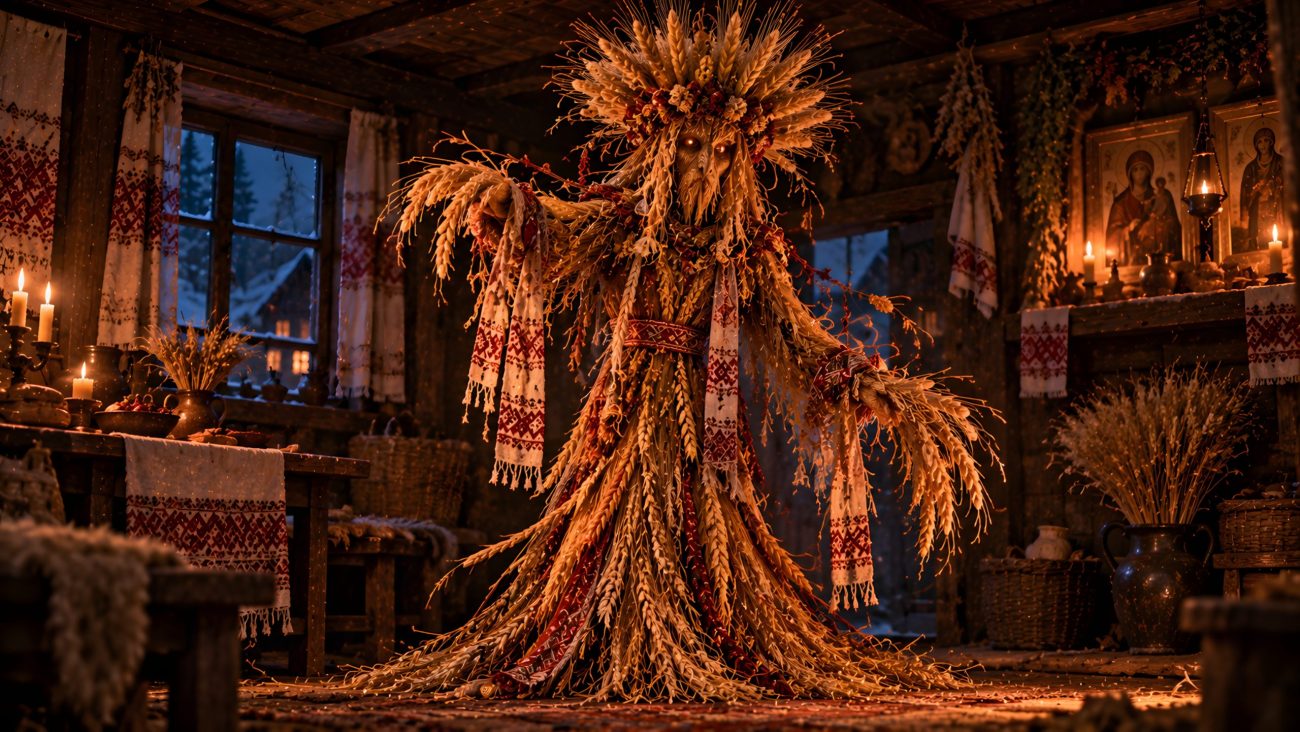
Tradition: Ukrainian Mythology, Polish Mythology
Alternative Names: Didukhy (plural)
Category: House dweller
The Myth
The Didukh is a traditional Ukrainian and Polish Christmas decoration made from a sheaf of wheat. Its name literally means “grandfather spirit,” reflecting its connection to the souls of deceased ancestors. Traditionally, the sheaf is made from the first or last stalks of wheat harvested during the year and decorated with colourful threads and ribbons. Beyond its role as a seasonal decoration, the Didukh represents the household’s hope for abundance, fertility, and a bountiful harvest in the coming year.
The Didukh holds particular spiritual significance during the Christmas holidays. According to traditional belief, the spirits of the household’s ancestors reside within the sheaf during this period. While the Didukh occupies a place of honour inside the home, the souls of the ancestors gather together and bless the family. It therefore serves as a symbolic dwelling for the dead, allowing them to return to the household and participate in its seasonal celebrations.
On Sviat Vechir, or Christmas Eve, the head of the household brings the Didukh inside. It is placed in the pokutia, the corner of the house containing religious icons, alongside kutia, a ritual food, and uzvar, a traditional ritual drink. Its position in this honoured space reflects the importance of welcoming the ancestors and seeking their blessing during the holiday season.
The Didukh remains inside the home until Masnytsia, when it is burned to symbolise the end of winter. This final act marks the conclusion of its seasonal role and the departure of the period in which the ancestors are believed to dwell within it.
The Didukh combines the symbolism of the harvest with the veneration of deceased family members. Its wheat sheaf represents hopes for agricultural prosperity, while its spiritual role connects the living household with its ancestors. Through the ritual placement and eventual burning of the Didukh, Ukrainian and Polish Christmas traditions express the relationship between family continuity, seasonal change, and the abundance of the coming year.
Sources
“Didukh.” Wikipedia: The Free Encyclopedia. Wikimedia Foundation. Accessed October 18, 2026. https://en.wikipedia.org/wiki/Didukh