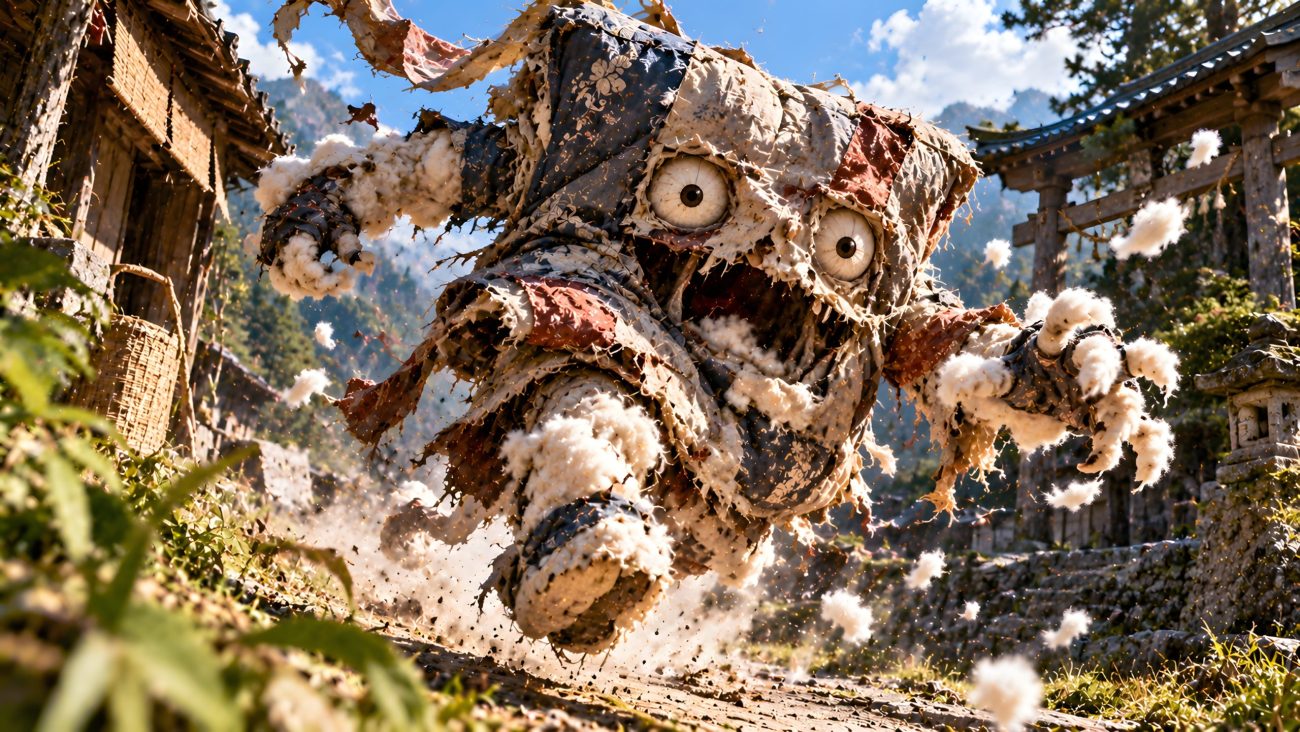
Tradition: Japanese Mythology
Alternative Names: Boroboro-ton, 暮露団
Category: Object
The Myth
Boroboro-dan is a yokai depicted in Toriyama Sekien’s Hyakki Tsurezure Bukuro. It appears as a worn-out, tattered futon, with ragged fabric forming its eyes and loose cotton or cloth resembling hands and feet. Its image evokes the appearance of a dilapidated bedding object that has taken on a supernatural form.
Sekien’s accompanying text refers to the boro, a type of wandering or mendicant monk associated with the late Kamakura period. During the early modern period, these figures became associated with the Fuke school of Zen Buddhism and the komusō, itinerant monks who travelled wearing distinctive baskets over their heads and playing the shakuhachi. Sekien describes a worn-out mat associated with such a solitary religious wanderer, connecting the yokai’s shabby appearance with the life of a recluse.
The entry may also draw inspiration from section 115 of Yoshida Kenkō’s Tsurezuregusa. This passage describes ragged religious wanderers who gathered at Shukugawara to chant the nembutsu, including two men who fought and fatally wounded each other. Although they professed to have abandoned worldly concerns, their stubbornness and self-centred behaviour contradicted their religious aspirations. Sekien’s reference to medieval poetry contests and wandering figures further connects Boroboro-dan with the imagery of itinerant monks and the humble objects associated with their lives.
Modern interpretations sometimes describe Boroboro-dan as an old kimono or futon that has absorbed the spirit of its former owner. However, this interpretation goes beyond the limited description in Sekien’s original entry, which primarily connects the tattered bedding with the image of a wandering, ascetic monk.
Sources
“Boroboroton.” 新版TYZ 妖怪図鑑 (New TYZ Yokai Encyclopedia). https://tyz-yokai.blog.jp/archives/1073015831.html