Tradition: Japanese Mythology
Alternative Names: 赤猪, Red Boar, Great Red Boar
Category: Pig
The Myth
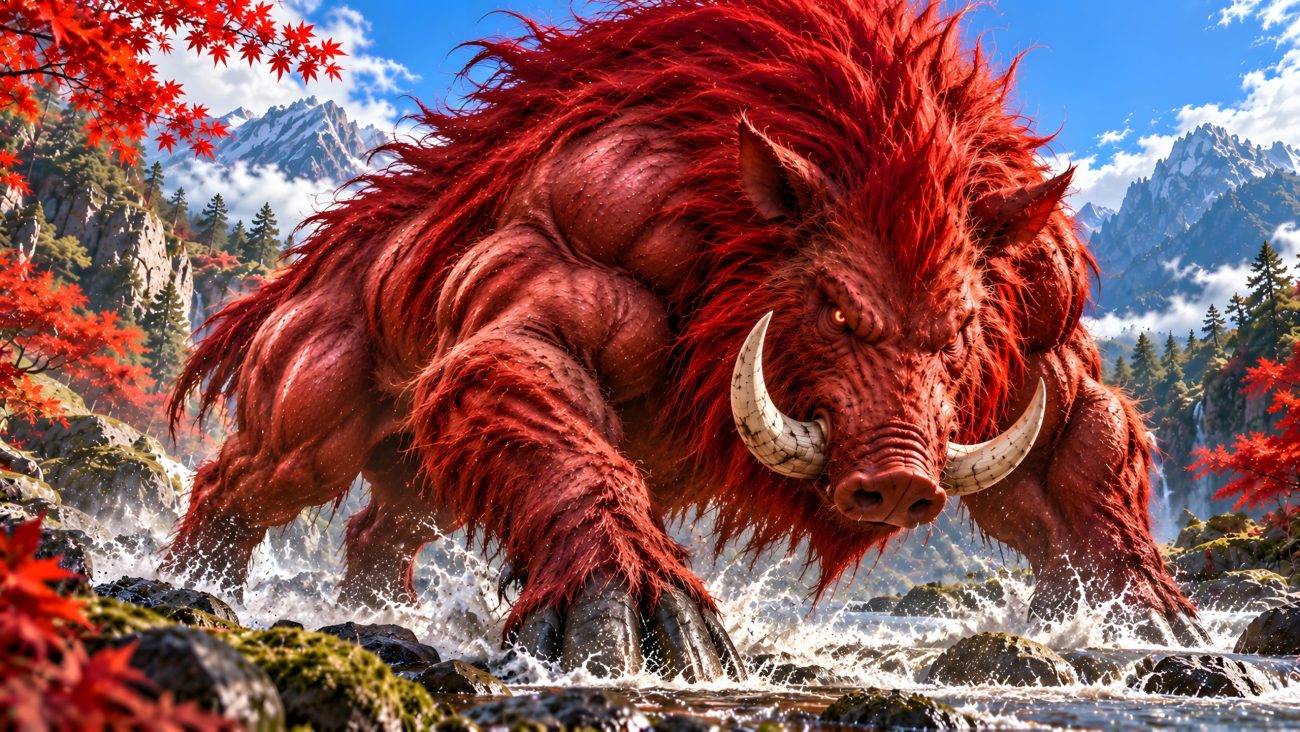
Red boars appear in several Japanese mythological traditions, including stories recorded in the Kojiki and Nihon Shoki. One famous account concerns Ōkuninushi, also known as Ōnamuchi, who incurred the jealousy of his many brothers after marrying Yagamihime. The brothers lured him to Mount Temma in Hōki Province, claiming that a red boar lived on the mountain. They told him they would drive the animal down the slope and ordered him to catch it, threatening to kill him if he failed. However, the brothers had heated a large stone until it glowed red and rolled it down the mountain. Mistaking the burning stone for a boar, Ōkuninushi tried to catch it and was fatally burned.
Ōkuninushi’s mother, Sashikuniwakahime, mourned his death and sought help from the heavenly deity Kamimusubi. The deity sent Kisagai-hime, a clam goddess, and Umugi-hime, a mussel goddess, who treated his burned body with their divine medicine and restored him to life. At Akaiwa Shrine in Nanbu, Tottori Prefecture, a rock associated with this episode is enshrined. Although the boar in the Kojiki story is an illusion created by the brothers, the red animal itself appears in another legend recorded in the Nihon Shoki.
Following the death of Emperor Chūai, his sons Kagosaka no Miko and Oshikuma no Miko feared that their younger half-brother, the future Emperor Ōjin, would inherit the throne. While secretly preparing for conflict, they performed a divinatory hunt at Utaga-no in Settsu Province, hoping that a successful catch would indicate that their plans would prosper. A red boar suddenly appeared, charged into the pavilion where the princes were seated, and devoured Kagosaka. Terrified by this supernatural occurrence, Oshikuma abandoned the location and withdrew with his army. The corresponding account in the Kojiki describes an enraged boar but does not specify its colour. An Edo-period essay, Ōō Hitsugo, explains the red boar as a divine beast whose coat was as red as fire.
Another legend comes from Akai in Iwaki, present-day Fukushima Prefecture, where a particularly large red boar was said to have ravaged local fields and farmland. In response to the villagers’ appeals, the court dispatched Iwaki kuni no miyatsuko Takerokoro no Mikoto and hunters to kill it. The leader’s first arrow struck the boar in the side, and a second arrow killed it as it fled north. The event was remembered in local place names: Akai-dake, also known as Akai-dake or Akai-dake’s mountain in the tradition, became associated with the red boar; Futatsuya-yama was named for the place where the second arrow was shot, and Inohana for the place where the boar’s snout was discarded. Futatsuya Shrine in Ogawa, Iwaki, is said to have originated with the enshrinement of the arrow used in the hunt.
Sources
“Akai.” 新版TYZ 妖怪図鑑 (New TYZ Yokai Encyclopedia). https://tyz-yokai.blog.jp/archives/1073394068.html